History

First Battle of Bull Run
The First Battle of Bull Run, also known as the First Battle of Manassas, was the first major battle of the American Civil War. It took place on July 21, 1861, near Manassas, Virginia. The Confederate victory shattered the Union's hopes for a quick end to the conflict and demonstrated that the war would be long and costly.
Written by Perlego with AI-assistance
Related key terms
1 of 5
10 Key excerpts on "First Battle of Bull Run"
 eBook - PDF
- Keith D. Dickson(Author)
- 2022(Publication Date)
- For Dummies(Publisher)
3 Opening Moves, 1861–1862 IN THIS PART . . . Explore the who, what, when, where, and why of each battle. Understand how battles fit into a campaign plan. Watch as the armies begin to advance, and see why the initial encounters between largely untrained troops and inexperienced leaders are bloody and indecisive. Watch as heroes are born, martyrs are created, and once-promising leaders disappear quickly in failure. CHAPTER 8 Starting the War: Bull Run (First Manassas), July 1861 93 Chapter 8 Starting the War: Bull Run (First Manassas), July 1861 T he battle of Bull Run as the Union called it, or Manassas as the Confederates called it, was the first major engagement of the war. Many honestly believed that one large battle would decide the outcome of the war, almost like a Super Bowl — whoever lost would allow the other side to pursue its strategic goals unmolested. Also like the Super Bowl, civilians from Washington came with picnic lunches to watch the battle and cheer for the Union army. Everyone who volun -teered wanted to get in the fight, afraid that the war would be over before they had a chance at glory. As they quickly learned, war is not sport. Battles are contests of will, involving unimaginable confusion, excitement, and horrific violence. The shock of combat is unforgettable, and it convinced many an eager volunteer that he had seen enough of war to last a lifetime. Battles also create (and sometimes destroy) heroes. Bull Run created one of the greatest and most well-known heroes in American military history: “Stonewall” Jackson. IN THIS CHAPTER » Setting the stage for battle » Making plans with the commanders » Looking at first moves and a Southern victory » Understanding the significance of the battle » Becoming a hero: “Stonewall” Jackson 94 PART 3 Opening Moves, 1861–1862 The First Rumblings: “On to Richmond!” The war began with neither side fully prepared to do anything. Neither side had a campaign plan to accompany the national strategy. eBook - PDF
With Lee in Virginia
A Story of the American Civil War
- (Author)
- 2011(Publication Date)
- The Floating Press(Publisher)
This, the first great battle of the war, is sometimes known as the battle of Manassas, but more generally as Bull Run. With the exception of one or two charges, the little body of Confederate horse did not take any part in the battle of Bull Run. Had they been aware of the utter stampede of the Northern troops, they could safely have pressed forward in hot pursuit as far as Washington, but being numerically so inferior to the Federal cavalry, and in ignorance that the Northern infantry had become a mere panic-stricken mob, it would have been imprudent in the extreme for such a handful of cavalry to undertake the pursuit of an army. Many of the Confederates were of opinion that this decisive victory would be the end of the war, and that the North, seeing that the South was able as well as willing to defend the position it had taken up, would abandon the idea of coercing it into submission. This hope was speedily dissipated. The North was indeed alike astonished and disappointed at the defeat of their army by a greatly inferior force, but instead of abandoning the struggle, they set to work to retrieve the disaster, and to place in the field a force which would, they believed, prove irresistible. Vincent Wingfield saw but little of the battle at Bull Run. As they were impatiently waiting the order to charge while the desperate conflict between Jackson's brigade and the enemy was at its fiercest, a shell from one of the Federal batteries burst a few yards in front of the troop, and one of the pieces striking Vincent on the side hurled him insensible from his horse. He was at once lifted 112 and carried by Dan and some of the other men-servants, who had been told off for this duty, to the rear, where the surgeons were busily engaged in dressing the wounds of the men who straggled back from the front. eBook - ePub
The Routledge Sourcebook of Religion and the American Civil War
A History in Documents
- Robert R. Mathisen(Author)
- 2014(Publication Date)
- Routledge(Publisher)
Chapter 2 From First Manassas/Bull Run to the Ironclads July 1861 to March 1862DOI: 10.4324/9780203767610-2“Already God’s hand is seen in the reverse. It was needed: it is working well. May it work completely!” —Rev. John F. W. Ware July 28, 1861“God has granted us a triumph which must resound through the civilized world.” —Rev. Stephen Elliott July 28, 1861Both sides in the Civil War believed God was on their side and that they were doing battle for the Lord. For that reason, it was a holy war being fought for a righteous cause. And that was the sentiment expressed by both sides as the dust settled in the aftermath of the first significant battle of the war, fought at Bull Run (or Manassas, as it was known in the South) on Sunday, July 21, 1861.During the week following the Confederacy’s decisive victory at Manassas, ministers had much to ponder as they prepared their sermons for the coming Sunday. For the first of what would be many times during the war, preachers crafted their comments to fit the circumstance. In doing so they had to address certain questions that would be asked and debated throughout the conflict. What did victory mean? And what about a defeat? Was God—could God—be present in both?When Unitarian minister John F. W. Ware addressed his Boston congregation the Sunday after the Union’s loss at Bull Run, he included the word “reverse” in the title of his sermon. This word would be used commonly by both sides as a euphemism for defeat. A battle lost was merely an occasion to reverse the direction being taken by the armies, and by the people back home. Ware understood the Union’s Bull Run loss as evidence of God’s chastisement for the national sin of slavery, and within one short week he believed God’s hand was seen in the reversal. It had done the work of “purging away all low motive; cleansing our councils of all but patriotism and faith; our armies of all but courage and honor, ourselves of all but conviction of the holiness of our cause, and confidence in God.” eBook - ePub
- Charles E. Heller, William A. Stofft(Authors)
- 2021(Publication Date)
- University Press of Kansas(Publisher)
67Other lessons, too, were derived from the First Battle of Bull Run. Formerly lax in the extreme, training and discipline showed marked improvement in both armies after 21 July. Because no officially sanctioned program of training was ever promulgated by the war departments of either North or South, responsibility for training resided at a relatively low level throughout the war. There, experience proved to be a great teacher. For those officers present, Bull Run provided a stern object lesson in what could happen when inadequately trained and poorly disciplined troops took the field. When the veterans of the battle moved on to other commands, their experiences at Bull Run remained vivid, and they incorporated that hard-won wisdom into their training schedules. As a result, the new volunteer regiments would undergo much more rigorous drilling than had those which fought in July 1861. Target practice still tended to be haphazard, but at least the new formations would be better able to march and maneuver under fire the next time battle was joined. No matter how high they rose in rank, some officers never forgot this lesson of Bull Run. In fact, William T. Sherman, one of those who had stormed Henry House Hill, as a corps commander instituted one of the best training programs seen in the Federal Army during the conflict. Others less renowned than Sherman responded in similar fashion.68In terms of organizational structure, McDowell’s creation of divisions to facilitate command-and-control proved to be a step in the right direction, although its advantages were not readily apparent on 21 July. Not long after taking command, McClellan established a formal brigade structure with regiments permanently assigned to particular brigades. The Confederate brigade structure crystallized along similar lines, with regiments from the same state usually being brigaded together, unlike Federal practice. In mid-October, McClellan established a formal division structure (with McDowell as a division commander), and in 1862 he arranged the divisions into army corps. These changes, too, soon were adopted by the Confederates. Under the new Federal structure, artillery batteries were assigned to divisions rather than to infantry brigades in hopes that greater concentrations of firepower might be achieved when necessary. Confederate artillerists took this concept one step further in 1863 by grouping their batteries into battalions, which were then assigned to army corps. Federal gunners adopted a similar organization shortly thereafter. In each case, the reorganization was made to improve the potential value of artillery on a battlefield where changing technology had threatened to render artillery impotent.69 eBook - ePub
Storm Over the Land
A Profile of the Civil War
- Carl Sandburg(Author)
- 2015(Publication Date)
- Mariner Books(Publisher)
CHAPTER 4First Battle of Bull Run
THE Confederate Government, strengthened by the finally seceded States of Arkansas, Tennessee, North Carolina, and Texas, had moved the last week in May from Montgomery, Alabama, to Richmond, Virginia, to be nearer the Border States and the expected heavy fighting. Into Richmond streamed regiments from all parts of the South. The cry in the South, “On to Washington!” snarled straight into the cry from the North, “On to Richmond!”Among troops at Richmond were farmers and hillmen who never owned a slave nor an acre of ground, and young men from the First Families where a thousand acres and a hundred slaves was the unit. Dapper companies with shining blouses, brass buttons, uniform rifles of recent make, were regimented with other companies in butternut jeans, carrying shotguns and squirrel rifles.The Richmond, Virginia, State House, where the Confederate Congress held sessionsSecession map, South Carolina December 20, 1860, Tennessee June 8, 1861. From Albert Shaw’s Abraham Lincoln, Year of His Election .From the Potomac River to the Gulf Coast and out where the Rio Grande trickled over New Mexico ran the recruiting ground of this Confederate Army. Its line zigzagged 1,500 miles from Chesapeake Bay through Kentucky and out to the corners of Kansas. Its brain and will centered in the capitol, the executive mansion, the departments, at Richmond. Its chief weapon of defense was an army of 100,000 troops. The controls of this Government were out of the hands of those who had first given it breath and fire. Rhett of the True Perpetual Separationists was now only a member of the Confederate Congress. The movement to elect him President and the efforts to appoint him Secretary of War had both failed.Women of the period. All of the soldiers had mothers and many had sisters and wives. Photographs by Brady and designated as Miss Mundelle (upper left ), Mrs. Chapin (upper right ), not named (lower left ), Mrs. Cory (lower right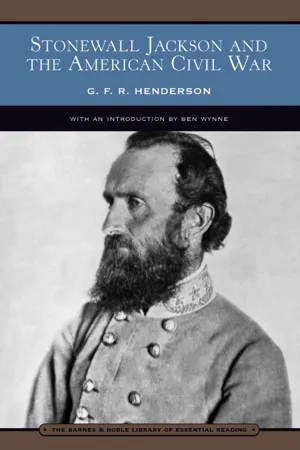 No longer available |Learn more
- G. F. R. Henderson(Author)
- 2009(Publication Date)
- Barnes & Noble(Publisher)
And Jackson’s attitude was that of the Southern people. When the news of Bull Run reached Richmond, and through the crowds that thronged the streets passed the tidings of the victory, there was neither wild excitement nor uproarious joy. No bonfires lit the darkness of the night; no cannon thundered out salutes; the steeples were silent till the morrow, and then were heard only the solemn tones that called the people to prayer. It was resolved, on the day following the battle, by the Confederate Congress: “That we recognise the hand of the Most High God, the King of kings and Lord of lords, in the glorious victory with which He has crowned our arms at Manassas, and that the people of these Confederate States are invited, by appropriate services on the ensuing Sabbath, to offer up their united thanksgivings and prayers for this mighty deliverance.”The spoils of Bull Run were large; 1,500 prisoners, 25 guns, ten stand of colours, several thousand rifles, a large quantity of ammunition and hospital stores, twenty-six wagons, and several ambulances were left in the victors’ hands. The Federal losses were 460 killed and 1,124 wounded; the Confederate, 387 killed, 1,582 wounded, and 13 missing. The First Brigade suffered more severely than any other in the Southern army. Of 3,000 officers and men, 488 were killed or wounded, nearly a fourth of the total loss.A few days after the battle Johnston advanced to Centreville, and from the heights above the broad Potomac his cavalry vedettes looked upon the spires of Washington. But it was in vain that the Confederate troopers rode to and fro on the river bank and watered their horses within sight of the Capitol. The enemy was not to be beguiled across the protecting stream. But it was not from fear. Although the disaster had been as crushing as unexpected, it was bravely met. The President’s demand for another army was cheerfully complied with. Volunteers poured in from every State. The men were no longer asked to serve for three months, but for three years. Washington became transformed into an enormous camp; great earthworks rose on the surrounding heights; and the training of the new levies went steadily forward. There was no cry for immediate action. Men were not wanting who believed that the task of coercion was impossible. Able statesmen and influential journalists advised the President to abandon the attempt. But Lincoln, true to the trust which had been committed to his keeping, never flinched from his resolve that the Union should be restored. He, too, stood like a wall between his defeated legions and the victorious foe. Nor was the nation less determined. The dregs of humiliation had been drained, and though the draught was bitter it was salutary. The President was sustained with no half-hearted loyalty. His political opponents raved and threatened; but under the storm of recrimination the work of reorganising the army went steadily forward, and the people were content that until the generals declared the army fit for action the hour of vengeance should be postponed.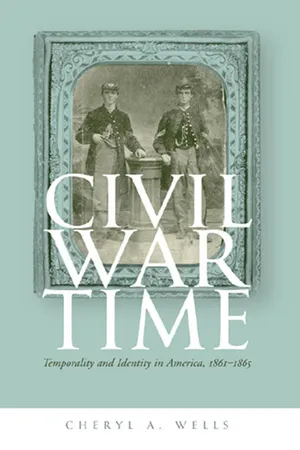 eBook - PDF
Civil War Time
Temporality and Identity in America, 1861-1865
- Cheryl Wells(Author)
- 2012(Publication Date)
- University of Georgia Press(Publisher)
TIME ON THE BATTLEFIELDS This page intentionally left blank 1 TIME LOST, TIME FOUND The Confederate Victory at Manassas and the Union Defeat at Bull Run “We shall see that not only every day of that delay, but even every hour of it, was essential to the Confederate victory which resulted.” confederate commander e. p. alexander “Watch in hand, they await[ed] the approach of the half hour, and as the last second of the last minute [was] marked on the dial plate,” Captain George S. James “pull[ed] the lanyard; there [was] a flash of light and a ten inch shell trac[ed] its pathway towards Fort Sumter.” 1 It was 4 : 30 a.m. on April 12 , 1861 , and it was the beginning of the Confederacy’s barrage on Fort Sumter in South Carolina’s Charleston Harbor. Thirty-three hours later, Robert Anderson surrendered Sumter, and the flag of South Carolina’s Palmetto Guards replaced the Stars and Stripes as the Confederacy won the opening engagement of the Civil War. On April 15 , President Abraham Lincoln responded by issuing a call for seventy-five thousand volunteers to suppress the insurrection. At roughly the same time, Confederate President Jefferson Davis, having already issued a March 6 call for one hundred thousand volunteers, requested additional men. Both men and their armies had no trouble filling their enlistments. Ordinary men heeded the call to arms for cause and country and prepared to fight. 13 14 Chapter One At the beginning of the Civil War, the Confederate States of America and the United States of America endeavored to mute the multiple and overlapping times of the antebellum era. The Union and Confederate mil-itary complexes were aware that “[t]ime pervade[d] all decision making in war” and “dictate[d] the design of weapons, the course of strategy, the organization of armed forces, . . . and the training of military leaders.” Presidents Lincoln and Davis knew that “[t]emporal considerations dic-tate[d] military doctrines, and ultimately destroy[ed] them as well.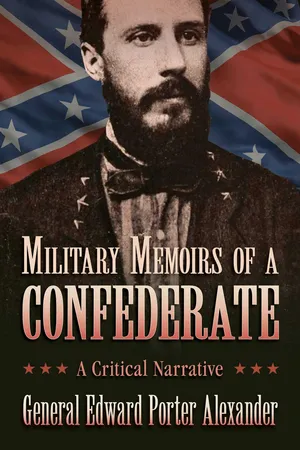 eBook - ePub
Military Memoirs of a Confederate
A Critical Narrative
- Edward Porter Alexander(Author)
- 2014(Publication Date)
- Skyhorse(Publisher)
P.M. We shall see that not only every day of that delay, but even every hour of it, was essential to the Confederate victory which resulted.So on my arrival at Manassas, July 2, there was really more time to install the signals than I expected, for “rumors of the foe’s advance” now swelled upon almost every breeze. I had brought with me from Richmond all necessary equipment and I had only to select men and train them. I soon made acquaintances and got the names of some intelligent privates, who might later be promoted. I had these detailed and put upon a course of instruction and practice. Meanwhile I procured a horse, and between times began an exploration of the country to find what facilities it offered for lines of signals.The topography was far from favorable. Our line of battle had been chosen behind the stream of Bull Run, about three miles north of Manassas, and the course of the stream was generally wooded and bordered with small fields and pastures, giving few open stretches. I was not sanguine of rendering any valuable service, but fortunately had time to examine the country, and, as will be seen, the line was found which disclosed the enemy’s attack in time to defeat it.About a mile east of Manassas, on the farm of a Mr. Wilcoxen, was a high rocky point having a good outlook over a valley to the north and west. I made this point a central station, and by a little clearing here and there got two straight six-mile ranges. One was northwest to a bluff over Bull Run valley on our extreme left, near the house of Van Ness, just above the Stone Bridge by which the Warrenton Turnpike crossed Bull Run. The other was north, to Centreville, about three miles beyond the Run, opposite our centre. A third station was found near the house of McLean, opposite our right centre, and a fourth near our headquarters at Centreville. This was the utmost the topography permitted, and the men were encamped at the stations and set to practising by day and night.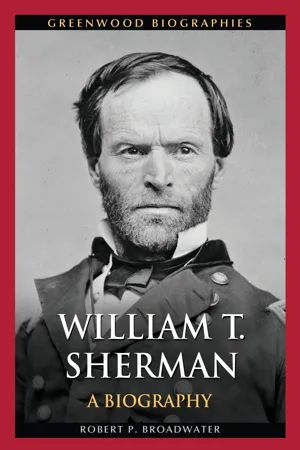 eBook - ePub
William T. Sherman
A Biography
- Robert P. Broadwater(Author)
- 2013(Publication Date)
- Greenwood(Publisher)
Chapter 7
BULL RUN
Regiment after regiment marched out of Washington to the sound of martial airs played by their bands. Julia Ward Howe watched with patriotic excitement as the bands and throngs of men gaily went forward to what most of them thought would be a great adventure. Julia listened as one of the bands played an old revival tune that caught her fancy. She would later add words to the melody, and the resulting song “The Battle Hymn of the Republic” would become the anthem of the Northern armies. The march of the Union army toward Manassas was a slow and tedious process, however. The men in the ranks were not accustomed to moving in large formations, having not yet mastered the intricate maneuvers of army drill. The heat was stifling, and the dust raised from the unpaved road by horses, wagons, and tens of thousands of marching feet filled the air with a choking cloud that made it hard for the men to breathe. Thousands of footsore and exhausted men fell out of the ranks to lay prostrate along the sides of the road. Wild blackberry bushes were to be found along the line of march, and many other soldiers bolted from their places in the ranks to pick the refreshing berries. Cump was dismayed by the actions of the soldiers. He said that “The march demonstrated little to save the general laxity of discipline; for with all my personal efforts I could not prevent the men from straggling for water, blackberries, or any thing on the way they fancied.” At the end of two days of marching, Colonel David Hunter’s Second Division arrived at Fairfax Courthouse, Virginia, little more than 20 miles from Washington.The slow pace of the Union army foiled McDowell’s plans thus far. He intended to take the Confederate garrison at Fairfax by surprise, but the defenders had ample time to make good their escape. Col. Samuel P. Heintzelman’s Third Division had skirted the town, and marched toward Bull Run, in an effort to develop the Confederate right flank. General Tyler’s division, of which Sherman’s brigade was a part, was behind Hunter’s in the line of march, and upon reaching Fairfax Courthouse, Tyler was ordered to march on through the town, toward Centreville, and the fords of Bull Run Creek beyond. McDowell desired Tyler to make a demonstration against the Confederate position to occupy their attention. In this way, he hoped to be able to mask Heintzelman’s flanking movement from observation. Tyler was ordered to make a noisy and convincing demonstration, but McDowell was quite clear in cautioning him, “Do not bring on an engagement.” Tyler moved his division forward with Col. Israel B. Richardson’s brigade in the lead. Upon reaching Centreville, the bulk of Tyler’s division stopped. Tyler, along with Richardson’s brigade, pushed on toward Blackburn’s Ford on Bull Run Creek. eBook - PDF
El Cinco de Mayo
An American Tradition
- David Hayes-Bautista(Author)
- 2012(Publication Date)
- University of California Press(Publisher)
To the United States’ shock and dismay, the Federal lines collapsed after a few hours’ fighting, in what turned into a complete rout. There were fears the Confederates would proceed to take Washington and thereby end the war T wo The First Battle of Puebla, 1862 52 • Th e Fi r st Bat t le of Pu ebl a almost as soon as it had begun, with victory for the South. Yet this did not happen. The editor of a Spanish-language newspaper in California thought, “The success that crowned the Confederates’ arms when the war broke out, especially when the Federal forces were defeated at Bull Run, confused them — surprised at the latter’s defeat — has inspired too much confidence in their own forces, and has induced them to stay inactive, without taking advantage of the head start that a first victory always provides.” 2 Southern troops remained in northern Virginia for some time, feeding worries of an eventual Confederate attack on the United States capital. But eventually, as autumn wore on, they moved back toward Richmond. The U.S. Army had been disgraced by its shameful performance, and Lincoln sacked the hapless General Irvin MacDowell. In contrast, the Confederates seemed to be blessed with better leadership. Commenting on recent maneuvers by the Confederate forces, José E. Gonzáles, the editor of the pro-Union Spanish-language paper El Amigo del Pueblo in Los Angeles, observed, “The latter have able commanders; and, as it appears, a great unanimity prevails through-out the South.” As the fall of 1861 turned to winter, the Union’s supporters Figure 4. Abraham Lincoln, whose election as president in 1860 led to the Southern states’ decision to secede from the United States and form the Confederate States of America, which they intended would maintain slav-ery as an institution. (John G. Nicolay and John Hay, Abra-ham Lincoln: A History, plate between pages 288 and 289) Th e Fi r st Bat t le of Pu ebl a • 53 grew tense and unhappy.
Index pages curate the most relevant extracts from our library of academic textbooks. They’ve been created using an in-house natural language model (NLM), each adding context and meaning to key research topics.

