History

Battle of Shiloh
The Battle of Shiloh, fought in April 1862 during the American Civil War, was a significant and bloody engagement between Union and Confederate forces. The battle resulted in a Union victory, but at a high cost in casualties for both sides. It marked a turning point in the war, demonstrating the scale and ferocity of the conflict.
Written by Perlego with AI-assistance
Related key terms
1 of 5
10 Key excerpts on "Battle of Shiloh"
- Stacy W. Reaves(Author)
- 2012(Publication Date)
- The History Press(Publisher)
1 THE Battle of ShilohGod grant that I may never be the partaker in such scenes again…When released from this I shall ever be an advocate of peace.—Soldier after the Battle of ShilohYears after the Civil War, Union general and former U.S. president Ulysses S. Grant wrote, “Shiloh was the severest battle fought in the West during the war, and but few in the East equaled it for hard, determined fighting.” Shiloh was indeed one of the fiercest battles in the western theater of the war. It quickly proved to the Federals that they should not underestimate the Confederates. The Confederate army went into battle believing it could defend the western portion of the Confederacy and that General Albert Sydney Johnston would lead it to independence. The Rebels returned from the battle defeated and without their beloved general. Legend has it that after the Battle of Shiloh the South never smiled again.Pittsburg Landing and Shiloh Church were not critical points in the Confederate or Union war strategies, but the battle would be significant. Early in the war, the Union army had developed a strategy that called for taking the Mississippi River Valley in the West and dividing the Confederacy. In February 1862, General Grant and flag officer Andrew H. Foote moved southward into northern Tennessee and quickly captured Forts Henry and Donelson. Because of these victories, Rebel general Albert Sydney Johnston, commanding the Army of the Mississippi, retreated from Kentucky and middle Tennessee to the town of Corinth, Mississippi. The town was a key city for the Confederacy. It contained a railroad junction for the Memphis & Charleston and the Mobile & Ohio Railroads. The Charleston & Memphis was the only direct east–west railroad in the South. Johnston began to mass his army in the sleepy town in hopes of holding the Mississippi Valley and protecting the vital railways. eBook - ePub
Ulysses S. Grant: A Victor, Not a Butcher
The Military Genius of the Man Who Won the Civil War
- Edward H. Bonekemper(Author)
- 2010(Publication Date)
- Regnery History(Publisher)
5 dp n="59" folio="40" ?Meanwhile, the Confederates were planning an offensive of their own. General Albert Sidney Johnston, a man senior to Robert E. Lee and all other Confederate generals except one, was assembling an impressive force at Corinth. He was gathering troops from across the South, including the Gulf Coast, the southeastern Atlantic Coast (including Beauregard and many troops from Charleston, South Carolina), and the Mississippi Valley (including Polk’s forces that had abandoned Columbus, Kentucky). On April 2, Johnston began moving his 44,000 troops the twenty miles toward Pittsburg Landing. In those first few days of April, Johnston’s cavalry sporadically encountered Grant’s pickets, but this was not enough to lead Grant to expect a Confederate offensive. One day before this surprise attack was to occur, still unaware of Johnston’s plan, Grant told a fellow officer, “There will be no fight at Pittsburg Landing; we will have to go to Corinth, where the rebels are fortified.” In his memoirs, he later explained: “The fact is, I regarded the campaign we were engaged in as an offensive one and had no idea that the enemy would leave strong entrenchments to take the initiative when he knew he would be attacked where he was if he remained.”6The frequency of skirmishes continued to increase, and on April 4 Grant was injured as he rode back to his headquarters in the dark. He had been meeting with officers from the front lines when his horse fell on his leg; he was unable to walk without crutches for two or three days. At that time, Grant was spending his nights downriver from Crump’s and Pittsburg Landings at Savannah, where Buell’s Army was expected to arrive. On April 5, Brigadier General William (“Bull”) Nelson and the lead division of Buell’s Army arrived at Savannah. Grant ordered Nelson to proceed down the east bank of the Tennessee so that he could be ferried across to Crump’s or Pittsburg Landing.7 eBook - ePub
Piercing the Heartland
A History and Tour Guide of the Fort Donelson, Shiloh, and Perryville Campaigns
- Jim Miles(Author)
- 1999(Publication Date)
- Cumberland House Publishing(Publisher)
Chapter 4The Battle of Shiloh
F ollowing the fall of Fort Donelson and the loss of Kentucky and much of West and Middle Tennessee, Albert Sidney Johnston was roundly condemned by the people of the South. He had intended to take up a position to defend Chattanooga, but Beauregard planned a campaign designed to take the offensive and regain the lost territory. Accepting the plan, Johnston concentrated his forces at Corinth, Mississippi, just south of the Tennessee line. Polk marched directly south from Columbus, Kentucky, through Jackson, Tennessee, while Hardee passed through Nashville, Murfreesboro, and Decatur, Alabama. Other soldiers were scavenged from across the South, including 10,000 from Pensacola under Braxton Bragg and 5,000 from New Orleans. By April 1862, Johnston commanded 40,000 men in the newly created Army of the Mississippi.Grant’s force, now known as the Army of the Tennessee, slowly made its way up the Tennessee River to Pittsburg Landing. From there it would begin a twenty-two-mile overland march to attack Corinth, a strategic railroad center. Grant was anxious to continue the offensive; but Halleck, who in March had been given command of the West by Lincoln, ordered him to wait and join forces with Buell’s 55,000-man force, recently named the Army of the Ohio. After occupying Bowling Green, Buell had continued to Nashville, 122 miles away. The cautious, methodical general slowly advanced toward Pittsburg Landing. While Grant spent the time planning future operations at Savannah, Tennessee, nine miles north of Pittsburg Landing, control of the Union camp was left to his trusted subordinate, William T. Sherman, who had recovered his composure and had returned to the army.Sherman’s headquarters were situated in the single room of Shiloh Church four miles south of the landing. The area seemed adequate for defensive purposes, protected as it was by the Tennessee River and three creeks. Heavy woods and steep gullies would hamper attackers, but Sherman anticipated no trouble. His men did not prepare breastworks, and pickets were stationed only one hundred yards from camp. Many of the troops had not experienced combat. eBook - PDF
Basil Wilson Duke, CSA
The Right Man in the Right Place
- Gary R. Matthews(Author)
- 2005(Publication Date)
- The University Press of Kentucky(Publisher)
22 General B. M. Prentiss, who had rallied a large force from his routed Union Sixth Division, occupied a wooded knoll that commanded the field of fire over which the oncoming Confederates had to cross. For most of the afternoon, the Confederates were engaged with Prentiss at this hotly contested position, aptly Shiloh, the End of Innocence 55 named the Hornet’s Nest. They attacked repeatedly, and, by late afternoon, his casualties heavy and his ammunition almost exhausted, Prentiss had no choice but to surrender. The Confederates began to re-form their lines to begin the final as-sault on Grant’s army, which by this time had its back precariously pinned against the Tennessee River. It was at this moment that Beauregard, who was now in com-mand, decided against any further action that day. 23 Early the next morning, April 7, the Confederates awoke to learn that Buell’s army was being ferried across the Tennessee River and unloading at Pittsburg Land-ing. Grant had received approximately thirty thousand reinforcements during the night and had immediately gone on the offensive in the morning. The Confeder-ates fought very well that second day, but, by 1:00 P . M ., the Union superiority in manpower had forced them off the battlefield. Beauregard felt that, in order to save the army, he had no choice but to retreat to Corinth. Morgan, along with Terry’s Texas Rangers, was ordered to cover the retreat. 24 The losses suffered by both armies were immense, and even the Europeans were horrified when they learned of the extent of the carnage. Union casualties totaled 13,000 out of the approximately 67,000 troops engaged over the two-day period. The Confederate losses of approximately 10,700, although not as high as those of the federal army, represented 25 percent of the army. 25 The Confederate army’s march back to Corinth lasted from April 7 to April 10. Duke, being seriously wounded, most likely was taken to the field hospital at the end of the first day of the battle. eBook - PDF
Iowa's Forgotten General
Matthew Mark Trumbull and the Civil War
- Kenneth L. Lyftogt(Author)
- 2009(Publication Date)
- University Of Iowa Press(Publisher)
Stone ( Drawing by Ron Prahl ) The Battle of Pittsburg Landing (Shiloh) 75 wings, that were loading and firing at us as they advanced. Many loose horses, caissons, artillery wagons, ambulances…were rushing out through the gap and we had to keep close watch or they would run over us. 26 Adjutant Sessions made it to the river first where he and the men with him tried to throw together a defensive line. Major Stone tried to retreat through the old camp and run for shelter in the woods but was cut off. Stone’s horse was killed and, as he fell to the ground, he was surrounded; he and thirty men of the Third Iowa were cap-tured. Stone surrendered his sword to Colonel William H. Rankin of Mississippi. Captain Trumbull took command of what was left of the regiment and tried to get to the river. However, a shell burst over his head, knocked him from his horse, and wounded him in the head and thigh. Lieutenant George W. Crosley of E Com-pany, in his war memoir, described what happened next: Just after we had passed our camp ground the brave Captain M. M. Trumbull… was wounded, and fell immediately in front of me. I stopped and raised him to a sitting posture, but he insisted upon my leaving him, saying it was better for him to be captured than for me to share his fate. Just then Joseph McGinnis—a large and powerful soldier of Captain Trumbull’s company (I)—came to the rescue, shouldering his captain and bore him to a place of safety in the rear. 27 General Prentiss was cornered in a place called Hell’s Hollow where he finally mounted the stump of a tree, waved a white handkerchief, and also surrendered his sword to Mississippi’s Colonel Rankin. 28 Everything was confusion back at the river. Hundreds of fear-crazed men cow-ered beneath the river bluffs. Others were too afraid to stay on land and jumped into the fast moving water, trying to make it to the safety of the boats. eBook - PDF
Johnny Green of the Orphan Brigade
The Journal of a Confederate Soldier
- John Williams Green, Albert D. Kirwan(Authors)
- 2014(Publication Date)
- The University Press of Kentucky(Publisher)
2 SHILOH With the defeat of the Confederate forces at Mill Springs and with the fall of Forts Henry and Donelson the Con-federate line of defense in Kentucky was broken and its forces at Bowling Green were in danger of encirclement, as also were Folk's at Columbus. The Tennessee and Cum-berland rivers were now broad highways for Union invasion, and Nashville was uncovered. Johnston ordered a hasty re-treat of Confederate forces from Kentucky through Tennes-see and a concentration at Corinth, Mississippi, a few miles from the Tennessee border. Here by the first of April he had assembled a force of about 40,000 to check further Union advances. After the Confederate evacuation Bowling Green and Nashville had been occupied by General Don Carlos Buell, commander of the Federal Department of the Ohio. Mean-while, after the capture of Donelson, Grant had moved his army by transport up the Tennessee and had them stationed by April 1 at Pittsburg, a landing on the west bank of the river about twenty miles northeast of Corinth. Grant main-tained his headquarters at Savannah, nine miles north on Shiloh J O H N N Y G R E E N the east bank of the Tennessee, awaiting the arrival of Buell, who had been ordered to concentrate his army with Grant's. Buell and his lead division under General William Nelson reached Savannah on the evening of the fifth, but for some reason Grant and Buell did not communicate with each other that night, and Grant left early the next morning for Pitts-burg, leaving word for Buell to follow with his army. Grant's army numbered slightly less than 40,000, and Buell's was almost as large, so that if they should join, they would outnumber Johnston almost two to one. Knowing that Grant and Buell were concentrating on his front, Johnston planned to attack Grant before Buell should arrive. Johnstons army was divided into three corps —under Braxton Bragg, who had recently arrived from Pen-sacola, William J. eBook - ePub
Civil War Places
Seeing the Conflict through the Eyes of Its Leading Historians
- Gary W. Gallagher, J. Matthew Gallman, Gary W. Gallagher, J. Matthew Gallman(Authors)
- 2019(Publication Date)
- The University of North Carolina Press(Publisher)
Shiloh may be equally fabled and fabulous, but the moral is different. Shiloh represents the death of national innocence. On an idyllic spring Sunday in America, War took an Edenic field of dogwoods and peach blossoms and painted it with gore.The fact that “War” did nothing of the kind—the fact that we inflicted it all ineptly upon ourselves—is something the national morality play is designed to elide. Lincoln employed the same elision: “And the war came.”Wars may be fought outside, but they are made inside—in the halls of Congress and the White House, in parlors, kitchens, and churches. Elsie Duncan’s father may have been a preacher, but he was also the community’s drillmaster. “He would prepare our young men to go into the army to fight other men that they did not even know, nor have anything against,” Elsie Duncan later marveled. “I use to sit and watch them go marching by and I wondered how many of them would be killed.” Duncan’s final time inside Shiloh Church was when she performed in a community concert. She enacted a skit in which the South was the goose that laid the golden egg, but Lincoln squeezed it too hard and it ran away. The girls waved Confederate flags and sang “Dixie.” The men threw “their hats up yelling, ‘hurrah for Jefferson Davis and the Southern Confederacy.’ How that old Shiloh Church did ring.”22Shiloh Church was everywhere in the battle. At different times it served variously as headquarters for both armies, a hospital, a prison, and a morgue. Albert Sidney Johnston’s body was carried to the church for a time. At the church, P. G. T. Beauregard, Johnston’s successor, decided not to follow up on the gains of April 6, giving Grant a chance to rally and recapture the church the next day. And while the church was not killed on the field, it was certainly a casualty. In the days and weeks after it gave its name to the battle it was torn down for firewood, bridges, and especially souvenirs. “No one who visits Pittsburg Landing has a thought of returning without first making a pilgrimage to Shiloh Church,” noted one newspaper, “and few have returned without bearing home with them ‘a piece of the church as a trophy.’ Shiloh Church is now in ruins.”23 eBook - PDF
Grant and Lee
Victorious American and Vanquished Virginian
- Edward H. Bonekemper III(Author)
- 2007(Publication Date)
- Praeger(Publisher)
Chapter 4 March–June 1862: Grant Wins at Shiloh While Lee Stymies McClellan Grant salvages a victory after his unprepared army is attacked at “Bloody Shiloh,” and Lee uses costly frontal assaults to drive McClellan away from Richmond. In April and June 1862, Grant and Lee were involved in two separate but deadly battles that awakened the eyes of the public—both North and South—to the nightmarish fury the war would bring. Grant moved farther south in Tennes- see and then saved his army from a surprise attack and drove the enemy from the field at “Bloody Shiloh,” where the two sides incurred almost 24,000 casualties in a two-day bloodbath. Two months later Lee fought the Seven Days’ Battle against General George B. McClellan on the Virginia Peninsula and saw his troops suffer 20,000 casualties, while imposing 16,000 on their opponents. GRANT SAVES HIS ARMY AT SHILOH While Lee was hoping for another field command, Grant was fully using his. He moved his Army of the Tennessee deeper into the Confederate left flank. Grant wanted to follow up his successes at Forts Henry and Donelson with an immediate move up the Cumberland to seize the Tennessee capital of Nashville. Instead, Major General Henry W. Halleck ordered him and Flag Officer Andrew Foote to stay at Fort Donelson and neighboring Clarksville and not move on Nashville. Halleck told them he was awaiting instructions from Washington. Actually, Halleck was pressuring General-in-Chief McClellan and Secretary of War Edwin M. Stanton to put him (Halleck) in charge of all the western Union armies and was holding Grant and Foote’s forward movement hostage to his ambitions. The Nashville situation was resolved when the Confederates aban- doned the city and Grant sent a division of Don Carlos Buell’s troops, which had arrived at Fort Donelson, upriver to occupy Nashville. 1 After Washington’s brusque rejections of his self-promotion efforts, Halleck took out his frustrations on Grant.![Book cover image for: The Civil War Diary Of Cyrus F. Boyd, Fifteenth Iowa Infantry, 1861-1863 [Illustrated Edition]](https://img.perlego.com/book-covers/3020145/9781787200296_300_450.webp) eBook - ePub
eBook - ePub- Lieut. Cyrus F. Boyd(Author)
- 2016(Publication Date)
- Golden Springs Publishing(Publisher)
Thousands of men who had fled from the field tried to get aboard the steamboats which lay at the bank. The Boats were ordered to leave and fall over to the other bank of the River. The crazy fugitives from behind crowded those in front and hundreds were pushed into the River and scores drowned. The cannon balls from the enemies batteries now passed over our heads and clear across the River, so close were they to us. Darkness and the gunboats determined our persistent foe to fall back and thus at dark we found ourselves crowded like a flock of sheep on the bluffs around the Landing just able to keep the Wolf at bay while the favoring night that settled down on friend and foe put an end to the fearful slaughter for the day a parallel to which this Continent had never before witnessed.Battle of Shiloh or Pittsburgh Landing Second Day’s BattleApril 7 th No pen can tell, no hand can paint no words can utter the horrors of last night. Such a doleful pressure of misery and woe and suffering as rested on this field of death. Unable to succor or help the poor wounded men that fell in yesterdays battle the living cared only for themselves. Scarcely able to endure the great fatigue of the day each one cared only for himself.The enemy held undisputed possession of the greater portion of the field where lay the badly wounded. About 10 o’clock at night the thick smoke in the air gathered in thunder clouds lit up by flashes of lightning and rolling thunder—and soon the rain began to come down in torrents drenching both man and beast{29} . There was no shelter any place. Piles of provisions and ammunition lay uncovered. The darkness was impenetrable except when the lightning flashed.The groans of the wounded and dying could be heard in the din of the tempest. The struggles of the wounded horses as they floundered upon the ground and came running through the darkness made the situation one of almost as much danger as during the day in the battle. Signal lights were flashing on the river all night as the boats kept constantly running back and forth bringing Buells Army across which yesterday marched thirty miles to be here at the fight which was impending. As the poor tired fellows came up from the landing they gave a shout and a cheer and yelled “Never mind boys. We’ll lick hell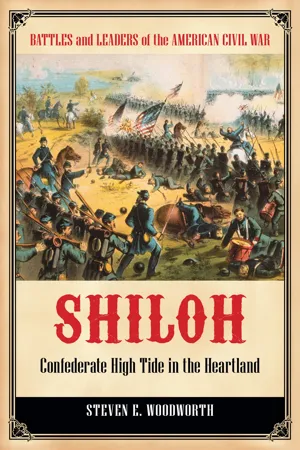 eBook - ePub
Shiloh
Confederate High Tide in the Heartland
- Steven E. Woodworth(Author)
- 2013(Publication Date)
- Praeger(Publisher)
Moving into position on Sherman’s left were the remaining two brigades of McClernand’s First Division. The First had seen heavy fighting at Fort Donelson seven weeks before, but on this morning its veteran troops were fresh and rested, with the exception of Raith’s by now badly battered brigade. As before, Raith’s troops stood immediately next to Sherman’s line, just west of the crossroads. To Raith’s left, east of the crossroads, Colonel C. C. Marsh’s veteran Illinois brigade held a line angling away to the rear of the Hamburg-Purdy Road. Extending that line on Marsh’s left was Colonel Abram Hare’s brigade of two Illinois and one Iowa regiments. Together, Marsh’s and Hare’s line extended about 1,000 yards due east of the crossroads of the Corinth and Hamburg-Purdy roads. At its far left, Hare’s Iowans extended their line just into the field of a farmer named Duncan. On the other side of Duncan Field, about 200 yards east of Hare’s left flank, troops of William H. L. Wallace’s Second Division were taking position along the east side of the field, facing southwest. Marsh’s and Hare’s troops faced due south.Shiloh, April 6, 1862, 10:00 a.m. (Charles D. Grear)It was probably while Sherman’s and McClernand’s divisions were taking up their positions along this line that Grant arrived on this part of the battlefield to survey the situation and consult briefly with his most trusted subordinate, Sherman. Grant had spent the preceding night at his headquarters at the Cherry Mansion in Savannah, where he had been awaiting Buell’s arrival. The slow-moving commander of the Army of the Ohio had actually arrived at Savannah the evening before, ahead of most of his troops, but had not bothered to make his presence known to Grant. Despite the lack of contact with Buell, Grant’s plans for April 6 had included shifting his headquarters and staff from Savannah to Pittsburg Landing due of official notification of McClernand’s promotion to major general of volunteers. Rather than allow five of his six divisions to come under the immediate command of that aspiring politician and military amateur, Grant had decided he could not afford to wait any longer for Buell. He would go to Pittsburg Landing and exercise immediate command himself.16
Index pages curate the most relevant extracts from our library of academic textbooks. They’ve been created using an in-house natural language model (NLM), each adding context and meaning to key research topics.

