History

Antietam
Antietam was a significant battle fought during the American Civil War on September 17, 1862, near Sharpsburg, Maryland. It was the bloodiest single-day battle in American history, with over 23,000 casualties. The Union victory at Antietam provided President Abraham Lincoln with the opportunity to issue the Emancipation Proclamation, which changed the nature of the war by making it a fight for freedom as well as preservation of the Union.
Written by Perlego with AI-assistance
Related key terms
1 of 5
6 Key excerpts on "Antietam"
 eBook - ePub
How Chance and Stupidity Have Changed History
The Hinge Factor
- Erik Durschmied(Author)
- 2016(Publication Date)
- Arcade(Publisher)
On the battlefield nothing was decided. Ambrose Burnside was no Stonewall Jackson, and George McClellan no Robert E. Lee.Antietam, or as some call it, Sharpsburg, was a moral victory for Lee and a political one for the Union. The overshadowing factor of Antietam is that Abraham Lincoln now took the initiative, and the face of war changed forever.Antietam prevented Britain and France from recognising the Confederate States of America. Had the two major European countries done so, it would have split the United States into two separate republics, 22 Union states and 13 Confederate states.And Antietam did provide President Lincoln with a favourable opportunity to issue his Emancipation Proclamation.5 Within two generations, the United States of America became the greatest industrial power in the world.A historic afterthought: by studying closely the tactics of Antietam, the European Powers could have avoided the enormous blunders perpetrated during the European wars of 1866 and 1871, and most certainly, at the beginning of the First World War. The horror of concentrated artillery fire against massed infantry was an example clearly to be seen, but nobody had learned the lesson.The Hinge Factor at Antietam was a parcel with three cigars. Because of it, the American Civil War was to continue for another four bloody years.1 It was the copy sent to General A. P. Hill.2 87,000 Union soldiers versus 30,000 Confederates.3 Lee will be wounded five times that day before he is carried to the rear.4 One of his descendents, Harry Josef Coons, led the charge on Hill 943 in Vietnam.5![Book cover image for: From Manassas To Appomattox : Memoirs Of The Civil War In America [Illustrated Edition]](https://img.perlego.com/book-covers/3020435/9781782895428_300_450.webp)
- General James Longstreet(Author)
- 2014(Publication Date)
- Golden Springs Publishing(Publisher)
CHAPTER XVIII. — BATTLE OF SHARPSBURG, OR Antietam.
Bloodiest Single Day of the War—Comparison of Casualties—Hooker opens the Fight against Jackson’s Centre—Many Officers among the Fallen early in the Day—McLaws and Walker in time to meet Sumner’s Advance under Sedgwick—Around Dunker Chapel—Richardson’s splendid Advance against the Confederate Centre the Signal of the bursting of another Storm—Longstreet’s and D. H. Hill’s Troops stood before it—Fall of General G. B. Anderson—General Richardson mortally wounded—Aggressive Spirit of his Command broken—Wonderful Cannon-shot—General D. H. Hill’s Third Horse killed under him.
The field that I have described—the field lying along the Antietam and including in its scope the little town of Sharpsburg—was destined to pass into history as the scene of the bloodiest single day of fighting of the war, and that 17th of September was to become memorable as the day of greatest carnage in the campaigns between the North and South.Gettysburg was the greatest battle of the war, but it was for three days, and its total of casualties on either side, terrible as it was, should be one-third larger to make the average per diem equal to the losses at Sharpsburg. Viewed by the measure of losses, Antietam was the fourth battle of the war, Spottsylvania and the Wilderness, as well as Gettysburg, exceeding it in number of killed and wounded, but each of these dragged its tragedy through several days. eBook - ePub
- Samuel Willard Crompton(Author)
- 2014(Publication Date)
- Visible Ink Press(Publisher)
Burnside had roughly twenty thousand men, leading the left flank of the Union force. He was in no possible danger—the fighting was all to his right (or to the north), and he was under orders to take the bridge that would bring his men into the battle. Why Burnside fumbled so badly on this occasion is not fully known, but he did not have his men in motion till 2 P.M., and the bridge was not taken until two hours later. The Confederates prudently withdrew, and Burnside was satisfied with occupying the ground on the west side of Antietam Creek. None of the top Union commanders seemed to realize that complete victory was within their grasp. One vigorous attack from the Union center would, very likely, have brought about a complete Confederate collapse.What was the scene like toward the end of the day?
The day, in the opinion of most of the participants, had gone on far too long. There was something eerie, too, in the reddish quality to the last sunlight of September 17, 1862. Even those who had fought in the worst of it, however, did not fully recognize the awful toll until days later. The Battle of Antietam, or Sharpsburg, was the single bloodiest day in American history.Can that be accounted for by the simple fact that Americans were fighting each other?
No. The total casualties on the Union side came to 2,010 killed, 9,416 wounded, and 1,043 missing, for a total of 12,469. Confederate losses are harder to be named with certainty, partly because there had been so many desertions, but it was at least equal to the Northern loss. Therefore, we can say, with little hesitation, that roughly 25,000 Americans were killed, wounded, or went missing in one day’s battle. Let us compare that to other terrible days in American history.On December 7, 1941, 2,386 Americans died when the Japanese bombed Pearl Harbor. That was indeed a black day in American history, but it did not come close, either in relative or in absolute terms, to the blood that flowed at Antietam. On September 11, 2001, 2,996 Americans were killed in the immediate aftermath of the terrorist attacks on the World Trade Center in New York City. While it was a horrific scene, and day, it does not approach the losses at Antietam. And even at the height of the Second World War, when the United States fought on two fronts—the battle-hardened Germans on one and the fanatical Japanese on the other—there was no day in which the casualty number or percentage came even close.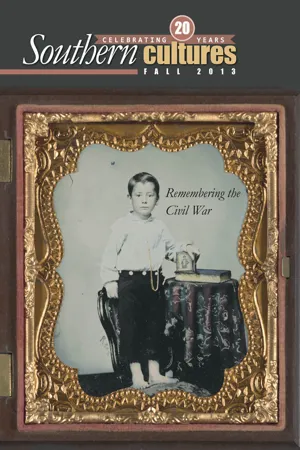 eBook - ePub
Southern Cultures: Remembering the Civil War Issue
Volume 19: Number 3 – Fall 2013 Issue
- Harry L. Watson, Jocelyn Neal, Harry L. Watson, Jocelyn Neal(Authors)
- 2013(Publication Date)
1More than 6,000 Union and Confederate soldiers died that day in the farm fields outside Sharpsburg, making it the single bloodiest day in American military history. More soldiers died that day than died in combat in all other wars fought by America in the nineteenth century combined: the War of 1812, the Mexican–American War, the Spanish–American War, and the Indian wars. Beyond the statistics was the indescribable carnage. “Words are inadequate to portray the scene,” wrote one soldier. Another, in charge of a burial party, described the dead “in every state of mutilation, sans arms, sans legs, heads, and intestines, and in greater number than on any field we have seen before.” It was said that a person could walk a mile or more atop the bodies without touching ground.2An estimated 5,000 people watched the fighting from a hill a safe distance away. Edwin Forbes of Frank Leslie’s Illustrated Newspaper reported that the battle took place on open ground and was fully visible from the hillside, which was “black with spectators.” “No battle of the war, I think, was witnessed by so many people,” he reported. It is possible the photographers Alexander Gardner and James F. Gibson were among them. The two men, employees of Mathew Brady, had been following the Union army for about two weeks, primarily photographing soldiers in their camps. When exactly they arrived at Antietam is uncertain, but they were on the field with their equipment the day after the battle; no other American battlefield had been photographed so soon after the fighting. The pair exposed seventy glass negatives within five days of the battle. Their images include landmarks of the field, hastily dug graves, and the corpses of horses and men. A union surgeon described bodies “stretched along, in one straight line, ready for interment, at least a thousand blackened bloated corpses with blood and gas protruding from every orifice, and maggots holding high carnival over their heads.”3 eBook - PDF
- Gary W. Gallagher(Author)
- 2011(Publication Date)
- Harvard University Press(Publisher)
Popular historians have created a body of work overwhelmingly fo-cused on armies and generals that routinely neglects, or ignores alto-gether, the larger political and social implications of military campaigns. They describe strategic maneuvering by generals seeking to place their opponent at risk. Once combat begins, officers and soldiers shed blood profligately for supremacy on previously insignificant bits of the Ameri-can countryside. Union troops fall by the thousands in a small cornfield owned by farmer D. R. Miller close to Antietam Creek in Maryland, set a ghastly standard of slaughter near a backwoods Methodist church in Tennessee called Shiloh, and leave a harvest of bodies in a jumble of rocks named Devil’s Den by local residents in southern Pennsylvania. Some of the most celebrated commanders in American military history dominate much of this Civil War. Ulysses S. Grant mounts a dazzling campaign against Vicksburg, reducing that Rebel stronghold overlook-ing the Mississippi River on July 4, 1863. Fourteen months after that pivotal event, William Tecumseh Sherman, who owes his success almost 122 The Armies entirely to Grant’s reassuring influence, delivers a powerful body blow to the Confederacy when he captures Atlanta. Hard on the heels of Sher-man’s success, Philip H. Sheridan rides to the battlefield at Cedar Creek to reverse an earlier tide of defeat and demoralization.Told and retold by every generation since the Confederate surrender in the spring of 1865, this Civil War—marked by honor and hubris, triumph and failure, and gallantry and perfidy on an epic scale—comes closer to serving as an American Iliad than any other element of our national past. 4 The second of these two Civil Wars emanates, for the most part, from scholars in an academic setting. Here the focus is on the home fronts, on the ways in which the conflict affects, or does not affect, the daily rhythms of life on farms and in cities.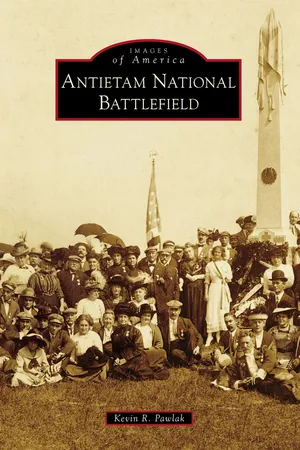 eBook - ePub
- Kevin R. Pawlak(Author)
- 2019(Publication Date)
- Arcadia Publishing(Publisher)
ThreeTHE BATTLEFIELDThousands of visitors travel to Sharpsburg every year to visit Antietam National Battlefield. The ground they tread on a daily basis looks much the same in the 21st century as it did in 1862. Historic homes, roads, fence lines, and farm fields still exist. One can walk in the footsteps of Union and Confederate soldiers from one end of the field to the other with few modern intrusions.This virtually unchanged appearance did not always exist, though. Once the armies moved on from the fields of Antietam, Sharpsburg’s citizens had to turn the area into a habitable place again. They built new homes, cut down historic trees, and planted new crops. Throughout the years, these post–Civil War homes became problematic on the battlefield landscape. A convenience store stood along the edge of the Bloody Lane while another used the foundation of the fallen Dunker Church. But the more things changed, the more things stayed the same at Antietam.A visiting delegation of North Carolina veterans in 1894 wrote back home, “The locality in the nearly thirty-two years since the battle has undergone remarkably small change. The landmarks are all there.” By the time of that visit, several monuments had already been erected on the battlefield. The monuments and the railroad increased visitation to the battlefield. This boon received praise from Sharpsburg’s citizens. “Our citizens are beginning to take a deep interest in the work of laying out this battlefield, and have it eventually pass into the hands of the government. Our town has always manifested a loyalty to the Union, and now we have an opportunity—a grand opportunity to demonstrate our patriotism and to show our deepest regard for the faith and work of the heroes now sleeping in Antietam National Cemetery,” read one local newspaper.The US War Department assumed control of the battlefield in 1890 as Antietam became one of America’s first five national military parks. In 1933, the National Park Service took charge of the park. The numerous images that appear in this chapter trace the history and preservation of Antietam National Battlefield through the years.
Index pages curate the most relevant extracts from our library of academic textbooks. They’ve been created using an in-house natural language model (NLM), each adding context and meaning to key research topics.

