History

Political Effects of The Civil War
The Civil War had significant political effects on the United States, including the abolition of slavery with the passage of the 13th Amendment, the expansion of federal power over the states, and the redefinition of the relationship between the federal government and individual states. These changes reshaped the political landscape and set the stage for the Reconstruction era.
Written by Perlego with AI-assistance
Related key terms
1 of 5

7 Key excerpts on "Political Effects of The Civil War"
 eBook - PDF
Writing the Civil War
The Quest to Understand
- James M. McPherson, William J. Cooper, James M. McPherson, William J. Cooper, Jr.(Authors)
- 2021(Publication Date)
- University of South Carolina Press(Publisher)
Fourth-and inextricably linked to this reorientation-have been trends in the broader field of political history that have shaped much recent writing about war-time politics. 113 MICHAEL F. HOLT The disjointed state of recent scholarship on Civil War politics is hardly unique. It stems primarily from the current disarray in the field of nine-teenth-century American political history in general. Prior to the mid-1960s, much of the most significant work on northern Civil War politics was produced by such historians as Williams and Donald, giants of Civil War historiography who were experts on the Civil War era as a whole, who were just as comfortable and prolific in writing about the military aspects of the war as about its politics, and who were primarily interested in whether and how northern politics helped or hindered the Union war effort. The conduct and outcome of the war, in sum, were their chief sub-jects; politics was one means, among many, of addressing them. To be sure, some writers about Civil War politics since 1965, includ-ing Donald himself as well as other biographers of Lincoln, have continued to stress the interaction among military developments, political maneu-vers, and northern victory. 5 Certain political events, such as Lincoln's reelection in 1864, have long been connected to battlefield outcomes like Sherman's capture of Atlanta. 6 Virtually all recent authors, moreover, ex-hibit considerable expertise about those aspects of the war on which they have focused. Nonetheless, the most influential writers since 1965 were usually trained as political historians or political scientists, not Civil War experts. In most cases, they have left military history to others. And they have not studied wartime political developments primarily in order to explain why the North won the war.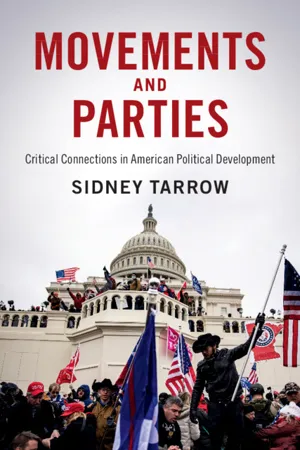 eBook - PDF
Movements and Parties
Critical Connections in American Political Development
- Sidney Tarrow(Author)
- 2021(Publication Date)
- Cambridge University Press(Publisher)
Although the moderates and conservatives who entered the party would have been happy with no more than the reinstatement of the Missouri Compromise, as Gienapp writes, “Advanced antislavery men wanted a platform that demanded the exclusion of slavery from all the territories, opposed the admission of any new slave states, and advocated the repeal of the fugitive slave law” (p. 91). In the run-up to the Civil War, these differences were papered over in the interest of furthering the new party’s hopes of gaining power. The differences between radicals who had come to the party from the antislavery movement, moderates like Lincoln, and conservatives with strong market-oriented instincts were deep and would last through the war and destroy the party’s unity during Reconstruction. ii war makes states – and movements In his wide-ranging book on war and state building in Western Europe (1990), Charles Tilly had little to say about the United States, but Richard Bensel took up Tilly’s aphorism and applied it to the American Civil War (1990). Taking the Tilly/Bensel thesis a step further, I will argue that war also affects contentious politics, spurs the creation of new movements, and remakes existing ones (Tarrow 2015). This was not the only place where war and social conflict brought about a challenge to slavery, but elsewhere, as Karp points out, antislavery gains followed violent revolution and military conflict – struggles that often originated over issues far removed from the question of slavery itself. Only in the United States, from 1854 to 1865, did an explicitly antislavery political victory precede, pro- duce, and in a critical fashion sustain an abolitionist military revolution. (Karp 2019: 141) The Civil War not only defeated the seceded southern states and the socioeconomic system they stood for, but it also loosened the boundaries of behavior, turned resentments into violent conflicts, and gave existing movements the resources with which to make bolder claims. eBook - PDF
War, Revenue, and State Building
Financing the Development of the American State
- Sheldon Pollack(Author)
- 2011(Publication Date)
- Cornell University Press(Publisher)
War and the Development of the American State 217 Party produced a dramatic transformation of the political ideology, political order, and institutional apparatus of the national government in the North. The Civil War brought a broad expansion of state authority as well as the triumph of the Republican Party’s nationalist vision of political econ-omy. Pursuant to the latter, the central state (firmly under the control of Republican nationalists) would, in Bensel’s telling words, “sweep aside re-gional and local barriers to the development of a national capitalist mar-ket and directly assist in the construction of the physical and financial infrastructure necessary for that market.” 38 The radical restructuring of the American economy during the Civil War was furthered by the Union government as it established a national currency, placed a large portion of the national debt with a new class of private finance capitalists, created a national banking system that superseded the state banks, taxed out of exis-tence the notes of the local state-chartered banks that virtually functioned as currency, took the nation off the gold standard, and adopted paper money (the “Greenback”) as legal tender. 39 In the face of relentless pressure to raise revenue for the war effort, political leaders turned to new forms of taxation that had been long resisted by powerful social and economic inter-ests. By bolstering the state’s capacity for revenue extraction and its capac-ity to borrow large amounts of money through the private capital markets, Republicans in the North permanently transformed the fiscal foundations of the American state. A comparable story of “revenue predation” (Mar-garet Levi’s term) unfolded in the South, where the leaders of the Confed-eracy wielded all of the vast coercive powers of that political organization to marshal societal resources for the military campaign they waged. eBook - PDF
- Dorothy Volo, James M. Volo(Authors)
- 2009(Publication Date)
- Greenwood(Publisher)
Yet the causes proved so lost in a maze of interrelated factors and so obscured by the hidden agendas of those who wrote, or rewrote, history that there was no possibility of identifying all of them. Historians found that more than two years before the outbreak of hostilities, Americans had already identified, to their satisfaction at least, a very powerful cause for the bloody struggle that loomed between the increasingly antagonis- tic sections of their country. “It is an irrepressible conflict between op- posing and enduring forces,” declared William H. Seward. Some modern historians still agree with this outspoken anti-slavery Republican, but oth- ers disagree, believing the war could have been avoided by compromise. Nonetheless, it seems certain, from the distance of generations, that some form of civil upheaval was inevitable. 5 In recent years, a more meaningful debate has centered on the people who found themselves caught in undercurrents of history so strong and compelling that they were unable to avoid conflict. This discussion has sparked several interesting lines of research into the nature of American society before and during the conflict, and historians have studied consti- tutional theory, politics, economics, geography, and society in an attempt to understand the wartime generation. Research in these areas has been particularly helpful in producing a mass of documentary evidence con- cerning the lives of the people of the Civil War era. This research has made it clear that secession, and not slavery, was the precipitating controversy of the war. Although anti-slavery was a promi- 6 Daily Life in Civil War America nent reform movement of the period, other causes, such as temperance, women’s rights, religious revival, public education, concerns for the poor, and prison reform, were as zealously pursued by activists. eBook - PDF
Critical Issues in American Religious History
A Reader, Second Revised Edition
- Robert R. Mathisen(Author)
- 2006(Publication Date)
- Baylor University Press(Publisher)
By summarizing the most important ways in which religion contributed to the growth of Southern distinctiveness and placing these themes in their historiographical context, this conclusion offers a modest contribution to explaining the coming of the Civil War. I The relationship between religious and political discourse was one way in which religion shaped the development of antebellum Southern separatism. Often, as with the biblical defense of slavery, this interaction worked simply as a borrowing of language and ideas from religion to politics. At other times, such as the denominational schisms, religious and political discourse con-verged and became mutually reinforcing. In two particular cases, this conflu-ence of religious and political discourse strengthened preexisting elements in Southern political culture that were crucial in leading the South down the road to disunion. The coming of the Civil War was in a fundamental sense a constitutional crisis. As historian Arthur Bestor suggested, the Constitution played a con-figurative role in the sectional controversy, providing the “narrow channel” through which all aspects of the slavery debate flowed. During the 1840s, the simultaneous appearance of the Methodist and Baptist schisms with the annexation of Texas and the Wilmot Provisio reinforced the constitutionalism in Southern political discourse. While politicians insisted that Congress had no right to legislate against slaveholders in the territories, Southern church-men claimed that the exclusionary actions of Northern dominated church bodies were unconstitutional. During the secession crisis, clergymen again contributed to Southern constitutionalism by defending states’ rights in their religious vindications of secession. Religion then reinforced the Southern habit of thinking about the sectional controversy over slavery in constitu-tional terms, which gave it a configuration capable of disrupting the Union. eBook - ePub
American Educational History
School, Society, and the Common Good
- William H. Jeynes(Author)
- 2007(Publication Date)
- SAGE Publications, Inc(Publisher)
CHAPTER 7The Effects of Events During and Between the Civil War and World War I
D uring the period from 1861 to 1918, from the Civil War to World War I, the United States matured into a primary economic world power. By 1900, the United States maintained the highest standard of living of any nation in the world, a position it would hold until 1973 (U.S. Department of Labor, 2005). Educators believe that the ascending American education system of the 19th and early 20th centuries contributed measurably to the puissant economy that Americans would enjoy in the 20th century (Hungerford & Wassmer, 2004). Undoubtedly, the period from 1861 to 1918 was an important one in the history of American education. Urbanization, industrialization, and immigration would all have a prominent impact. In addition, schools assumed new social roles that produced some controversy. Educators also debated about what should be the appropriate nature of education for African Americans in the post–Civil War era. This chapter of American educational history also yielded a more well-defined American education system, which in most respects resembled that which the nation’s citizenry is familiar with today.IMPACT OF THE CIVIL WAR
Many historians claim that America did not become a full-fledged nation until the conclusion of the Civil War (Johnson, 1997). There are a number of reasons historians make this assertion.First, slavery had divided the nation prior to the Civil War. In a very real sense, as the slave trade grew, the nation became two nations under one roof (Johnson, 1997). On the basis of this reality, Abraham Lincoln (1858) made a famous speech in which he declared, paraphrasing Jesus in the New Testament, “A house divided against itself cannot stand.” Certainly with such a division tearing the country apart, the United States really could not function as one nation. eBook - PDF
Transnational Nation
United States History in Global Perspective since 1789
- Ian Tyrrell(Author)
- 2015(Publication Date)
- Red Globe Press(Publisher)
Canada achieved its federation and dominion status in 1867, partly as a response to the Civil War, with diplo-matic tensions between the United States and the British North American provinces displaying just how vulnerable those possessions would be to US annexationist pressure unless united. In Europe, as in the United States, war was a direct agent of political concentration of power. The creation of the modern American industrial nation through war bears more than a pass-ing resemblance to the transition to nationhood in Europe – Lincoln and Otto von Bismarck could each be seen as men who united a nation through blood and iron. 13 Lincoln’s politics of moderate, liberal nationalism and his enunciation of a ‘new birth of freedom’ in the Gettysburg Address were, however, far removed from the objectives of the conservative Prussian and his authori-tarian brand of nationalism. As late as the First World War’s beginning, the German Empire lacked a representative let alone a truly democratic type of government. Moreover, the growth of the American nation-state remained remarkably circumscribed. State distrust of federal power remained and America’s Civil War and Its World Historical Implications 99 Southern resistance to the imposition of Yankee ways during and after Reconstruction was a paramount influence. The ‘spring of government’ was weak. 14 Because laissez-faire prevailed there could be no truly strong central authority. This was made clear in Reconstruction policy. The vast invest-ment of federal resources needed to strengthen the position of the ex-slaves in the South and provide them with land did not transpire. Instead, their advancement was limited to civil and political rights as befitting of a liberal revolution. Even that achievement was rolled back after the mid-1870s as the military occupation of the South ceased and ‘Redeemer’ governments devoted to white supremacy took charge in the Southern states.
Index pages curate the most relevant extracts from our library of academic textbooks. They’ve been created using an in-house natural language model (NLM), each adding context and meaning to key research topics.

