History

Era of Reconstruction
The Era of Reconstruction in the United States refers to the period following the Civil War, from 1865 to 1877, when the country sought to rebuild and integrate the Southern states back into the Union. It was marked by efforts to address the social, economic, and political challenges resulting from the war, including the abolition of slavery and the expansion of civil rights for African Americans.
Written by Perlego with AI-assistance
Related key terms
1 of 5
9 Key excerpts on "Era of Reconstruction"
 eBook - PDF
- P. Scott Corbett, Volker Janssen, John M. Lund, Todd Pfannestiel, Paul Vickery, Sylvie Waskiewicz(Authors)
- 2014(Publication Date)
- Openstax(Publisher)
White southerners reacted with outrage at the changes imposed upon them. The sight of once-enslaved blacks serving in positions of authority as sheriffs, congressmen, and city council members stimulated great resentment at the process of Reconstruction and its undermining of the traditional social and economic foundations of the South. Indignant southerners referred to this period of reform as a time of “negro misrule.” They complained of profligate corruption on the part of vengeful freed slaves and greedy northerners looking to fill their pockets with the South’s riches. Unfortunately for the great many honest reformers, southerners did have a handful of real examples of corruption they could point to, such as legislators using state revenues to buy hams and perfumes or giving themselves inflated salaries. Chapter 16 | The Era of Reconstruction, 1865–1877 467 Such examples, however, were relatively few and largely comparable to nineteenth-century corruption across the country. Yet these powerful stories, combined with deep-seated racial animosity toward blacks in the South, led to Democratic campaigns to “redeem” state governments. Democrats across the South leveraged planters’ economic power and wielded white vigilante violence to ultimately take back state political power from the Republicans. By the time President Grant’s attentions were being directed away from the South and toward the Indian Wars in the West in 1876, power in the South had largely been returned to whites and Reconstruction was effectively abandoned. By the end of 1876, only South Carolina, Louisiana, and Florida still had Republican governments. The sense that the South had been unfairly sacrificed to northern vice and black vengeance, despite a wealth of evidence to the contrary, persisted for many decades. So powerful and pervasive was this narrative that by the time D.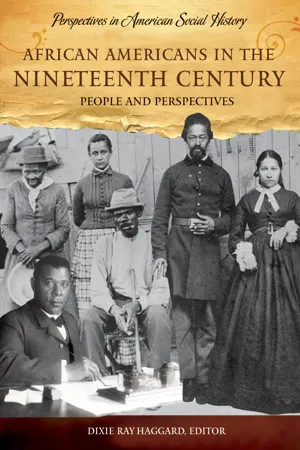 eBook - PDF
African Americans in the Nineteenth Century
People and Perspectives
- Dixie Ray Haggard(Author)
- 2010(Publication Date)
- ABC-CLIO(Publisher)
African Americans during Reconstruction (1863–1877) Dawn J. Herd-Clark 7 R econstruction, the period immediately after the Civil War (1861–1865), was initially a period of substantial changes for African Americans living in the former southern slave states. Beginning in 1863, with the implementation of President Abraham Lincoln’s Ten Percent Plan for recon- structing the South, Reconstruction lasted until 1877, when the last of the federal troops were removed from the former Confederate states. During Reconstruction, African Americans, many of whom had been enslaved their entire lives, had an opportunity to experience freedom for the first time. This freedom allowed some African Americans to receive an education, own land, vote, and hold political office for the first time in their lives. By the end of the 19th century, however, freedom for African Americans living in the South would be limited because of racism and discrimination by southern whites and neglected by other segments of the American population. The rights African Americans fought to achieve during Reconstruction would be lost until the modern civil rights movement of the 1950s and 1960s. Freedom There had always been a free African American population in the antebel- lum South, although their rights were limited by southern prejudice. Dur- ing the Civil War, the number of free blacks increased as slaves took the liberty of liberating themselves as Union troops approached. Even more slaves sought their freedom once President Abraham Lincoln announced the Emancipation Proclamation, stating ‘‘all persons held as slaves within any State or designated part of a State, the people whereof shall then be in rebellion against the United States, shall be then, thenceforward, and eBook - PDF
- Jane Kamensky, Carol Sheriff, David W. Blight, Howard Chudacoff(Authors)
- 2018(Publication Date)
- Cengage Learning EMEA(Publisher)
Between 1866 and 1868, the president and the Republican leadership in Congress engaged in a bitter power struggle over how to put the United States back together again. Before the struggle ceased, Con- gress had impeached the president, enfranchised freed- men, and given them a role in reconstructing the South. The nation also adopted the Fourteenth and Fifteenth Amendments, ushering in equal protection of the law, a definition of birthright citizenship, and universal man- hood suffrage into the Constitution. By 1868–1869, the Ku Klux Klan employed extensive violence and terror to thwart Reconstruction and under- mine black freedom. As white Democrats in the South took control of state governments in the 1870s, they encountered little opposition from the North. Moreover, the wartime industrial boom had created new opportunities and priori- ties. The West, with its seemingly limitless potential and its wars against Native peoples, drew American resources and consciousness like never before. Americans moved in huge numbers and sought new “homes” in the trans-Mississippi West and the homes of Native Americans were displaced or destroyed. Political corruption became a nationwide scandal, and bribery a way of doing business. Thus, Reconstruction became a revolution eclipsed. The white South’s desire to reclaim control of its states and of race relations overwhelmed the national interest in stopping it. But Reconstruction left enduring legacies from which the nation has benefited and with which it has struggled ever since. In every succeeding racial or constitutional reckoning, we often return to Reconstruction as a means of understand- ing ourselves anew. ■ Should the Reconstruction era be considered the Second American Revolution? By what criteria should we make such a judgment? ■ What were the origins and meanings of the Fourteenth Amendment in the 1860s? What is its significance today? ■ Reconstruction is judged to have “ended” in 1877. eBook - PDF
Reconstruction in the United States
An Annotated Bibliography
- David Lincove(Author)
- 2000(Publication Date)
- Greenwood(Publisher)
General Historiography and Surveys of Reconstruction 29 151. Stampp, Kenneth M. The Era of Reconstruction, 1865-1877. New York: Alfred A. Knopf, 1966. 229p. Bibl. Stampp examines the main issues of contention between revisionist historians and the long established views of William Dunning who depicted Reconstmction as disgraceful, scandalous, and a complete failure. Stampp emphasizes that when the period is studied closely without preconceived notions and biases, a more realistic picture of events emerges. While agreeing with some of the traditional criticism of Republican motives and federal and state government corruption, Stampp reveals that Southerners were not treated brutally, and many Republicans sincerely cared about helping freedmen and encouraged aid and assistance through the Freedmen's Bureau. The passage of the 14th and 15th Amendments legally ensured civil rights for blacks and made Reconstmction a long term success. 152. Stampp, Kenneth M. and Leon Litwack. Reconstruction: An Anthology of Revisionist Writings. Baton Rouge: Louisiana State University Press, 1969. 531 p. This book of 23 previously published journal articles and book chapters provides views of Lincoln, Johnson and the Radical Republicans, the response of the freedmen to emancipation, local Republican politics in the South, and the basis for the collapse of Reconstmction in national and local governments. 153. Taylor, A. A. "Historians of the Reconstmction." Journal of Negro History 23 (January 1938); 16-34. In this address delivered at the annual meeting of the Association for the Study of Negro Life and History on November 2, 1937 Taylor offers a survey of the historiography of Reconstmction. He focuses on major monographs written from the 19th century until the 1930s. 154. Taylor, Joe Gray. "The White South From Succession to Redemption." In Interpreting Southern History: Historiographical Essays in Honor of Sanford W. Higgenbotham. Edited by John B. Boles and Evelyn Thomas Nolen.
- Elizabeth Cobbs, Edward Blum, Jon Gjerde, , Elizabeth Cobbs, Edward Blum, Jon Gjerde(Authors)
- 2016(Publication Date)
- Cengage Learning EMEA(Publisher)
CHAPTER 1 Reconstruction Many nations that have a civil war end up having more civil wars. The reasons for the originating conflict are often unresolved. In the case of the United States, the epic strug-gle from 1861 to 1865 did not lead to another full-blown military encounter. Instead, the states that had seceded were quickly reincorporated into the legal fold of the nation; Confederate leaders and civilians were reconstituted as citizens; and the key political problems that caused the war — slavery and its future in the territories and states — were resolved. Three new constitutional amendments transformed the nation ’ s founding document to make certain of this final point. The questions for Reconstruction were many, but the central ones were how would the United States avoid another violent war? What would be the status of people formerly owned by other people? What would be the status of those who had committed treason against the government? How would the nation develop economically and territorially into the West now that slavery was not an option? Even before the Civil War ended, President Lincoln and congressional leaders puz-zled over how best to reintegrate the people of the South into the Union. Before he was assassinated, President Lincoln proposed a “ 10 percent plan, ” which would have allowed a state government to reestablish itself once one-tenth of those who had voted in 1860 took an oath of loyalty to the United States. Radicals in Congress were appalled by the seem-ingly lenient plan and pushed through their own bill, which increased the proportion to one-half of the voters who were required to swear that they had never supported secession. Lincoln ’ s assassination cut short this increasingly scathing debate and drastically altered the mood of Reconstruction. Political disagreements over Reconstruction policy were vast, and the strategies advo-cated were so varied that Reconstruction took a crooked road. No longer available |Learn more
Liberty, Equality, Power
A History of the American People, Concise Edition
- John Murrin, Paul Johnson, James McPherson, Alice Fahs(Authors)
- 2013(Publication Date)
- Cengage Learning EMEA(Publisher)
C H A P T E R 17 reconstruction, 1863 – 1877 WARTIME RECONSTRUCTION Radical Republicans and Reconstruction ANDREW JOHNSON AND RECONSTRUCTION Johnson ’ s Policy Southern Defiance The Black Codes Land and Labor in the Postwar South The Freedmen ’ s Bureau Land for the Landless Education THE ADVENT OF CONGRESSIONAL RECONSTRUCTION Schism between President and Congress The Fourteenth Amendment The 1866 Elections The Reconstruction Acts of 1867 THE IMPEACHMENT OF ANDREW JOHNSON The Completion of Formal Reconstruction The Fifteenth Amendment The Election of 1868 THE GRANT ADMINISTRATION Civil Service Reform and Foreign Policy Issues Reconstruction in the South Blacks in Office “ Carpetbaggers ” “ Scalawags ” The Ku Klux Klan The Election of 1872 The Panic of 1873 THE RETREAT FROM RECONSTRUCTION The Mississippi Election of 1875 The Supreme Court and Reconstruction The Election of 1876 Disputed Results The Compromise of 1877 The End of Reconstruction F rom the beginning of the Civil War, the North fought to “ reconstruct ” the Union. Lincoln at first attempted to restore the Union as it had existed before 1861, but once the abolition of slavery became a northern war aim, the Union could never be reconstructed on its old foundations. Instead, it must experience a “ new birth of freedom, ” as Lincoln had said at the dedication of the military cemetery at Gettysburg. But precisely what did “ a new birth of freedom ” mean? At the very least it meant the end of slavery. But what would liberty look like for the four million freed slaves? Would they become citizens equal to their former masters in the eyes of the law? And on what terms should the Confederate states return to the Union? What would be the powers of the states and of the national government in a reconstructed Union? 385 Copyright 2014 Cengage Learning. All Rights Reserved. May not be copied, scanned, or duplicated, in whole or in part. WCN 02-300 eBook - PDF
A People and a Nation
A History of the United States
- Jane Kamensky, Carol Sheriff, David W. Blight, Howard Chudacoff(Authors)
- 2017(Publication Date)
- Cengage Learning EMEA(Publisher)
The ideology of free labor dictated that property should be respected and that individuals should be self-reliant. Racism endured and transformed into the even more virulent forms of Klan terror and theories of black degeneration. Concern for the human rights of African Americans and other reforms frequently had less appeal than moneymaking in an individualistic, industrializing society. New challenges began to overwhelm the aims of Reconstruction. How would the country develop its immense resources in an increasingly interconnected national econ- omy? Could farmers, industrial workers, immigrants, and capitalists coexist? Industrialization not only promised prosperity but also wrought increased exploitation of labor. Moreover, industry increased the nation’s power and laid the foundation for an enlarged American role in international affairs. In the wake of the Civil War, Americans faced two pro- found tasks—the achievement of healing and the dispens- ing of justice. Both had to occur, but they never developed in historical balance. Making sectional reunion compatible with black freedom and equality overwhelmed the imagination in American political culture, and the nation still faced much of this dilemma more than a century later. Copyright 2019 Cengage Learning. All Rights Reserved. May not be copied, scanned, or duplicated, in whole or in part. Due to electronic rights, some third party content may be suppressed from the eBook and/or eChapter(s). Editorial review has deemed that any suppressed content does not materially affect the overall learning experience. Cengage Learning reserves the right to remove additional content at any time if subsequent rights restrictions require it. 439 Suggestions for Further Reading Suggestions for Further Reading David W. Blight, Race and Reunion: The Civil War in American Memory (2001) Gregory P. Downs, Declarations of Dependence: The Long Reconstruction of Popular Politics in the South, 1861–1908 (2011) W. eBook - PDF
Decades of Reconstruction
Postwar Societies, State-Building, and International Relations from the Seven Years' War to the Cold War
- Ute Planert, James Retallack(Authors)
- 2017(Publication Date)
- Cambridge University Press(Publisher)
Blacks became officeholders in every southern state. 19 They helped govern the nation by sending sixteen congressmen to participate in the federal government during the 1870s and 1880s. 20 Reconstruction was, as Eric Foner has written, a “stunning experiment in the nineteenth- century world, the only attempt by an outside power in league with the emancipated slaves to fashion an interracial democracy from the ashes of slavery.” 21 Reconstruction represented a radical revolution in US political institu- tions, but it depended upon an even more sweeping ideological transfor- mation in the minds of Republicans. In the 1850s, many Republicans favored “whites-only nationalism,” 22 but by the late 1860s, the Republican Party endorsed a civic nationalism that sought to create a united American people defined by racially egalitarian republicanism. Membership in that nation depended not on race but loyalty and senti- ment. This civic nationalism included African Americans. 23 To defend 18 Foner, Reconstruction, 119–136, 176–216, 261–264. 19 Ibid., 228–333. 20 Philip Dray, Capitol Men: The Epic Story of Reconstruction through the Lives of the First Black Congressmen (New York, 2008), 380. 21 Eric Foner, Nothing but Freedom: Emancipation and Its Legacy (Baton Rouge, LA, 1983), 40. 22 Eric Foner, Free Soil, Free Labor, Free Men: The Ideology of the Republican Party before the Civil War (New York, 1970), 261–300. 23 Charles Calhoun, Conceiving a New Republic: The Republican Party and the Southern Question, 1869–1900 (Lawrence, KS, 2006), 7–21; CG, 40th Congress, 3rd Session, 708–709; CG, 39th Congress, 1st Session, 293, 303–305. This racially egalitarian nationalism had limits. In the West, many Republicans adopted virulently anti-Asian views, objected to citizenship for Chinese immigrants, and had a similarly negative out- look concerning Native Americans. No longer available |Learn more
- Gary Walton, Hugh Rockoff(Authors)
- 2017(Publication Date)
- Cengage Learning EMEA(Publisher)
PART 3 The Reunification Era: 1860–1920 Photodisc/Thinkstock Copyright 2018 Cengage Learning. All Rights Reserved. May not be copied, scanned, or duplicated, in whole or in part. WCN 02-300 ECONOMIC AND HISTORICAL PERSPECTIVES, 1860–1920 1. For nearly 100 years following 1815, there were no major wars between national coalitions. The U.S. Civil War, the nation’s bloodiest war ever, was a violent exception in this long period of global peace. 2. After the Civil War, rapid industrialization in the North and renewed western expan-sion sustained a high overall growth rate for the nation. The large absolute fall in out-put in the South due to the war and emancipation and the slow pace of growth in the cotton belt ushered in an era of southern backwardness and regional disparity. 3. Emancipation redistributed wealth and incomes sharply from white slave owners to blacks but created a legacy of slavery that sustained black poverty, especially in the Deep South. 4. By the mid-1890s, the United States had become the world’s leading industrial power, and by 1910, it was outproducing by nearly twice the nearest industrial rival, Germany, while England had slipped into third place. 5. Technological change, economies of scale, and mass production methods became the main engines of modern economic growth, powered by growth enhancing institutions. 6. The path of growth was far from smooth. Periods of deflation, financial crises, and fears of the concentration of wealth led to demands for reform of the economic and financial systems. 7. The U.S. population topped 100 million during World War I; 48 states were in the Union; and federal, state, and local expenditures combined reached a record high of nearly 10 percent of GNP. Copyright 2018 Cengage Learning. All Rights Reserved. May not be copied, scanned, or duplicated, in whole or in part. WCN 02-300
Index pages curate the most relevant extracts from our library of academic textbooks. They’ve been created using an in-house natural language model (NLM), each adding context and meaning to key research topics.

