History

The New South
The New South refers to the period of economic and social transformation in the southern United States following the Civil War. This era saw the rise of industrialization, urbanization, and the diversification of the region's economy. The New South also witnessed significant changes in race relations and the emergence of Jim Crow laws, which enforced racial segregation.
Written by Perlego with AI-assistance
Related key terms
1 of 5
9 Key excerpts on "The New South"

- Donald Sheehan, Harold C. Syrett, Donald Sheehan, Harold C. Syrett(Authors)
- 2019(Publication Date)
- Columbia University Press(Publisher)
When to the collec-tive memory of historical tragedy and exaltation of industrializa- COOKE: T H E NEW S O U T H 53 tion was joined fear and hatred of the Negro, the attitude which underlay contemporary interpretations was established. The last four decades have witnessed in those who write Southern his-tory, if not in those who read it, a marked alteration of attitude. The Civil War and Reconstruction became subjects to be investi-gated rather than experiences one recalled; the industrialization of the South, as it gradually was accomplished, became a process the benefits and costs of which should be examined rather than a prize to be sought; the Negro a subject of compassion rather than an object of contempt. These changes, it should be em-phasized, were not characteristic of most Southerners and possibly not most Americans; they do seem to have characterized the work of those who, in recent decades, have written on the history of The New South. The correctness of the designation The New South has itself been questioned. Although it probably did not originate with him, it was Henry W. Grady who popularized the phrase. In an address entitled The New South, Grady, in 1886, announced to a New York audience that the South, having found victory in de-feat, was entering upon a new era of history. The Old South, he declared, rested everything on slavery and agriculture, un-conscious that these could neither give nor maintain healthy growth. The New South presents . . . a hundred farms for every plantation, fifty homes for every palace—and a diversified industry that meets the complex need of the complex age. 4 Along with Grady, many contemporary observers considered a diversified economy—more specifically the increase of cotton mills—the es-sential component of the newness of the South. But as used by The New South promoters, the term soon became a slogan, connot-ing a belief in progress, a hopeful nationalism, an abandonment of the ideals of a rural society. eBook - ePub
- James S. Humphreys(Author)
- 2018(Publication Date)
- The Kent State University Press(Publisher)
Reconstruction, the Lost Cause, the industrialization of the South, southern agriculture, the politics of the South, and southern biography were all treated with a greater breadth and depth than ever before. With the notion of The New South a century old, studies synthesizing research on different eras of New South history became easier to write. In 1982, Daniel Joseph Singal shed light on the intellectual history of the South from the end of World War I to the completion of World War II. In 1988, Eric Foner argued that Reconstruction had not yet ended and that the main issues of the post–Civil War period continued to resonate in the late twentieth century. Reconstruction, he said, was “America’s unfinished revolution.” In the 1990s, John Egerton explored “the generation before the Civil Rights Movement in the South”; Numan Bartley illuminated The New South period from 1945 to 1980; and Edward L. Ayers provided a history of the entire New South era. By century’s end, writing about the region had experienced a revolution, one that deeply enriched the subject, but one that remained nevertheless “unfinished.” 53 R ECENT T RENDS The study of The New South has grown richer and more nuanced in recent decades because of the attention granted to new fields of inquiry: the role of women in The New South, the environmental history of the region, and the global influence of The New South. Gerda Lerner’s The Grimké Sisters: Rebels against Slavery (1967) stands out as a classic in women’s history. 54 Numerous presses rejected the book in the 1960s, telling Lerner that women’s history would not sell well. Officials of the Houghton Mifflin Company, however, accepted the manuscript and saw their gamble pay off. The book remains in print eBook - ePub
Politics in the New South
Republicanism, Race and Leadership in the Twentieth Century
- Richard K. Scher(Author)
- 2016(Publication Date)
- Routledge(Publisher)
These are not trivial questions. At least since the end of the Civil War, if not earlier, journalists, scholars, politicians, visionaries, and other students of southern affairs have debated, sometimes acrimoniously, whether a new South could emerge. While there has never been agreement on the specific character of a new South, most suggested that it would be a region freed of the historical burden of slavery and defeat in the Civil War, humiliation during Reconstruction, and subsequent guilt about its peculiar position in American history. It might also mean a reduction, even elimination, of its traditional characteristics of poverty, illiteracy, racism, lack of opportunity, and, ultimately, despair, to become more like the rest of America, particularly in the promises it held out.The likelihood of this transformation has also been a matter of considerable debate. For some observers, the emergence of a new South was both inevitable and desirable. Henry Grady and the disciples of the “new South creed” late in the nineteenth century, as well as more recent students of the South such as H. Brandt Ayres and Thomas Naylor, were strong advocates of regional progress that permitted the South to transcend its past and become fully integrated into the life of the nation. Others, such as the Vanderbilt agrarians, were rueful of what progress might mean to the traditional verities of southern life. And still other writers, from the acerbic H.L. Mencken to the encyclopedic regionalists Howard Odum and Rupert Vance to the eminent political scientist V.O. Key, wondered about the conditions under which the South might develop social and political institutions capable of coping with its traditional, massive problems.The literature on The New South and a new southern politics dwarfs the imagination. It is virtually impossible for any one person to have read, let alone digested, the numerous studies, books, essays, articles, tracts, and divinings prepared by a host of scholars, journalists, pundits, muckrakers, defenders, travelers, onlookers, and other interested participants and bystanders during the late nineteenth and early twentieth centuries. But while there is no shortage of facts, information, and interpretation, neither is there a clear picture of what The New South really is, when it arrived, what it looks like, or, indeed, if it is anything other than a figment of the imagination. The same could also be said about the putative existence of a new southern politics. eBook - PDF
- Stephen S. Birdsall, Jon C. Malinowski, Wiley C. Thompson(Authors)
- 2017(Publication Date)
- Wiley(Publisher)
The Solid South was a label used for decades to indicate that the entire region voted as a bloc, often in direct contradiction to national trends. Southern voters associated the Civil War and Reconstruction with the North and the Republican Party, so Southern whites became stubborn opposition Democrats. Long after blacks were disenfranchised and the Northern tenor of both parties changed, the South continued to vote Democratic, at least at the local level. Manifestations of the South’s sectionalism can be extremely subtle, but they nevertheless reflect regional culture. Interwoven with the other major strands of widespread poverty, explicit racism, and a continued agrarian and small‐town orientation was Southerners’ sense of their region as having always been different from the rest of the country. This feeling created an isolation and regional consciousness that reinforced existing differences. As Thomas Wolfe pointed out, Southerners’ sense of region is strong and conscious. Perhaps because of Ettie Temple/Stock Montage This 1923 editorial cartoon from the New Orleans Times‐Picayune reflects a Southern viewpoint of Northern labor recruiters as sharp‐eyed outsiders attempting to sway contented black labor with false stories. But in fact, black labor was not contented in the South and wages were higher and hours shorter in the North. The New South 181 this regional identification and the disdainful attention it received from non‐Southerners, the slow erosion of sectionalism’s potency was little noticed for many years. Even after it was clear that the South was chang- ing, observers continued to refer in sectional terms to the rise of The New South. T H E N E W S O U T H The New South is unfolding from the old South. Its present spatial and regional characteristics are built on patterns that evolved over decades and, in some ways, over centuries. The key to recent changes lies in the South’s grad- ually fading regional isolation. eBook - ePub
Planters and the Making of a "New South"
Class, Politics, and Development in North Carolina, 1865-1900
- Dwight B. Billings(Author)
- 2017(Publication Date)
- The University of North Carolina Press(Publisher)
27 As a peripheral region devoted to cotton growing, the postbellum South was a dependent economy. The literature on dependency discussed above thus suggests handicaps in economic development which the South shared with other peripheral regions, but caution is urged. The South’s position within the American political economy was stronger than that of an overseas possession. The South did industrialize, and the sources of this change were internal.The Transition from Old South to New
Despite caveats concerning the quality of southern industrialization, the South has changed profoundly. Tobacco rows and cotton fields now share the land with tobacco factories and cotton mills. Cities have arisen and, with them, new classes and new political forces. How has all of this come about? Economic constraints frequently keep plantation societies underdeveloped. Policies that benefit plantation societies in the long run are often resisted by landowning classes. How did the South overcome these obstacles to change? One answer is that the South has advanced through industrialization and diversification only where its dependency on primary production has been broken. In class terms, this is to suggest that change has been possible only where the traditional resistance to change by the planter class has been overcome. Some indirect support for this interpretation comes from research reported by economist William Nicholls.Having demonstrated the favorable effects of industrial-urban development on the rural economy of the Upper East Tennessee Valley, Nicholls asks the fundamental question of why some areas in the South had substantial industrial-urban growth while others experienced none. Specifically, he was puzzled by why this section of Tennessee, a relatively undeveloped region during the antebellum period, should outstrip the rest of the South even prior to TVA. He concluded that the answer was noneconomic, arguing that “the outstanding economic progress of this area was in significant part the result of its failure to share with other southern areas most of the tenets of southern tradition.” More generally, he argued that “the South’s lag in industrial development is in substantial part the result of its stubborn adherence to a set of values inconsistent with a high rate of industrialization.”28 eBook - PDF
Dollars for Dixie
Business and the Transformation of Conservatism in the Twentieth Century
- Katherine Rye Jewell(Author)
- 2017(Publication Date)
- Cambridge University Press(Publisher)
Bartley, The New South, 1945–1980 (Baton Rouge: Louisiana State University Press, 1995), xxi, 449; Beckert, Empire of Cotton, 396, 429; James Cobb and William Stueck, eds., Globalization and the American South (Athens: University of Georgia Press, 2005); Maunula, Guten Tag, Y’all. Wright, “Afterword” in Scranton, The Second Wave, 286. Southern agriculture and plantations also experienced a revolution in the 1930s and 1940s, which “convulsed” the region, gutting the sharecropping system and contributing to further migration and mechanization. Jack Temple Kirby, Rural Worlds Lost: The American South, 1920–1960 (Baton Rouge: Louisiana State University Press, 1987), 52–53. Introduction: The New South and the New Deal 12 1 2 The SSIC also straddled two eras of southern politics. The tepid progressivism of mill managers of the early twentieth century gave way to an embrace of modern conservatism following World War II. Prompted by the New Deal to resolve the ongoing conflict between, as historian William A. Link put it, “the paternalism of reformers and the localism and community power of traditionalists,” southern industrialists turned to the language of free enterprise. In so doing, business leaders helped reshape the politics of The New South into the politics of the Sunbelt. As mill-village paternalism declined, southern manufacturers neverthe- less maintained their mission to retain low wages but redefined southern interests away from the defense of traditional social hierarchy toward the prevention of bureaucratic involvement in the region’s economic affairs. Even as traditional southern industries became a less dynamic part of the southern economy, eclipsed in attention by the booming Sunbelt defense industry, which emerged between 1945 and 1960, the ideas that southern industrialists promoted remained central to Dixie’s economic identity. eBook - PDF
Reconstruction in the United States
An Annotated Bibliography
- David Lincove(Author)
- 2000(Publication Date)
- Greenwood(Publisher)
Regional Studies on Reconstruction in the South 255 Documents reveal the condition of cotton plantations and labor in 1865 and 1866 and show that the organization sought funding in the North and in Europe, particularly France. 1306. Woodman, Harold D. "The Economic and Social History of Blacks in the Post-Emancipation South." Trends in History 3 (Fall 1982): 37-56. In Woodman's bibliographic essay he discusses recent scholarship about the lives of freedmen after the Civil War, particularly regarding the meaning of freedom, labor, agriculture, education, and community. References are made to studies published from the 1860s to the early 20th century. He is encouraged by the growing number of works on social and economic history of black Americans. 1307. Woodman, Harold D. "Economic Reconstmction and the Rise of The New South, 1865-1900." In Interpreting Southern History: Historiographical Essays in Honor of Sanford W. Higgenbotham. Edited by John B. Boles and Evelyn Thomas Nolen. Baton Rouge: Louisiana State University Press, 1987. Pp. 254-307. Woodman's focus is broader than just Reconstmction because economic developments can only be interpreted over a longer period of time than the chronological bounds of political events. Citing literature since the early 1960s, he notes that the few economic interpretations that appeared have tended to argue that the results of the Civil War reflect either a continuity or a discontinuity in Southern history. Economic historians established race as a secondary factor in economic developments. More important were labor, market forces, and social relations between classes in the South. Woodman calls for more regional comparisons between the West and the South, and the study of the Southern economy within the broader context of American economic development. 1308. Woodman, Harold D. King Cotton and His Retainers: Financing and Marketing the Cotton Crop of the South, 1800-1925. Lexington: University of Kentucky Press, 1968. 386p.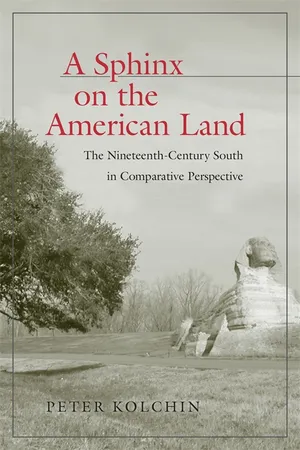 eBook - PDF
A Sphinx on the American Land
The Nineteenth-Century South in Comparative Perspective
- Peter Kolchin(Author)
- 2003(Publication Date)
- LSU Press(Publisher)
O n the continuing southern obsession with distinctiveness even as that distinctiveness declined and A merica itself became increasingly southernized, see James C. Cobb, “Modernization and the Mind of the South,” in his R e d e fi nin g So ut h ern C u l ture : M in d an d Id entity in t h e Mod-ern So ut h ( A thens: University of Georgia P ress, 1999 ), es p . 206 – 208 . Howard N. R abi-nowitz identified at least four major “New Souths” between the 1870 s and the 1970 s; see his Th e F irst Ne w So ut h: 1865 – 1920 ( A rlington Heights, I ll.: Harlan Davidson, 1992 ), 1 . “Nearly every decade since the late-nineteenth century has heralded a nascent New South,” wrote Joe P . Dunn in his p reface to Th e F uture So ut h: A H ist o rica l Perspective fo r t h e Tw enty -F irst C entury , ed. Joe P . Dunn and Howard L. P reston (Urbana: University of I llinois P ress, 1991 ), 1 . For one of many lamentations over the decline of southern distinc-tiveness, see John E gerton, Th e A mericani z ati o n of D i x ie : Th e So ut h erni z ati o n of A merica (New York: Har p er’s Magazine P ress, 1974 ). For the contrary view, that even as it increasingly influences A merican culture, the South “is still fighting most of its oldest battles,” see P eter App lebome, D i x ie R isin g: How t h e So ut h I s Sh apin g A merican V a l ues , P ol itics , an d C u l ture (New York: R andom House, 1996 ), 14 . For the continuing scholarly debate, see R obert P . Steed, Lawrence W. Moreland, and Tod A . Baker, eds., Th e D isap -pearin g So ut h: S tu d ies in R e g i o na l Ch an g e an d Co ntinuity (Tuscaloosa: University of A la-bama P ress, 1990 ). the south and the un -south 11 ern deficiencies. Such negative images of the South reached their p eak during the 1950 s and 1960 s, when, to a generation ins p ired by the struggle for civil rights, the South a pp eared as ho p elessly retro-grade as it had to antebellum o pp onents of slavery.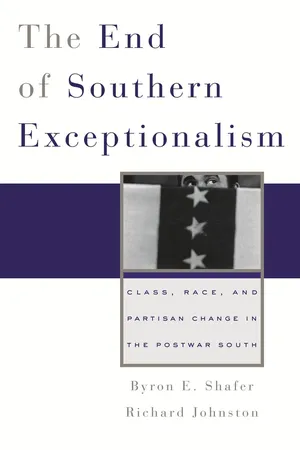 eBook - PDF
The End of Southern Exceptionalism
Class, Race, and Partisan Change in the Postwar South
- Byron E. Shafer, Richard Johnston, Byron E Shafer(Authors)
- 2009(Publication Date)
- Harvard University Press(Publisher)
The course of headline events in social change for the postwar South is as dramatic as any in American political history. The scope of the Southern economic miracle that coincided with partisan change is legitimately de-scribed as “dramatic”: a region having many of the distinguishing charac-teristics of the contemporary third world at the beginning of the postwar era managed to rejoin the rest of the nation economically within two gen-erations, even while the rest of that nation enjoyed explosive growth. Nevertheless, for drama as the notion is conventionally understood, the civil rights revolution overwhelmed the economic miracle. From the bus boycott in Montgomery, to lunch-counter sit-ins in Greensboro, through the murder of civil rights workers in rural Mississippi, to confrontations on the Edmund Pettis Bridge during the march to Selma—and on and on and on—the truly incendiary incidents of those two political generations were forged in the attempt to end legal segregation in the American South. Yet surface drama cannot by itself demonstrate that political behavior followed from these events in any one-to-one fashion. Such a demonstra-tion requires a different kind of analysis. We have found the existing litera-ture of Southern politics, from V. O. Key onward, to be hugely useful in getting a purchase on the relevant hypotheses about this political change. We have also found bits of data scattered throughout this literature, some useful and some not, along with the occasional extended analysis, which we have borrowed gratefully. Beyond that, it has been necessary to construct a comprehensive dataset, with systematic mass, elite, and contextual elements. When these intend-edly relevant data are then applied to hypotheses drawn from the original literature, we have found a picture of partisan change in the postwar South that should remain familiar in its main elements but with fresh contours and a different balance.
Index pages curate the most relevant extracts from our library of academic textbooks. They’ve been created using an in-house natural language model (NLM), each adding context and meaning to key research topics.

