History

Jim Crow
Jim Crow refers to the system of racial segregation and discrimination that was enforced in the southern United States from the late 19th century to the mid-20th century. These laws and practices aimed to maintain white supremacy and control over African Americans, leading to widespread inequality and injustice in areas such as education, housing, and public facilities.
Written by Perlego with AI-assistance
Related key terms
1 of 5
10 Key excerpts on "Jim Crow"
 eBook - ePub
- Jamie J. Wilson(Author)
- 2013(Publication Date)
- Greenwood(Publisher)
ONE “I've Been ’buked and I've Been Scorned”: The Rise of Jim Crow and Its Implications for Africans Americans T HE SYSTEM OF RACIAL SEGREGATION in the United States, commonly called Jim Crow, directly affected the lives of generations of African Americans and shaped race relations for millions of whites and blacks in the northern and southern states from the late 19th century to the late 20th century. Jim Crow determined one's residence and educational opportunities, dictated one's behavior and demeanor, and restricted one's employment and political rights. As a system, it was meant to codify white supremacy and politically, socially, and economically subordinate African Americans living in the American South. Historians disagree on the exact period when Jim Crow and segregation became an impregnable system of customs and laws. However, evidence suggests that during the Reconstruction Era, from 1865 to 1877, the policy of segregating African Americans in public accommodations replaced the older, antebellum policy of excluding African Americans from public accommodations in southern states. The Republican Party—the party of the Great Emancipator, Abraham Lincoln—may have freed African Americans from slavery with the Thirteenth Amendment, granted them citizenship and the right to due process with the creation of the Fourteenth Amendment, and bestowed the right to vote upon African American men with the Fifteenth Amendment, but these political rights did not equate to integration, social equality, or unrestricted access to public services eBook - PDF
African Americans in the Nineteenth Century
People and Perspectives
- Dixie Ray Haggard(Author)
- 2010(Publication Date)
- ABC-CLIO(Publisher)
African American Responses to Early Jim Crow Mary Block 8 T he term ‘‘Jim Crow’’ originated as early as 1832 in the title of a black face minstrel show performed by a white man named Thomas ‘‘Daddy’’ Rice. Rice covered his face with charcoal paste or burnt cork to make it black, and then he danced and sang his act on stage for the amusement of white audiences. Daddy Rice’s show consisted of racist, ster- eotypical caricatures of black men. In 1841, Massachusetts’ abolitionists usurped the term and applied it to the segregated railway cars in the state. ‘‘Jim Crow’’ came to signify the car set aside for African Americans. Schol- ars are not certain as to how the phrase Jim Crow came to be synonymous with the complex series of racial laws and traditions that southern whites developed to ensure their racial, legal, political, and social supremacy. We do know that the first southern laws dubbed ‘‘Jim Crow’’ pertained to the segregated railroad cars and so the term seems to have carried over from its earlier popularized usage. The phrase’s meaning and common usage expanded by the turn of the 20th century as segregation expanded beyond railroad cars. The Jim Crow system entailed not only the customary and legal racial segregation and political disenfranchisement of African Americans, but also the violent and brutal tactics that whites employed to gain and maintain dominance over blacks. The function of Jim Crow was to maintain white supremacy through the denigration and humiliation of African Americans. Although Jim Crow is associated with the South and the southern way of life, it also existed in the North and the West. We tend to attribute the sys- tem of Jim Crow almost exclusively to the South because the vast majority of African Americans lived in that region and so it was most ubiquitous there, and also because white southerners implemented it with a savagery and viciousness unparalleled in the other regions of the country. eBook - ePub
Driving the Green Book
A Road Trip Through the Living History of Black Resistance
- Alvin Hall(Author)
- 2023(Publication Date)
- HarperOne(Publisher)
The Green Book existed.During the era of Jim Crow, millions of people in the United States, either actively or passively, not only indulged in bigoted and discriminatory behaviors and attitudes, they remained silent when they saw them happening. Politicians and community leaders wrote anti-Black policies into the laws and enforced them with sometimes severe penalties by local, state, and national government agencies wielding the full power of American society, up to and including the death penalty.The name “Jim Crow” was the colloquial term for a group of primarily southern, segregationist, anti-Black laws and practices, although segregation practices were found across the US. The name came from a fictional character created by a white minstrel singer named Thomas Dartmouth “Daddy” Rice in the 1830s. Caricaturing a stupid, clumsy enslaved man, Rice would wear blackface makeup and sing a song with the refrain, “Weel about and turn about and do jis so, eb’ry time I weel about I jump Jim Crow.” The popularity of Rice’s act in the United States and Britain led to “Jim Crow” becoming a popular derisive term for Black people, and then the name of the system by which, for generations, African Americans were controlled and denied participation in the freedoms written into the US Constitution.Under Jim Crow, Black Codes harshly restricted what people of color could do. In much of the country, Black people were prevented from voting, serving on juries, running for office, or defending their rights in court. They worked under systems of labor like sharecropping that were designed to keep them in poverty. Sharecropping was a farming practice in which someone, usually a white person, owned the land, while a tenant farmer, usually a Black person or family, worked the land for a share of the crop. During the planting and growing season, the tenant farmer would pay for seeds, tools, food, and rent using a charge account with the landlord farmer. Once the crop was harvested and sold, the tenant farmer would receive a small percentage of the sale price, minus the expenses accrued in the charge account. Some tenant farmers made a small profit or broke even. However, many did not make enough to pay off the charge account in full and therefore remained in debt to the landlord farmer year after year. When a sharecropper or any other Black person managed to amass a bit of money or property, unscrupulous white people supported by government officials would often seize it. eBook - ePub
Having Our Say
The Delany Sisters’ First 100 Years
- Sarah L. Delany, A. Elizabeth Delany, Amy Hill Hearth, Dr. A. Elizabeth Delany(Authors)
- 2023(Publication Date)
- Blackstone Publishing(Publisher)
PART IVJIM CROW DAYSA GENERATION after the end of slavery, freedom for black Americans was still elusive. Strategies were being devised, such as poll taxes, to block black Americans from voting, and a flurry of racial restrictions was coming to be codified as "Jim Crow" laws. The Delany sisters recall the beginning of Jim Crow in North Carolina as "the day that everything changed."Jim Crow became entrenched in Southern society in 1896, with the Supreme Court ruling in the Plessy v. Ferguson case. The case stemmed from an incident in which a Louisiana citizen named Homer Plessy was arrested for refusing to sit in a "colored" railroad car. Mr. Plessy lost on his appeal to the Supreme Court, which sanctioned the establishment of "separate but equal" facilities for blacks and whites.There had long been segregation by custom, but the Jim Crow laws, named for a minstrel show character, made it legal and official. Under the new laws, black Americans faced separate — and inferior — facilities in every part of society, including schools, public transportation, and hospitals. Even public restrooms and drinking fountains in the South were labeled "Colored" and "Whites Only."By 1914 every state in the South had passed laws that, in effect, relegated Negroes to a lower status than whites. "We knew we were already second-class citizens," recalls Sadie Delany, "but those Jim Crow laws set it in stone."It would be decades before Jim Crow would begin to finally unravel. In 1954 the Supreme Court ruled in Brown v. Board of Education of Topeka, Kansas,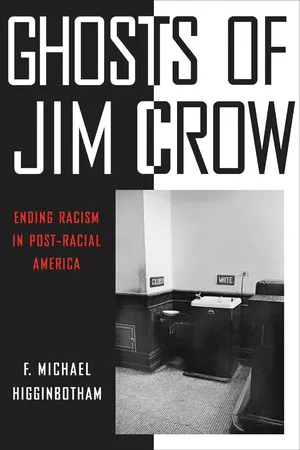 eBook - ePub
Ghosts of Jim Crow
Ending Racism in Post-Racial America
- F. Michael Higginbotham(Author)
- 2013(Publication Date)
- NYU Press(Publisher)
28 The “harmless” humor on the minstrel stage created an atmosphere that accepted and justified segregationist laws. Those laws maintained and exacerbated physical and psychological distance between the races. Segregation spread and got ever stronger during the latter half of the 19th century, fueled by the notions of black inferiority celebrated in Jim Crow minstrel shows.Jim Crow laws provided a combination of government hindrance of economic opportunities for blacks and empowerment for whites. The notion of white superiority/black inferiority was strengthened in many forms—eliminating blacks from sporting competition with whites; preventing educational opportunities for blacks; generating housing segregation such as all-white towns or designated black areas; excluding blacks from certain jobs; creating government programs, like farm assistance, of which poor and middle-class whites were the primary beneficiaries; and refusing to acknowledge or recognize black inventions and technological advancements.29The Supreme Court Embraces Jim Crow: Plessy v. Ferguson
While black separation practices existed prior to Reconstruction, constitutional sanction of race separation, allowing for widespread and comprehensive coverage, would not occur until the end of the 19th century.30 In 1896, the Supreme Court, in Plessy v. Ferguson ,31 upheld a Louisiana statute that prohibited black passengers from riding alongside whites in railway cars. In doing so, the Court placed its imprimatur on discrimination—even the justice who disavowed race separation embraced notions of white superiority.32 eBook - PDF
Justice Deferred
Race and the Supreme Court
- Orville Vernon Burton, Armand Derfner(Authors)
- 2021(Publication Date)
- Belknap Press(Publisher)
CHAPTER FOUR The Supreme Court and the Jim Crow Counterrevolution v By 1890, white supremacists had gained or regained control of the former Confederate states. With legal and governmental ma- chinery now in their hands, they were determined to strip African Ameri- cans of the opportunities they earned during Reconstruction, drive them from public life, and restore as much of slavery’s caste system as might be allowed. The counterrevolution of 1890 was about to begin. It was a dizzying descent into Jim Crow. “Jim Crow” is the colloquial term for the regime of mandated white supremacy. The term derives from a Black character in early-nineteenth-century minstrel shows, portrayed—often by white actors wearing blackface—as childlike and foolish. It came to stand for the com- prehensive rule of racial inequality that dominated every aspect of legal and social relations from cradle to grave in the band of states stretching from Virginia to Texas, and it spread its tentacles outward from there. Jim Crow was rigidly enforced by law, fraud, and violence, and by the educa- tion and socialization that infected the minds of millions of otherwise decent people, white and Black. 1 Jim Crow was built on two fundamental and related supports, the twin pillars of segregation and disfranchisement. Especially in the early days, southern leaders had to wonder how far the Supreme Court would let them go, but they need not have worried. Segregation and disfranchisement were challenged repeatedly in court by African Americans, but both pillars and other forms of discrimination would receive the Supreme Court’s blessing, The Supreme Court and the Jim Crow Counterrevolution u 85 not once or twice, but in a parade of more than twenty cases over the next two decades. The story properly begins with two events in the middle of 1890, one in Louisiana involving segregation and the other in Mississippi involving disfranchisement. eBook - PDF
Cornerstones of Georgia History
Documents That Formed the State
- Thomas Scott(Author)
- 2011(Publication Date)
- University of Georgia Press(Publisher)
A graduate of Michigan State College, Baker published many of his articles in McClures and the American Magazine. His best-known works were on labor relations, discriminatory railroad rates, and Southern race problems. The selection below describes Atlanta's Jim Crow system in the first decade of the 2oth century. Atlanta is a singularly attractive place, as bright and new as any Western city. Sherman left it in ashes at the close of the war; the old buildings and narrow streets were swept away and a new city was built, which is now growing in a man-ner not short of astonishing. It has 115,000 to 125,000 inhabitants, about a third of whom are Negroes, living in more or less detached quarters in various parts of the city, and giving an individuality to the life interesting enough to the unfamil-iar Northerner. A great many of them are always on the streets far better dressed and better-appearing than I had expected to see—having in mind, perhaps, the tattered country specimens of the penny postal cards. . . . One of the points in which I was especially interested was the Jim Crow regulations, that is, the system of separation of the races in street cars and rail-road trains. Next to the question of Negro suffrage, I think the people of the North have heard more of the Jim Crow legislation than of anything else con-nected with the Negro problem. . . . I was curious to see how the system worked out in Atlanta. Over the door of each car, I found this sign: WHITE PEOPLE WILL SEAT FROM FRONT OF CAR TOWARD THE BACK AND COLOURED PEOPLE FROM REAR TOWARD FRONT Sure enough, I found the white people in front and the Negroes behind. As the sign indicates, there is no definite line of division between the white seats and the black seats, as in many other Southern cities. This very absence of a clear demarcation is significant of many relationships in the South. The colour line is drawn, but neither race knows just where it is.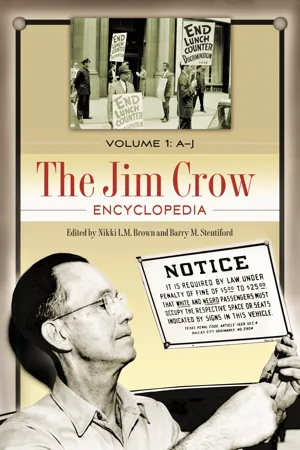 eBook - PDF
The Jim Crow Encyclopedia
Greenwood Milestones in African American History [2 volumes]
- Nikki Brown, Barry M. Stentiford, Nikki Brown, Barry M. Stentiford(Authors)
- 2008(Publication Date)
- Greenwood(Publisher)
Overall, regardless of their position on Jim Crow laws, pastors had wide-reaching effects on the battle over Jim Crow. See also Catholicism. Further Readings: Chappell, David. A Stone of Hope: Prophetic Religion and the Death of Jim Crow. Chapel Hill: University of North Carolina Press, 2004; Fairclough, Adam. To Redeem the Soul of America: The Southern Christian Leadership Conference & Martin Luther King, Jr. Athens: University of Georgia Press, 1987; Packard, Jerome M. American Nightmare: The History of Jim Crow. New York: St. Martin’s Press, 2002; Sernett, Milton C. Bound for the Promised Land: African American Religion and the Great Migration. C. Eric Lincoln Series on the Black Experience. Durham, NC: Duke University Press, 1997. Shawntel Ensminger Prisons Southern prisons during the Jim Crow era earned the ‘‘dubious distinction’’ of ‘‘America’s worst prisons.’’ Jim Crow prisons in the South took various, yet equally brutal forms—a traditional penitentiary, a penal farm, a former slave plantation, brickyards, or temporary road camps. The prisons were erected PRISONS 635 in forests, swamps, mines, brickyards, or levees, and the convicts were housed in tents, log forts, and rolling cages. Jim Crow punishment existed in two phases, during the leasing era, which ran from 1890 to the 1920s, and then in the state control system, from the 1920s to 1965. Distinctive in the penal history of this era, the use of state prisons to control black population are deeply rooted in the South. Immediately after the Civil War, Southern states turned to the criminal justice system in order to control the newly freed slave population. They also needed a labor force to repair Civil War damages. Although Southern states had built penitentiaries before the Civil War, most of them were so badly dam- aged during the war that they were unusable. eBook - ePub
The Color of Compromise
The Truth about the American Church’s Complicity in Racism
- Jemar Tisby(Author)
- 2019(Publication Date)
- Zondervan(Publisher)
The name “Jim Crow” comes from a minstrel character played by Thomas D. Rice in the 1830s and 1840s. Even though it is easy to characterize the worst forms of racism as an exclusively southern phenomenon, Rice actually hailed from Manhattan. Although he was not the first white actor to utilize “blackface,” his career skyrocketed when he began painting his face black and playing the role of a likable trickster named Jim Crow. The plays portrayed stereotypes about black intelligence, sexual appetites, contentment under slavery, and obeisance to white people. In the years following the Civil War, as white people scrambled to recover a semblance of the racial order they once knew, they reached back to Rice’s plays and saw them as an apt description of the social conditions of the late nineteenth century.Jim Crow took the form of both legal policies and informal traditions designed to segregate and subjugate black people in American society. This system extended to all areas of the country, not just the former Confederate states. The North and West, for instance, had “sundown towns”—communities where black people had to be out before sundown or face violent repercussions. Some cities even posted signs that read, “Nigger, Don’t Let the Sun Go Down on You in This Town.” Towns such as Appleton, Wisconsin; Levittown on Long Island; and the Chicago suburb of Cicero, among hundreds of others, kept their communities intentionally all-white. Larger cities, including New York and Tulsa, could not entirely exclude racial minorities,but they conducted periodic “purges” of black neighborhoods to intimidate residents into moving out or staying confined to certain parts of the city.27 Other Jim Crow laws and customs mandated that black and white baseball teams could not play on the same field, black and white people had to be buried in separate cemeteries, white students could not have textbooks that originally had been assigned to black students, and prison inmates had to be divided by race.The sexual dimensions of Jim Crow deserve special attention. During this era, the prohibition against interracial sexual relations and marriage became one the most inviolable of social conventions in America. Under Jim Crow, the myth of the Lost Cause positioned white women as the epitome of purity and vulnerability, and by contrast, black men came to symbolize raw lust and bestiality. According to the racist myths about sexuality, brutish black men always prowled around for delicate white women on whom they could unleash their unholy appetites. In a stark demonstration of the hypocrisy and illogical nature of racism, Jim Crow advocates almost never mentioned the long-standing and more common pattern of powerful white men raping vulnerable black women. eBook - ePub
Social Identity and the Law
Race, Sexuality and Intersectionality
- Barbara L. Graham(Author)
- 2018(Publication Date)
- Routledge(Publisher)
Civil Rights Cases is that Congress did not enact another major civil rights law until 89 years later, the Civil Rights Act of 1964, under its power to regulate interstate commerce. After the death of Chief Justice Waite, there was considerable personnel change on the Supreme Court. From the beginning of the Fuller Court in 1888 until the end of the Taft Court (1930), nine presidents appointed twenty-five Justices to the Supreme Court, including three Chief Justices. Despite the remarkable turnover during this forty-two year period, the Supreme Court’s jurisprudence in the area of racial equality was steadfastly entrenched in a conservative direction. By the 1890s, ideas of black intellectual, biological and cultural inferiority dominated popular, scientific and jurisprudential thought. The Court’s decisions during this era espoused a jurisprudence grounded in state prerogatives and laissez-faire ideology.American-Style Apartheid
The racial caste system that operated primarily but not exclusively in Southern and border states during the Reconstruction period until the mid-1950s is commonly referred to as the era of Jim Crow segregation. Southern states began passing Jim Crow laws around 1890 and passed a second wave of laws a decade later. Laws requiring separation of the races were comparable to the Black Codes adopted in 1865 after the ratification of the Thirteenth Amendment. In both contexts, the intent of the segregation laws was to force people of color into a continued state of subjugation and quasi-slavery status.AMERICAN-STYLE APARTHEID BOX 2.2Jim Crow in the American South“The extremes to which caste penalties and separation were carried in parts of the South could hardly find a counterpart short of the latitudes of India and South Africa. In 1909 Mobile passed a curfew law applying exclusively to Negroes and requiring them to be off the streets by 10 p.m. The Oklahoma legislature in 1915 authorized its Corporation Commission to require telephone companies “to maintain separate booths for white and colored patrons.” North Carolina and Florida required that textbooks used by the public-school children of one race be kept separate from those used by the other, and the Florida law specified separation even while the books were in storage. South Carolina for a time segregated a third caste by establishing separate schools for mulatto as well as for white and Negro children. A New Orleans ordinance segregated white and Negro prostitutes in separate districts. Ray Stannard Baker found Jim Crow Bibles for Negro witnesses in Atlanta courts and Jim Crow elevators for Negro passengers in Atlanta buildings.”
Index pages curate the most relevant extracts from our library of academic textbooks. They’ve been created using an in-house natural language model (NLM), each adding context and meaning to key research topics.

