History

Black Codes
Black Codes were laws enacted in the southern United States during the Reconstruction era to restrict the freedom and rights of African Americans. These laws aimed to maintain white supremacy by regulating the labor, movement, and behavior of newly freed slaves. Black Codes were a precursor to the Jim Crow laws and had a significant impact on the lives of African Americans in the post-Civil War South.
Written by Perlego with AI-assistance
Related key terms
1 of 5
10 Key excerpts on "Black Codes"
 eBook - PDF
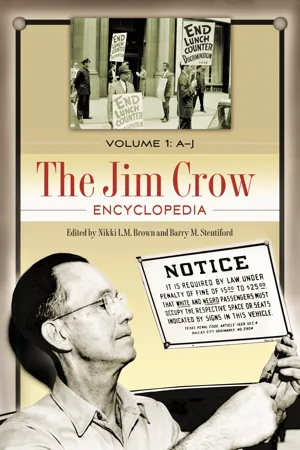
The Jim Crow Encyclopedia
Greenwood Milestones in African American History [2 volumes]
- Nikki Brown, Barry M. Stentiford, Nikki Brown, Barry M. Stentiford(Authors)
- 2008(Publication Date)
- Greenwood(Publisher)
Blacks, particularly those who had been emancipated recently, would struggle to survive. Thus, they contended, it fell to the South to once again intervene to provide the necessary direction required by black people. Presidential Reconstruction made it easy for Southern state legislatures to pass laws that placed blacks into a twilight world between slavery and free- dom. The Black Codes set out the rights of blacks, but they also established pernicious labor requirements that severely limited their freedoms. Northern- ers accused Southern states of attempting to reestablish slavery, but the Black Codes, while impinging on many aspects of freedmen’s lives, never went that far. Instead, freedmen in the South found themselves in an awkward position Black Codes 79 between the full freedom that they expected upon emancipation and the com- plete subordination of slavery. The Black Codes were a stern response to con- cerns in the aftermath of the Civil War, but they drew on diverse legal precedents. The slave codes and the laws that had governed the behavior of free blacks during slavery were easy models to reach for. So, too, were the codes that had been implemented in the British West Indies after the abolition of slavery there. Other existing laws, particularly vagrancy statutes, were used in the formulation of the Black Codes. The first Black Codes were introduced in Mississippi and South Carolina in late 1865, and these two states had the most far-reaching codes. As well as being the first, they were also amongst the harshest, since the lack of agricul- tural labor would be hardest felt in these states. The Mississippi Black Codes applied to anyone who was one-eighth or more black. In setting out the rights of blacks in Mississippi, the Black Codes recognized slave marriages, allowed black people to own property (although with limitations on where they could own land), make contracts, sue and be sued, and be witnesses in cases in which a black person was involved.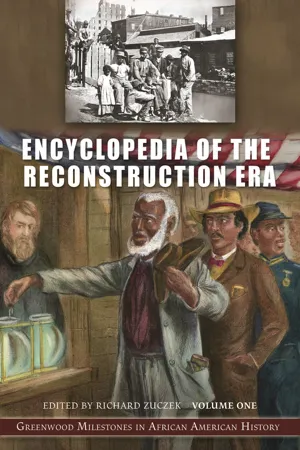 eBook - PDF
Encyclopedia of the Reconstruction Era
Greenwood Milestones in African American History [2 volumes]
- Richard Zuczek(Author)
- 2006(Publication Date)
- Greenwood(Publisher)
Unwilling to subject the freedpeople to their provisions, federal army com- manders, agents from the Bureau of Refugees, Freedmen, and Abandoned Lands, and provisional governors prevented the Black Codes’ enforcement. The Black Codes nevertheless signified white southerners’ ongoing com- mitment to slavery, to white supremacy, and their determination to circum- scribe the legal status of the freedpeople. Confident that Johnson and the U.S. Congress would allow them to retain racial control over the blacks, during the first months of Reconstruction, whites brazenly passed laws designed to keep their former bondspeople separate and unequal, to limit severely their be- havior and mobility, and to tie them to the land as a perpetual peasant class. In 1866, Congress passed the Civil Rights Act and the Fourteenth Amend- ment in part to protect the freedpeople from the neoslavery captured in the spirit and the letter of the notorious Black Codes. These laws nevertheless provided the ideological and legal foundation for the labor contracts, vagrancy legislation, lien laws, convict labor statutes, enticement laws, and debt pe- onage laws enacted by the southern states following Radical Reconstruction’s demise. See also Abolition of Slavery; African Americans; Congressional Re- construction; Labor Systems. Further Reading: Fleming, Walter L. Documentary History of Reconstruction. 2 vols. 1906–1907; reprint, New York: McGraw-Hill, 1966; Harris, William C. Presidential Reconstruction in Mississippi. Baton Rouge: Louisiana State University Press, 1967; Mecklin, John M. ‘‘The Black Codes.’’ South Atlantic Quarterly 16 (1917): 248–59; Smith, John David. An Old Creed for the New South: Proslavery Ideology and Histori- ography, 1865–1918. Westport, CT: Greenwood Press, 1985; Wilson, Theodore B. The Black Codes of the South. University: University of Alabama Press, 1965. John David Smith 74 Black Codes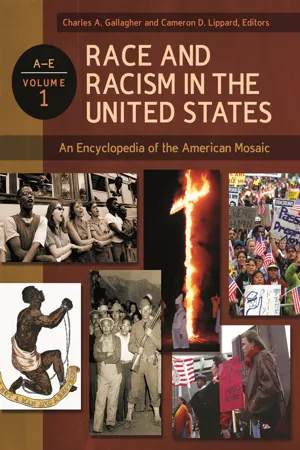 eBook - ePub
Race and Racism in the United States
An Encyclopedia of the American Mosaic [4 volumes]
- Charles A. Gallagher, Cameron D. Lippard, Charles A. Gallagher, Cameron D. Lippard(Authors)
- 2014(Publication Date)
- Greenwood(Publisher)
The Black Codes were short lived as a legal entity. The large number of laws enacted throughout the South, and their openly prejudiced nature, made them an easy target for the Freedmen’s Bureau and the federal government. From their introduction, many Black Codes had been struck down throughout the South, mainly as a result of being too blatantly discriminatory. From their inception, the Black Codes had provoked ire outside the South. Northerners considered them to be a barefaced attempt to re-create slavery and so contrary to the spirit of emancipation that many people, even those who did not necessarily support civil rights for blacks, demanded that the South respect the ideology of free labor. The pleas of Southern blacks for evenhanded treatment and recognition of their status were well publicized in the North, and helped to galvanize support for action.Even within the South, there had been some concern over the Black Codes, at least over the speed and severity with which they had been applied, if not necessarily their purpose. In 1866, several Southern legislatures had reduced the severity of some Black Codes, largely as a response to the failure of the anticipated outward migration of former slaves, but also in response to concerns that their continued operation would attract unwanted Northern intervention.The Civil Rights Act of 1866, which defined citizenship and established the civil rights of citizens, and the Fourteenth Amendment were intended in part to check the effects of the Black Codes. The establishment of full Congressional Reconstruction from 1867 onward saw the formal end of the Black Codes throughout the South, and Reconstruction governments removed the remains of the Black Codes from the statutes. Of particular significance, and as a reminder of the extent to which the Black Codes had been driven by a desire to control black activity in the labor market, the last vestiges of controls over black employment opportunities were removed. eBook - PDF
- Gerald D. Jaynes(Author)
- 2005(Publication Date)
- SAGE Publications, Inc(Publisher)
For this reason, many of the Black Codes dealt specif-ically with labor issues. Throughout the South, state legislatures passed laws forbidding blacks from owning or renting farmland. Instead, the former slaves were forced to work as wage laborers on land owned by whites. Any African American without a white employer could be arrested for vagrancy. Blacks who quit their jobs or who wished to seek a new employment situation could be arrested for breach of contract. Black Codes also mandated that African American children could be forced into apprenticeships with whites if their parents were unable to provide for them. Black Codes restricted the freedom of African Americans in other ways as well. Many of the laws stipulated that African Americans could not “unlaw-fully assemble,” own guns, insult white people, or give inflammatory speeches. Penalties for violating this black code were severe, ranging from whippings to sen-tences of involuntary servitude. As a result of such laws, many of the newly freed slaves found that their personal situations had not improved much since before Emancipation. Their legal status had changed slightly. Unlike during slavery, the Black Codes recognized legal marriages between blacks. African Americans also were given the right to sue each other in court. However, blacks could not instigate lawsuits involving white people, nor could they testify against a white person. As a result, whites found that they could abuse the former slaves with impunity just has they had done under slavery. The situation improved briefly for former slaves after 1866, when the U.S. Congress intervened in the Reconstruction of the South. Many Northern legislative Black Codes ——— 113 leaders, especially Representative Thaddeus Stevens of Pennsylvania and Senator Charles Sumner of Massachusetts, were unhappy with the speed with which white Southerners had regained control over their state legislatures and their former slaves. eBook - PDF
African Americans in the Nineteenth Century
People and Perspectives
- Dixie Ray Haggard(Author)
- 2010(Publication Date)
- ABC-CLIO(Publisher)
Despite these new liberties, Black Codes also contained other provisions that were detrimental to the freedom of African Americans. One black code allowed African American children to be apprenticed out to families if the state deemed necessary to do so, without the consent of the child’s parents. Another black code required freedmen to have written employment for the forthcoming year. If laborers left before they completed their contract, they forfeited all previously earned wages. Other Black Codes included vagrancy laws, bans on alcohol usage, and laws against owning firearms. Black Codes were designed to allow any white person to enforce them, thus keeping southern blacks as close to the institution of slavery as possible and ensuring the South a cheap labor source. Because of these difficult conditions for southern blacks, many freedmen attempted to leave the South. Civil Rights Act of 1875 As Reconstruction drew to a close, Congress made one last attempt to pro- tect the rights of southern African Americans with the passage of the Civil Illustration from 1874 depicting the White League and Ku Klux Klan shaking hands over cowering African Americans. On April 13, 1873, in Colfax, Louisiana, a group of white men (including members of the White League and the Ku Klux Klan) clashed with African Americans at the Col- fax courthouse ostensibly over a con- tested local election. The massacre eventually led to the 1875 Supreme Court case, United States v. Cruikshank. (Library of Congress) 106 A F R I C A N A M E R I C A N S I N T H E N I N E T E E N T H C E N T U R Y P E R S P E C T I V E S I N A M E R I C A N S O C I A L H I S T O R Y Rights Act of 1875. The initial goal of the legislation, proposed by Radical Republican Senator Charles Sumner and House member Benjamin Butler, was to allow African Americans access to public accommodations, includ- ing schools, churches, cemeteries, and hotels, without regard to race. eBook - PDF
The Forgotten Emancipator
James Mitchell Ashley and the Ideological Origins of Reconstruction
- Rebecca E. Zietlow(Author)
- 2017(Publication Date)
- Cambridge University Press(Publisher)
The Black Codes required black workers to form year-long contracts with their employers by mid-January each year. The codes imposed restrictions on free move- ment, which often forced freed slaves to contract with their former masters, and applied the doctrine of specific performance to all black residents. Artisans (independent workers) were required to seek annual licenses from district courts, and all were subject to criminal penalties if they quit their jobs. Black Codes also authorized state courts to bind out orphans, or any children under the age of eighteen if the court deter- mined that their parents lacked the means to care for them, to work for employers chosen by the courts. Vagrancy laws, apprenticeship systems, and criminal penalties for breach of contract were all designed to control the black labor force. Thus, southern states introduced a system of Benedict, Compromise, ; Donald G. Nieman, To Set the Law in Motion: The Freed- man’s Bureau and the Legal Rights of Blacks (Millwood, NY: KTO Press, ), xv–xvi; Trefousse, Radical Republicans, . The Forgotten Emancipator legally compelled labor to address concerns about labor shortage and perpetuate slavery in all but name. Not surprisingly, the newly freed slaves were outraged by the Black Codes. They chafed at the restrictions on their movement and choice of employer and type of work. Freed slaves resisted the legal requirements that they work for their own masters and took to the roads, traveling to look for family members and better employment. According to historian Eric Foner, “[M]any former slaves saw freedom as an end to the separ- ation of families, the abolition of punishment by the lash, and the oppor- tunity to educate their children. eBook - PDF
The Reconstruction Era
Primary Documents on Events from 1865 to 1877
- Donna L. Dickerson(Author)
- 2003(Publication Date)
- Greenwood(Publisher)
" If blacks did not have a job, they would be arrested for vagrancy, and if a freedman left a job before his contract was up "he shall forfeit his wages for that year, up to the time of quitting" and he could be returned to his employer. The legislative committee that recom- mended Mississippi's Black Codes recognized that some of the laws might seem "rigid and stringent to sickly modern humanitarians," but they would "hurt no one." 1 w 43 44 The Reconstruction Era Other states passed codes to prohibit blacks from owning guns so they could not hunt for a living, from leaving plantations so they could not look for better work, from assembling in groups larger than five to prevent them from instigating insurrection, from living in cities and towns so they could only work as farm laborers, from using public transportation so they could not leave their "home," and from renting or purchasing property so they could not work their own land. In South Carolina, a former Confederate officer, summing up the need for Black Codes, said black freedom must be "limited, controlled, and sur- rounded with such safeguards as will make the change as slight as possible. . . . The general interest of both the white man and the negro requires that he should be kept as . . . near to the condition of slavery as possible, as far from the condition of the white man as practicable." South Carolina's codes prohibited freedmen from following any profession except farmer or ser- vant unless they could pay an annual head tax that could be as high as $100. In Florida, disobedience, impudence, and disrespect of an employer were crimes. Black Codes also made it legal to bind over children to plantation own- ers when parents were in trouble with the law or were not under contract. Parents were not required to give permission for their children to be ap- prenticed and often were not informed where their children were sent to work. eBook - PDF
Unequal Freedom
How Race and Gender Shaped American Citizenship and Labor
- Evelyn Nakano Glenn(Author)
- 2009(Publication Date)
- Harvard University Press(Publisher)
rienced significant in-migration by both whites and blacks during this period. The cities were where black men and women mounted the most significant challenges to exclusion and subordination by building institutions that expressed more communal, inclusive, and universal conceptions of citizenship and rights. In order to appreciate what was at stake in the post-Reconstruction and Jim Crow eras, we have to understand the possibilities opened up by Reconstruction. By 1865, soon after warfare had ended, President Andrew Johnson’s policy of “reconciliation” had essentially returned white Confederate rule; the newly restored state governments quickly moved to impose a regime as close to slavery as possible. The legisla-tures passed a series of laws, the so-called Black Codes, to control and discipline the freed blacks by restricting their movement, forcing them to work, and defining a wide variety of activities as crimes when en-gaged in by blacks. Faced by this wholesale negation of rights, the new radical Republican majority in Congress passed a series of Reconstruc-tion Acts in 1867. These Acts abolished existing state regimes, estab-lished temporary military governments, and required states to write new constitutions providing for black male suffrage and ratification of the Fourteenth Amendment in order to be restored to the Union. Congress also provided for elections and voter registration under fed-eral supervision. Black men would for the first time be allowed to par-ticipate in elections and legislative procedures. 2 Freedpeople responded with great fervor. In Mississippi fully 96.7 percent of freedmen of eligible age registered. They formed a majority of registered voters in that state, as well as in Florida, South Carolina, Alabama, and Louisiana. eBook - ePub
Racism
Reality Built on a Myth
- John Lovchik(Author)
- 2018(Publication Date)
- Resource Publications(Publisher)
The withdrawal was done promptly and, twelve years after the defeat of the attempted secession, the southern states were again in control of their own affairs. 194 The progress made in the previous twelve years was not immediately undone, and some of the changes had permanent impact. But the predominant attitude toward Blacks was not changed, and the process of establishing White control could now resume without federal interference. The secret societies continued their intimidation tactics for a while but, as Whites regained political control, secrecy was no longer needed and the societies disbanded. Old Black Codes could now be enforced and new ones written. Some laws were directed specifically against Blacks, in clear violation of the Constitution. But usually, to avoid a constitutional challenge, the laws were written in a general form, with an understanding that they would only be enforced against Blacks. Laws against vagrancy, for example, were vaguely defined and could be enforced in such a way that any Black on the street could be arrested and charged for being unemployed. Unless he worked for a white farmer or sharecropped a white farmer’s land, and the white farmer was willing to testify on his behalf, he would be found guilty. 195 Laws prevented workers from changing employers without permission, allowing farmers to mistreat or underpay employees at will. If the employee left the farm without permission, he was guilty of a crime. 196 Sharecroppers had no control over the revenues produced or the allocation of costs, leaving them always in debt to the landowner and unable to leave without being charged with the crime of failing to pay a debt eBook - PDF
Equality by Statute
Legal Controls Over Group Discrimination
- Morroe Berger(Author)
- 2019(Publication Date)
- Columbia University Press(Publisher)
What is usually referred to as a failure, however, must be considered to have succeeded to an extent generally over- 12 Civil Rights Today and During Reconstruction looked in the emphasis upon the unrealized part of the program. The legal measures did have effect. Southern state legislation against the Negro did not, after the passage of the Thirteenth, Fourteenth, and Fifteenth Amendments, accomplish what, to judge by the Black Codes which these amendments invalidated, some powerful sections of the white South wanted. Much of what Southern legislatures could not do constitutionally, of course, they did by subterfuge, and the white community did as a matter of custom, both reinforced by an imposing legal system of segregation and discrimination. Yet the federal and state laws did act as a deterrent to even greater disabilities, and laid the basis for the substantial gains Negroes and other groups were able to make in the decades following the Reconstruction. There is, nevertheless, no question but that the legal measures fell far short of accomplishing their stated purposes. Five facts help explain this failure. First, the Congressional civil rights program failed in the Supreme Court partly be-cause it cut across the issue of the federal-state balance. The Northern victory in the Civil War did not signify the total subjection of the states to the central government. Second, the interest in civil rights was not sustained over a long period of time, and the legal changes were not reinforced by other in-stitutional changes in work, housing, recreation, and so on. The new laws were the very first breach in a strongly en-trenched system. Besides, the powerful and constant opposition of the substantial white minority in the South won out over the shifting and less adamant majority throughout the nation.
Index pages curate the most relevant extracts from our library of academic textbooks. They’ve been created using an in-house natural language model (NLM), each adding context and meaning to key research topics.

