History

Separate Car Act
The Separate Car Act was a law passed in the southern United States during the late 19th century that mandated racial segregation on trains. It required separate accommodations for white and black passengers, reflecting the era's widespread discrimination and segregation laws. The act was a significant part of the Jim Crow laws that enforced racial segregation in public facilities.
Written by Perlego with AI-assistance
Related key terms
1 of 5

6 Key excerpts on "Separate Car Act"
 eBook - ePub
Supreme Decisions, Volume 2
Great Constitutional Cases and Their Impact, Volume Two: Since 1896
- Melvin I. Urofsky(Author)
- 2018(Publication Date)
- Routledge(Publisher)
But although the practices of segregation may have been inconsistent, the white South stood united in the belief that blacks belonged in a secondary status in society, in which they could not exercise political power and would not threaten the social hegemony of whites. Some historians have seen the beginnings of segregation on public transportation, such as steamboats and railroads, as at least in part gender-based. White women had always enjoyed separate first-class train accommodations, so they could be insulated against the crudeness of the men’s smoking car, lower-class whites, and of course slaves and other African Americans, except those who traveled with their mistresses as maids or nannies. The men’s equivalent had been the first-class smoking car, with its bar and spittoons. When freed blacks attempted to buy tickets for these cars, the railroads, sensitive to the patronage and power of their white clients, refused.In 1878, the Supreme Court in Hall v. DeCuir ruled that states could not prohibit segregation on common carriers such as railroads, streetcars, or riverboats. A dozen years later it approved a Mississippi statute requiring segregation on intrastate carriers in Louisville, New Orleans & Texas Railway v. Mississippi (1890). In doing so the Court essentially acquiesced in the South’s solution to the problems of race relations. Only Justices Harlan and Bradley dissented, on the grounds that such laws, even if confined to intrastate lines, had an inhibitive effect on interstate commerce.From 1887 to 1892 nine states, including Louisiana, passed laws requiring separation on public conveyances, such as streetcars and railroads. Though they differed in detail, most of these statutes required equal accommodations for black passengers, and imposed fines and even jail terms on railroad employees who did not enforce these regulations. Five of the states also provided criminal fines or imprisonment for passengers who tried to sit in cars from which their race excluded them. The Louisiana Separate Car Act passed in July 1890. In order to “promote the comfort of passengers,” railroads had to provide “equal but separate accommodations for the white and colored races” on lines running in the state. eBook - ePub
Traveling Black
A Story of Race and Resistance
- Mia Bay(Author)
- 2021(Publication Date)
- Belknap Press(Publisher)
By the 1880s southern lawmakers were eager to pass legislation requiring racial segregation on the railroads. Although legally obliged to provide first-class ticket holders with first-class seats, the railroads were reluctant to add additional first-class cars for Black passengers. But with no federal protection for Black civil rights in place, the southern states were finally free to force the issue by enacting laws that made such arrangements mandatory. Tennessee led the way with a “separate car law” passed in 1881, a time when the Civil Rights Act of 1875 was at least theoretically still in effect but widely regarded as doomed.Ineffectual or not, the federal law was notably unpopular with the Democratic legislators in Tennessee, who displayed their defiance to it less than a month after the act took effect by passing a law that abolished their state’s common-law rights of equal access to transportation and public accommodations. At the crossroads of several of the South’s largest rail networks, Tennessee was also home to a large Black middle class, whose refusal to accept second-class accommodations in the railroads’ smoking cars clearly galled state legislators. “While the state legislature had no power to take away the rights granted by the federal act,” the legal scholar Kenneth Mack explains, it could and did express its displeasure with the legislation by removing “any parallel rights that its black citizens might enjoy under state law.”111 Its 1881 legislation had a similar goal.Tennessee’s groundbreaking Separate Car Act was developed after the state legislature’s four Black Republicans led a protracted but ultimately unsuccessful campaign to secure equal accommodations for Blacks on the state’s railroads. First they tried to repeal the law abolishing their common-law rights, and when that failed, they introduced “a bill that would have banned racial discrimination on Tennessee railroads.” White legislators rejected this bill and proposed, by way of compromise, a new bill calling for separate but equal railroad cars. Entitled “An Act to prevent discrimination by railroad companies among passengers who are charged and paying first class passage,” the bill addressed African American complaints about discrimination on the railroads by requiring the railroads to “furnish separate cars, or portions of cars cut off by partition walls, in which all colored passengers who shall pay first-class rates of fare, may have the privilege to enter and occupy.” It also specified that the separate cars “be kept in good repair,” “have the same conveniences,” and be “subject to the same rules governing other first-class cars, preventing smoking and obscene language.”112 eBook - PDF
- Donald E. Lively(Author)
- 1992(Publication Date)
- Praeger(Publisher)
Florida enacted the first Jim Crow law in 1887, requiring racial separation in public transportation. By the end of the century, 90 THE CONSTITUTION AND RACE official segregation had become comprehensively established in and a defining feature of the South. In Plessy v. Ferguson, the Supreme Court considered the constitution- ality of state-enforced segregation. 4 The case presented a challenge to a Louisiana law, enacted in 1890, requiring racially separate rail cars. Specifically, the statute provided that all railway companies carrying passengers in their coaches in this state shall provide equal but separate accommodations for the white and colored races, by providing two or more passenger coaches for each passenger train, or by dividing the passenger coaches by a partition so as to secure separate accommodations. The petitioner in the case was described as a person of "seven eighths Caucasian and one eighth African blood ... [and in whom] the mixture of colored blood was not discernible." 5 The Court in Plessy rejected contentions that the law violated the Thir- teenth and Fourteenth Amendments.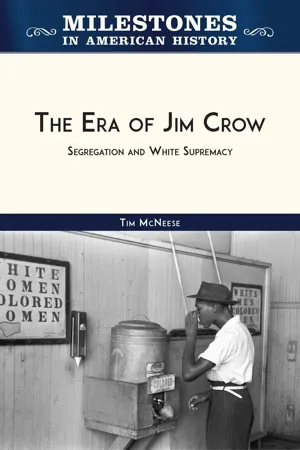 eBook - ePub
The Era of Jim Crow
Segregation and White Supremacy
- Tim McNeese(Author)
- 2021(Publication Date)
- Chelsea House(Publisher)
In the United States of 1896, few cared whether the court upheld a single “Jim Crow” law. In the issue published the day after the decision, the New York Times reported the story on page three of its second section alongside other run-of-the-mill railroad-related stories. The Times noted Justice Harlan’s solo rejection of the arguments in favor of the Separate Car Law, observing how “he saw nothing but mischief in such laws.” 15 The New Orleans newspaper, the Daily Picayune, praised the court’s decision and expressed support for the Separate Car Law, anticipating that “this regulation for the separation of the races will operate continuously on all lines of Southern railway.” 16 In Richmond, Virginia, the Dispatch pondered, given the now-sanctioned Louisiana Separate Car Law, “whether such a law as that of Louisiana is not needed in all the Southern States.” 17 Even most Northern papers did not raise any significant issue with the Supreme Court’s decision. But at least the Springfield, Massachusetts, Republican asked an inconvenient question, mocking the court’s decision to maintain “separate but equal” to keep the races apart: “Did the southerners ever pause to indict the Almighty for allowing Negroes to be born on the same earth with white men?” 18 The Spread of Jim Crow Laws With the United States Supreme Court declaring the concept of “separate but equal” as an acceptable legal tenet, Jim Crow laws spread into more and more areas of African-American life. Eight Southern states, including Louisiana, had created separate car laws prior to Plessy boarding his “test case” train outside New Orleans in 1892, the others being Alabama, Florida, Georgia, Kentucky, Mississippi, Tennessee, and Texas. Following Plessy v. Ferguson, others added their own versions: South Carolina in 1898; North Carolina the following year; Virginia in 1900; Maryland in 1904; and Oklahoma in 1907. New Jim Crow laws filled the statute books eBook - PDF
The Reconstruction Era
Primary Documents on Events from 1865 to 1877
- Donna L. Dickerson(Author)
- 2003(Publication Date)
- Greenwood(Publisher)
Many simply be- lieved that it was "dead on arrival." In 1883, in a series of five cases known as the Civil Rights Cases, the Supreme Court struck down the law. 3 The cases involved black citizens who were denied access to public accommodations and facilities. In an 8 to 1 decision, the Court held that the Fourteenth Amendment only prohibited 360 The Reconstruction Era state abridgement of civil rights and not abridgement by individuals. And in the infamous Plessy v. Ferguson case in 1896, the Court endorsed the "separate but equal" doctrine that kept enforced segregation alive for another 70 years. 4 The Civil Rights Cases and the Plessy decision ushered in a new era in Southern racism—official segregation through Jim Crow laws. Unlike the ear- lier black codes that controlled the economic lives of blacks, Jim Crow laws were primarily to keep whites and blacks separated. States and cities passed laws establishing separate school systems, accommodations, and transporta- tion—a U.S. system of apartheid that did not begin to die out until the 1960s. The section containing editorials against the Civil Rights Act begins with one by Charles de Young from the San Francisco Chronicle, which declares that the animosity between blacks and whites is a fact and cannot be healed by forcing reforms such as common schools. The second entry, by E.L. God- kin, argues that not only is the South not ready for social equality but the law itself is unconstitutional since only the states, not the federal govern- ment, can create and enforce equality. The next selection is from a Southern newspaper, which uses racism and sarcasm to make the point that the Civil Rights Act will give blacks advantages not enjoyed by whites. The last read- ing in this section, by George Jones, argues that the Civil Rights Act will do great damage to the Republican Party, because it will make it impossible to attract any Southerners to the party—something that was needed for the party's survival. eBook - PDF
Racism in America
A Reference Handbook
- Steven L. Foy(Author)
- 2020(Publication Date)
- ABC-CLIO(Publisher)
Public buses were similarly segregated (Klarman 2004). These restrictions led to transportation boycotts throughout the South in Vir- ginia, Georgia, Tennessee, Louisiana, North Carolina, South Carolina, Texas, Florida, and other states, as well as petitions to local political leaders. Blacks also resisted by organizing their own systems of transportation, running everything from wag- ons to passenger vans (Meier and Rudwick 1969). Meanwhile, those who were not categorized as “colored” but did not neces- sarily classify themselves as white often found themselves in ambiguous situations. For example, Asian Americans would sometimes sit at the back of the bus and then be told to sit in the white section (Bow 2010). Black resistance to transportation restrictions would con- tinue for decades, with arguably the most well-known exam- ple being the bus boycott that followed Rosa Parks’s arrest in Montgomery, Alabama, in 1955. In Alabama, whites had first priority to the middle section of the bus, but blacks could sit there if no white person was standing. Parks was arrested after she refused to give up her seat there to a white passenger. The case was eventually appealed to the Supreme Court, where public transportation segregation was ruled unconstitutional in 1956 (Theoharis 2015). Transportation systems perpetuated racial hierarchy in the United States in other ways as well. Specific railroad tracks and avenues often served as dividing lines between black and white neighborhoods. During the Jim Crow era, such transportation features were used by banks to determine where they would and would not extend home loans and by local officials to de- termine who would go to which schools with an eye toward 38 Racism in America segregation. Further, new highways were built to allow whites to live in suburban areas and commute to cities for work (i.e., white flight).
Index pages curate the most relevant extracts from our library of academic textbooks. They’ve been created using an in-house natural language model (NLM), each adding context and meaning to key research topics.

