History

Plessy vs Ferguson
"Plessy v. Ferguson" was a landmark 1896 Supreme Court case that upheld the constitutionality of racial segregation under the "separate but equal" doctrine. The ruling allowed for segregation in public facilities, setting a precedent for institutionalized racial discrimination. This decision was later overturned by the Supreme Court in the 1954 case Brown v. Board of Education.
Written by Perlego with AI-assistance
Related key terms
1 of 5

10 Key excerpts on "Plessy vs Ferguson"
 eBook - PDF
- Andrew Kull(Author)
- 2009(Publication Date)
- Harvard University Press(Publisher)
7 Plessy v. Ferguson The pivotal importance of Plessy v. Ferguson 1 to the history of the color-blind Constitution has been recognized only in part. In a decision that attracted little attention when it was announced in May 1896, 2 the Supreme Court held that Louisiana’s “separate car law,” requiring railroads in that state (other than streetcar lines) to provide “equal but separate accommo-dations for the white and colored races,” 3 violated no right guaranteed by the Thirteenth or Fourteenth Amendment. The Court’s businesslike an-nouncement that nothing in the Constitution prevented the states from imposing reasonable measures of racial ordering inspired, in the celebrated dissenting opinion of John Marshall Harlan, a statement of the antidis-crimination principle that remained its lodestar. To the arguments inherited from Charles Sumner, Harlan added not only new rhetorical force but also a new and complementary legal analysis that avoided the familiar stalemate over “separate but equal” by denying the authority of the courts to police the reasonableness of legislative classifications. The opinion for the seven-man majority 4 by Justice Henry Billings Brown was at least as significant as Harlan’s dissent, because it announced for the first time the Court’s considered opinion about the ordinary meaning of “equal protection” as applied to the legislative use of racial classifications. The majority opinion in Plessy makes a comfortable target, and it is routinely vilified. 5 But in its broad holding as opposed to its particular application, Plessy has never been overruled, even by implication. On the contrary, it announced what has remained ever since the stated view of a majority of the Supreme Court as to the constitutionality of laws that classify by race. The relation between “equal protection” and racially discriminatory statutes was problematical from the outset. eBook - PDF
Foreshadows of the Law
Supreme Court Dissents and Constitutional Development
- Bloomsbury Publishing(Author)
- 1992(Publication Date)
- Praeger(Publisher)
In Plessy v Ferguson, the Court examined a Louisiana law requiring "equal but sepa- rate accommodations for the white and colored races" on passenger trains. In disposing of arguments that the statute violated the Thirteenth Amend- ment, the Court concluded that a mere "legal distinction between the white and colored race . . . has no tendency to destroy the legal equality of the two races, or reestablish a state of involuntary servitude." The constitu- tional prohibition against slavery, diminished in the Civil Rights Cases, wa further reduced by the Plessy Court to concern with the technical existenc of "a state of bondage; the ownership of mankind or a chattel, or at least the control of the labor and services of one man for the benefit of an- other." Although acknowledging that the Fourteenth Amendment was intended to establish "the absolute equality of the two races before the law," the Court determined that it did not "abolish distinction based upon color, or . . . enforce social, as distinguished from political inequality, or a com- mingling of the two races upon terms unsatisfactory to either." Authority to segregate, according to the majority, was within the state's police power subject only to the requirement of reasonableness. From the Court's per- spective, formal separation of the races was reasonable because it operated for the public good rather than "the annoyance or oppression of a partic- ular class." It also comported with "established usages, customs, and tra- ditions of the people" and accounted for "the promotion of their comfort, and the preservation of the public peace and good order." Justification of official segregation required a reckoning with established precedent. eBook - PDF
- Donald E. Lively(Author)
- 1992(Publication Date)
- Praeger(Publisher)
Florida enacted the first Jim Crow law in 1887, requiring racial separation in public transportation. By the end of the century, 90 THE CONSTITUTION AND RACE official segregation had become comprehensively established in and a defining feature of the South. In Plessy v. Ferguson, the Supreme Court considered the constitution- ality of state-enforced segregation. 4 The case presented a challenge to a Louisiana law, enacted in 1890, requiring racially separate rail cars. Specifically, the statute provided that all railway companies carrying passengers in their coaches in this state shall provide equal but separate accommodations for the white and colored races, by providing two or more passenger coaches for each passenger train, or by dividing the passenger coaches by a partition so as to secure separate accommodations. The petitioner in the case was described as a person of "seven eighths Caucasian and one eighth African blood ... [and in whom] the mixture of colored blood was not discernible." 5 The Court in Plessy rejected contentions that the law violated the Thir- teenth and Fourteenth Amendments. eBook - ePub
What Brown v. Board of Education Should Have Said
The Nation's Top Legal Experts Rewrite America's Landmark Civil Rights Decision
- Jack M. Balkin, Jack Balkin(Authors)
- 2001(Publication Date)
- NYU Press(Publisher)
I feel this concern most keenly in the apparent unwillingness on the part of several of my fellow Justices to overrule Plessy v. Ferguson outright and generally, not only with respect to public schools but also as to transportation—the context in which it was originally announced—and to other sectors of American life where the separate-but-equal doctrine has dropped deep roots. An authoritative study on race relations reports as follows in this regard: Most other public facilities—such as libraries, parks, playgrounds—are available to Negroes with about the same amount of discrimination in the various regions of the country, as in schools. Negroes are not permitted to use these in the South unless they are acting in a servant capacity. Many Southern cities have separate parks, playgrounds, and libraries for the Negroes, but in all cases they are poor substitutes for those available to whites. Gunnar Myrdal, An American Dilemma 634 (1944). 1 There is, in my estimation, no justification for judicial timidity in this regard. For we know as men and women that until the Plessy doctrine is eliminated “root and branch,” true progress in achieving racial equality will be significantly frustrated and retarded. We have also learned through our own decision-making process that racial segregation practices reinforce, and are in turn reinforced by, numerous official acts of outright denials of constitutionally protected rights on a racially discriminatory basis. This pattern has repeated itself during the 20th century, to cite just a few examples, in the field of housing, Barrows v. Jackson, 346 U.S. 249 (1953) (holding that award by state court of damages against co-covenantor for breach of racially restrictive housing covenant constitutes state action depriving non-Caucasians of equal protection of the laws), Shelley v. Kraemer, 334 U.S eBook - PDF
The Supreme Court and American Democracy
Case Studies on Judicial Review and Public Policy
- Earl Pollock(Author)
- 2008(Publication Date)
- Greenwood(Publisher)
(Douglas responded: “I do not think I would change a single word.”) However, when the next draft of the Brown opinion was circulated, a sentence concerning Plessy v. Ferguson was revised. The initial draft stated that “In so far as there is language in Plessy v. Ferguson contrary to this finding with respect to public education, that case is overruled.” In the draft sent on May 12 to the Court’s print shop, that sentence (per- haps in recognition of the fact that Plessy involved segregation in transportation, not education) was changed to read that “Any language in Plessy v. Ferguson contrary to this finding is rejected.” 38 After a few further editorial changes, the Court’s unanimous opinion—the next- digested case—was delivered on May 17, 1954. Brown v. Board of Education, 347 U.S. 483 (1954) FACTS: The four cases decided in this opinion came from the States of Kansas, South Carolina, Virginia, and Delaware. In each of the cases, minors of the Negro race 48 The Supreme Court and American Democracy 35 Earl Warren, The Memoirs of Chief Justice Earl Warren [Doubleday 1977]: 285. 36 Papers of Earl Warren, Library of Congress, Box 571. 37 Ibid. 38 Ibid. (through their legal representatives) sued in the lower courts to obtain admission to the public schools of their community on a nonsegregated basis. In each instance, they had been denied admission to schools attended by white children under state laws requiring or permitting segregation according to race. The plaintiffs attacked the constitutional validity of the “separate but equal” doc- trine upheld in the Supreme Court’s decision in Plessy v. Ferguson, 163 U.S. 537 (1896). They contended that segregated public schools are not “equal” and cannot be made “equal,” and that hence they were being deprived of the equal protection of the laws under the Fourteenth Amendment. The cases were initially argued before the Supreme Court in its 1952 Term and then reargued the following term. eBook - ePub
Success Without Victory
Lost Legal Battles and the Long Road to Justice in America
- Jules Lobel(Author)
- 2006(Publication Date)
- NYU Press(Publisher)
Between 1865 and 1903, more than seventy challenges to discriminatory schools were litigated throughout the United States. 26 Blacks overwhelmingly lost the cases that were decided on Fourteenth Amendment grounds, although they were often successful on narrower state law claims. 27 Moreover, even lawsuits that lost in court often led to legislative victories. For example, New York blacks lost all six cases that they brought challenging school segregation in the nineteenth century, but the judicial battle was a springboard to victory in the local political arena; the state legislature enacted legislation securing integration. As Professor J. Morgan Kousser has written about the New York experience: “the failures of success and the ultimate success that stemmed from those failures … all would be missed by observers concerned only with the abstract principles embodied in printed court opinions.” 28 Thus, the Citizens Committee decision to turn to the courts and the arguments that they presented in court can be understood only in the context of a developing culture of rights that used litigation as one tool in a broader political effort to attack segregation. Despite the bleak political and social climate in the years leading up to Plessy v. Ferguson and the slim prospect of legal victory, the New Orleans Citizens Committee pressed on until it found its test case. On June 7, 1892, Homer A. Plessy, a thirty-four-year-old shoemaker who was one-eighth black and who was a friend of the Citizens Committee’s leader, Rudolphe Desdunes, purchased a ticket on the East Louisiana Railway from New Orleans to Covington, Louisiana, a purely intrastate journey. 29 Plessy insisted on boarding a coach reserved for whites and, by prior arrangement with a sympathetic railroad company, was arrested for violating the separate-car law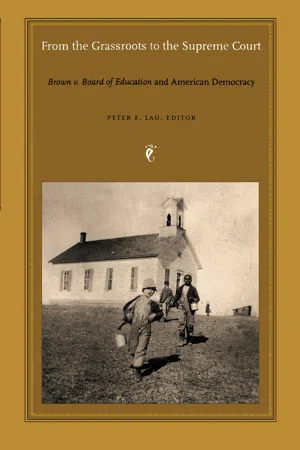 eBook - PDF
From the Grassroots to the Supreme Court
Brown v. Board of Education and American Democracy
- Peter F. Lau, Neal Devins, Mark A. Graber(Authors)
- 2004(Publication Date)
- Duke University Press Books(Publisher)
Ferguson , see Plessy v. Ferguson: A Brief History with Documents , ed. Brook Thomas (Boston: Bedford, 1997). For a close analysis of the case law, the best account available is found in Lofgren, The Plessy Case . 50 L. A. Martinet to A. Tourgee, 20 May 1893, item 6998, Tourgee Papers. 51 ‘‘Race Identity in New Orleans,’’ Southwestern Christian Advocate , 19 July 1900, 8. vicki l. ruiz Tapestries of Resistance Episodes of School Segregation and Desegregation in the Western United States ‘‘We always tell our children they are Americans . . .’’ —Felícitas Méndez j In 1945, nine years before Brown , Latino parents in Orange County, California, led by Gonzalo and Felícitas Méndez, sued four local school districts for segregating their children. This case, Méndez v. Westmin-ster (1946), would foreshadow the landmark Supreme Court case in several ways, including its judicious use of social science research, the application of the Fourteenth Amendment, and the involvement of Thurgood Mar-shall, a co-author of the amicus curiae brief filed by the naacp . Landing a blow for segregation in California, the Méndez case would also serve as a precedent for judicial decisions in Texas and Arizona. Though relatively unknown on a national level, Méndez v. Westminster places the struggles for civil rights across regional, racial, and ethnic temporalities. Moving beyond a black-white binary, this chapter explores how diverse groups in the west-ern United States developed parallel strategies for addressing injustice, though often in isolation from one another, which came together most visibly in Méndez . As a land of encounters and conquests, the western United States en-compasses multiple and overlapping histories. This chapter focuses on selected episodes involving educational segregation and desegregation in the western United States through the stories of people of color, especially Asian Americans, Mexican Americans, and American Indians.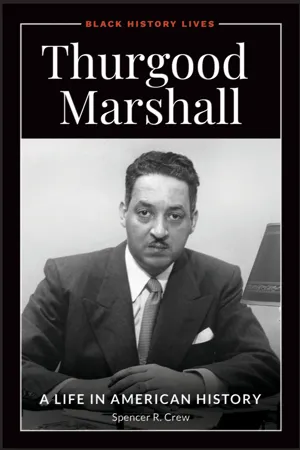 eBook - ePub
Thurgood Marshall
A Life in American History
- Spencer R. Crew(Author)
- 2019(Publication Date)
- ABC-CLIO(Publisher)
A key part of Carter’s case was the testimony of Oliver Brown. During his testimony, Brown described his seven-year-old daughter Linda’s daily travel to Monroe, her segregated school, which was about a mile’s distance from her home. Each day Linda left at 7:40 a.m. to get to school by 9:00 a.m. To catch her school bus by 8:00 a.m., Linda walked a dozen blocks between railroad tracks to the bus stop. Brown pointed out that the bus often came late, which forced her to stand in the rain or snow until it arrived. After a thirty-minute ride, she arrived at the school, where she stood outside as long as thirty minutes waiting for the building to open. In contrast, Sumner, the white school, was only about seven blocks from the Browns’ home, with a much shorter and less dangerous route to travel. But when he sought to enroll Linda at Sumner, the principal denied his request, prompting Brown to join in the suit.The trial lasted for three days, with the lawyers for the school system taking the position that the African-American schools were not inferior and, as such, did not violate separate but equal. They also argued that public opinion in their community supported the maintenance of segregated schools, and it was not the duty of the schools to go against community preferences. After five weeks of deliberation, the district court judges handed down their decision. They found in favor of the Topeka school board. In their judgment, earlier U.S. Supreme Court decisions, such as the McLaurin case, pertained only to graduate and professional schools. The Plessy decision still ruled, and the actions of the school board met the requirements set out by it. At the same time, the judges gave hope to Carter and the NAACP through an attachment to their ruling containing nine “Findings of Fact” related to the case. In five of the facts they gave credence to the psychological argument offered by the NAACP. The last sentence in that finding indicated that the judges accepted the detrimental impact of separate systems: “Segregation with the sanction of law, therefore, has a tendency to retard the educational and mental development of Negro children and to deprive them of some of the benefits they would receive in a racially integrated school system” (Kluger, 2004, p. 424). Marshall and the NAACP saw this statement as a small moral victory. They felt the 1951 ruling of the Kansas judges would place pressure on the U.S. Supreme Court to provide their view on whether Plessy v. Ferguson should stand. Marshall quickly had the appeal of the case sent forward to the U.S. Supreme Court.Meanwhile, in South Carolina, officials filed the six-month report required by the district judges. In it they pointed to progress in providing funding for equalizing school buildings, the purchase of new equipment, upgrades to the curricula at African-American schools, as well as the equalization of teacher salaries. They asserted their commitment to seeing these actions through to completion and asked only for additional time to make them happen. In light of this report, the U.S. Supreme Court, to whom the NAACP had appealed the original decision, directed the lower court to issue a final judgment. It again found in favor of South Carolina. Marshall immediately appealed their decision to the U.S. Supreme Court, asserting that only an end to segregation would meet the immediate needs of their clients. eBook - PDF
- Anthony G. Amsterdam, Jerome Bruner, Anthony G. AMSTERDAM, Jerome S. Bruner, Jerome Seymour Bruner(Authors)
- 2009(Publication Date)
- Harvard University Press(Publisher)
84 These strategies were aided by two powerful props: the then-fashionable notion that race was a biologi-cal way of color-coding superior and inferior human beings, 85 and the 266 Minding the Law dramatic death of all idealism that followed the horrors of the Civil War. As Andrew Delbanco put it neatly: “Before the war, Americans spoke of providence. After it, they spoke of luck . . . . God had been re-placed by fortune, and fortune makes no moral judgments.” 86 Plessy was nominally about railroad cars, but it put the Court’s stamp of approval on the notion that separation of the races was nat-ural and unexceptionable. On this rock, Jim Crow could stand firm for more than half a century. The elaboration of public education sys-tems featuring white and colored schools throughout the South and in some other regions was a particularly crucial step in limiting the en-try of America’s ex-slaves into the category of ordinary Americans. By consigning African-American children to separate, inferior, under-financed schools, the segregated educational establishment made it easy enough to prove that they were inferior. If black folks didn’t like it, there was always crypto-police-power to enforce white superiority through tolerated mob violence, the Klan, and racist court practices. 87 And everybody knew what the conjunction of separate-but-equal meant. “Separate” was to give the Court’s warrant to reality; “equal” was to wash the Court’s hands symbolically of any responsibility for that reality. It was not to be until well after World War I that the stance of America’s dominant culture on the question of race, depicted as unal-terable fact and canonized as constitutional law in Plessy, began to change. As Higham and others have noted, the isolationism and adu-lation of normalcy that followed the war were accompanied by a de-termination to keep African-Americans, like everything else, firmly in their traditional place. eBook - PDF
Badges and Incidents
A Transdisciplinary History of the Right to Education in America
- Michael J. Kaufman(Author)
- 2019(Publication Date)
- Cambridge University Press(Publisher)
FROM COUNTRY ROADS TO COURTHOUSE STEPS: THE LONG WAR AGAINST PLESSY V. FERGUSON The story of the decades-long struggle to declare legally segregated school systems unconstitutional is, among many other things, a story of the power of education. Systematically excluded from mainstream American society, African Americans built parallel institutions of their own. While certainly unequal when measured by 55 access to resources and quality of facilities, they were entirely the equal of white schools in terms of dedicated teachers and emphasis on learning. In fact, the story of Brown cannot be told without recounting the work of an extraordinary lawyer and educator named Charles “Charlie” Houston. Inspired to study law after witnessing multiple racially motivated courts-martial while serving in World War I, Houston turned Washington, DC’s Howard School of Law into a West Point for African American lawyers. As author Juan Williams relates, “Houston made no secret of his main goal. He wanted to make the American legal system work for blacks, and to do so he was training a cadre of top- notch black lawyers.” 1 Houston’s students, many of whom would go on to become giants of the legal profession, were invariably turned away by segregated law schools. Rather than bow to this injustice, Houston rallied these bright young minds and trained them to beat their segregationist adversaries at their own game: constitu- tional law. Keenly aware of the Supreme Court’s preference for incremental holdings rather than sweeping pronouncements, Houston sought to lead the Court toward deseg- regation, step by step. Williams explains, Houston worked out his own detailed, long-range strategy. They would begin by attacking segregation in professional and graduate schools.
Index pages curate the most relevant extracts from our library of academic textbooks. They’ve been created using an in-house natural language model (NLM), each adding context and meaning to key research topics.

