History

Thurgood Marshall
Thurgood Marshall was the first African American to serve on the United States Supreme Court. Before his appointment, he was a prominent civil rights lawyer who successfully argued the landmark case Brown v. Board of Education, which led to the desegregation of public schools. Marshall's legacy includes his tireless efforts to advance civil rights and his significant impact on the American legal system.
Written by Perlego with AI-assistance
Related key terms
1 of 5
12 Key excerpts on "Thurgood Marshall"
 eBook - PDF
American Voices
An Encyclopedia of Contemporary Orators
- Bernard K. Duffy, Richard Leeman, Bernard K. Duffy, Richard Leeman(Authors)
- 2005(Publication Date)
- Greenwood(Publisher)
Thurgood Marshall (1908-1993) 299 Thurgood Marshall (1908-1993) Lawyer, U.S. Supreme Court Justice STEPHEN A. SMITH Known as "Mr. Civil Rights," Thurgood Marshall was one of the heroes in the battles to secure the constitutional rights of Black Americans, and he had a leading role in that drama on the stage of public life for almost 60 years. Marshall is most remembered as the first African American justice of the U.S. Supreme Court, on which he served from 1967 to 1991, but his earlier career as a legal advocate for civil rights forever changed the nation far more than his opinions on the Supreme Court. "When I think of great American lawyers, I think of Thurgood Marshall, Abe Lincoln and Daniel Webster," said Georgetown law professor Thomas G. Krattenmaker. And Marshall, he told biographer Juan Williams, "is certainly the most important lawyer of the 20th century." As an at- torney in private practice and later leading the NAACP Legal Defense Fund assault on segrega- tion, Marshall fought and won hard legal cases throughout the South, culminating in the land- mark Brown v. Board of Education and provid- ing the rhetorical structure and the constitutional warrant for the political success of the civil rights movement. Thurgood Marshall was born in Baltimore in 1908, a place and time that reflected the segregated praxis of American life, into his family that was securely among the middle class on the Black side of the color line. His mother, Norma Williams Marshall, was a teacher in the segregated elemen- tary schools. A graduate of Coppin Normal who had completed additional graduate work at Mor- gan State and Columbia University, she empha- sized the value of education and hoped that Thur- good would become a dentist, but it seems that he was adept with his own mouth in other ways. One neighbor recalled that Thurgood was "a jolly boy who always had something to say"; however, his jovial nature and quick wit were not always ap- preciated in school. eBook - PDF
Icons of African American Protest
Trailblazing Activists of the Civil Rights Movement [2 volumes]
- Gladys L. Knight(Author)
- 2008(Publication Date)
- Greenwood(Publisher)
Thurgood Marshall (1908–1993) Library of Congress Thurgood Marshall was a civil rights attorney for the NAACP and was the first African American to serve on the U.S. Supreme Court (1967–1991). He is most widely known for his work on the famous Brown v. Board of Edu- cation case, which desegregated public schools in 1954. Thurgood Marshall began his journey to success and fame when he replaced his mentor Charles Hamilton Houston as attorney for the National Association for the Advancement of Colored People (NAACP) in 1936. Marshall was only twenty-eight years old, full of zest, humor, and confidence. With his fair com- plexion, silky black hair, and manicured mustache, Marshall bore a resemblance to two other African Americans who attended the same university and rose to the top of their fields: Cab Calloway, the zoot-suited and bodacious musician who reigned supreme during the 1930s and 1940s; and the thought-provoking Langston Hughes, master poet and writer who made a living both celebrating black life and culture and showing its unglamorous side, as well as delving into the most controversial subject of the early twentieth century: racism. Marshall was a master in his field, as well. He attained celebrity status thanks to a number of high-profile victories in court. He won twenty-nine out of thirty-two cases that he argued before the U.S. Supreme Court. There is a picture of him, taken in 1956, that personifies the man who was such an extraordinary champion of black justice and equality. The photo catches Marshall, at six feet tall, weighing over two hundred pounds and broad- shouldered, poised in mid-stride as he leaves the federal courthouse in Bir- mingham, Alabama. He wears a long khaki trench coat and has one hand in his pocket. To his left and right and behind him are a phalanx of black sup- porters. To his immediate right is plaintiff Autherine Lucy, at that time in the midst of her struggle to maintain her enrollment in the University of Alabama. eBook - PDF
Icons of Black America
Breaking Barriers and Crossing Boundaries [3 volumes]
- Matthew Whitaker(Author)
- 2011(Publication Date)
- Greenwood(Publisher)
Thurgood Marshall (1908–1993) Joseph Lavenburg, National Geographic Society, Collection of the Supreme Court of the United States Thurgood Marshall was one of the most influential lawyers in the United States in the twentieth century. As a litigator and strategist with the National Association for the Advancement of Colored People (NAACP) Legal Defense and Educational Fund (LDF), Marshall helped craft and implement much of the civil rights campaigns in the nation’s courts that from the 1930s to the 1960s laid siege to and eventually overturned the law and practice of Jim Crow racial segregation. As plaintiffs’ lead counsel, he won the landmark Brown v. Board of Education (1954) case in which the Supreme Court of the United States declared that “in the field of public education, the doctrine of ‘separate but equal’ has no place” (347 U.S. 483, 495). That signaled an accelerating end to legal segregation. In 1967, Marshall became the first black justice on the Supreme Court of the United States, where he remained a steadfast cham- pion of equal protection of the law for all. Named Thoroughgood at his birth on July 2, 1908, in Baltimore, Maryland, Marshall reportedly changed his name in elementary school. Illustrating early impatience for which he would be noted later, he cut one-third of the 12 letters and wrote his personal name simply as “Thurgood.” Marshall’s parents, the schoolteacher ne ´e Norma Williams and the porter-steward-waiter William Canfield Marshall, accepted their second son’s asserting himself as another sign of his being special. He clearly differed from their first son, who carried his father’s name, William. Born on September 15, 1905, he was not a junior, however. His parents believed in individuality. They gave baby William the middle name Aubrey, and that was what the family called him, “Aubrey.” They gave their second son the name his once enslaved great-grandfather reportedly gave himself on enlisting in the U.S. eBook - ePub
Black Leaders and Ideologies in the South
Resistance and Non-Violence
- Preston King, Walter Earl Fluker(Authors)
- 2013(Publication Date)
- Routledge(Publisher)
6Thurgood Marshall's Pursuit of Equality through Law
ADAM FAIRCLOUGH‘Probably the most important American lawyer of the twentieth century’ (Balkin 2001: 29), Thurgood Marshall personified both the strengths and limitations of using the courts as a means of establishing substantive equality between black and white Americans. As the principal architect of the epochal 1954 Brown decision, Marshall not only demolished de jure segregation in the South but also laid the groundwork for an attack upon racial inequality in the nation at large. His own career dramatically illustrated the political success of the civil rights movement. Born in 1908, he joined the staff of the NAACP Legal Defense and Educational Fund (LDF) in 1936, and headed that organisation between 1940 and 1961. Laying siege to the citadel of white supremacy, he not only breached its walls but entered the castle keep. Appointed Solicitor General in 1965, he joined the US Supreme Court two years later. He was the first African American to serve in either position. The outsider became the ultimate insider.Yet Marshall spent most of his 24 years on the Supreme Court fighting a conservative majority that possessed a cold, narrow, procedural view of the law that clashed with his own passionate conviction that the Court should be especially attentive to the rights of the poor, the powerless and the historic victims of discrimination. The black-robed justice, ostensibly one of the most powerful men in the land, wielded less influence than the poorly paid civil rights attorney who had been threatened by policemen, jailed and on more than one occasion almost lynched.For a man who had spent the first half of his career using the law as an instrument to promote equality, and with great success, this was a profound irony. As one of his law clerks wrote of these Supreme Court years, ‘Justice Marshall made a career of protesting the roll-back in school desegregation, the dismantling of procedural protections for the accused, the erection of new barriers to affirmative action, the disregard for free speech, and the reinstitution of the death penalty.’ For someone who was a man of action rather than a legal theorist, this impotence was excruciating. Anger crept into Marshall's later dissents. He lambasted decisions of the conservative majority as, in his own words, facile, myopic, disgraceful, arrogant and indecent (Fiss 1994: 52).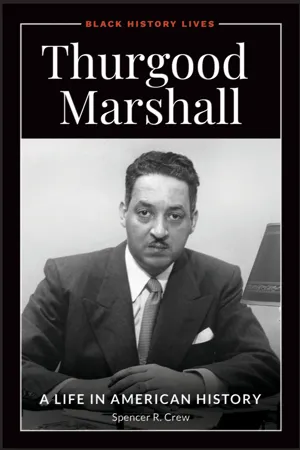 eBook - ePub
Thurgood Marshall
A Life in American History
- Spencer R. Crew(Author)
- 2019(Publication Date)
- ABC-CLIO(Publisher)
Baltimore Afro-American gave Marshall the lion’s share of the credit for the court victory while other African-American newspapers used the words “brilliant,” “resourceful,” and “dedicated” to describe him.Organizations outside of the African-American community also acknowledged Thurgood’s accomplishments. The Workman’s Circle, the largest Jewish fraternal labor organization, awarded Marshall their human rights award. Life magazine, which had followed his career closely, described Thurgood as “the chief counsel for equality.” Time magazine featured Marshall on its cover in September 1955. Consequently, Thurgood Marshall became a widely recognized national figure and a symbol of how unwavering dedication to a conviction could effect change.It was his success as a lawyer with the NAACP that brought Thurgood to the attention of Presidents Kennedy and Johnson. Both men understood his iconic stature among African Americans and civil rights supporters for his unwavering championing of equal rights. If they wished to make a statement illustrating their support of African Americans and legislation backing improved civil rights, appointing Thurgood to a prominent position in their administrations was a logical decision to make. A judicial appointment for a prominent lawyer like Thurgood made the most sense. President Kennedy appointed Thurgood to the Second Circuit Court, but for Johnson, the U.S. Supreme Court was where he believed Marshall belonged.The judicial appointments repositioned Marshall’s role with regard to civil and human rights legal issues. As a judge, he no longer brought cases to the courts hoping to convince them to rule in his favor. His conversations now were with other fellow justices as they conferred. Sitting on the bench, he had more direct impact on the final rulings they offered. This was an opportunity Thurgood embraced wholeheartedly. As a federal judge, Thurgood remained a staunch champion of civil and human rights. He took seriously the part of the judicial oath that obligated them to “administer justice without respect to persons, and do equal right to the poor and to the rich.” His record on the U.S. Supreme Court, in particular, reflected his commitment to this responsibility. eBook - PDF
Pillars of Justice
Lawyers and the Liberal Tradition
- Owen Fiss(Author)
- 2017(Publication Date)
- Harvard University Press(Publisher)
Marshall was also the lawyer responsible for the initial victory in Brown, and thus his decision to withdraw from public life underscored in a bold and dramatic way the troubled state of the legacy of the Warren Court and, for that matter, American law in general. Marshall died in 1993. Throughout his life, Thurgood Marshall was moved and supported by his love of family. In December 1955, following the death of his first wife, he married Cecilia Suyat, known to everyone as Cissy, and they soon had two sons. Cissy was spirited and determined, but also exuded the warmth that was the Justice’s trademark. Every time Marshall said—which was quite often—“Isn’t she something?,” all who knew her rushed to agree. Marshall was equally devoted to his sons. He certainly was the only judge on the Second Circuit who drove his children to and from school each and every day—and enjoyed it. He also got a kick out of the fact that his younger son, John, had become, in the Justice’s words, “a law enforcement 28 The Struggle for Civil Rights officer.” At the time of Marshall’s retirement, John was a Virginia state trooper; later he would become a U.S. Marshal and still later, Secretary of Public Safety in Virginia. Marshall’s older son, Thurgood Jr., fol-lowed more closely in the Justice’s footsteps: He became a lawyer. On his last day of service, Marshall stepped from behind the bench, took off his robe, walked to the Supreme Court lectern he knew so well, and moved Thurgood Jr.’s admission to the bar. This small ceremony, and Cissy’s presence in the courtroom on the final day of Justice Marshall’s tenure, spoke powerfully of the role of his family in his life. In the late 1920s, Marshall had announced that he would make his life in the law. Amid the brutal and all-encompassing racism of the day, his grandmother responded to this announcement by offering, with only a touch of irreverence, to teach him how to cook so that he might always have a job to support himself. eBook - ePub
Representing the Race
The Creation of the Civil Rights Lawyer
- Kenneth W. Mack(Author)
- 2012(Publication Date)
- Harvard University Press(Publisher)
What set Marshall apart was his ability to do something most of his contemporaries could not—get into court in a few high-profile cases that made his reputation on both sides of the color line. Marshall came to prominence as a lawyer because, for blacks and whites alike, he seemed to represent something much larger than himself. White lawyers and judges tended to see the young, confident, impeccably trained black lawyer as someone much like themselves. Black Marylanders did, too. The authentic representative of African Americans in the courts, both groups told themselves, was a black lawyer who seemed as much like his white colleagues as possible. But each group wanted something different from the youthful lawyer whose presence in court seemed so disruptive of local racial mores. White lawyers seemed to desire, most of all, a person who could explain to a skeptical black public that the legal system treated them fairly. Blacks seemed to want an African American lawyer whose acceptance by whites gave him the power to call out racial inequity in the system. Marshall walked a fine line in his early years in practice, and the key to his success as a civil rights lawyer was his ability to convince each group that when he stepped into the courtroom, he represented its particular point of view. It was a paradoxical position, but that balancing act was the foundation for the stunning victories that marked his early years as a lawyer, including the one that desegregated the University of Maryland’s law school.Reversals of View: Law and LawyersMore than anything else, Thurgood Marshall’s formative years as a lawyer were shaped by the fact that he began practicing law in the shadow of the Crawford case. Baltimore’s white lawyers and judges, like their counterparts throughout the South, were well aware of the events that had taken place in nearby Loudoun County, and of the interpretation that the lawyers had stamped on the trial’s unexpected end. In fact, the leaders of the city’s bench and bar were in the midst of their own controversy about race and criminal justice. Two of the leading figures in that controversy would play key roles in Marshall’s early career. The first one, Judge Morris Soper, was already on his way to a career as one of the most respected federal circuit court judges in the country. As a younger man, however, he had opposed his state’s leading lawyers by carrying a black voting rights case all the way to the Supreme Court, where it became one of the famous “Grandfather Clause” cases of 1915. Soper also incurred the displeasure of the local bar association by his unsuccessful effort to get it to admit black lawyers to membership. The second figure who would make a difference in Marshall’s career was Baltimore City circuit judge Eugene O’Dunne. Earlier in his career, O’Dunne had also risked his reputation, and his life, in defending a black man accused of an interracial rape on the state’s then-remote Eastern Shore, after a mob of thousands had tried to lynch him. O’Dunne succeeded in getting the original trial invalidated because it had taken place in a mob atmosphere, and got the retrial moved to Baltimore County.2 eBook - PDF
Servants of the People
The 1960s Legacy of African American Leadership
- L. Williams(Author)
- 2016(Publication Date)
- Palgrave Macmillan(Publisher)
T H U R G O O D M A R S H A L L , A D R U M M A J O R F O R J U S T I C E 93 Since the Plessy v. Ferguson case, legal loopholes in the law have permit- ted complainants similar to Bakke to corrupt the intent of the Fourteenth Amendment to the Constitution. Thurgood Marshall valiantly fought against these very loopholes. Yet, since the Warren Court, under which Marshall real- ized his great constitutional victories, the expanding conservative majority seated on the Supreme Court has steadily retreated from the Court’s previ- ous commitment to civil rights. The Supreme Court’s conservatism, matched with that of Congress, has relegated social engineering to the back seat of the national agenda. MENTORING A LEGAL TEAM WORTHY OF ITS HIRE Marshall became assistant chief counsel to the national NAACP in 1936 and four years later assumed the position of chief counsel when ill health forced Charles Hamilton Houston to relinquish the post. 43 By then the school deseg- regation cases were advancing rapidly. Marshall had assembled a staff of able lawyers, supplementing them with legal experts from throughout the country. He also maintained ties to Howard University, holding moot court in the law school library. Constance Baker Motley, the only woman on Marshall’s legal team—including a woman at all was quite a bold statement at the time—re- membered being part of these sessions: “Prior to each Supreme Court argu- ment, he invariably practiced before a panel of Howard Law School faculty members. Not only did Marshall’s staff members attend these moot court ses- sions, but on occasion we participated as well. In addition, we were included in the preparation of cases.” 44 Marshall obviously respected the intellect of the Howard faculty; further, he recognized the significance and appropriateness of having the dialogue and debate in a historically black setting. Holding these forums at a black college, even though segregated public facilities in Washington, D.C. eBook - ePub
People's Lawyers
Crusaders for Justice in American History
- Diana Klebanon, Franklin L Jonas, Diana Klebanow(Authors)
- 2020(Publication Date)
- Routledge(Publisher)
On January 14, 1993, eighteen months after his retirement, Marshall died at Bethesda Naval Hospital at the age of eighty-four. The cause was heart failure. He was buried at Arlington National Cemetery. Tributes to him came from all parts of the nation. But one of the most moving statements had already been made by Associate Justice O’Connor. Taking note of the occasion of his retirement from the Supreme Court, Justice O’Connor had written:But Thurgood Marshall will not be remembered for his stories. His work was his legacy, and he arguably had more of an impact upon American society than any other lawyer in history.I recall his unwavering commitment to the poor, the accused, and the downtrodden, and his constant, impassioned refutation of the death penalty. More than that, though, I think of the raconteur himself. Occasionally, at Conference meetings, I still catch myself looking expectantly for his raised brow and his twinkling eye, hoping to hear, just once more, another story that would, by and by, perhaps change the way I see the world.104Notes
- 1. Quoted in Michael D. Davis and Hunter R. Clark, Thurgood Marshall: Warrior at the Bar, Rebel on the Bench (New York: Birch Lane Press, 1992), 8; Bob Woodward and Scott Armstrong, The Brethren: Inside the Supreme Court (New York: Simon and Schuster, 1979; reprinted, New York: Avon Books, 1981), 64.
- 2. Glen M. Darbyshire, “Clerking for Justice Marshall,” ABA Journal 11 (September 1991): 50; quoted in “Chronicle,” New York Times , November 17, 1998, B7.
- 3. Stuart Taylor Jr., “Plain Truth from the People’s Lawyer,” Legal Times , July 1, 1991, 32.
- 4. Quoted in Mark V. Tushnet, Making Constitutional Law: Thurgood Marshall and the Supreme Court, 1961–1991 (New York: Oxford University Press, 1997), 4–5.
- 5. Juan Williams, Thurgood Marshall: American Revolutionary (New York: Times Books, 1998), 80.
- 6. Ibid., 131–142; Davis and Clark, Thurgood Marshall , 105–119; Carl T. Rowan, Dream Makers, Dream Breakers: The World of Justice Thurgood Marshall (Boston: Little, Brown, 1993), 98–123.
- 7. Quoted in Darbyshire, “Clerking for Justice Marshall,” 51.
- 8. Quoted in Neil A. Lewis, “Marshall Urges Bush to Pick The Best,’” New York Times , June 29, 1991, Section 1, 8.
- 9. Sidney E. Zion, “Thurgood Marshall Takes a New Tush-Tush’ Job,” New York Times Magazine
 eBook - PDF
- Kofi Lomotey(Author)
- 2009(Publication Date)
- SAGE Publications, Inc(Publisher)
As a lawyer, Marshall argued a number of educational segrega-tion cases that opened primary through graduate education, including the 1954 Brown v. Board of Education, Topeka, Kansas, case. Marshall further broke the color barrier, using his HBCU educa-tion, by being named the first Black solicitor gen-eral and associate justice of the U.S. Supreme Court. Marshall agreed to the use of his name, and the National Black Education Fund was renamed the Thurgood Marshall Scholarship Fund on December 9, 1986. The name change became offi-cial in 1987. The new organization was small and used its first few years to build support. Using a grassroots 622 Thurgood Marshall Scholarship Fund strategy. TMSF built commitments from additional corporations, foundations, and business leaders. By 1993, TMSF was providing merit-based schol-arships for 4-year and graduate degrees to stu-dents attending 38 public HBCUs. In 2000, the Thurgood Marshall Scholarship Fund expanded its mission beyond merit-based scholarships and added programmatic and capacity-building sup-port for member colleges and universities. Today’s Program and Accomplishments The TMCF, today, now supports 47 four-year public HBCUs and 6 law schools and has awarded more than $50 million in scholarships, capacity-building and programmatic support. More than 5,000 Thurgood Marshall Scholars, who receive between 33% and 100% of their total tuition costs through the scholarships, have graduated and are employed in the fields of science, technology, gov-ernment, human service, business, and education. The organization reports that 98% of scholarship recipients obtain degrees, and 52% of those go beyond the bachelor’s degree and attend graduate or professional schools. The TMCF estimates that their programmatic support and capacity-building grants have bene-fited more than 228,000 students at the 47 mem-ber colleges and universities. eBook - ePub
Thurgood Marshall
Race, Rights, and the Struggle for a More Perfect Union
- Charles L. Zelden(Author)
- 2013(Publication Date)
- Routledge(Publisher)
government, Marshall replied: “You are a white representative of the government. They want to see Thurgood.” Marshall was correct. “Thurgood was a god, there was no question about it,” Bernhard recalled. “At one point I told Thurgood that he should not be telling Kenyatta how he should be running the government [of Kenya]. I said ‘You’re behaving like the Emperor Jones.’” Marshall’s response was “White boy, when we’re in East Africa, I am the Emperor Jones!” 19 Less enjoyable was Marshall’s participation as “the first Negro to represent the Diocese of New York” in the Episcopal Church’s triennial general convention in October 1964. When Southern lay delegates defeated a resolution that “recognized the right of any person for reasons of conscience to disobey laws or social customs in conflict with the law of God, so long as such person is willing to carry out this protest in a nonviolent manner,” an “angry” Marshall publically “bolted” the conference. Once home, Marshall refused to justify his actions. However, a few weeks later, Marshall explained his motivations in a talk to the Greater Hartford Forum. Asked how he, as a federal judge, could support “a resolution which in effect advocated civil disobedience to the law,” Marshall countered that “the [resolution] didn’t advocate disobedience.” Rather it “gave everyone the right … to disobey a law which they considered against their conscience.” What could be more Christian than this? After all, “I seem to remember some place in the Bible where Jesus grabbed some money-changers and kicked the living daylights out of them, which I assume was against the law.” 20 Incidents such as these were increasingly rare, however. By and large, Marshall’s life had slowed to the almost monastic rhythms of life on the bench: measured, deliberative, and mostly uneventful eBook - PDF
A Chief Justice's Progress
John Marshall from Revolutionary Virginia to the Supreme Court
- David Robarge(Author)
- 2000(Publication Date)
- Praeger(Publisher)
Chapter 8 Chief Justice, 1801-1835 When John Marshall became America's premier judicial officer, he was 45 years old, and his public and private identities were fully formed. He possessed a vision of what America could and ought to become as a people and a nation, but he confronted dynamic, unforeseen, and at times threatening forces to which he had to respond personally, politically, and institutionally. The manner in which Marshall sought to achieve his public goals, and the degree of success he had in doing so, can be described and interpreted through the three distinctive leadership roles he took on as chief justice. These roles were usually interrelated but sometimes discrete, and Marshall either fashioned them for himself, some more quickly and resolutely than others, or assumed them because of changing historical circumstances, or immediate political disputes, or both. First, and most important for the Supreme Court's place in American history as a governmental institution, Marshall was a judicial statesman who, as the most influential member of the Court in its first half-century, guided it in creating a powerful and independent judiciary and establishing a consistent, widely accepted, practical, and durable body of constitutional law. As one of the leading Federalists directly engaged in the debate over the judiciary during the ratification period, he knew as well as anyone what the purposes of the "least dangerous branch" were to be, and, operating in an incremental, opportunistic way, he went about accomplishing them. Second, and most significant for the Court's impact on daily life and the material world, he was a constitutional and economic nationalist, developing and adjusting the federal "common market" by according constitutional protection to property rights and corporations, restricting state mercantilism, and promoting investment and expansion through the agency of the federal courts.
Index pages curate the most relevant extracts from our library of academic textbooks. They’ve been created using an in-house natural language model (NLM), each adding context and meaning to key research topics.

