Politics & International Relations

Marbury v Madison
"Marbury v. Madison" was a landmark 1803 U.S. Supreme Court case that established the principle of judicial review, giving the Court the power to declare laws unconstitutional. The case arose from a political dispute between outgoing President John Adams and incoming President Thomas Jefferson, and it set the precedent for the Court's role in interpreting the Constitution.
Written by Perlego with AI-assistance
Related key terms
1 of 5

11 Key excerpts on "Marbury v Madison"
 eBook - PDF
- I. Unah(Author)
- 2016(Publication Date)
- Palgrave Macmillan(Publisher)
The significance of Marbury v. Madison is that it declared an Act of Congress unconstitutional, thereby affirming judicial review and indepen- dence. Ironically, by rejecting a congressional grant of additional powers, the Court actually gained more power in terms of prestige and political influ- ence. But the idea of judicial review itself was neither new nor born in that case. For instance, in 1795, in the case of Van Horne’s Lessee v. Dorrance, Justice Paterson explained that in the American form of government [A] Constitution is the sun of the political system, around which all Legislative, Executive, and Judicial bodies must revolve. Whatever may be the case in other countries, yet in this there can be no doubt, that every act of the Legislature, repugnant to the Constitution, is absolutely void. 39 Similarly, James Iredell stated in Calder v. Bull (1798) that “If any act of Congress, or of the legislature of a state, violates . . . constitutional provisions, it is unquestionably void.” Iredell further noted that the authority to make such a declaration “is of a delicate nature” only to be exercised in “urgent” situa- tions. Thus, the justices were simply waiting for the appropriate or “urgent” case through which they can firmly establish judicial review. It was this princi- ple expressed by Justice Paterson in Van Horn’s Lesee and by Justice Iredell in Calder that Marbury v. Madison confirmed and institutionalized eight years later as the most wide-ranging grant of power to the American judiciary. Application of Judicial Review How did the Court exercise its power of judicial review in the aftermath of Marbury? In the years following the Marbury decision, the Supreme Court used its power of judicial review to further establish itself as a coequal gov- erning partner under the Constitution and to firmly declare the superiority of the federal government over the states. eBook - ePub
Judicial Review and Judicial Power in the Supreme Court
The Supreme Court in American Society
- Kermit L. Hall(Author)
- 2014(Publication Date)
- Routledge(Publisher)
OLUME 1969 JANUARY NUMBER 1A CRITICAL GUIDE TO MARBURY V. MADISON
WILLIAM W. VAN ALSTYNE *The concept of judicial review of the constitutionality of state and federal statutes by the Supreme Court is generally rested upon the epic decision in Marbury v. Madison. The controversies which have surrounded the exercise of this power by the Supreme Court require a periodic reexamination of the concept of judicial review at its source, the Marburyopinion. This article proceeds by examining the historical context in which the case arose and analyzes the opinion in terms of various alternative approaches which might have been util ized by Chief Justice Marshall. The specific holding of the case is isolated in contrast to later interpretation given it, and a collection of relevant historical materials is presented to lend insight into the constitutional viewpoints of the period.INTRODUCTION
T HE DECISION in Marbury v. Madison 1 was written under seemingly inauspicious circumstances. Its author, John Marshall, the fourth Chief Justice of the United States, had come to the Supreme Court without prior judicial experience and had served on the Court a scant three years before rendering this decision. Marshall was appointed to the post from the President’s cabinet as a second choice in the aftermath of a national election in which the President and his party had been deposed. The decision itself partly turned upon facts of which the Chief Justice had personal knowledge because of his previous involvement in the controversy while serving as Secretary of State. Though he wrote for a unanimous Court in Marbury v. Madison eBook - ePub
Judges on Judging
Views from the Bench
- David M. O′Brien(Author)
- 2016(Publication Date)
- CQ Press(Publisher)
Chapter 1 The Doctrine of Judicial ReviewMr. Marshall, Mr. Jefferson, and Mr. MarburyWarren E. BurgerChief Justice, Supreme Court of the United States (1969–1986) and Judge, U.S. Court of Appeals, District of Columbia (1956–1969)Lord Bryce once observed :I should add that in some quarters, the Supreme Court’s guardianship of that Ark probably has received more guarded praise than in distant places where its impact is purely theoretical. Lord Bryce, of course, had reference to the doctrine of judicial review, sometimes described as the doctrine of judicial supremacy, in the interpretation of constitutional terms and principles. . . .No feature of the government of the United States has awakened so much curiosity in the European mind, caused so much discussion, received so much admiration, and been more frequently misunderstood, than the duties assigned to the Supreme Court and the functions which it discharges in guarding the Ark of the Constitution.1It is helpful to an understanding of this subject to examine it in the setting in which Marbury v. Madison was decided in 1803 with all its momentous consequences for our country and to suggest to you that this great case had its antecedents in our colonial experience, and its taproots in the declarations of fundamental rights of Englishmen back to Magna Carta.Marbury v. Madison: Act One, the Setting
Very early in the history of our country the colonial experience of living under a parliamentary system with no check on the legislative or executive branch, except that of popular will in a limited way, led our Founding Fathers to feel strongly the need for limitations on all branches of government. The intellectual spadework for the system ultimately adopted for our federal government had been done, of course, by such seventeenth- and eighteenth-century political theorists as Hobbes and Locke.2 As we know, the great rationalist Montesquieu contributed the notion of a separation of powers within the government itself, in order that each branch might act as a sort of brake upon the others.3 As the system works today, one of the checks exercised by the Supreme Court involves measuring executive or legislative action against the Constitution whenever a challenge to such action is first properly brought within the framework of a “case” or “controversy,”4 and then properly brought within the “appellate jurisdiction”5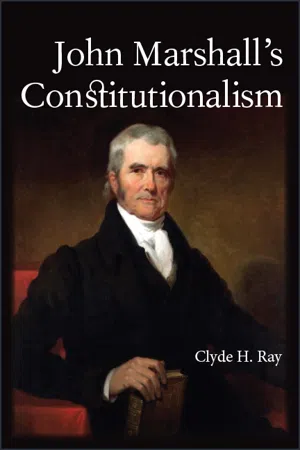 eBook - ePub
- Clyde H. Ray(Author)
- 2019(Publication Date)
- SUNY Press(Publisher)
1John Marshall, Marbury v. Madison , and the Construction of Constitutional Legitimacy
P erhaps no other Supreme Court decision has offered a more lucid and forceful defense of the Constitution than Marbury v. Madison (1803). There are several explanations for the case’s prominence in American legal history, including the Court’s defense of the vested rights of individuals, its formulation of the “political questions” doctrine, and its assertion of judicial supremacy. For most scholars, the opinion’s articulation of the principle of judicial review continues to loom particularly large.1 All of these factors were indeed important in shaping the future course of the nation, and they are rightfully acknowledged in any assessment of the opinion’s impact. But they do not tell the whole story. To enter into a discussion of Marbury is above all to enter into John Marshall’s discussion of the fundamental authority of the Constitution. For in drafting the Court’s unanimous opinion, Marshall did more than artfully avoid a clash between the Federalist judiciary and its Jeffersonian critics. More important, he offered a detailed justification of the binding authority of the Constitution, mapping out justifications familiar if still undeveloped at the time of the decision. In examining these theories as well as his own, Marbury yields a purchase for surveying the assumptions implicit in contemporary arguments concerning constitutional legitimacy.Marshall’s own theory of constitutional legitimacy runs deeper than the concepts and language familiar to most Americans of his day. At the heart of his theory is a belief in the Constitution’s moral legitimacy, namely, its ability to provide fundamental law that, while perhaps not ideal, merits the respect and obedience of all citizens. Thus, while more familiar justifications based on rights, popular sovereignty, and the document’s settlement function help orient his view of constitutional legitimacy, Marshall’s theory of it includes at its center a subtle understanding of legitimacy inherent to the document itself. In justifying to his nineteenth-century audience his view of the Constitution’s authority, we find the first evidence of Marshall’s construction of a political theory that is distinctly his own, anchored neither to liberalism’s emphasis on individual rights nor to a republican common good. Instead, as described in Marbury eBook - ePub
The Constitution Explained
A Guide for Every American
- David L. Hudson(Author)
- 2022(Publication Date)
- Visible Ink Press(Publisher)
Marshall said that purely political questions are beyond the purview of the Court. This is called the political question doctrine, a matter discussed earlier in the chapter on the powers of the executive branch. However, Marshall wrote that where the executive “is directed by law to do a certain act affecting the absolute rights of individuals,” the court can declare a remedy for the harmed individual.Thus, so far, Marbury appeared to be winning the case. He had a right to the position, he deserved a legal remedy, and the Court had the power to issue the remedy. So why did he ultimately lose the case?He lost because Chief Justice Marshall determined that a section of the Judiciary Act of 1789 was unconstitutional. Marbury had reasoned that he had a right to sue directly in the U.S. Supreme Court, because Section 13 of the Judiciary Act of 1789 gave him this right. Marshall reasoned that Section 13 of the Judiciary Act of 1789 was unconstitutional because it conflicted with Article III of the Constitution, which did not give Marbury the right to sue directly in the U.S. Supreme Court.In other words, Section 13 of the Judiciary Act of 1789 gave the Supreme Court more types of original jurisdiction than did the language in Article III. Thus, Marshall reasoned that when a statute or law conflicts with the Constitution, the Constitution prevails. Marshall explained that Marbury should have filed in a lower federal court, not directly in the Supreme Court, writing, “the jurisdiction had to be appellate, not original.”The importance of Marbury v. Madison is that Marshall established that the judicial branch, most notably the U.S. Supreme Court, has the power to determine the constitutionality of the laws. In other words, a law repugnant to the Constitution is void and cannot be enforced or applied. This is the venerated power of judicial review.Power of Judicial Review
It is emphatically the province and duty of the judicial department to declare what the law is.—Chief Justice Marshall in Marbury v. Madison eBook - PDF
The Judicial Branch of Federal Government
People, Process, and Politics
- Charles L. Zelden(Author)
- 2007(Publication Date)
- ABC-CLIO(Publisher)
As a result, Marshall struck down section 13 of the 1789 Judi- ciary Act as unconstitutional, told Mar- bury that the Supreme Court could not assist him in his quest for his commis- sion, and asserted a larger political power than the minor judicial power to issue writs of mandamus—the power of judi- cial review over congressional legisla- tion. In doing all this, Marshall managed to criticize the Jefferson Administration for its actions (which he wished to do on partisan political grounds) while at the same time avoiding an open confronta- tion with the administration by denying Marbury his request for the writ of man- damus. And Marshall accomplished this political feat while grabbing the funda- mental power of the Supreme Court, ju- dicial review. Having set itself up as the sole inter- preter of the Constitution, the Supreme Court wields enormous power over the public policies established by the Con- gress and the president and, as elaborated upon in cases such as Fletcher v. Peck (1810) and McCulloch v. Maryland (1819), the states as well. In denying it- self the minor power of mandamus, Mar- shall claimed for the Supreme Court the power to be the final decision maker on the constitutionality of federal and state policies. Even though the Supreme Court used judicial review sparingly regarding federal legislation for the next fifty years and used its power of judicial review over 132 THE POLITICS OF THE COURTS state legislation only slightly more fre- quently, the significance of the power cannot be overestimated. In Marbury v. Madison, Marshall laid the foundations that provide the institution of the Supreme Court its power and impor- tance in the federal government. By 1835, when Marshall died, the Supreme Court had become a full-fledged third branch of government, protecting its own powers and holding the other branches of the federal government as well as the states accountable to its deci- sions through the judicial review of their legislative policies. eBook - ePub
- James Daley(Author)
- 2012(Publication Date)
- Dover Publications(Publisher)
Marbury v. Madison1803
Following Thomas Jefferson’s defeat of John Adams in the presidential election of 1800, Adams went about appointing sixteen new circuit judges and forty-two new justices of the peace for the District of Columbia. However, when Adams failed to deliver four of the justices of the peace (including William Marbury) before his last day in office, Jefferson’s new secretary of state, James Madison, refused to give these four men their commissions. Marbury, in turn, called upon the Supreme Court to exercise a power Congress had bestowed upon it in the Judiciary Act of 1789 by issuing a writ of mandamus ordering Madison to deliver the four appointees to their commissions.It was the decision of the court that, because the jurisdiction bestowed upon it in the Judiciary Act was not enumerated in the Constitution, the Judiciary Act was null and void, and therefore the court did not have the authority to issue the requested writ of mandamus. The great significance of this case, however, comes from the fact that in order to reach this decision, the court found that it had the power and authority to review acts of Congress for their conformity to the Constitution.U.S. SUPREME COURT
MARBURY V. MADISON, 5 U.S. 137 (1803)
5 U.S. 137 (Cranch)WILLIAM MARBURY V. JAMES MADISON, SECRETARY OF STATE OF THE UNITED STATES.February Term, 1803AT THE December term 1801, William Marbury, Dennis Ramsay, Robert Townsend Hooe, and William Harper, by their counsel [5 U.S. 137, 138] severally moved the court for a rule to James Madison, secretary of state of the United States, to show cause why a mandamus should not issue commanding him to cause to be delivered to them respectively their several commissions as justices of the peace in the district of Columbia.This motion was supported by affidavits of the following facts: that notice of this motion had been given to Mr. Madison; that Mr. Adams, the late president of the United States, nominated the applicants to the senate for their advice and consent to be appointed justices of the peace of the district of Columbia; that the senate advised and consented to the appointments; that commissions in due form were signed by the said president appointing them justices, &c. and that the seal of the United States was in due form affixed to the said commissions by the secretary of state; that the applicants have requested Mr. Madison to deliver them their said commissions, who has not complied with that request; and that their said commissions are withheld from them; that the applicants have made application to Mr. Madison as secretary of state of the United States at his office, for information whether the commissions were signed and sealed as aforesaid; that explicit and satisfactory information has not been given in answer to that inquiry, either by the secretary of state, or any officer in the department of state; that application has been made to the secretary of the senate for a certificate of the nomination of the applicants, and of the advice and consent of the senate, who has declined giving such a certificate; whereupon a rule was made to show cause on the fourth day of this term. This rule having been duly served—[5 U.S. 137, 139] Mr. Jacob Wagner and Mr. Daniel Brent, who had been summoned to attend the court, and were required to give evidence, objected to be sworn, alleging that they were clerks in the department of state, and not bound to disclose any facts relating to the business or transactions of the office. eBook - PDF
The Supreme Court and American Democracy
Case Studies on Judicial Review and Public Policy
- Earl Pollock(Author)
- 2008(Publication Date)
- Greenwood(Publisher)
Both authors implicitly accept the premise that the Court’s decisions are binding on the other two branches. Jackson uses the term “judicial supremacy” perjoratively to describe what Jackson regards as the abuse of judicial review in the New Deal era. 4 See, e.g., Leonard Levy, Original Intent and the Framers’ Constitution [MacMillan 1988]: 77; Robert L. Clinton, Marbury v. Madison and Judicial Review [University Press of Kansas 1989]; Randy Barnett, Restoring the Lost Constitution: The Presumption of Liberty [Princeton 2004]: 143–144; Jean Edward Smith, John Marshall: Definer of a Nation [Henry Holt 1996]: 323, 326. 5 See, e.g., Smith, John Marshall: Definer of a Nation, at 326: “With the decision in Marbury v. Madison, Marshall was neither embarking on a crusade for judicial supremacy, nor was he charting new territory.” Abraham Lincoln’s position was similar. When the Supreme Court announced its Dred Scott decision (holding that Congress had no power to regulate slavery), Lincoln (1857) denied that the decision had “established a settled doctrine for the country.” After his election, in his First Inaugural Address (1861), Lincoln declared that the candid citizen must confess that if the policy of the Government upon vital questions affecting the whole people is to be irrevocably fixed by decisions of the Supreme Court, the instant they are made in ordinary litigation between parties in personal actions, the people will have ceased to be their own rulers, having to that extent practically resigned their Government into the hands of that eminent tribunal. Unquestionably Marshall’s Marbury opinion was a major step in the evolution that ultimately led to the Supreme Court’s present status as the “first among equals” and the final arbiter in the interpretation of the Constitution. But that development reflects what the case has now come to stand for—not what the case actually decided.
- Rosalind Dixon, George Williams(Authors)
- 2015(Publication Date)
- Cambridge University Press(Publisher)
CHAPTER 3 JUDICIAL REVIEW AND CONSTITUTIONAL AMENDMENT 55 it merely requires us to explain where it sits in the finely balanced ecosystem of our power-sharing arrangements. 81 Democracy is more complex than direct appeal to the people through elec- tions and referendums: it involves power-sharing between different levels of government, and between and within different institutions. The genius of judi- cial power, separated out gradually over many centuries, and the idea of law, legality, and the rule of law, was to create constraints on naked force and arbitrary power in abstract principles and to create a class of learned high priests to give those principles their authentic expression. The subjectivity and immediacy of force and will gave way to the objectivity and distance of abstract ideas. Judicial review set the lawful limits within which other kinds of power could be exercised. If this sounds familiar, it is probably because it evokes the classic exposition and justification of judicial review – in the sense of power to invalidate legislative and executive acts of the elected representatives of the people – in the momentous nineteenth century American case of Marbury v Madison. 82 That the politics of that exposition were pivotal to its success in no way detracts from the force and influence of its ideas. 83 Yet, ever since, many American commentators have been uncomfortable with the idea of unelected judges overturning the work of elected lawmakers. 84 It is a discomfort fuelled by many things: from perceptions of subjectivity and human fallibility in the operation of an ostensibly objective process; to disagreement, usually on policy grounds, with particular outcomes; to belief in a more simplistic form of populist democracy. In any event, one epithet that has been attached to the phenomenon of judicial review, as well as to particular exercises of it, is description of the practice as ‘countermajoritarian’. eBook - ePub
The Doctrine of Judicial Review
Its Legal and Historical Basis and Other Essays
- Edward S. Corwin(Author)
- 2017(Publication Date)
- Routledge(Publisher)
91A few months later occurred the decision in Marbury v. Madison , which against this background assumes its true color. Yet Marshall’s performance is by no means to be regarded as a work of supererogation. In the first place, vested as it was with the apparent authority of a judicial decision, it brought to an end a discussion which, for all that it had been highly favorable to judicial review, might in the end have proved unsettling. Again, it threw the emphasis once more upon the great essential considerations of the character of the Constitution, as “fundamental and paramount law” and “the province and duty of the judicial department to say what the law is.” Finally, in the very process of vindicating judicial review, it admitted to a degree the principle that had thus far been contended for only by opponents of judicial review. Thus, discussing the amenability of the President and his agents to mandamus, the Chief Justice says: “By the Constitution of the United States the President is vested with certain important political powers in the exercise of which he is to use his own discretion and is accountable only to his country in his political character and to his own conscience.”92 Later of course, this doctrine, which we may call the doctrine of departmental discretion , was supplemented by the doctrine that the powers of Congress must be liberally construed,93 and later still by the doctrine of the immunity of the President from judicial process.94 All these doctrines may be readily harmonized with the theory of judicial review.95 eBook - PDF
The Legislative Branch of Federal Government
People, Process, and Politics
- Gary P. Gershman(Author)
- 2008(Publication Date)
- ABC-CLIO(Publisher)
Resolution of litigation challenging the constitutional authority of one of the three branches cannot be evaded by courts because the issues have political implications in the sense urged by Congress. Mar- bury v. Madison, was also a “political” case, involving as it did claims under a judi- cial commission alleged to have been duly signed by the President but not delivered. But “courts cannot reject as ‘no law suit’ a bona fide controversy as to whether some action denominated ‘political’ exceeds constitutional authority.” Baker v. Carr, supra. . . . The contentions on standing and justiciability have been fully examined, and we are satisfied the parties are properly before us. The important issues have been fully briefed and [*944] twice argued. . . . The Court’s duty in these cases, as Chief Justice Marshall declared in Cohens v. Virginia is clear: 432 DOCUMENTS “Questions may occur which we would gladly avoid; but we cannot avoid them. All we can do is, to exercise our best judgment, and conscientiously to perform our duty.” . . . III A We turn now to the question whether action of one House of Congress under § 244(c)(2) violates strictures of the Constitution. We begin, of course, with the presump- tion that the challenged statute is valid. Its wisdom is not the concern of the courts; if a challenged action does not violate the Constitution, it must be sustained. . . By the same token, the fact that a given law or procedure is efficient, convenient, and useful in facilitating functions of government, standing alone, will not save it if it is contrary to the Constitution. Convenience and efficiency are not the primary objec- tives—or the hallmarks—of democratic government and our inquiry is sharpened rather than blunted by the fact that congressional veto provisions are appearing with increasing frequency in statutes which delegate authority to executive and independ- ent agencies.
Index pages curate the most relevant extracts from our library of academic textbooks. They’ve been created using an in-house natural language model (NLM), each adding context and meaning to key research topics.

