Politics & International Relations

Roe v. Wade
"Roe v. Wade" is a landmark 1973 U.S. Supreme Court case that legalized a woman's right to have an abortion. The ruling established a woman's right to choose to terminate a pregnancy within certain restrictions, based on the constitutional right to privacy. This decision has had a significant impact on reproductive rights and has been a highly debated and controversial issue in American politics.
Written by Perlego with AI-assistance
Related key terms
1 of 5

12 Key excerpts on "Roe v. Wade"
 eBook - PDF
Contemporary American Politics and Society
Issues and Controversies
- Robert Singh(Author)
- 2002(Publication Date)
- SAGE Publications Ltd(Publisher)
33 abortion, but also because of its contentious constitutional basis. Roe galvanized both a ' pro-life ' movement that sought to reverse the decision and a 'reproductive rights' lobby that viewed abortion as a proxy for broader issues of women's equality. Together, the abortion issue was national ized and politicized. Although the Supreme Court has not overtu rned Roe, it has -in combinat ion with Republican admin istrat ions, Congress and direct action by pro-life groups -effectively limited women's access to abortion. While most Americans concur with the current polit ico-legal settlement, in which a woman's right to terminate her pregnancy is recognized but so too are the rights of individual states to regulate conditions sur rounding the exercise of abortion rights, the divisive nature of the issue has not seen an abatement of political conflict. The fundamental conflict of ind ividual female autonomy versus community values has been especially controversial because of the involvement of a third party whose scientif ic, legal and constitutional status remains a matter of intense dispute: the foetus. Norma McCorvey (aka 'Jane Roe') occupies an unusual position in American politics. She has been celebrated for her courage, moral strength, and for personifying what the modern-day struggle over the issue of abor-tion has been about -by both the 'pro-choice ' and 'pro-life ' movements. That exceptional niche has been the result of McCorvey being the woman responsible for bringing to fed-eral courts one of the most important and controversial cases of the twentieth century, R oe v. Wade (1973), that established for the first time the constitutional right of a woman to terminate her pregnancy by abortion; and for then renouncing her behaviour 20 years later and joining the religious right. eBook - PDF
Before Roe
Abortion Policy in the States
- Rosemary Nossiff(Author)
- 2011(Publication Date)
- Temple University Press(Publisher)
6 The trajectory of the issue during this period (1973– 89) was especially evident in Pennsylvania, where the state legislature enacted four abortion-control acts that pitted the legislature against the courts. 144 Chapter Seven Roe v. Wade The breadth of the decision in Roe v. Wade was shocking to both sides. In the words of Lawrence Lader, a pro-abortion activist, “It came like a thunderbolt on January 22, 1973— a decision from the United States Supreme Court that went beyond what anyone had predicted.” 7 A pro-life activist in California was similarly stunned: “Well, I think just about like everyone else in the [Support Life] league, we felt as though the bottom had been pulled out from under us. It was an incredible thing. I couldn’t believe it. In fact, I didn’t. For a couple of months I kept thinking, ‘It can’t be right, I’m not hearing what I’m hearing.’ ” 8 Despite the incredulity even of activists, the Roe decision was in some ways a logical extension of Griswold, and of the Supreme Court’s 1972 decision in Eisenstadt v. Baird, which held that a Massachusetts law prohibiting the distribution of contraceptive devices to unmarried people was unconstitu-tional because it violated the right to privacy. 9 Griswold had applied the right to privacy to enable a married couple to buy contraceptives without state interference; Eisenstadt expanded this definition of privacy to single people. Roe extended the definition of privacy a step further, to include abortion. Furthermore, the decision essentially enabled women to obtain legal abortions up to the 24th week of pregnancy with few state restrictions, precisely what the 1970 N.Y. abortion repeal law had done 3 years earlier. While the Court held in Roe that a woman’s right to pri-vacy included the right to choose to terminate a pregnancy, it also maintained that the states had a direct interest at a later point: “The pregnant woman cannot be isolated in her privacy. eBook - PDF
The Supreme Court and American Democracy
Case Studies on Judicial Review and Public Policy
- Earl Pollock(Author)
- 2008(Publication Date)
- Greenwood(Publisher)
Roe v. Wade, in suggesting other- wise, proceeded on an assumption not derived or derivable from Griswold v. Connecticut, Abortion and the ‘‘Right of Privacy’’ 135 5 John Hart Ely, “The Wages of Crying Wolf: A Comment on Roe v. Wade,” 82 Yale Law Journal 920 (1973), reprinted in John Hart Ely, On Constitutional Ground [Princeton 1996]: 285, 289, 293, 296. from any previous case, or indeed, from any constitutional clause. It was rather judicial legislation. 6 And Ruth Bader Ginsburg, a future Supreme Court Justice who in 1973 had headed the American Civil Liberties Union’s Women’s Rights Project, said that the “heavy- handed judicial intervention” in Roe v. Wade “was difficult to justify.” She criticized Roe for going too far too fast and contended that the decision had “halted a political process that was moving in a reform direction and thereby, I believe, prolonged divi- siveness and deferred stable settlement of the issue.” 7 Thirty-five years after the decision, the controversy continues. Indeed, the case is viewed by many on both sides as virtually a litmus test for either election to high office or appointment to the Supreme Court. Abortion Decisions between Roe and Casey In the 19 years between Roe and the next-digested case, Planned Parenthood of Southeastern Pennsylvania v. Casey, the Court struck down a variety of other restric- tions on abortions. These included, for example: requiring abortions after the first tri- mester to be performed in a hospital; requiring a 24-hour waiting period after the patient signs a consent form; requiring the participation of a second physician for post-viability abortions; requiring the attending physician to convey to the patient cer- tain prescribed information about the procedure; and requiring an unmarried woman under 18 to obtain the consent of a parent (unless the statute also provided an alterna- tive judicial procedure to bypass the need for parental consent).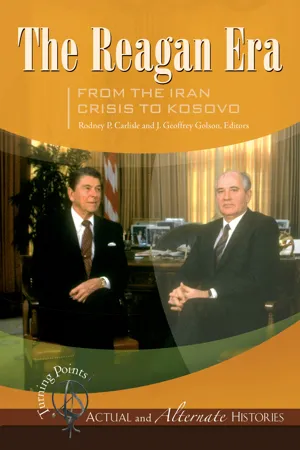 eBook - PDF
Turning Points—Actual and Alternate Histories
The Reagan Era from the Iran Crisis to Kosovo
- Rodney P. Carlisle, J. Geoffrey Golson, Rodney P. Carlisle, J. Geoffrey Golson(Authors)
- 2007(Publication Date)
- ABC-CLIO(Publisher)
8 Roe v. Wade What if Reagan had appointed Supreme Court justices who had unraveled parts of Roe v. Wade? INTRODUCTION Perhaps no single social issue draws as much political attention in the United States as abortion. Ever since the beginning of the women’s movement in the 1960s, abortion has been a focal point in almost every state and national election. Candidates for many political and judicial offices must define their positions in relation to abortion law. Many vot- ers choose a candidate because of his or her stance on this single issue. The role that the U.S. government should play in creating and enforcing abortion laws has been in contention for decades. Prior to the 1970s, abor- tion was generally considered a state issue. State legislatures made laws regarding abortion, and state courts tried cases related to those laws. The fed- eral government avoided the creation of abortion legislation, viewing the issue as one suitable for the states to control. The inequities between state laws meant that in a few states, it was possible for a woman seeking an abor- tion during her first trimester to find a legal abortion provider. In most states, though, it was impossible for a woman to get a legal abortion at any point in a pregnancy unless the pregnancy jeopardized her life. Many women in these states turned to illegal providers, who were willing to perform abortions while charging high fees. Without legal oversight, women suffering compli- cations from such abortions found it hard to get medical treatment or to sue for malpractice. Poor women suffered even more from these restrictive laws. Without the money to pay for illegal abortions, they were left to continue their unwanted pregnancies or to try to induce their own miscarriages. As women gained political and economic power in the 1960s and 1970s, the issue of abortion became a national focus.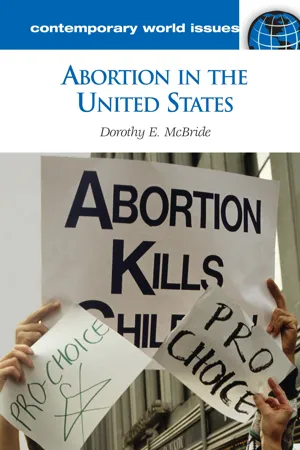 eBook - PDF
Abortion in the United States
A Reference Handbook
- Dorothy E. McBride(Author)
- 2007(Publication Date)
- ABC-CLIO(Publisher)
Both sides publicly criticized the ruling. Perhaps that meant the Court had struck a compromise between the women’s rights and liberty and the fetus’s right to life. The rul- ing and the opinions were complicated. No opinion was signed by a majority of the justices, but there was an outcome: 1. A majority of the justices confirmed the Court’s central ruling in Roe v. Wade: “a recognition of the right of the woman to choose to have an abortion before viability and to obtain it without undue interference from the state” (505 U.S. 833, 846). 2. A plurality of the justices agreed that the trimester framework was no longer in force. The place to draw the line with respect to states’ power to prohibit abor- tion would be viability. 3. Justices agreed that prior to viability the state could put administrative hurdles in place as long as these did not Constitutional Legality of Abortion 39 constitute an “undue burden” on a woman’s liberty. “A finding of an undue burden is a shorthand for the con- clusion that a state regulation has the purpose or effect of placing a substantial obstacle in the path of a woman seeking an abortion of a nonviable fetus” (505 U.S. 833, 877). The Planned Parenthood v. Casey decision cooled the turmoil over Roe v. Wade for more than a decade. Pro-choice leaders pur- sued the FOCA, but many members of Congress did not want to go on record for a woman’s right to choose. At the same time President Bill Clinton appointed two pro-Roe justices to the Court: Justices Steven Breyer and Ruth Bader Ginsburg. The movements went on to other debates until another pro-life pres- ident, President George W. Bush, took office in 2001. Activists cal- culated the ages of the justices, thinking about who would be likely to retire during the second Bush administration. The Contemporary Debate over Roe v. Wade In 2005 it turned out that one justice from each side of the divide—Justices O’Connor and Rehnquist—left the Court. eBook - ePub
The Street Politics of Abortion
Speech, Violence, and America's Culture Wars
- Joshua C. Wilson(Author)
- 2013(Publication Date)
- Stanford Law Books(Publisher)
1 Abortion Politics, Legal Power, and StorytellingWhen the United States Supreme Court decided the case of Roe v. Wade in January 1973, it simultaneously struck down state abortion laws and helped fuel the creation of the modern social conservative movement. Up through the early 1970s the legality of abortion was largely seen as a “Catholic issue.” That changed in the aftermath of Roe v. Wade .1 While it did not happen immediately, legalized abortion became a central issue for social conservatives who came to see Roe as a particularly morally intolerable example of the political Left once again marshaling the unelected federal judiciary to undo the popular will of the states.2In this line of conservative thinking, the Supreme Court, headed by Chief Justice Earl Warren, was seen as forcing racial integration, banning prayer and religion from public life, creating soft-on-crime policies, and liberating sexual taboos.3 This growing catalog of offenses helped bring Nixon’s “Forgotten Americans” to the polls in 1968, but even that was apparently not enough to stop the Court’s socially disruptive progressive trend. Nixon was almost immediately able to reform the Supreme Court in his first term with four judicial appointments, including Chief Justice, but the Court persisted in producing progressive rulings. Over two decades of controversial court cases and social turmoil had helped to move the Forgotten Americans and the “Silent Majority” to vote, but Roe v. Wade was the ruling that would mobilize a more sustained and not-so-silent movement.The anti-abortion movement has taken many forms in the four decades since.4 In the 1980s and 90s one of its identifying hallmarks was clinic-front activism. These protests took various forms, but collectively they served to publicize the cause, gain more members, give participants the feeling of empowerment via direct action, impede clinic access, and tax clinic resources. A less desirable outcome, from the anti-abortion perspective, was that this activism also spurred abortion-rights advocates to organize to directly counter these street-level tactics. While those fighting for abortion rights may have believed that they had reached their goal with the Roe decision, it quickly became clear that the Supreme Court case was just one step in a protracted and ongoing movement-counter-movement struggle.5 eBook - ePub
Family Values
Divorce, Working Women, and Reproductive Rights in Twentieth-Century America
- Isabel Heinemann, Alex Skinner(Authors)
- 2023(Publication Date)
- De Gruyter Oldenbourg(Publisher)
103 The Washington Post, on the other hand, published a critical article that addressed the value conflicts within the Catholic Church, commenting on them from a feminist perspective.104 It was in fact to be quite some time before feminists explicitly defended the law in the press, though the focus of their articles and op-eds was mainly on newly established abortion clinics.105Recent scholarship, however, has not only characterized the Supreme Court’s decision in Roe v. Wade as a liberal achievement, but has also pointed to its era-specific downsides. While Johanna Schoen describes Roe as a positive sign of the inclusion of legal abortion in women’s health care, Mary Ziegler views the decision as the beginning of a long process of reorienting the women’s movement toward “choice” as a form of “single-issue politics.”106 In contrast, Marc Stein criticizes the judges for pursuing a “classed, gendered, and racialized doctrine of heteronormative supremacy.”107 Roe, he contends, was aimed less at women’s reproductive autonomy than at their role in family, marriage, and society. Yet here Stein disregards the fact that in 1973 marriage and family still constituted the national normative lodestone of both politics and jurisprudence. Still, his observations highlight a fundamental problem in the women’s movement’s campaign for the right to abortion: for white activists, the practice had a quite different—exclusively positive—quality than for their African American or Mexican-born comrades-in-arms, who first had to struggle to achieve the right to reproduction itself.108 Stein also points out that although the Supreme Court justices based their decision on the “right to privacy,” they placed the final decision on abortion in the hands of the doctor.109 Detailing future abortion procedures in the first trimester of a pregnancy, the court stated: “the abortion decision and its effectuation must be left to the pregnant woman’s attending physician.”110 eBook - PDF
- J. Gelb(Author)
- 2003(Publication Date)
- Palgrave Macmillan(Publisher)
Chapter 4 Reproductive Rights Policy in the United States and Japan Introduction I n this chapter, the impact of the landmark abortion Supreme Court decision Roe v. Wade (410 US 113; 1973) on reproductive rights policy in the United States will be assessed and compared with related policy in Japan. The historic ruling, which legalized abortion nationwide in the fifty American states, had unforeseen consequences resulting in mobilization and polarization, which have persisted during the ensuing decades. In contrast to Japan, where relatively free access to abortion was a legacy of the post-war period, in the United States a recip- rocal dynamic was created in which exclusive moral perspectives and identity politics prevented compromise, despite the continued activism of the feminist movement on this issue, considered “the core” concern for many (Warren, 2001). Unlike in the United States, however, and in contrast to the case of abortion policy, the politics of contraception in Japan proved more contentious and less easy to resolve, making Japan the only nation with legal abortion but no legal con- traceptive pill as late as 1990 (Gelb, 1996, 121). This situation was finally altered in 1999. In the Japanese context, it is necessary to explore the reasons for the apparent contradiction between abortion and contraceptive policies. The former has been liberal since 1948, though not without conflict, and the latter conserva- tive, limiting access to the low-dose birth control pill. The American women’s movement has had to remain on the defensive with regard to the erosion of abortion rights, sometimes leading to neglect of other issues and constrained resources and strategies. Contending forces, the pro- and anti-choice movements, rooted in collective identities reflecting differing ideolo- gies and cultures as well as symbolic and real issue divides, have been unable to resolve conflicting values and norms (Johnson, Larana and Gusfield, 1994, 7). No longer available |Learn more
- (Author)
- 2014(Publication Date)
- White Word Publications(Publisher)
________________________ WORLD TECHNOLOGIES ________________________ Chapter 8 Abortion in the United States Abortion in the United States has been legal in every state since the United States Supreme Court decision in Roe v. Wade , on January 22, 1973. Prior to Roe, there were exceptions to the abortion ban in at least 10 states; Roe established that a woman has a right to self-determination (often referred to as a right to privacy) covering the decision whether or not to carry a pregnancy to term, but that this right must be balanced against a state's interest in preserving fetal life. Roe established a trimester system of increasing state interest in the life of the fetus corresponding to the fetus's increasing viability (likelihood of survival outside the uterus) over the course of a pregnancy, such that states were prohibited from banning abortion early in pregnancy but allowed to impose increasing restrictions or outright bans later in pregnancy. That decision was modified by the 1992 case Planned Parenthood v. Casey , which upheld the central holding in Roe that there is a fundamental right to privacy encompassing the decision about abortion, but replacing the trimester system with the point of fetal viability (whenever it may occur) as defining a state's right to override the woman's autonomy. Casey also lowered the legal standard to which states would be held in justifying restrictions imposed on a woman's rights; Roe had held this to be strict scrutiny - the traditional Supreme Court test for impositions upon fundamental Constitutional rights - whereas Casey created a new standard referring to undue burden, specifically to balance the state's and the woman's interests in the case of abortion. eBook - PDF
Abortion and the Law in America
Roe v. Wade to the Present
- Mary Ziegler(Author)
- 2020(Publication Date)
- Cambridge University Press(Publisher)
22 18 Roe v. Wade and the Rise of Rights Arguments Feminist organizations, like the National Organization for Women (NOW) and the Women’s National Abortion Action Coalition (WONAAC), argued that legal abortion would benefit women by allowing them to participate more equally in the life of the nation. Founded in 1966, NOW initially focused on issues like workplace sex discrimination and sex stereotypes in the media. Following an intense internal debate, NOW endorsed abortion repeal in 1967. Founded by socialist feminists, WONAAC organized in 1971 to campaign for abortion law repeal. Groups like NOW and WONAAC described abortion as a civil right for women. At the same time, NOW and WONAAC members emphasized the benefits women would gain if they chose when to carry a pregnancy to term. Other single-issue groups focused on the issue of abortion repeal. Organized in 1969, NARAL included population controllers, feminists, and physicians who prioritized repeal for different reasons. New members of the repeal movement often believed that women should have the ability to end their pregnancies without having to justify themselves to lawmakers or physicians. 23 Legal changes strengthened the repeal movement. State and federal courts alike began recognizing constitutional abortion rights. In 1969, the California Supreme Court struck down a criminal abortion law by reasoning that “the fundamental right of the woman to choose whether to bear children follows from the Supreme Court’s and this court’s repeated acknowledgment of a ‘right of privacy’ or ‘liberty’ in matters related to marriage, family, and sex.” In 1972, in Abele v. Markle, a federal district court in Connecticut reached a similar decision. Antiabortion attorneys also scored victories in state courts. Favorable judicial decisions increased the appeal of consti- tutional arguments for and against legal abortion. eBook - ePub
The Abortion Rights Controversy in America
A Legal Reader
- N. E. H. Hull, Williamjames Hoffer, Peter Charles Hoffer, N. E. H. Hull, Williamjames Hoffer, Peter Charles Hoffer(Authors)
- 2018(Publication Date)
- The University of North Carolina Press(Publisher)
CHAPTER 4
…Roe v. Wade before the High Court
Roe v. Wade had the company of other abortion cases making their way toward the U.S. Supreme Court in 1971. Of the other cases on appeal, one from Georgia also caught the attention of the justices. In Doe v. Bolton abortion rights advocates were challenging a “reform” statute with a much broader therapeutic exception than Texas allowed. The federal district court panel in Georgia had struck down the statute for much the same reasons as the federal district court panel in Texas, and both sides in Doe appealed to the High Court for the same reasons as both sides in Roe .In the meantime, another doctor prosecuted for performing an abortion in Texas had appealed his case to the state supreme court. The state supreme court upheld the prosecution, ignoring the federal district court ruling in Roe . In Thompson v. State (1971), the court held that “the State of Texas has a compelling interest to protect fetal life” and that the state’s law was not in violation of the federal Constitution. What was more, the state court insisted that the definition of human life was for the state legislature and not the federal courts to determine. The physician’s abortion conviction was affirmed.Thus the federal court’s refusal to enjoin Texas from prosecuting doctors under its law had become a live issue—just as plaintiffs in Roe had feared. Moreover, the Texas authorities’ defiance of the federal court ruling raised the specter of massive resistance by southern state legislatures and courts to federal court orders in desegregation and other civil rights, a defiance that had infuriated the High Court. The abortion rights cases would thus touch more than abortion and women’s rights issues. They raised questions of federalism (federal government–state government relations) and separation of powers among the branches of government (legislatures versus courts).Roe v. Wade and Doe v. Bolton eBook - PDF
Abortion Regret
The New Attack on Reproductive Freedom
- J. Shoshanna Ehrlich, Alesha E. Doan(Authors)
- 2019(Publication Date)
- Praeger(Publisher)
However, the Roe court instead chose to reason about these laws as if their sole aim was the protection of fetal life, thus missing a critical opportunity to examine their gender- coercive function. It is our view that the Roe court’s elision of the gendered work that these laws were enacted to accomplish in favor of a fetal-focused narrative arc has served to blunt the full weight and meaning of the new The Evolving Legal Status of Abortion 41 pro-woman/pro-life antiabortion position. As we develop in the remaining chapters of this book, this approach is not new, but rather, it resurrects and repackages this earlier essentialized and flattened conception of women’s place in a fixed gendered order. †† ROE V . WADE: THE COUNTERMOBILIZATION The public reaction to the Roe decision was swift and impassioned. Needless to say, for abortion rights supporters, the day was one of cele- bration. Although the victory was somewhat tempered by the court’s fail- ure to declare abortion an absolute right within the sole control of women, this did not overshadow the importance of its sweeping invalidation of all existing state criminal abortion laws. By locating the abortion right within the protective mantle of the federal Constitution, the decision was a wholesale repudiation of the legal regime that Storer and his colleagues had worked so hard to install only a century earlier. It, of course, goes without saying that opponents of abortion had a very different reaction to the decision. As Kristin Luker explains, those who believed that abortion was tantamount to murder had assumed theirs was the majority position. They accordingly experienced the Roe decision as a “bolt from the blue,” which challenged their fundamental belief that “the embryo was human life as valuable as any.” 44 Additionally, by making moth- erhood optional, the decision was also experienced as a deeply unwelcome assault on the traditional family, and women’s pivotal role within it.
Index pages curate the most relevant extracts from our library of academic textbooks. They’ve been created using an in-house natural language model (NLM), each adding context and meaning to key research topics.

