Politics & International Relations

Gideon v. Wainwright
"Gideon v. Wainwright" was a landmark U.S. Supreme Court case in 1963 that established the right to legal counsel for criminal defendants who are unable to afford an attorney. The ruling held that state courts are required to provide counsel in criminal cases for defendants who cannot afford their own representation, ensuring fair trials and due process for all individuals.
Written by Perlego with AI-assistance
Related key terms
1 of 5
3 Key excerpts on "Gideon v. Wainwright"
 eBook - ePub
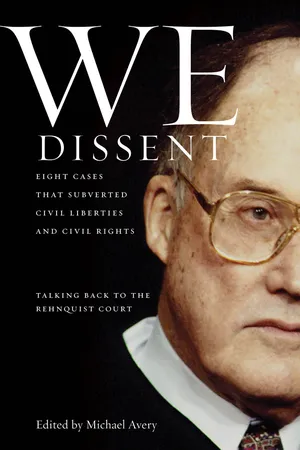
We Dissent
Talking Back to the Rehnquist Court, Eight Cases That Subverted Civil Liberties and Civil Rights
- Michael Avery(Author)
- 2009(Publication Date)
- NYU Press(Publisher)
6The 1963 Gideon decision is the starting point—and the high-water mark—for any discussion of the right to counsel. Unlike other Warren Court criminal procedure decisions, Gideon enjoyed support across the ideological spectrum when it was decided and remains uncontroversial today. Most Americans would find it unthinkable to face serious criminal charges without a lawyer.7Gideon occupies a special place in our law and culture in part because it is a classic American story.8 Clarence Earl Gideon, a poor drifter who had been in and out of jail, was charged with breaking and entering into a pool hall. He denied the crime. When his case was called to trial, he asked the court to appoint a lawyer because he had no money to hire one himself. The court denied his request, and Gideon reluctantly went to trial without a lawyer. He was quickly convicted and sentenced to five years in prison.From prison, Gideon sent a handwritten note to the Supreme Court asking that it hear his case. Against the odds—for many prisoners write such pleas—the Justices agreed. The Court appointed Abe Fortas, one of the country’s most prominent lawyers, to represent Gideon.9 On March 18, 1963, the Court overruled an earlier decision guaranteeing counsel only in capital cases and held that there could be no fair trial in serious cases without a right to counsel for the defendant.It is sometimes easy to forget the difference good counsel can make. At his new trial, Gideon was represented by an experienced court-appointed lawyer. He was acquitted.10Gideon promised so much. But the vision of a “vast, diverse country in which every man charged with crime will be capably defended, no matter what his economic circumstance, and in which the lawyer representing him will do so proudly, without resentment at an unfair burden, sure of the support needed to made an adequate defense,” has not come to pass.11 As one commentator observed, “No constitutional right is celebrated so much in the abstract and observed so little in reality as the right to counsel.”12 eBook - PDF
The Defender
The Battle to Protect the Rights of the Accused in Philadelphia
- Edward W. Madeira Jr., Michael D. Schaffer(Authors)
- 2020(Publication Date)
- Temple University Press(Publisher)
Gideon then represented himself at trial, lost, and was given a five-year prison sentence. In 1962, he penciled a handwritten appeal to the U.S. Supreme Court, claiming he was entitled to counsel under the due process clause of the Four-teenth Amendment—the same position that the court had rejected in Betts. This time, the justices—seven of them newcomers to the court since Betts and two who had dissented—agreed that penniless defen-dants facing felony charges should come under the protection of the Fourteenth Amendment. In Gideon v. Wainwright they voted unani-mously to overturn Betts . 8 The State of Florida retried Gideon after his successful appeal, but this time he was represented by counsel and was acquitted. Three other Supreme Court decisions in the 1960s would amplify the rights of defendants and profoundly affect the Defender’s role in the criminal justice system: Mapp v. Ohio (1961), 9 Escobedo v. Illinois (1964), 10 and Miranda v. Arizona (1966). 11 Mapp forbade the use of AFTER GIDEON | 27 illegally obtained evidence in state court prosecutions. It gave lawyers a tool, the exclusionary rule, for enforcing the constitutional prohibi-tion of unlawful search and seizure. (The bride of a young Defender Association volunteer came to court in 1961, post-Mapp , curious to watch her new husband at work. She was impressed to see him get one case dismissed on grounds that the evidence was illegally obtained. She was even more impressed when she heard the defendant exclaim, as he got into a City Hall elevator on his way to unexpected freedom: “I don’t know what happened in there because I was guilty as hell.”) 12 Escobedo defined the right of suspects to have counsel present during interroga-tion but was quickly eclipsed two years later by Miranda , which re-quired that criminal suspects be informed at the time of arrest of their right to remain silent and have counsel, including free, court-appointed counsel if they were indigent. eBook - ePub
Chasing Gideon
The Elusive Quest for Poor People's Justice
- Karen Houppert(Author)
- 2013(Publication Date)
- The New Press(Publisher)
With him gone, Betts was clearly in jeopardy. Gideon stood a good chance of winning. Finally, on January 15, 1963, the Supreme Court heard oral arguments in Gideon v. Wainwright. Everyone in the legal community understood the huge ramifications of this decision—and all eyes were on the court. The morning before, Bruce Jacob had to arrange for his admission to the Supreme Court Bar—a prerequisite to arguing before the court. A lawyer is eligible only after three years practicing in a state’s highest court. Jacob barely made the requirement. Meanwhile Fortas, who had argued before the U.S. Supreme Court on numerous occasions, used his casual Tennessee twang to soften his sharp arguments. He began by assuring the judges that they were deciding an easy, “narrow” issue. “The question, of course, is the right of accused in State criminal proceedings to the appointment of counsel. . . . In the present case which you have before you, the question is an exceedingly narrow one,” he began. “The question in the present case is whether. . . the accused being concededly indigent, it is the duty of the State to accede to that request and to appoint counsel.” 28 He went on to build his case by explaining why the Betts Rule did not apply, and yet had, in any case, become completely obsolete. “This record. . . does not indicate that Clarence Earl Gideon is a man of inferior natural talents,” he said. “This record does not indicate that Clarence Earl Gideon is a moron or a person of low intelligence. This record does not indicate that the judge of the trial court in the state of Florida, or that the prosecuting attorney in the state of Florida, was derelict in his duty. On the contrary, it indicates that they tried to help Gideon. But to me, if the Court please, this record indicates the basic difficulty with Betts against Brady
Index pages curate the most relevant extracts from our library of academic textbooks. They’ve been created using an in-house natural language model (NLM), each adding context and meaning to key research topics.

