History

Loving v Virginia
"Loving v. Virginia" was a landmark civil rights case in which the U.S. Supreme Court declared laws prohibiting interracial marriage unconstitutional. The case involved Richard and Mildred Loving, a white man and a black woman who were convicted under Virginia's anti-miscegenation laws. The Court's ruling in 1967 invalidated such laws nationwide, affirming the right to marry regardless of race.
Written by Perlego with AI-assistance
Related key terms
1 of 5

5 Key excerpts on "Loving v Virginia"
 eBook - ePub
Race, Sex, and the Freedom to Marry
Loving v. Virginia
- Peter Wallenstein(Author)
- 2014(Publication Date)
- University Press of Kansas(Publisher)
CHAPTER 6Loving v. Virginia and the US Supreme Court
Richard Loving, a private and taciturn man, put more words together for public consumption than usual after the Virginia Supreme Court ruled against him and Mildred in March 1966. Now they would have to take their appeal to the nation’s highest court. “We have thought about other people,” he told a reporter in Richmond, “but we are not doing it just because someone had to do it and we wanted to be the ones. … We are doing it for us — because we want to live here,” in Virginia. He was not discounting the broader significance of their action and its possible success, but that was not what animated him or his bride, although Mildred Loving told Hope Ryden that her family could always go back to DC but she saw the importance to others of their pursuing “the principle” of it all. This was no contrived case. It came, as great constitutional cases generally do, out of real world concerns, in which someone’s life, liberty, or property turned on the outcome.First the Lovings had to convince the nation’s highest court even to hear their case. In their jurisdictional statement to the Court, attorneys Bernard Cohen and Philip Hirschkop began with facts that would have been unavailable even three years earlier. The Civil Rights Act of 1964 and the Voting Rights Act of 1965 were both on the books, they noted, so “the elaborate legal structure of segregation has been virtually obliterated with the exception of the miscegenation laws.” As for those remainders from the panoply of Jim Crow statutes, they went on, “There are no laws more symbolic of the Negro’s relegation to second-class citizenship. Whether or not this Court has been wise to avoid this issue in the past, the time has come to strike down these laws; they are legalized racial prejudice, unsupported by reason or morals, and should not exist in a good society.”As the Court considered whether to hear the case, Justice John Marshall Harlan’s clerk said it another way. “The miscegenation issue … was left open in McLaughlin
- Robin Fretwell Wilson(Author)
- 2018(Publication Date)
- Cambridge University Press(Publisher)
5 Id. at 417. 564 Anthony Michael Kreis same-sex marriage are comparable to the 34 states that permitted interracial marriage when the Supreme Court decided Loving. If the majority in this case is waiting for a tipping point, it seems to have arrived. 6 Judge Sutton’s and Judge Daughtrey’s colloquy on family law history, tipping points, judicial restraint, and capacity to change minds suffers from a glaring analytical weakness. Neither opinion develops a comparative analysis of family law’s evolution on the question of same-sex marriage and its evolu- tion on interracial marriage. 7 Indeed, both Sixth Circuit opinions leave two questions unanswered: how did family law develop in the crucial twenty years prior to Loving v. Virginia, and how does the historical record square with our understandings of courts’ role in the evolution of family life? Examining past developments around marriage and family can help with the questions looming on the horizon: whether to recognize polygamous families; whether and what remedies non-marital families should have avail- able to them; and who should speak for family members on important ques- tions such as medical care or end-of-life decisions. Section I describes the law of interracial marriage in the U.S. before Loving v. Virginia to set context for assessing the role of courts versus legislatures in effecting social change and more expansive understandings of family. Section II describes the groundbreaking litigation to constitutionalize interracial mar- riage rights, beginning with a pivotal decision from the California Supreme Court, Perez v. Sharp, which struck California’s interracial marriage ban. Section III describes the impact of decisions by state courts on efforts to mobilize legislators to enact legislation affirming the right of interracial couples to marry. Section IV documents the successful legislative efforts to remove most interracial marriage bans in the states before Loving. eBook - ePub
Blue Laws and Black Codes
Conflict, Courts, and Change in Twentieth-Century Virginia
- Peter Wallenstein(Author)
- 2013(Publication Date)
- University of Virginia Press(Publisher)
Other Virginians had spent years in prison for breaking that law, and now it looked like two more people would join their ranks. The Lovings were terrified at the prospect. They were free while awaiting their trial, but a trial nonetheless loomed. Not only was there no way to turn the clock back to May, they would not have wanted to. They wanted to be married, and they wanted to live together in peace in their rural community. Richard Loving had thought they could do both if they went out of state to marry, but they discovered that the same law banning their getting married in Virginia also outlawed their living together there as an interracial married couple, expressly so if they had briefly left the state to evade the law that prevented their marrying each other in Virginia.Virginia was by no means alone in maintaining a law—termed a “miscegenation” law—against marriages between people identified as white and other people, especially African Americans but sometimes also Asian Americans and Native Americans. From 1913 to 1948 thirty states had miscegenation laws on the books (map 1), and as late as 1958, when the Lovings were arrested, twenty-four of the forty-eight states retained such laws. The last of those states outside the South dropped theirs in 1965.2 Retaining such laws were all seventeen states of the Deep South, the Upper South, and the Border South (map 2): all eleven states of the former Confederacy plus Delaware, Maryland, Kentucky, Missouri, Oklahoma, and West Virginia.The prospect of successfully challenging the Virginia law’s constitutionality was not bright, though court challenges had occasionally succeeded in other states. In the history of the Republic, four state supreme courts ruled against the constitutionality of a miscegenation law. During Reconstruction, in the 1870s, three states did so—Alabama, Louisiana, and Texas—before reversing themselves, restoring such statutes, and leaving them in place, where they remained until 1967. In 1948, by a 4–3 vote, the California Supreme Court did so, but no other state supreme court followed, in or out of the South.3 eBook - PDF
Racializing Justice, Disenfranchising Lives
The Racism, Criminal Justice, and Law Reader
- M. Marable, K. Middlemass, I. Steinberg(Authors)
- 2007(Publication Date)
- Palgrave Macmillan(Publisher)
However, Ham Say Naim, who was seeking American citizenship, which depended on his marriage to an American citizen, challenged the verdict, stating that it violated his rights under the Fourteenth Amendment. Nevertheless, similar to the Lovings, who would use the same argument ten years later, the Virginia Supreme Court unanimously ruled against Ham Say Naim. Yet, unlike with the Lovings, the U.S. Supreme Court refused to hear the case. Subsequently, in the 1964 Supreme Court case of McLaughin v. Florida, in which a white woman and black man were arrested for unlawful cohabi- tation, the justices, though not overturning antimiscegenation laws, unanimously voted to overturn the couple’s conviction, stating that “a state could not use the law that specifies race to keep people from living together.” 23 By the time the Loving case reached the high court, twenty of the thirty-one states that had once enforced antimiscegenation laws had repealed them. However, eleven states, all in the south, remained steadfast in their position against mixed-race mar- riages. Realizing that they could no longer hold off on ruling on the question of marriage across color lines, the Supreme Court agreed to hear the Loving case on December 12, 1966. Both sides presented their arguments on April 10, 1967. On June 12, 1967 the high court handed down its decision, which overturned the Lovings’ conviction and declared antimiscegenation laws unconstitutional. One Caroline County leader didn’t mince words when citing the effect of the high court’s verdict, “The power boys in the county despised Richard because he ended the white man’s moonlighting in romance. Now they got to cut out this jive of dating Negro women at night and these high yaller Negroes got to face up to the facts of life.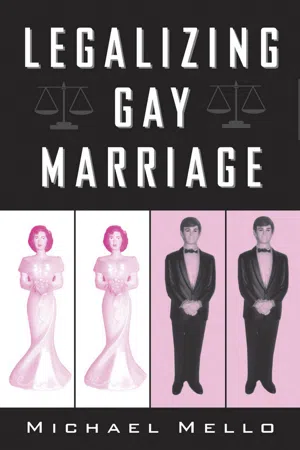 eBook - PDF
Legalizing Gay Marriage
Vermont And The National Debate
- Michael Mello(Author)
- 2008(Publication Date)
- Temple University Press(Publisher)
of them, a survivor of them, has the right to Social Security benefits. All of these are denied to them. The enormity of the injustices involved under this statute merely serves as indicia of how the civil liabilities amount to a denial of due process to the individuals involved. As I started to say before, no matter how we articulate this, no matter which theory of the due process clause, or which emphasis we attach to it, no one can articulate it better than Richard Loving, when he said to me: “Mr. Cohen, tell the Court I love my wife, and it is just unfair that I can’t live with her in Virginia.” I think this very simple layman has a concept of fundamental fairness, and ordered liberty, that he can articulate as a bricklayer, that we hope this Court has set out time and time again in its decisions on the due process clause. 128 Peter Irons described the outcome in Loving v. Virginia : On June 2nd, 1967, Richard and Mildred Loving celebrated their ninth wedding anniversary. Ten days later, the Supreme Court added a pres-ent. The Lovings—and their kids—could sleep without any worries that Sheriff Brooks would drag them out of bed. Like the Brown [v. Board of Education] case, Loving v. Virginia was unan-imous. And like Brown, Chief Justice Warren spoke for the Court. His opinion was short and blunt. Virginia’s law against racially mixed mar-riages violated two provisions of the Fourteenth Amendment. The equal protection clause bans racial laws that do not serve a “permissible state objective.” The state’s only purpose, Warren said, was “to maintain White Supremacy.” The law also violated the due process clause, which protects the right of liberty. That right includes the “fundamental freedom” to marry, without restriction on race. The Lovings were thrilled with their anniversary present. “I feel free now,” Mildred said. “It was a great burden.” Rich was relieved.
Index pages curate the most relevant extracts from our library of academic textbooks. They’ve been created using an in-house natural language model (NLM), each adding context and meaning to key research topics.

