History

Post Reconstruction South
The Post-Reconstruction South refers to the period following the Reconstruction era in the United States, roughly from the late 1870s to the early 1900s. This era was characterized by the rise of Jim Crow laws, which enforced racial segregation and disenfranchisement of African Americans, as well as the emergence of sharecropping as a dominant economic system. It was a time of significant social and political upheaval in the southern states.
Written by Perlego with AI-assistance
Related key terms
1 of 5
8 Key excerpts on "Post Reconstruction South"
 eBook - ePub
Sharing the Prize
The Economics of the Civil Rights Revolution in the American South
- Gavin Wright(Author)
- 2013(Publication Date)
- Belknap Press(Publisher)
CHAPTER 2THE POLITICAL ECONOMY OF THE JIM CROW SOUTHAbolition of slavery in the United States was swift and thorough, in contrast to other emancipations cushioned by gradualist timetables, compensation, or periods of apprenticeships. Slaves in the rebellious states were legally freed by the Emancipation Proclamation on New Year’s Day 1863, and this radical step was reaffirmed by the Thirteenth Amendment to the U.S. Constitution in 1865 and by the first state postwar constitutions under Presidential Reconstruction. The Fourteenth Amendment, granting citizenship and equal protection of the laws to freedmen, was ratified in 1868; the Fifteenth Amendment, prohibiting denial of the vote on the basis of “race, color or previous condition of servitude,” passed in 1870. Although these measures seemed definitive and were intended to be so at the time, the political and economic character of the postemancipation South was hotly contested for a full generation thereafter.It would not be accurate to say that the region settled into a new form of slavery. Labor mobility was high in the postbellum era, and the new systems of sharecropping and tenancy emerged as a kind of market-generated compromise between the freedmen’s goal of independence and the planters’ quest for cash crops. But the abandonment of plans to distribute land to the former slaves meant that blacks entered such contracts from a position of weakness. At the same time, high postwar cotton prices encouraged many smaller white farmers to take up cash-crop production. Subsequent stagnation in world cotton demand combined with high rates of population growth to bring blacks and many whites to a regional economic standard that was low relative to national norms. eBook - PDF
Reconstruction in the United States
An Annotated Bibliography
- David Lincove(Author)
- 2000(Publication Date)
- Greenwood(Publisher)
Regional Studies on Reconstruction in the South 255 Documents reveal the condition of cotton plantations and labor in 1865 and 1866 and show that the organization sought funding in the North and in Europe, particularly France. 1306. Woodman, Harold D. "The Economic and Social History of Blacks in the Post-Emancipation South." Trends in History 3 (Fall 1982): 37-56. In Woodman's bibliographic essay he discusses recent scholarship about the lives of freedmen after the Civil War, particularly regarding the meaning of freedom, labor, agriculture, education, and community. References are made to studies published from the 1860s to the early 20th century. He is encouraged by the growing number of works on social and economic history of black Americans. 1307. Woodman, Harold D. "Economic Reconstmction and the Rise of the New South, 1865-1900." In Interpreting Southern History: Historiographical Essays in Honor of Sanford W. Higgenbotham. Edited by John B. Boles and Evelyn Thomas Nolen. Baton Rouge: Louisiana State University Press, 1987. Pp. 254-307. Woodman's focus is broader than just Reconstmction because economic developments can only be interpreted over a longer period of time than the chronological bounds of political events. Citing literature since the early 1960s, he notes that the few economic interpretations that appeared have tended to argue that the results of the Civil War reflect either a continuity or a discontinuity in Southern history. Economic historians established race as a secondary factor in economic developments. More important were labor, market forces, and social relations between classes in the South. Woodman calls for more regional comparisons between the West and the South, and the study of the Southern economy within the broader context of American economic development. 1308. Woodman, Harold D. King Cotton and His Retainers: Financing and Marketing the Cotton Crop of the South, 1800-1925. Lexington: University of Kentucky Press, 1968. 386p.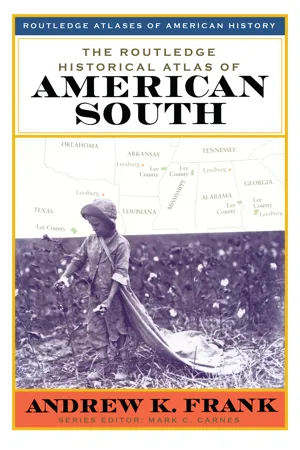
- Andrew Frank(Author)
- 2020(Publication Date)
- Routledge(Publisher)
For Douglass, Du Bois, and others, the most pressing issue after the American Civil War concerned the nearly four million former slaves who had recently obtained their freedom. Emancipation and citizenship—granted by the Thirteenth, Fourteenth, and Fifteenth Amendments—did not necessarily signify political, economic, or social equality for black Southerners. During the initial years of Reconstruction, President Johnson seemed unconcerned for the plight of the freedmen. Republican congressmen eventually wrested control from the executive branch and began to address some of the needs of Southern blacks. New policies protected the liberties of African-Americans and freed up federal funds to restructure the region. Southern blacks enjoyed access to the ballot box, and hundreds of black public officials were elected in the 1870s. Policies also protected the ability of Southern blacks to marry, file court cases, serve on juries, relocate, and obtain educations. African-American families who had been separated during slavery reunited, and thousands of former slaves formally changed their names to reflect their new freedom. In addition, Southern blacks formed independent churches, schools, fraternal organizations, equal rights leagues, and burial societies.The end of Reconstruction in 1877 was followed by a complete repudiation of these liberties. Southern blacks remained free in the New South era, but the meaning of this freedom was severely curtailed. Poll taxes, grandfather clauses, literacy tests, understanding clauses, and physical intimidation resulted in the complete disfranchisement of Southern blacks. Vagrancy laws restricted the mobility of blacks, and Jim Crow segregation laws brought racial inequality to nearly every aspect of Southern life. Interaction between the races was governed by an extensive code that expected blacks to be submissive, docile, and dependent. Lynchings and other forms of extralegal violence were used by Southern whites to enforce the region's new racial etiquette. Some blacks tried to escape the New South conditions by migrating north during World War I, but most African-Americans simply endured the postwar realities.The limited meaning of freedom for emancipated African-Americans resulted partly from the region's inequitable division of land. Black Southerners—with few exceptions—did not benefit from policies of land redistribution during Reconstruction or the New South. Former slaves received their freedom, but they primarily remained poor and landless. As a result, Southern blacks had few alternatives for employment other than working for the region's landed masters. Cultivation of cotton remained the region's central source of employment, and white landowners controlled this economic arena. The labor systems that emerged in the Reconstruction South and the New South—primarily sharecropping and tenant farming—brought black laborers and white landowners back together. In many ways, these labor systems resembled the Old South's system of slavery. White landowners limited the ability of their black fieldhands to negotiate better work conditions, and they used a system of debts to prevent their laborers from physically moving. AfricanAmericans attempted to shape this new labor system to their own desires by controlling their family's labor and by avoiding gang labor. Nevertheless, the inability of Southern blacks to purchase their own land severely curtailed their ability to make the New South look remarkably different from the Old. eBook - ePub
- Lacy Ford(Author)
- 2011(Publication Date)
- Wiley-Blackwell(Publisher)
Most of the historians writing about the postbellum reorganization of southern labor have been social historians. Although, like the economists, they have typically accepted the basic contours of the “standard scenario” of post-emancipation labor reorganization, differences of ideological orientation and disciplinary method have led them to strikingly different conclusions. To begin with the most obvious, in contrast to the predominant view among econometricians, social historians have been almost universally predisposed to interpret major historical developments as the outcome of the conflict between social groups rather than the decisions of individually oriented producers. The difference has been manifested most strikingly in the analyses of several historians who employed a Marxist framework. These scholars approached emancipation in the American South as part of a larger global trend toward the ascendancy of capitalist social relations. Within a year of the publication of One Kind of Freedom, two influential Marxist studies set forth such an interpretation and concluded that the prewar planter class had successfully preserved their control over labor and, as a result, postponed the triumph of liberal capitalism within the region. In The Roots of Black Poverty (1978), Jay R. Mandle attributed the persistent poverty of the former slaves to the survival of a low-wage plantation system after the Civil War. Events during the Reconstruction era demonstrated, in Mandle’s view, that the preservation of slavery was not essential to the preservation of the plantation system. Two factors were critical to its survival after emancipation: the failure of the federal government to distribute land among the freedmen, and the severely restricted employment opportunities for blacks in either southern or northern industry, due primarily to discriminatory hiring practices eBook - ePub
Remembering Reconstruction
Struggles over the Meaning of America's Most Turbulent Era
- Carole Emberton, Bruce E. Baker(Authors)
- 2017(Publication Date)
- LSU Press(Publisher)
2 It was not necessarily replaced by a new, celebratory memory of Reconstruction, but even an end to the old ways of commemorating Reconstruction could be counted a success of some sort. For an all-too-brief moment in the 1970s, South Carolina came closer than it ever had before—or has since—to creating a civic culture of racial inclusiveness that drew the support of the public, to having an economic system that was at least further from desperation than usual, and to telling a story of its own past that did not pivot around white unity on the basis of racial exclusion. Political and economic forces tore apart much of the foundation for that change during the 1980s and 1990s, but by then enough had changed that the white supremacist narrative of Reconstruction never found the level of public acceptance and was never officially endorsed by public figures as it had been up to the early 1960s. Perhaps that is all the progress we can hope for when considering the South in the late twentieth century.By the late 1960s, as plans for the Tricentennial were being formed, South Carolina was in the midst of a period of significant if subtle change. The civil rights movement had played out in dramatic form on the streets of Little Rock in the late 1950s, at lunch counters in Greensboro and around the South in 1960, at bus stations and city parks and university campuses across the Deep South, with prayers and hymns, police dogs and fire hoses and billy clubs, but throughout this, South Carolina had remained relatively calm. Yet changes beneath the surface would disrupt that calm in the last few years of the 1960s. South Carolina was more fortunate than many southern states in that older structures remained strong enough to contain disorder while new, more progressive structures emerged within them. In politics, the old rings and alliances maintained much of their strength, and the reformers and modernizers worked within them. By the time African Americans reentered politics in South Carolina, a fairly orderly transfer of power to a younger generation of Democrats had taken place, while the Republican Party had established itself as the home for those who opposed all forms of desegregation.3 In the economy as well, the textile industry remained strong, reaching its peak in the early 1970s, but even in this time of success, political leaders took strong steps to diversify the state’s industrial base and recruit foreign companies that would replace the “easy come, easy go” jobs of the textile industry when it eventually began to collapse in the early 1980s.4 eBook - PDF
The American Civil War
A Handbook of Literature and Research
- Steven E. Woodworth(Author)
- 1996(Publication Date)
- Greenwood(Publisher)
One final group of essays certainly worth reading is Frank McGlynn and Seymour Dreschar, eds., The Meaning of Freedom: Economics, Politics, and Culture after Slavery (1992). Several of its eleven essays deal with emancipation in the American South. Some describe what they consider to be the largely predetermined economic circumstances following emancipation in the South; others dwell on what might have been if America had not been a racist society. The most optimistic one concerning Federal policy during the Civil War and Reconstruction is Peter Kolchin's "The Tragic Era? Interpreting Southern Re- construction in Comparative Perspective." According to Kolchin, despite dra- matic changes in Reconstruction historiography, the Tragic Era concept remains a persistent theme of all schools of thought. But he disagrees with the idea. The birth of freedom was troubled everywhere, he argues—in Russia and in the Americas elsewhere. Comparison suggests that conditions for freedmen were better in the Southern United States than elsewhere. Segregated schools, for example, were far preferable to no schools at all. Compared to their previous status, he writes, the changed position of the freedmen was miraculous. Who could have predicted in the 1850s that within the next decade not only would 584 Reconstmction and Beyond slavery be abolished, but former slaves would be attending school, voting, and serving on juries. The works mentioned in this piece represent the latest findings of scholars while raising almost all the questions that have been asked about emancipation during the last one hundred years. Hardly any suggest that all would have been well for the freedmen if the South had been left alone. But they do point to a growing impression: that while much more could have been done by the national government for the freedmen—economically, educationally, and legally—there were no cure-alls available. eBook - PDF
- P. Scott Corbett, Volker Janssen, John M. Lund, Todd Pfannestiel, Paul Vickery, Sylvie Waskiewicz(Authors)
- 2014(Publication Date)
- Openstax(Publisher)
The South, which had experienced catastrophic losses during the conflict, was reduced to political dependence and economic destitution. This humiliating condition led many southern whites to vigorously contest Union efforts to transform the South’s racial, economic, and social landscape. Supporters of equality grew increasingly dismayed at Reconstruction’s failure to undo the old system, which further compounded the staggering regional and racial inequalities in the United States. Chapter 16 | The Era of Reconstruction, 1865–1877 451 16.1 Restoring the Union By the end of this section, you will be able to: • Describe Lincoln’s plan to restore the Union at the end of the Civil War • Discuss the tenets of Radical Republicanism • Analyze the success or failure of the Thirteenth Amendment The end of the Civil War saw the beginning of the Reconstruction era, when former rebel Southern states were integrated back into the Union. President Lincoln moved quickly to achieve the war’s ultimate goal: reunification of the country. He proposed a generous and non-punitive plan to return the former Confederate states speedily to the United States, but some Republicans in Congress protested, considering the president’s plan too lenient to the rebel states that had torn the country apart. The greatest flaw of Lincoln’s plan, according to this view, was that it appeared to forgive traitors instead of guaranteeing civil rights to former slaves. President Lincoln oversaw the passage of the Thirteenth Amendment abolishing slavery, but he did not live to see its ratification. THE PRESIDENT’S PLAN From the outset of the rebellion in 1861, Lincoln’s overriding goal had been to bring the Southern states quickly back into the fold in order to restore the Union (Figure 16.3). In early December 1863, the president began the process of reunification by unveiling a three-part proposal known as the ten percent plan that outlined how the states would return.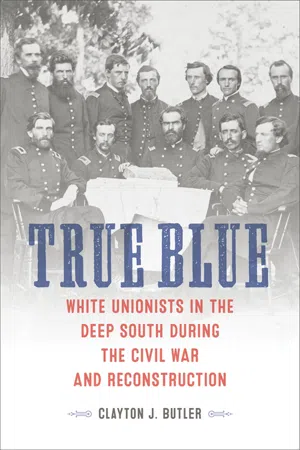 eBook - ePub
True Blue
White Unionists in the Deep South during the Civil War and Reconstruction
- Clayton J. Butler(Author)
- 2022(Publication Date)
- LSU Press(Publisher)
CHAPTER 5 Losing the Peace White Unionists in Presidential Reconstruction, 1865–1867W hite southern Unionists assumed a central role during Reconstruction and shaped the profound social and political fluctuations of the era in important ways. The experiences of former Unionists in that crucial and contentious period—their motivations, aims, and expectations—illustrate some of Reconstruction’s key dynamics. Unionists’ mistreatment by former Confederates helped galvanize the North to embrace Congressional Reconstruction, and many played notable political and civic roles based on their war record. They became judges, legislators, and governors, and moved in the highest circles of power; they were also called traitors to their race and became the victims of mob violence and the Klan. Some, finding common cause, allied themselves politically with newly emancipated African Americans; others refused to do so. By contributing to the “redemption” of their states by the Democratic Party, they helped ensure the resumption of white rule throughout the Deep South. Prominent Unionists, because of the stand they had taken and the risks they had run during the late conflict, expected a seat at the table in the postwar decision-making process, and many did indeed go on to make a substantial impact on their states and on the nation. Former Unionists remained an important, distinct group even after the crisis of the Union had come to an end, and proved pivotal to the trajectory of the postwar era.1To many observers throughout the reunited nation, white southerners who had stood by the Union at all hazards appeared the first and most natural component of a potential Republican constituency in the postwar South. Their wartime unity of purpose, however, proved illusory, and rapidly evaporated with the reestablishment of peace. The nucleus of unconditional Unionism that the administration had attempted to cultivate in the Deep South during the conflict failed to mature into a reliable base of white support during Reconstruction. Unionists for the most part remained deeply unpopular and greatly outnumbered among the white population. Divergent prewar political leanings among them reemerged and—critically for the party, the region, and the nation—white southern Unionists split in the postwar period, most commonly over the issues of disenfranchisement of former rebels and civil rights for African Americans. The sole foundation of their past cooperation had been their uncompromising Unionism, and with the integrity of the Union no longer at issue, that foundation quickly gave way to conflicting visions for its future. “Unionism . . .
Index pages curate the most relevant extracts from our library of academic textbooks. They’ve been created using an in-house natural language model (NLM), each adding context and meaning to key research topics.

