History

American Slavery
American slavery refers to the system of forced labor and exploitation of African people in the United States from the early 17th century until the end of the Civil War in 1865. Slavery played a central role in the economic, social, and political development of the nation, and its legacy continues to impact American society today, particularly in terms of racial inequality and systemic discrimination.
Written by Perlego with AI-assistance
Related key terms
1 of 5
12 Key excerpts on "American Slavery"
 eBook - PDF
Holy War and Human Bondage
Tales of Christian-Muslim Slavery in the Early-Modern Mediterranean
- Robert C. Davis(Author)
- 2009(Publication Date)
- Praeger(Publisher)
CHAPTER 2 RACE SLAVERY AND FAITH SLAVERY For most of us, slavery is about Black Africans and the trans-Atlantic slave trade that brought them from the Old World to the New. Though the 20th century has given us a long succession of gulags and lagers, the notion of slave labor, for most modern sensibilities, remains tied to slave ships, Caribbean sugar islands, and the plantations of the American South where this ‘‘peculiar institution’’ once so perniciously flourished. No wonder: it has left a deep mark on our historical con- sciousness. An estimated 20 million African men, women, and chil- dren were captured by the slavers between 1500 and 1880. Of these, barely half ever made it to the Americas, to the short and bitter exis- tence that awaited them; the rest, in confronting the relentless voyage west, died of disease, grief, or terror along the way. Many committed suicide rather than face life on the other side. Our modern imagina- tions may strain to envision the slave trade’s devastating impact on the once rich world of West Africa—the ruined villages, the devas- tated and depopulated nations that the slavers left behind, as they clear-cut their human prey from the land. We can more readily dis- cern slavery’s legacy in North and South America, where the millions of unwilling immigrants made new homes and gave their own cultural and physical presence to the New World. It is no surprise that this holocaust and the term slavery itself have conjoined and are likely to remain connected for centuries to come, as we struggle to work out the economic, political, and psychological implications of the largest involuntary migration in human history. Trans-Atlantic slavery was, of course, neither the only slavery in history nor the only slavery to touch our awareness. Anyone familiar with the Bible or the Classics has made intellectual, and perhaps emo- tional contact with slave societies operating on a vast scale, with their own ways of organizing the elements of bondage. eBook - PDF
- T. Adams Upchurch(Author)
- 2011(Publication Date)
- Greenwood(Publisher)
1 At the heart of the modern stereotype of slavery lies racism. Contrary to popular misconception, the belief that the white race was naturally superior and that the black race was therefore automatically inferior did not exist at the beginning of the African slave trade but rather evolved over a matter of centuries. The role that race and skin color played in American Slavery ultimately made it different from earlier forms of slavery and from forms practiced in other places at the same time. When it was fully evolved, the belief in white supremacy was responsible for the worst atrocities associated with slavery, culminating with the degradation of the legal status of blacks to essentially that of livestock in the Dred Scott ruling of the U.S. Supreme Court in 1857. To see how this evolution occurred, the history of slavery must be briefly traced from its origins outside the United States. Going back to ancient history, most cases of slavery had been caused by one of two things—debt or war. Creditors sometimes collected unpaid debts by taking a proverbial pound of flesh; if there were no more possessions to seize, they took the man who owed them the money, or a member of his family, as payment. In some cases, fathers resorted to selling their children to satisfy their unpaid financial obligations. These cases of slavery generally involved people from the same race, tribe, or nationality, and they created extreme caste structures in those societies in which the rich got richer and the poorest of the poor became slaves. War, however, typically introduced foreign slavery into a culture. Victors took their defeated foes captive, sometimes dragging them hundreds of miles away to the conquering tribe, nation, or empire’s homeland. Often, these wars were purely territorial in nature, and the aggressor enjoyed aggrandizement at the expense of neighbors. No longer available |Learn more
Racist America
Roots, Current Realities, and Future Reparations
- Joe R. Feagin, Kimberley Ducey(Authors)
- 2018(Publication Date)
- Routledge(Publisher)
10With much farm land available for new European immigrants, colonial entrepreneurs and development companies frequently could not secure enough white laborers. Thus, importation and enslavement of African women, men, and children not only stemmed from a desire for profit but also from a concern with developing a scheme of control that maintained bond-labor against the resistance of those enslaved. The color and cultural differences of Africans typically made them easier for whites to identify for purposes of profitable enslavement and sustained control.The Legal Establishment of Slavery
The first Africans brought into English colonies were bought by Jamestown colonists from a Dutch-flagged ship in 1619. Laws firmly institutionalizing slavery were not put in place in the English colonies until the mid-seventeenth century. Yet, even during the earliest decade, the 1620s, the Africans were treated differently from English colonists. As early as 1624, one court case made clear that a “negro”—note the early white naming of Africans and lowercase spelling—could testify in court only because he was a convert to Christianity. A “negro” status was already socially and legally inferior to a European colonist’s status.11 Historians have shown that Christianity in this period, as later, was dogmatic and Eurocentric in “ideology , organization, and practice.”12 In this 1624 example the Eurocentric viewpoint included the idea that a person must become a Christian to have legal rights. To the present day, many apologists for centuries of enslavement of African Americans have argued that one of the virtues of slavery was bringing this Christianity to those enslaved.Early on, the human degradation of this slavery was clear. In one 1671 declaration Virginia’s General Assembly put “sheep, horses, and cattle” in the same category as “negroes.” Colonial laws early on attempted to prevent black men and women from running away; there were barbaric laws encompassing the whipping, castration, or killing of those who were rebellious. Slavery meant more than coerced labor. Enslaved black men, women, and children were legally subjugated in or excluded from key areas of all major societal institutions, including economic, legal, and political institutions.13 eBook - PDF
American Slavery, American Imperialism
US Perceptions of Global Servitude, 1870–1914
- Catherine Armstrong(Author)
- 2020(Publication Date)
- Cambridge University Press(Publisher)
The use of indentured labour, for example, so-called coolies from India and China and the perpetua- tion of blackbirding in the Pacific, was a direct result of the abolition of the transatlantic slave trade, and of slavery itself. Many indivi- duals entangled in these systems of labour movement suffered terri- ble personal hardship resulting from their commodification. Some were coerced using physical or mental violence and their practical labouring experience differed little from chattel slavery. However, other migrants used labour shortages to their own advantage, will- ingly leaving troubling situations at home and choosing to move Global Contexts: US Perceptions of Slavery 69 long distances, on a temporary or permanent basis, to craft a better life for themselves and their families. By denying their identity as free people, those seeking to control, limit or end their migration emphasised the abusive and coercive nature of the labour migration system, not in order to protect these workers, but rather for protec- tionist and reactionary reasons to limit the numbers migrating. At the very end of the nineteenth century, in the context of this evolving complex global conception of slavery, the United States itself become an imperial nation, and, as in the European nations, slavery in the United States framed the national vision of empire, and was used both to encourage and discourage imperialist endea- vours. Of course, imperialism on both sides of the Atlantic was not an identical phenomenon and, for much of the nineteenth century, the United States was a reluctant imperialist and the country extracted principles from the Monroe Doctrine to justify isolationist policies, and looked inward to rebuild following the fratricidal hor- rors of the Civil War. While there was considerable intellectual cross-pollination by the political elites of both Britain and the United States, slavery did not function identically, rhetorically speak- ing, in both regions. eBook - ePub
Human Rights
An Introduction
- Darren O'Byrne(Author)
- 2014(Publication Date)
- Routledge(Publisher)
7Suffice it to say that a vast library of work has been carried out, primarily by historians, on chattel slavery as it existed in the United States prior to the Civil War. It is important to touch on some of this here. However, in so far as much of this was polemical in nature, we should treat it with care when addressing, as we shall below, some of the key sociological questions, such as those which relate to the role played by slavery as an institution within wider social, cultural, economic, and political conditions. Historians such as Ulrich Bonnell Phillips and those who followed him tended to discuss slavery not in terms of rights but in terms of its positive contribution to society, both as a means of social control, and also as an educational and civilising experience for the ‘inferior’ black slave.8 If such pro-slavery pieces tended to be somewhat sympathetic towards the plight of the slaves, there were also those which adopted a far more aggressive, racist view on the issue. In the early part of the twentieth century, social Darwinism was beginning to take form as an intellectual perspective. Of course, as the century progressed, so did the academic debate, with various reports and studies setting out to counter either (or both) the paternalistic pro-slavery literature or the biological-reductionist rants. In this respect, studies by Gunnar Myrdal and Kenneth Stampp are significant.9 However, as Stanley Elkins points out, even as thorough and ground-breaking a research project as that undertaken by Stampp could not escape from the agenda which had been set by the earlier writers — an agenda driven by moral polemic which betrayed ‘all the characteristics one might expect of white men who knew nothing of what it meant to be reared in slavery’.10 eBook - ePub
Inner-City Blues
Black Theology and Black Poverty in the United States
- Darvin Anton Adams(Author)
- 2023(Publication Date)
- Cascade Books(Publisher)
216 Wright’s analysis is helpful to Baptist’s argument that slave labor built and developed the American economy. The massive number of African slaves brought to the United States signifies an exponential amount of hardcore slave labor in various regions of the country.Concerning the other half of the story of how slavery evolved over time and numerous generations of African ancestors and African American families, Baptist states that “Slavery’s story gets told in ways that reinforce all these assumptions.”217 The story of slavery often time fails to mention that African slaves had already become an economic enterprise by the time they arrived in Virginia in 1619 . J. Deotis Roberts affirms that, “Slavery became an established institution in the New World. Consequently, an abundant supply of slaves was demanded by numerous business-minded, slave masters. Forts and bases were established along the Ivory Coast and other outlets to the sea. Slaves were captured through raids in the interior, or through wars between the tribes instigated by the slavers. In exchange for slaves the Europeans brought fabrics, copper, glass, and firearms for the African kings.”218 With the introduction of sugar and the opening up of the Western hemisphere to European conquest at the end of the fifteenth century, the volume of slaves increased significantly.219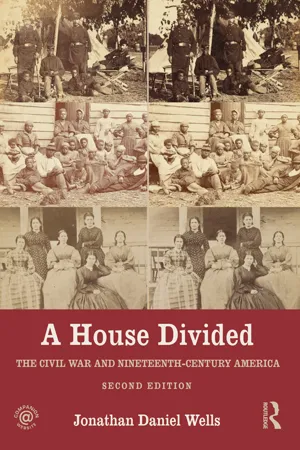 eBook - ePub
A House Divided
The Civil War and Nineteenth-Century America
- Jonathan Wells(Author)
- 2016(Publication Date)
- Routledge(Publisher)
The African slave trade is one of the darkest stories in human history. The ruthlessness with which men and women of all ages were forcibly transported to the New World is stunning. Yet the slave trade did not begin with the opening of the Americas in the 1600s. Europeans had owned slaves (both white and black) long before the beginning of American colonization. In ancient civilizations in Egypt, Greece, and Rome, slavery was an important part of the economy and society. Africans themselves had been active for hundreds of years in capturing other Africans and selling them into slavery. But slavery meant different things at different times, and scholars have discovered that the concept of slavery is a complicated one. If you are used to thinking of slaves as agricultural laborers, you might be surprised to find that in world history, slaves were often soldiers, government officials, wives, concubines, and tutors, and that some societies even allowed their slaves to participate in politics.Despite the long and sad history of human slavery, bondage seemed particularly brutal in the New World. The first colonists and traders to bring Africans to the Americas were the Spanish and Portuguese, who used them to replace or supplement the dwindling numbers of Indian slaves toiling in Caribbean colonies. Large plantations, some with thousands of slaves, grew sugar and other crops. Jamaica, Haiti, Cuba, Bermuda, and other islands were the centers of the slave trade in the New World. Slavery in the Caribbean was brutal, with punishments swift and harsh on large sugar plantations or in mining operations. Tens of thousands of slaves also went to South America, particularly Brazil, which in the 1880s became the last country in the western Hemisphere to outlaw slavery. In fact, after the South lost the Civil War many southerners moved to Brazil, carrying their slaves with them, and reestablished their plantations where a community of descendants from the American South lives to this day. Slavery, therefore, was not confined to the colonial South; it was a worldwide practice that had involved many of the world’s leading nations, and had spread to the New World particularly rapidly. eBook - ePub
From Gulag to Guantanamo
Political, Social and Economic Evolutions of Mass Incarceration
- Wesley Kendall(Author)
- 2015(Publication Date)
- Rowman & Littlefield(Publisher)
The sordid history of men exploiting and enslaving other men in pursuit of profit is an unfortunately long one and transcends all cultural, geographic and racial boundaries. The revelatory moment in which early man first understood the nature of the freedom he possessed is unfortunately obscured by history, but one can imagine that not long thereafter arose the impulse in other men to take ownership of that freedom. The insight that W. E. B. DuBois offers in the quote above is his argument that freedom and slavery, in the minds of most, are mutually inclusive concepts, and one cannot be separated from the other. From a broadly esoteric perspective, one can imagine that DuBois implied that freedoms are accompanied by some form of debt, such as the freedoms enshrined in the US Constitution that have been paid for by America’s forebears for their successors to enjoy. A more literal interpretation of DuBois, a preeminent African American author, would suggest that most men perceive freedoms as privileges, exercised vigorously by those with the economic power to enforce them, that are borne on the backs of others. This conception of freedom and labour as integral parts of a fiscal equation is edifying for the purposes of understanding the economies of mass incarceration. This chapter explores how freedom has become historically equated with economic power, commoditized and then efficiently exploited through the system of US slavery, which then evolved into one of mass incarceration.THE AMERICAN INDUSTRIAL REVOLUTION AND THE ECONOMICS Of SLAVERY
The majority of historical texts that contemplate the American Slavery era are inclined to direct the reader’s attention to the social and racial contexts of slavery and largely deflect focus away from the national economic incentives that made the trafficking of slaves a profitable enterprise.1 The desire to diminish the importance of the profit motive in the establishment of the American slave trade was first stoked immediately after the Civil War ended, when the interests of national reconciliation were considered paramount to the continued moral denunciation of southern slave states ravaged by the war and to begin the process of Reconstruction. ‘Above all, the historians of a reunified nation insisted that slavery was a premodern institution that was not committed to profit seeking’, states historian Edward Baptist, in his book The Half Has Never Been Told.2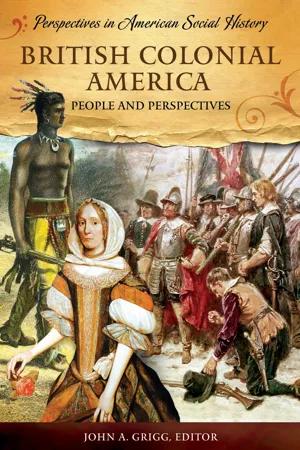 eBook - PDF
British Colonial America
People and Perspectives
- John A. Grigg(Author)
- 2008(Publication Date)
- ABC-CLIO(Publisher)
As Sewall’s diary suggests, their story is per- haps best told as a story of contradiction and paradox. Slaves were regarded as the objects of personal possession, to be used as humanely or inhumanely as their owners saw fit. And yet, despite their status as the property of others, slaves were undeniably their own masters, exercising measures of personal agency and autonomy in every part of their daily lives, no matter how ex- treme their subjugation. They were, in the end, the agents of their own lives, and not the objects of their masters’ designs. In the grips of an institution that denied them the most basic rights of personhood, slaves nevertheless found ways to shape, influence, and even transform the conditions of their difficult lives. By doing so, slaves exerted an authority of their own that even the most exacting of slaveholders were forced to recognize. Thus, the dynamic between masters and slaves was characterized not by simple domination and submission but rather by complex negotiation, mediation, and concession. Slavery Changes the American Colonies The American colonies—and the republic that emerged from them—were radically and irrevocably changed by the presence and influence of African slaves. Slaves were fundamental to the economic development and financial success of the colonial project. As the use of indentured servants declined, the colonies’ dependence on slaves as a primary source of labor grew. In cer- tain regions, slaves were indispensable to the day-to-day functioning of the local market economy, so much so that white colonists could not conceive of their lives—or their fortunes—without them. Slaves were also critical to the cultural life of the colonies, bringing African and West Indian traditions to every corner of the colonial empire. These traditions, modified over time, eventually gave rise to a new Creole culture, signs of which may still be found today. eBook - PDF
American History, Race and the Struggle for Equality
An Unfinished Journey
- Masaki Kawashima(Author)
- 2016(Publication Date)
- Palgrave Macmillan(Publisher)
After several years of servitude, he was freed, given land, and then finally became an owner of a plantation with his own slaves and servants. With the second and third generations, and with the num- ber of children of slaves increasing in Virginia, the need to consolidate a legal system to regulate Africans forced the ruling class to enact the formal establishment of slavery. From the 1660s to the 1690s, Virginia shifted from a “society with slaves” to a “slave society.” The latter was a society in which slavery as a system basically regulated society as a whole. 6 1.3 The Beginning of the “American Paradox” According to detailed research by Higginbotham (1978), the process leading to legalized slavery in the Colony of Virginia, as a precedent for the rest of the British colonies in Mainland North America, was an accu- mulation of court decisions that were still highly fluid as late as the 1640s. Higginbotham mainly analyzes cases of the white servants’ relationships SLAVERY AND THE EARLY DEVELOPMENT OF AMERICA 35 with African slave women. From the outset, white indentured servants and Black slaves were not perfectly equal. For instance, only baptized slaves were entitled to be witnesses in court trials. Interracial sexual intercourse cases were examined not in civil but in criminal trials. The sentences handed down often consisted of corporal punishment and some form of public humiliation, such as being whipped in public. If white servants had been tried in a civil court, they would have only had to give mon- etary compensation to a slave master for the time lost when the female slave was unable to work due to pregnancy and childbirth. These court decisions reflected “common sense” and of course might be perceived as strong messages for ordinary people at that time.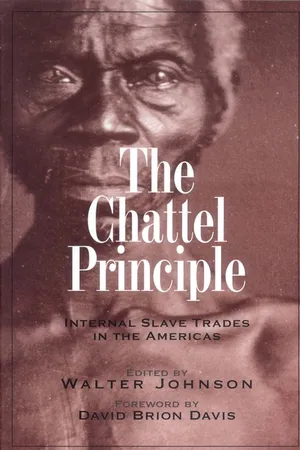 eBook - PDF
The Chattel Principle
Internal Slave Trades in the Americas
- Walter Johnson(Author)
- 2008(Publication Date)
- Yale University Press(Publisher)
Although this action Domestic Slave Trade in America 93 ultimately brought their system to an end, it ironically only added to the nation’s acceptance of the white South’s defense of their region’s most impor-tant form of commerce. And, unfortunately, more than anything else, it has been the dominance and persistence of this apologist view of the domestic trade that has left most people today completely unaware of the prominent role that this essential feature of the southern slave system played in ante-bellum American life. I The buying and selling of human beings had always been a part of American society, yet the nature of this traffic had changed over time. In the colonial period most slaves sold in British North America were individuals imported from Africa or the West Indies, although by the mid-eighteenth century a small locally based domestic trade had also developed. Following the American Revolution this changed, especially after the closing of the Afri-can trade in 1808. By the early nineteenth century, the slave trade had become an indigenous operation, transporting thousands of enslaved men and women from the Upper South to the Lower South each year and transferring an even greater number locally from one owner to another. ≥ It is hard to overemphasize the impact that this new traffic in human com-modities had on the southern states and the role that it played in the southern economy. Between 1790 and 1860 Americans transported more than one million African American slaves from the Upper South to the Lower South; approximately two-thirds of these slaves arrived there as a result of sale. Moreover, twice as many individuals were sold locally. During this period, slave sales occurred in every southern city and village, and coffles of slaves could be found on every southern highway, waterway, and railroad. The do-mestic trade, in all its components, was the lifeblood of the southern slave system, and without it, the institution would have ceased to exist.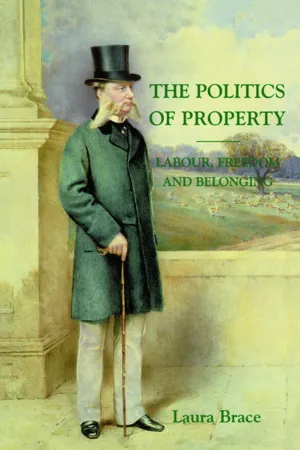 eBook - PDF
The Politics of Property
Labour, Freedom and Belonging
- Laura Brace(Author)
- 2004(Publication Date)
- Edinburgh University Press(Publisher)
This subjugation had to be justified, and in response doctrines of racial inequality were established by law. In legislating for black chattel slavery, ‘Americans went beyond any explicit provisions in English law and gave legal expression to an increasingly racialized sense of their identity so powerful that the very humanity of these outsiders was denied’. 80 Slaves were forced into a separate sphere, and their exclusion from the community was not only a result of their dishonour and natal alienation, but also of how they were incorporated into the labour force and the relations of production. S L AV E R I E S A N D P R O P E RT Y – 179 – Legislation set out the conditions under which labour power could be exploited. Slave labour was never based on a purely private relation of domination and submission: it was constituted, reproduced and enforced by the state. The state, for example, enforced the pass system in the Caribbean and chartered companies to procure and supply human beings to be enslaved. 81 There were important political as well as economic considerations in the English settlement of the Caribbean. The Council of State in 1656 issued an order to apprehend and export dangerous persons, vagrants and idlers to the Americas. The idle and the listless, those hedged out by enclosure and the changing relations of production in England, had become a ‘surplus population’ who needed to be removed. 82 In Miles’s account, the state used political and legal means to bind migrants to landowners and prevent them from establishing themselves as indepen-dent producers. The state uses racism to select and legitimate whose labour power counts as improving, rational and industrious and who remains indolent and idle. In the process, it constructs a hierarchy of acceptability and incorporation, within which some are incorporated into servitude and contract labour and others are constructed as foreigners and migrants, on the outside.
Index pages curate the most relevant extracts from our library of academic textbooks. They’ve been created using an in-house natural language model (NLM), each adding context and meaning to key research topics.

