History

Thirteenth Amendment
The Thirteenth Amendment to the United States Constitution, ratified in 1865, abolished slavery and involuntary servitude, except as punishment for a crime. It was a landmark moment in American history, marking the end of legal slavery and laying the foundation for the civil rights movement. The amendment was a crucial step towards ensuring freedom and equality for all citizens.
Written by Perlego with AI-assistance
Related key terms
1 of 5

10 Key excerpts on "Thirteenth Amendment"
 eBook - PDF
Encyclopedia of African American History
[3 volumes]
- Leslie M. Alexander, Walter C. Rucker, Leslie M. Alexander, Walter C. Rucker(Authors)
- 2010(Publication Date)
- ABC-CLIO(Publisher)
There are lessons to be learned from the role of the Thirteenth Amendment in African American history. Al- exander Tsesis, who may be today’s leading authority on the Thirteenth Amendment, observes that each new genera- tion must reexamine the nation’s past, its core documents, and its moral progress as a constitutional democracy. Tse- sis argues that the Thirteenth Amendment offers a more forthright warranty of freedom than other constitutional provisions on which the Supreme Court has relied. And be- yond the amendment’s role in barring racist labor practices, Tsesis advocates a progressive legal theory that legislatively and judicially expands the power of the Thirteenth Amend- ment to curb all coercive practices and repressive conduct rationally related to abridgments of freedom. Congress has virtual plenary power to protect individual rights under the Thirteenth Amendment. Yet this legislative power remains largely untapped. The Supreme Court, moreover, has yet to fully consider what freedoms Congress may protect pursu- ant to the Thirteenth Amendment. Judicial analysis under the Thirteenth Amendment asks the question, Is the act or law an incident or badge of servitude? An answer of “yes” to this constitutional test should trigger the Thirteenth Amendment’s enforcement power. The Thirteenth Amend- ment has transformed the Declaration’s national aspiration for freedom and equality by abolishing the Constitution’s protections of slavery—thereby establishing federal power to enforce civil rights against all recrudescent vestiges
- John R. Vile(Author)
- 2021(Publication Date)
- Praeger(Publisher)
The causes of the Civil War were complex, but differences between the North and South over slavery were among the most fundamental. Although Abraham Lincoln initially waged the war primarily to preserve the Union, as the toll on life mounted, he used it to justify emancipating and protecting the former slaves. During the war, Lincoln issued his path-breaking Emancipation Proclamation, but both its scope and its legal foundation were limited. Essentially a war measure that Lincoln took as commander in chief, the Emancipation Proclamation applied only behind enemy lines, where the North initially had limited ability to enforce it. Moreover, as a presidential directive, the Proclamation lacked constitutional permanency. Lincoln joined those who favored amendments to guarantee that former slaves would remain free and would have the privileges of citizenship.Between 1865 and 1870, Congress proposed, and the states ratified, the Thirteenth, Fourteenth, and Fifteenth Amendments amid intense political debate and acrid controversy. Each amendment had a different objective. The Thirteenth Amendment ended slavery. The Fourteenth Amendment overturned the notorious Dred Scott decision of 1857 by vesting blacks with citizenship and granting them constitutional rights. This amendment further reversed the restrictive black codes that some states had enacted in the wake of Emancipation, which had regulated the movements and other freedoms of former slaves. The Fifteenth Amendment focused more explicitly on voting rights.THE Thirteenth AmendmentSection 2. Congress shall have power to enforce this article by appropriate legislation. The End of SlaveryAmendment XIII. [1865] Section 1. Neither slavery nor involuntary servitude, except as punishment for crime whereof the party shall have been duly convicted, shall exist within the United States, or any places subject to their jurisdiction.The Thirteenth Amendment was the easiest to enforce. Although it did not eliminate the economic dependence that soon manifested itself in the system of sharecropping that developed in the South after the Civil War, the amendment once and for all eliminated the earlier system of chattel slavery. In the Peonage Act of 1867, Congress made it clear that the law also prohibited individuals from forcing others to work for them to pay off their debts. One notable aspect of the Thirteenth Amendment is that it did not provide, as had an emancipation law for the District of Columbia, for compensation to slave owners, many of whom had supported the Confederacy. Absent an amendment, the just compensation requirement for governmental takings in the Fifth Amendment might have required this.
- Jack N. Rakove, Jack N Rakove(Authors)
- 2009(Publication Date)
- Belknap Press(Publisher)
Adoption of the Thirteenth Amendment signaled not only the onset of Recon-struction but a new attitude about the Constitution and the Union it embodied. The amendment also solved the surprisingly difficult question of how to complete the great project of abolishing “slavery”—a word now making its first and only appearance in the Constitu-tion. The Emancipation Proclamation applied only to slaves be-hind southern lines, and the three amendments that Lincoln had proposed to Congress in pursuit of emancipation were gradual-ist measures that would give the nonseceding border states where slavery was still legal (Maryland, Delaware, Kentucky, and Mis-souri) incentives for abolition and would compensate masters who remained loyal to the Union for their lost property. The longer the amendments to the constitution 255 amendment xiii (1865) Section 1. Neither slavery nor involuntary servitude, ex-cept as a punishment for crime whereof the party shall have been duly convicted, shall exist within the United States, or any place subject to their jurisdiction. Section 2. Congress shall have power to enforce this ar-ticle by appropriate legislation. 13 256 annotations war ground on, with its horrific toll in lives lost, the more emanci-pation seemed its only just end, particularly when slaves revealed their own longing and capacity for freedom by seeking refuge be-hind Union lines and enlisting as soldiers themselves. Even then, Congress was slow to think of a constitutional amendment as the best means to achieve emancipation with one decisive stroke. It took an unlikely coalition of northern Democrats, eager to take the slavery question out of politics entirely, and abolitionists to push the amendment alternative forward. Many previous amendments had contained multiple clauses, but this was the first to be divided into two numbered sections. Sec-tion 1 appears to be what lawyers call a “self-executing” provision: it issues a command that is legally sufficient in itself. eBook - ePub
Intimate States
Gender, Sexuality, and Governance in Modern US History
- Margot Canaday, Nancy F. Cott, Robert O. Self, Margot Canaday, Nancy F. Cott, Robert O. Self(Authors)
- 2021(Publication Date)
- University of Chicago Press(Publisher)
5 One key goal of this essay is to show how centuries of sexual violence against slave women, and the children born as a result, set a deep explosive charge under every negotiation over the terms of freedom in the postwar South.The Thirteenth Amendment: Passage and Ratification
Passage of the Thirteenth Amendment was a crucial achievement of the Lincoln administration and a measure of state authority so untrammeled that it can be said to have remade the United States.6 The total, immediate, and uncompensated abolition of slavery was codified in the amendment and imposed on the rebel states as a condition of readmission to the Union. It was “one of the largest liquidations of private property in world history,” fully two-thirds of the capital wealth of the Southern states.7 A measure entirely unthinkable in 1860, it was achieved (in part) in 1863 only as an executive order issued as a war measure.8 Revising the US Constitution by amendment thus was essential. The amendment and its implementation stand at the very center of arguments about the Civil War as the “birth of the modern American state.”9 Enforcement in the defeated Confederate states represented an assertion of central state authority in the affairs of the separate states inconceivable in the first republic.Even in the Republican-controlled 38th Congress, passage of the amendment was not an easy proposition. It passed in the House of Representatives on January 31, 1865, on an almost party-line vote of 119 to 56, a stripped-down but revolutionary measure ending the national government’s recognition of legitimate property in human beings.10 The amendment was quickly ratified by numerous Northern states and small Unionist governments of occupied Confederate states, but Union border states remained opposed. The Kentucky legislature declined to ratify even on condition of compensation and a strictly limited set of civil rights for newly freed slaves; tellingly, the one new right the state was willing to grant was recognition of marriages and parental relationships.11 In mid-April 1865 when Grant accepted Lee’s surrender, the amendment remained short of the votes needed for ratification. Its fate thus fell into the hands of the defeated Confederate states, and their defiant posture did not bode well. President Johnson urged provisional governors to ratify as the basis of a lenient reconstruction and readmission.12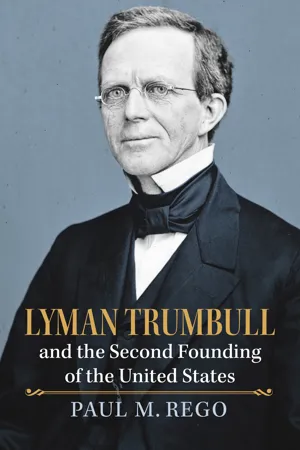
- Paul Rego(Author)
- 2022(Publication Date)
- University Press of Kansas(Publisher)
He suggested that, in adopting and ratifying the Thirteenth Amendment, Congress and the entire nation had made it clear “that slavery in no form shall exist hereafter.” Echoing Trumbull, Henderson explained that “if the abolition of slavery is not to be followed by such privileges and rights as will maintain and perpetuate the freedom of the emancipated, it amounts to nothing. It is ‘as sounding brass or a tinkling cymbal.’” Thus, like many other Republican leaders who advanced the cause of civil rights, Henderson came to believe that eliminating slavery meant eliminating, once and for all, every law and custom that was associated with, and a by-product of, chattel slavery. The purpose of the Thirteenth Amendment, in other words, was to remove all the impediments to personal improvement that had been placed in the way of African Americans, which gets to Henderson’s most profound point. Unless the country rejected every bogus and destructive assumption on which slavery had been based, the nefarious institution would never be destroyed. Put simply, the nation had “to grapple with prejudice.” 65 Henderson finally understood and admitted that the legitimacy of slavery was predicated entirely upon unreasonable assumptions about Black inferiority. 66 So, despite what was initially said about the potential of the Thirteenth Amendment (before its adoption), most Republican leaders in Congress, including many former conservatives such as Henderson, ultimately agreed with Trumbull that the Civil Rights Act of 1866 could be justified on Thirteenth Amendment grounds. 67 Representative John Bingham of Ohio was one notable exception. He conceded that Congress had the power to declare in the Civil Rights Act that “every human being born within the jurisdiction of the United States” was a citizen of the United States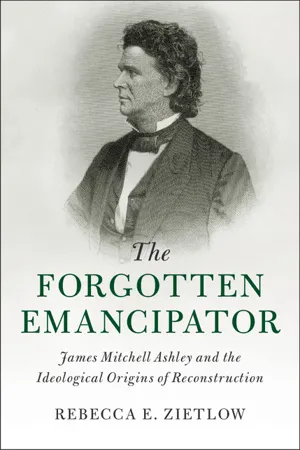 eBook - PDF
The Forgotten Emancipator
James Mitchell Ashley and the Ideological Origins of Reconstruction
- Rebecca E. Zietlow(Author)
- 2017(Publication Date)
- Cambridge University Press(Publisher)
However, because the debates over the Thirteenth Amendment took place during a politically sensitive time, many Republicans chose not to articulate the broader meaning of the amendment for the rights of freed slaves. Ashley was not so reticent. From the outset he made it clear that Cong. Globe, th Cong., st Sess., –; th Cong., H.R. , , , ½, ; H.R. Joint Resolution . Cong. Globe, th Cong., st Sess., . Compare with Section of the Thirteenth Amend- ment: “Neither slavery nor involuntary servitude, except as punishment for crime whereof the party shall have been duly convicted, shall exist within the United States, or any place subject to its jurisdiction.” According to Ashley, that change “materially improved” the Amendment. Letter from James Ashley to Benjamin Arnett, December , , Duplicate Copy of the Souvenir from The Afro-American League of Tennessee to Hon. James M. Ashley of Ohio (Benjamin Arnett, ed.) (Publishing House of the AME Church, Phila- delphia, ) (hereafter referred to as Souvenir), , ; Vorenberg, Final Freedom, . Cong. Globe, th Cong., nd Sess., (January , ); Vorenberg, Final Freedom, –, –. The Forgotten Emancipator he believed that the abolition of slavery would empower Congress to establish equal rights for blacks. A week after he proposed his version of the amendment, Ashley proposed a Reconstruction bill that would enforce the amendment and lay out a blueprint for a free labor society. The bill was similar to the Reconstruction bill that he proposed in . While no longer authoriz- ing the seizure of rebel lands, this bill contained the same broad protec- tions for the rights of freed slaves. Ashley’s bill would have guaranteed “equality of civil rights before the law . . . to all persons in said states.” The bill also would have recognized freed slaves as citizens, with the right to vote and to serve on juries.
- Marcus D. Pohlmann, Linda Vallar Whisenhunt(Authors)
- 2002(Publication Date)
- Greenwood(Publisher)
The major concern came to be providing legal protection for newly freed slaves resid- ing in less than friendly Southern states. Black codes, which made blacks second-class citizens under state law, restricted their rights and tied them to near slave-like working conditions. The Civil Rights Act of 1866, passed over President Andrew John- son's veto, was designed to protect the freedmen by guaranteeing among other things that former slaves were to enjoy the "full and equal benefit of all laws . . . as enjoyed by white citizens." Congress found its authority to pass such a law in its power to enforce the Thirteenth Amendment, which ended slavery. Opponents chal- lenged its constitutionality, however, claiming that Congress lacked the authority to limit state governments in such a manner. In point of fact, the United States Supreme Court had explicitly read the United States Constitution's first ten amendments, the Bill of Rights, to apply only to the federal government. Consequently, such liberties were protected against federal intrusion, but state govern- FOURTEENTH AMENDMENT 93 ments remained free to respect only those rights they so chose to respect. 1 In order to head off a protracted constitutional battle over Con- gress's authority in this realm, the Republican-dominated first Re- construction Congress finally passed the Fourteenth Amendment in June of 1866 and then submitted it to the states. If ratified, the amendment would nullify the infamous Dred Scott decision by granting full citizenship to all those born or naturalized in the United States. 2 Far more sweepingly, it would require states to pro- vide due process and equal protection under their laws, as well as respect all federal privileges and immunities. The amendment es- sentially redefined U.S. federalism in a very significant way. eBook - PDF
The Reconstruction Era
Primary Documents on Events from 1865 to 1877
- Donna L. Dickerson(Author)
- 2003(Publication Date)
- Greenwood(Publisher)
C H A P T E R I O The Fourteenth Amendment, 1866 ne of the most infamous cases ever decided by the U.S. Supreme Court was Dred Scott v. Sanford m 1857. In this case, the Court ruled that Congress was prohibited from abolishing slavery and that blacks—free or enslaved—were not citizens of the United States. Without cit- izenship, said the Court, blacks could not claim rights under state or federal law. Ten years later, the Dred Scott decision had been nullified by a war, by statute, and by two constitutional amendments: the Thirteenth Amendment abolished slavery, the Civil Rights Act of 1866 guaranteed citizenship and protected the equal rights of all citizens, and the Fourteenth Amendment made citizenship and civil rights a constitutional guarantee. But despite the legal end to slavery, Southern states continued to insist they had the sole authority to define the status and determine the rights of their people. Freedmen continued to be kept in a state of bondage through repressive black codes and economic intimidation, and local courts refused to prosecute whites who abridged the personal and property rights of blacks. While President Johnson sanctioned much of this behavior, Congress had other ideas. In December 1865, Congress established a Joint Commit- tee of Reconstruction (sometimes referred to as the Joint Committee of Fif- teen) to investigate conditions in the South. For the next five months, the committee read reports and heard testimony from Southern governors, mil- itary officers, Southern blacks, white Unionists, and even such notables as General Robert E. Lee and former Confederate vice president Alexander H. Stephens. The committee concluded that the former Confederate states were not entitled to representation in the Congress until "adequate security for future peace and safety" was guaranteed. The only way to guarantee such safety was to protect the civil and political rights of all the citizens.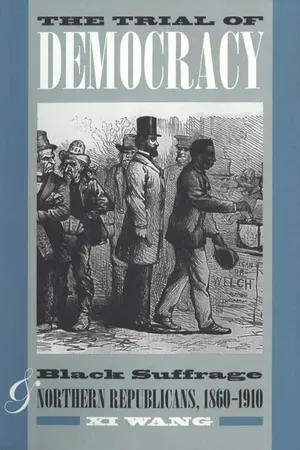 eBook - PDF
The Trial of Democracy
Black Suffrage and Northern Republicans, 1860-1910
- Xi Wang, Paul Finkelman, Timothy Huebner(Authors)
- 2012(Publication Date)
- University of Georgia Press(Publisher)
52 Believing that the amendment should move beyond a mere con-stitutional declaration of the death of slavery, Sumner wanted it to give com-pleteness and permanence to emancipation, and bring the Constitution into avowed harmony with the Declaration of Independence. 53 But when he pro-posed to insert a provision into the amendment—that all persons are equal be-fore the law, so that no person can hold another as a slave; and the Congress may make all laws necessary and proper to carry this article into effect every-where within the United States and the jurisdiction thereof—his colleagues re-sponded coldly and asked him to withdraw his proposal. Sumner later regretted succumbing to the pressure, but he must have realized how unprepared his col-leagues were even to think about black rights when some of them were totally lost upon hearing the phrase equality before the law. 54 In the House, radical Republicans employed an argument that black leader Frederick Douglass and Republican theoretician Francis Lieber had used ear-lier: that is, the war had created a new nation, which required new responsibil-ity from the federal government. Ashley argued that the supreme power of the national government had always been placed in the Constitution, which se-cures nationality of citizenship and guarantees that the citizens of each State shall enjoy all the rights and privileges of citizens of the several States. Ashley identified national citizenship with national suffrage, declaring that a univer-sal franchise ... [could not] be confined to States, but belong[ed] to the citizens The Road to the Fifteenth Amendment 17 of the Republic. By formulating such reasoning, Ashley helped translate the political ideals of radical Republicans and black leaders into constitutional lan-guage.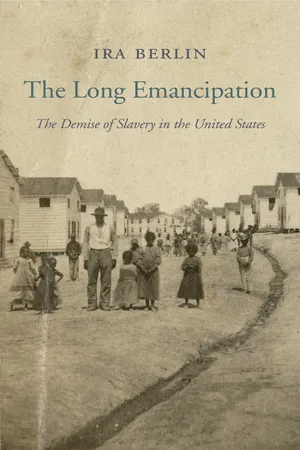 eBook - PDF
The Long Emancipation
The Demise of Slavery in the United States
- Ira Berlin(Author)
- 2015(Publication Date)
- Harvard University Press(Publisher)
1 The Near-Century-Long Demise of Slavery T he season of emancipation is upon us. The sesquicentennials of the Emancipation Procla-mation and the Thirteenth Amendment have prompted much discussion about the arrival of uni-versal freedom in the United States. Yet, while both events are well worthy of commemoration, they might also be occasions to reconsider the single- minded focus on the wartime destruction of slavery, whether in print, on the small screen, or on the big screen—most powerfully in Steven Spielberg’s Lin-coln . 1 Slavery’s demise might better be understood as a near-century-long process in the United States, entwined with an even longer transatlantic struggle, rather than the work of a moment, even if that mo-ment was a great civil war. To put this another way, 13 The Near-Century-Long Demise of Slavery emancipation began long before January 1, 1863, and of course continued after it. Slavery in the United States came apart in pieces. Despite every effort of slaveholders and their allies to make the system of chattel bondage airtight by denying black people access to freedom, slavery proved a leaky vessel. Enslaved black men and women wanted out of bondage, and they found nu-merous exits prior to the Civil War, with its special Articles of War, Confiscation Acts, congressional legislation, presidential edicts, and the definitive constitutional amendment. To begin, some Africans arrived in North Ame-rica prior to the advent of chattel bondage and eluded the snare of enslavement. They and their de-scendants shared freedom, however imperfect, with other Americans. 2 Among the enslaved, numerous black men and women gained their freedom by successful flight, self-purchase, freedom suits, state- sponsored emancipations, or liberation by indi-vidual owners. Prior to the Civil War, the largest group of enslaved African Americans exited slavery in the decades following the American Revolution through a glacially slow process known as “post-nati
Index pages curate the most relevant extracts from our library of academic textbooks. They’ve been created using an in-house natural language model (NLM), each adding context and meaning to key research topics.

