History

Southern Renaissance
The Southern Renaissance was a cultural movement that emerged in the American South during the early 20th century. It was characterized by a renewed interest in Southern history, literature, and culture, and was marked by the emergence of writers such as William Faulkner, Flannery O'Connor, and Eudora Welty. The movement sought to challenge stereotypes about the South and to celebrate its unique cultural heritage.
Written by Perlego with AI-assistance
Related key terms
1 of 5

6 Key excerpts on "Southern Renaissance"
- Harilaos Stecopoulos(Author)
- 2021(Publication Date)
- Cambridge University Press(Publisher)
literary studies. Small wonder, then, that critic Kenneth Lincoln called attention to the cultural arm of the American Indian Movement of the 1960s and 1970s by christening it the “Native American Renaissance.” 2 Along the way, the literature of the U.S. South came in for its own share of renaissancing. Sociologist Edwin Mims suggested in his 1926 study, The Advancing South, that an “intellectual renascence” was brewing in the region, and Mississippian Herschel Brickell echoed this verdict in a 1927 review that found it “no exaggeration to speak of a renaissance of literature in the South.” 3 Allen Tate did his renaissancing more indirectly in 1935 when, without using the term, he compared “the considerable achievement of Southerners in modern American letters” to “the outburst” – Wendell’s word again – “of poetic genius at the end of the sixteenth century when commercial England had already begun to crush feudal England.” 4 A decade later, Tate made his case more explicitly in “The New Provincialism,” arguing that the “backward glance” of southern writers “stepp[ing] over the border” between tradition and modernity “gave us the Southern renas- cence, a literature conscious of the past in the present.” 5 Soon afterward, the edited collection Southern Renascence (1953) did as much as any single publication to make the concept a linchpin of southern literary history. 6 This multitude of modern renaissancing projects notwithstanding, the use of the term as a periodizing concept should not be entered into lightly. Unlike such designations as “interwar,” “eighteenth century,” or, more recently, “Anthropocene,” renaissance is a periodizing term that doesn’t 2 Kenneth Lincoln, Native American Renaissance (Berkeley: University of California Press, 1983). 3 Edwin Mims, quoted in Sarah E. Gardner, Reviewing the South: The Literary Marketplace and the Southern Renaissance, 1920–1941 (New York: Oxford University Press, 2017), 2; Herschell Brickell, quoted in C.
- Richard Gray, Owen Robinson, Richard Gray, Owen Robinson(Authors)
- 2008(Publication Date)
- Wiley-Blackwell(Publisher)
But even if not of the first order, they are no longer simply typed as writers of simple and obvious melodrama, work fit for the dustbin rather than the library. Instead, their writing is The Southern Literary Renaissance 155 now for the most part being seen as an important expression of the Southern Renaissance, appreciated for its complexity and richness, and particularly for its redefining of cultural stereotypes enforced by the dominant Southern culture. The Southern Renaissance Now What now to make of the Southern literary renaissance? Revisionary work in Southern literary study has reconfigured literature of the 1920s, 1930s, and 1940s, not only vastly opening up the canon but also calling the very idea of the renaissance into question. Returning to the questions I posed early on: How should we now configure the renaissance, assuming we still accept there was one? With the expanded canon is there anything significant that links the writing – other than chronology and regional identity – that would warrant the designation not only of a literary period but also of a period of great worth? These are the matters I would like to address in this final section. Surprisingly enough, in terms of the fundamental themes and concerns with which Southern writers worked, the Southern literary renaissance looks pretty much the same, even with the much enlarged canon. And perhaps even more surprisingly, Tate’s paradigm of the clash of the traditional and the modern still seems significant, even for those writers whom that paradigm was once used to exclude.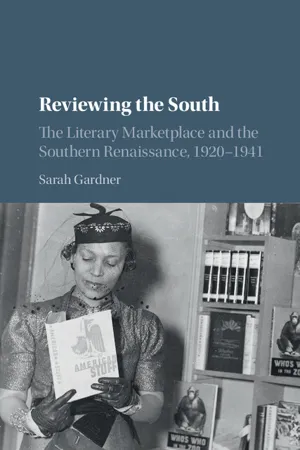 eBook - PDF
Reviewing the South
The Literary Marketplace and the Southern Renaissance, 1920–1941
- Sarah Gardner(Author)
- 2017(Publication Date)
- Cambridge University Press(Publisher)
It culminated with Robert Penn Warren’s Pulitzer Prize in 1947 and William Faulkner’s Nobel Prize for Literature in 1949. Collectively, these writers broke with every literary convention that had defined southern writing since Reconstruction. No longer exclusively defensive and nostalgic, they assumed a critical and distancing perspec- tive on their homeland. They challenged the sentimentalist stories of Thomas Nelson Page and Joel Chandler Harris, the moonlight and mag- nolia romance about the Old South, but they also rejected the explicit racism of Thomas Dixon, whose turn-of-the-century novels The Leopard Spots and The Klansman advocated white supremacy and the rule of the Darwinian elite in the “New South.” Subject matter changed too. Renaissance writers ventured out beyond the plantation big house and into the seamy underbelly of the cotton mills or into “Niggertown.” They wrote about the rapaciousness of white bosses who sexually abused their female African American workers. They wrote about native-born union organizers who threatened to overturn the industrial-capitalist order that had kept workers mired in poverty. They wrote about the lynchings of African American men wrongly accused of crimes. And they wrote about the insuperable odds faced by sharecrop- pers and tenant farmers who struggled to eke out the barest of existences. Yet more than subjectivity and subject changed. Southern Renaissance writers experimented with form as well, adopting modernist literary tech- niques and approaches. Some blurred the lines between genres, mixing poetry and prose, reportage and folklore – sometimes in the same piece. Others engaged in stream of consciousness writing of Joycean proclivi- ties. In both cases, writers sought to erase the distance between reader and character and encourage the reader to participate rather than merely observe. In rejecting the old ways, these writers re-created an image of the South for the twentieth century. eBook - PDF
The Cambridge History of the Gothic: Volume 3, Gothic in the Twentieth and Twenty-First Centuries
Volume 3: Gothic in the Twentieth and Twenty-First Centuries
- Catherine Spooner, Dale Townshend(Authors)
- 2021(Publication Date)
- Cambridge University Press(Publisher)
25 This observation is fair enough, so far as it goes, but, as King 23 Herbert Marshall McLuhan, ‘The Southern Quality’, The Sewanee Review 55:3 (1947): 357–83 (p. 382). 24 Flannery O’Connor, ‘Some aspects of the Grotesque in Southern Fiction’, in Sally Fitzgerald and Robert Fitzgerald (eds), Mystery and Manners (London: Faber and Faber, 1972), pp. 36–50 (p. 37). 25 Richard A. King, A Southern Renaissance: The Cultural Awakening of the American South, 1930–1955 (New York: Oxford University Press, 1980), p. 4. Gothic and the American South, 1919‒1962 73 notes, the argument is so overly generalised as to be effectively useless as a tool of critical interrogation: which twentieth-century culture is not, at base, shaped by the encounter with modernity? Moreover, it begs the formal question: what literary shape does the clash of tradition and modernity take? What genres will they inhabit? How will these clashes recombine elements and re-shape those genres? Southern Writing after the Second World War In the years between the Second World War and Faulkner’s death in 1962, the ‘Southern Renaissance’ had become a cultural certitude, almost something of a cliché; indeed, some critics recognised that Southern writers had reached the peak of their accomplishments and that this was a literature in decline, or even dying. While the consensus is that the Renaissance waned in the mid- 1950s, a post-war generation of writers emerged who, however much they engaged with the global scope of the Cold War or increasingly embraced the Civil Rights movement and other political causes, did not entirely shake off the mantle of regionalism and continued working in explicitly Gothic modes. There are two important and interrelated observations that should be made, however, about the mid-century canonisation of a Southern tradition: first, it was an exclusively white tradition.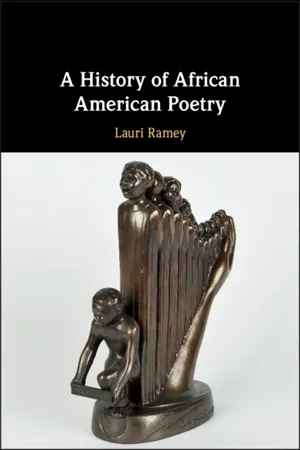 eBook - PDF
- Lauri Ramey(Author)
- 2019(Publication Date)
- Cambridge University Press(Publisher)
Both moments are deeply contextualized in recurring patterns that move ever forward, as we shall see. Now I will briefly summarize the conventions and alternatives. As part of a larger historical era, this chapter opens with the period in the first part of the twentieth century whose impact is incommensurable, yet its title and timing remain arguable. Though there is relative unanimity on certain causes, manifestations, and results, there is substantial scholarly difference of opinion on others; the naming and dating debate tends to indicate these varying interpretations. African American modernism, the New Negro Movement, the Harlem Renaissance, the Black Renaissance, the Afro-American Renaissance, the African American Renaissance, the Negro Awakening, and the New Negro Renaissance are some frequent designations. In the 1960s and 1970s, there was a period of equiva- lent drama and prominence that has been referred to as Afrocentric postmodernism, African-American postmodernism, the Black Arts Movement, the Black Power Movement, the Black Arts Era, the New Black Renaissance, the Second African American Renaissance, the Era of Reform and Revolution, the Freedom Movement, the Civil Rights and Post-Civil Rights Era, the Protest Era, the Contemporary Period, the Human Rights Era, and the Sixties and Seventies. Even if readers have lit- tle or no specific knowledge about African American poetry, they still are likely to have glamorous impressions of the vaunted Harlem Renaissance with its flapper clothes, house parties, bigger than life writers, romans à clef, and anthemic poems, when the Negro was in vogue, as Hughes put it.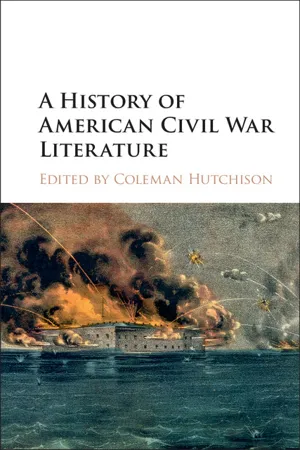 eBook - PDF
- Coleman Hutchison(Author)
- 2015(Publication Date)
- Cambridge University Press(Publisher)
The “American Renaissance” 59 apprehending perfection, and of becoming transfigured by that vision.” 25 At the heart of this recognition, unacknowledged but vitally present, was the Civil War. Matthiessen may have arrived at this conclusion by reading his own times into the past. The radicalization of Northern intellectuals in the wake of the Fugitive Slave Act seemed to him historically analogous to the socialist fervor that swept through the literary class during the Great Depression of the 1930s. As he explained to a colleague at Harvard in 1937, “I cannot study with profit revolutions of the past unless my mind is closely in touch with revolutionary process in the present.” 26 But the emphasis on tragedy also allowed Matthiessen to construct a narrative about the buoyant rise and tragic fall of a native idealism without allud- ing to the horrors of Civil War. It enabled him to posit a set of distinctly American ideas and commitments without extending them into the social realm or without interrogating their violent consequences. If the Civil War provided a historical endpoint that enabled Matthiessen to make sense of his antebellum authors, it also provided a cautionary tale about the risks of inserting the aesthetic into the political – a struggle Matthiessen him- self enacted in trying to fuse his interest in literature with his Christian Socialism. In this way, American Renaissance is not so different from the plethora of American literary histories that followed the treaty signing at Appomattox. The fear of a second secession or a renewal of sectional conflict ensured that literary historians would view the New England renaissance as either a rarified aesthetic and philosophical strain detached from the vagaries of history or conversely as a historical force involved in emancipatory move- ments that were strictly bounded by historical demarcations such as the “antebellum period.” Matthiessen’s work performed a similar function.
Index pages curate the most relevant extracts from our library of academic textbooks. They’ve been created using an in-house natural language model (NLM), each adding context and meaning to key research topics.

