History

Northern Renaissance
The Northern Renaissance was a cultural and artistic movement that took place in Northern Europe during the 15th and 16th centuries. It was characterized by a revival of interest in classical learning and a focus on individualism, realism, and naturalism in art. Key figures of the Northern Renaissance include Albrecht Dürer, Jan van Eyck, and Hans Holbein the Younger.
Written by Perlego with AI-assistance
Related key terms
1 of 5

11 Key excerpts on "Northern Renaissance"
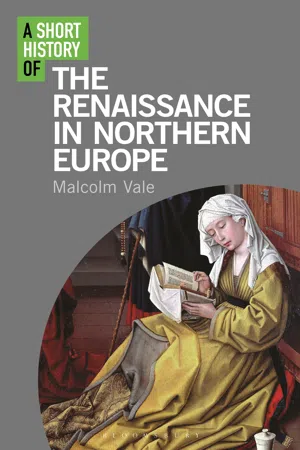
- Malcolm Vale(Author)
- 2020(Publication Date)
- Bloomsbury Academic(Publisher)
1 What was the ‘Northern Renaissance’? We are reluctant to acknowledge how medieval the man of the Renaissance really was, the man whom we salute as a superman, the liberator of the individual from the dark prisons of the church. (Aby Warburg, Flanders and Florence [1901]) 1 The concept of a renaissance To embark on any account of the so-called Renaissance in Northern Europe, we must first attempt to define what we mean by the term ‘Renaissance’. The idea of a ‘Renaissance’ or ‘rebirth’ (from Fr. renaitre, Lat. renascere, It. rinascita) has been linked to notions of renewal, renovation and sometimes reformation, in many epochs of human history. We hear of a ‘Carolingian Renaissance’, a ‘Twelfth-Century Renaissance’, a ‘Christian Renaissance’, an ‘Elizabethan Renaissance’ or, most recently (2017), a Franco-German ‘renaissance’ of the European Union. The Renaissance which is the subject of this book is that which is normally thought to have taken place in Western Europe between the fourteenth and sixteenth centuries. But what was actually ‘reborn’ during these periods? What, if anything, has prompted the desire to represent an age as one which gave birth to a renewed and reinvigorated world? Is the Renaissance, it has been asked, nothing but a metaphor, which obfuscates rather than illuminates, forming a ‘mere figurative intrusion’ into historical thought and historiography? But a tendency to lament, often in nostalgic terms, the decline or decay into which a civilization, culture or some aspects of their specific forms were judged to have fallen, can be found in many past – and indeed present – societies. A renewal or revival is awaited. The Renaissance is no exception to this rule. To be ‘reborn’, something has presumably had to die, or at least to have degenerated and broken down into a condition in which it is either unrecognizable or unacceptable, or both No longer available |Learn more
- (Author)
- 2014(Publication Date)
- The English Press(Publisher)
The Renaissance has a long and complex historiography, and there has been much debate among historians as to the usefulness of Renaissance as a term and as a historical delineation. Some have called into question whether the Renaissance was a cultural advance from the Middle Ages, instead seeing it as a period of pessimism and nostalgia for the classical age, while others have instead focused on the continuity between the two eras. Indeed, some have called for an end to the use of the term, which they see as a product of presentism – the use of history to validate and glorify modern ideals. The word Renaissance has also been used to describe other historical and cultural movements, such as the Carolingian Renaissance and the Renaissance of the 12th century. ________________________ WORLD TECHNOLOGIES ________________________ Overview Leonardo da Vinci's Vitruvian Man shows clearly the effect writers of Antiquity had on Renaissance thinkers. Based on the specifications in Vitruvius's De architectura around 1500 years before, Da Vinci tried to draw the perfectly proportioned man. The Renaissance was a cultural movement that profoundly affected European intellectual life in the early modern period. Beginning in Italy, and spreading to the rest of Europe by the 16th century, its influence affected literature, philosophy, art, politics, science, religion, and other aspects of intellectual inquiry. Renaissance scholars employed the humanist method in study, and searched for realism and human emotion in art. ________________________ WORLD TECHNOLOGIES ________________________ Renaissance thinkers sought out in Europe's monastic libraries and the crumbling Byzantine Empire the literary, historical, and oratorical texts of antiquity, typically written in Latin or ancient Greek, many of which had fallen into obscurity.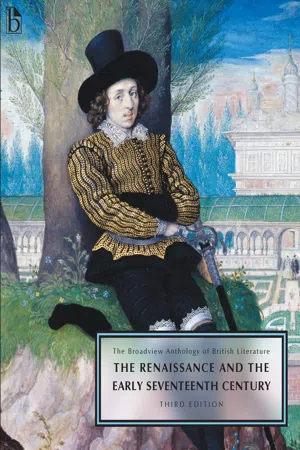
- Joseph Black, Leonard Conolly, Kate Flint, Isobel Grundy, Wendy Lee, Don LePan, Roy Liuzza, Jerome J. McGann, Anne Lake Prescott, Barry V. Qualls, Jason Rudy, Claire Waters(Authors)
- 2016(Publication Date)
- Broadview Press(Publisher)
Recent generations of scholarship have done much to destabilize this conceptual framework. Medievalists have located a variety of “renaissances” in, for example, the ninth and the twelfth centuries, and have thor-oughly debunked the idea that the supposed “dark ages” were lacking intellectual or cultural life. Scholars have also distinguished among the later renaissances of the fourteenth through sixteenth centuries: a renaissance in Italy that began in the early fourteenth century (with the writings of Dante and Petrarch and the paintings of Giotto) and reached its full flowering in the late fif-teenth and early sixteenth centuries (the age of Machia-velli, of Leonardo da Vinci, and of Michelangelo); a renaissance that occurred in northern Europe in the late fifteenth and early sixteenth centuries, especially in the Low Countries but also manifesting itself in France and in England (among the leading figures of this renaissance were the great Humanist thinkers Desiderius Erasmus and Sir Thomas More, and the painters Jan van Eyck and Hans Holbein); and a renaissance that occurred in England toward the end of the sixteenth century in the latter part of the reign of Elizabeth I (the age of Edmund Spenser, Sir Philip Sidney, and Christopher Marlowe as well as Shakespeare). Other scholars, though, have questioned whether or not England ever experienced anything that can properly be termed a “Renaissance.” At a minimum, then, the phenomena associated with “the Renaissance” extended over a considerable stretch of time and across much of Europe. But they were not isolated from one another, sharing a tendency to focus on human concerns in new ways (and, in the visual arts, to depict the human form in persuasively realistic if often idealized representations). Historically too, the various renaissances were connected by a variety of direct links, many of them stemming from royal initiatives. eBook - PDF
- Frank Kidner, Maria Bucur, Ralph Mathisen, Sally McKee(Authors)
- 2018(Publication Date)
- Cengage Learning EMEA(Publisher)
❱ » The rediscovery of classical texts refreshed knowledge of a past world and stimulated a new type of critical textual analysis. ❱ » Artisans strove to depict the human form in lifelike dimensions, which included situating figures real-istically within a painted scene. The skills required were more than those of a technician. It took an artist to render the soul in human form. ❱ » In northern Europe scholars focused on the Bible and the writings of the church fathers. ❱ » Humanists such as Erasmus came to believe that there was cause to review the translations from Greek of the New Testament. ❱ » The spread of printing presses across western Europe assisted the humanists in their goals. Communities of scholars now had identical texts to study. ❱ » The Medici family of Florence, the republics of Venice and Genoa, and the Sforza family of Milan conducted campaigns of conquest and ruthlessly squashed republican sentiment. ❱ » Francis I of France introduced many of the achieve-ments of the Italian Renaissance and lured many of its artisans, like Leonardo, to follow him. ❱ » The absorption of Renaissance ideals by the peoples of England, the Holy Roman Empire, and Russia occurred at a slower pace. Copyright 2019 Cengage Learning. All Rights Reserved. May not be copied, scanned, or duplicated, in whole or in part. Due to electronic rights, some third party content may be suppressed from the eBook and/or eChapter(s). Editorial review has deemed that any suppressed content does not materially affect the overall learning experience. Cengage Learning reserves the right to remove additional content at any time if subsequent rights restrictions require it. eBook - PDF
Men and Ideas
History, the Middle Ages, the Renaissance
- Johan Huizinga(Author)
- 2014(Publication Date)
- Princeton University Press(Publisher)
Almost a decade earlier Balzac had used the word Renaissance as an autonomous cultural concept in the short novel Le bal de Sceaux, dated December 1829, in which it is said of one of the leading characters: "she could argue fluently on Italian or Flemish painting, on the Middle Ages or the Renaissance. . . ." The conceptual system in which the cultural history of Europe was largely to be conceived from then on was gradually acquiring its fixed form and its full resilience: the Middle Ages and the Renaissance as an explicit antithesis, 254 MEN AND IDEAS each of the two a cultural image. But before we trace the further development of the concept of the Renaissance, ref- erence should be made to a peculiar fact for which I imagine there are parallels to be found in many other fields—that the school opinion, the condensed view of the Renaissance propagated by the textbooks, was even then lagging behind what historians understood by the term. That school opinion may perhaps be described as follows: Toward the end of the Middle Ages (Middle Ages in the rationalistic view as representing darkness and barbarism) the arts and learning were revived, first of all in Italy, be- cause Greeks fleeing from Constantinople brought the West once more in contact with the inspiration of the ancient Greek spirit. Or even in cases where no such predominant influence was attributed to the exiles, the revival of classical culture was viewed both as the causal element and the out- ward characteristic of the Renaissance. The Renaissance came because people learned how to understand the spirit of the ancients, and its essential element was the imitation of classical art and literature. Some of the textbooks also made a small place for the art of printing and the discovery of America among the causes of the general revival. eBook - PDF
Western Civilization
Beyond Boundaries
- Thomas F. X. Noble, Barry Strauss, Duane Osheim, Kristen Neuschel(Authors)
- 2013(Publication Date)
- Cengage Learning EMEA(Publisher)
Due to electronic rights, some third party content may be suppressed from the eBook and/or eChapter(s). Editorial review has deemed that any suppressed content does not materially affect the overall learning experience. Cengage Learning reserves the right to remove additional content at any time if subsequent rights restrictions require it. 356 Chapter 12 The Renaissance Chapter Summary ◆ ◆ How did Italians use classical values to deal with cultural and political issues? The Renaissance was a broad cultural movement that began in Italy in response to a series of crises in the early fourteenth century. It was a cultural and ideological movement based on the assumption that study and imitation of the past was the best method for reform and innovation in the future. The impulse for change arose from the belief, shared by thinkers from Petrarch to Machiavelli, that a great deal could be learned from study of the Roman past. This was the basis for humanistic innovations in language, history, and politics. Even revolutionary thinkers, such as Lorenzo Valla and Niccolò Machiavelli, began with the study of classical literature and history. ◆ ◆ What was “new” about Renaissance art? The same transformation is evident among the artists. Early in the fifteenth century, Florentines who experimented with perspective were intent on recovering lost Roman knowl- edge, and Michelangelo was praised not only for mastering but also for surpassing Roman norms. The artistic innovations of Italy were noted and valued throughout the Mediterranean and northern Europe. Artists like Albrecht Dürer combined their understanding of Italian art with northern ideas. Throughout Europe, art was an important component of religious and political culture. ◆ ◆ In what ways did humanism outside Italy differ from Italian humanism? Humanistic studies outside of Italy were less tied to public life. eBook - PDF
- Susan Bruce, Rebecca Steinberger, Susan Bruce, Rebecca Steinberger(Authors)
- 2009(Publication Date)
- Continuum(Publisher)
The rediscovery or ‘rebirth’ (‘re-naissance’) of knowledge about Greek and Latin artistic production gives the age its traditional name, as scholars and artists in Italy, and later across Europe, were reshaped by their experiences with classical life, and moved aggressively to reshape their native traditions. In Italy this provoked a revolution in the visual arts, so that the views of a classical thinker like Pythagoras, with his maxim that ‘man is the measure of all things’, can be seen to be echoed in the celebration of human beauty visible in the paintings of Fra Angelico, Botticelli, Leonardo da Vinci and Michelangelo. In England, classical learning inspired a new approach to lan-guage: a revised school curriculum based on Latin education was developed, and a number of grammar schools founded (especially during the short reign of King Edward VI), many of which still exist today. More generally, the age saw the birth of a reading culture that often invoked the values of the classical world. This movement was as much about making language heroic – and beautiful – as it was about particular texts or authors; art historian E. H. Gombrich wryly claims that the Renaissance came ‘not so much from the discovery of Man as in the discovery of diphthongs’ (Fraser 1967). This new approach to learning that characterized the intellectual movement was known as humanism. This is a term that has meant very different things across the centuries. Renaissance humanism was something quite different from the secular humanism of the twenty-first century, being originated by very pious Christian men. What defined it were certain emphases, especially a specific approach to language, to beauty, to civic life and to the potential of the individual. eBook - ePub
The Ascent of the West
From Prehistory Through the Renaissance
- Britannica Educational Publishing, Heather Campbell(Authors)
- 2010(Publication Date)
- Britannica Educational Publishing(Publisher)
Cities were also markets for culture. The resumption of urban growth in the second half of the 15th century coincided with the diffusion of Renaissance ideas and educational values. Humanism offered linguistic and rhetorical skills that were becoming indispensable for nobles and commoners seeking careers in diplomacy and government administration, while the Renaissance ideal of the perfect gentleman was a cultural style that had great appeal in this age of growing courtly refinement. At first many who wanted a humanist education went to Italy, and many foreign names appear on the rosters of the Italian universities. By the end of the century, however, such northern cities as London, Paris, Antwerp, and Augsburg were becoming centres of humanist activity rivaling Italy’s. The development of printing, by making books cheaper and more plentiful, also quickened the diffusion of humanism.A textbook convention, heavily armoured against truth by constant reiteration, states that northern humanism—i.e., humanism outside Italy—was essentially Christian in spirit and purpose, in contrast to the essentially secular nature of Italian humanism. In fact, however, the program of Christian humanism had been laid out by Italian humanists of the stamp of Lorenzo Valla, one of the founders of Classical philology, who showed how the critical methods used to study the Classics ought to be applied to problems of biblical exegesis and translation as well as church history. That this program only began to be carried out in the 16th century, particularly in the countries of northern Europe (and Spain), is a matter of chronology rather than of geography. In the 15th century, the necessary skills, particularly the knowledge of Greek, were possessed by a few scholars. A century later, Greek was a regular part of the humanist curriculum, and Hebrew was becoming much better known, particularly after Johannes Reuchlin published his Hebrew grammar in 1506. Here, too, printing was a crucial factor, for it made available a host of lexicographical and grammatical handbooks and allowed the establishment of normative biblical texts and the comparison of different versions of the Bible. eBook - PDF
- Lois Fichner-Rathus(Author)
- 2016(Publication Date)
- Cengage Learning EMEA(Publisher)
Due to electronic rights, some third party content may be suppressed from the eBook and/or eChapter(s). Editorial review has deemed that any suppressed content does not materially affect the overall learning experience. Cengage Learning reserves the right to remove additional content at any time if subsequent rights restrictions require it. Fifteenth-Century Northern Painting | 355 Changes, artistic and otherwise, took root all over Europe, but Italy and Flanders (present-day Belgium and the Netherlands) developed into world-class economic and cultural centers in the fifteenth century (see Map 17.1 ). Given its Classical roots, Italy never quite succumbed to Gothicism and readily introduced elements of Greek and Roman art into its art and architecture. But Flanders was steeped in the medieval tradition of northern Europe and continued to concern itself with the spiritualism of the Gothic era, enriching it with a supreme realism. (It is worth noting that because the word renaissance gener-ally refers to the artistic and cultural revival of Classical sources, some art historians no longer use it to describe northern art of this period.) The difference in attitudes was summed up during the later Renaissance years by one of Italy’s great artists, Michelangelo Buonarroti, not entirely without prejudice: Flemish painting will, generally speaking, please the devout better than any painting in Italy, which will never cause him to shed a tear, whereas that of Flan-ders will cause him to shed many. . . . In Flanders they paint with a view to external exactness or such things as may cheer you and of which you cannot speak ill, as for example saints and prophets. They paint stuffs and masonry, the green grass of the fields, the shadows of trees, and rivers and bridges. 1 Thus, the subject matter of northern artists remained more consistently religious, although their manner of representation was that of an exact, trompe l’oeil rendi-tion of things of this world. eBook - PDF
Culture and Values
A Survey of the Humanities, Volume II
- Lawrence Cunningham, John Reich, Lois Fichner-Rathus, , Lawrence Cunningham, John Reich, Lois Fichner-Rathus(Authors)
- 2017(Publication Date)
- Cengage Learning EMEA(Publisher)
Copyright 2018 Cengage Learning. All Rights Reserved. May not be copied, scanned, or duplicated, in whole or in part. Due to electronic rights, some third party content may be suppressed from the eBook and/or eChapter(s). Editorial review has deemed that any suppressed content does not materially affect the overall learning experience. Cengage Learning reserves the right to remove additional content at any time if subsequent rights restrictions require it. 478 | CHAPTER 14 The High Renaissance in Northern Europe and Spain otherworldly nature of the upper canvas. The emotion is high pitched and exaggerated by the tumultuous atmosphere. This emphasis on emotionalism links El Greco to the onset of the Baroque era. His work contains a dramatic, the- atrical flair, one of the hallmarks of the 17th century. musIc As in the visual arts, the Renaissance produced major stylistic changes in the development of music, but in general, musical development in the Renaissance was marked by a less severe break with medieval custom than was the case with the visual arts. Although 16th-century European composers began to increase the complexity of their style, frequently using polyph- ony, they continued to use forms developed in the High Middle Ages and the Early Renaissance. In religious music, the motet remained popular, set to a religious text. Com- posers also continued to write madrigals (songs for three or more solo voices based generally on secu- lar poems). For the most part, these were intended for performance at home, and elaborate, interweav- ing polyphonic lines often tested the skill of the singers. The difficulty of the parts often made it necessary for the singers to be accompanied instrumentally. This increasing complex- ity produced a significant change in the character of madrigals, which were especially popular in Elizabethan England. None- theless, 16th-century musicians were recognizably the heirs of their 13th- and 14th-century predecessors. eBook - PDF
- (Author)
- 2009(Publication Date)
- The Floating Press(Publisher)
The English Renaissance of Art * AMONG the many debts which we owe to the supreme aesthetic faculty of Goethe is that he was the first to teach us to define beauty in terms the most concrete possible, to realise it, I mean, always in its special manifestations. So, in the lecture which I have the honour to deliver before you, I will not try to give you any abstract definition of beauty - any such universal formula for it as was sought for by the philosophy of the eighteenth century - still less to communicate to you that which in its essence is incommunicable, the virtue by which a particular picture or poem affects us with a unique and special joy; but rather to point out to you the general ideas which characterise the great English Renaissance of Art in this century, to discover their source, as far as that is possible, and to estimate their future as far as that is possible. I call it our English Renaissance because it is indeed a sort of new birth of the spirit of man, like the great 105 Italian Renaissance of the fifteenth century, in its desire for a more gracious and comely way of life, its passion for physical beauty, its exclusive attention to form, its seeking for new subjects for poetry, new forms of art, new intellectual and imaginative enjoyments: and I call it our romantic movement because it is our most recent expression of beauty. It has been described as a mere revival of Greek modes of thought, and again as a mere revival of mediaeval feeling. Rather I would say that to these forms of the human spirit it has added whatever of artistic value the intricacy and complexity and experience of modern life can give: taking from the one its clearness of vision and its sustained calm, from the other its variety of expression and the mystery of its vision.
Index pages curate the most relevant extracts from our library of academic textbooks. They’ve been created using an in-house natural language model (NLM), each adding context and meaning to key research topics.

