Literature

Pre-Raphaelite
The Pre-Raphaelite movement was a group of English artists and writers in the 19th century who sought to revive the sincerity and detailed technique of early Italian Renaissance art. They rejected the academic standards of their time and were known for their vivid, detailed, and often romanticized portrayals of nature, medieval themes, and literary subjects.
Written by Perlego with AI-assistance
Related key terms
1 of 5
12 Key excerpts on "Pre-Raphaelite"
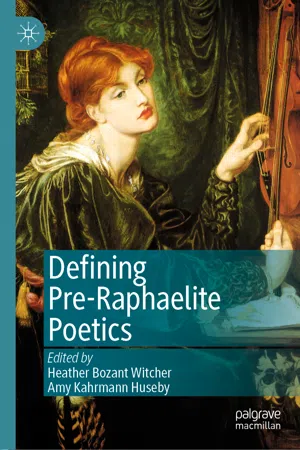 eBook - ePub
- Heather Bozant Witcher, Amy Kahrmann Huseby, Heather Bozant Witcher, Amy Kahrmann Huseby(Authors)
- 2020(Publication Date)
- Palgrave Macmillan(Publisher)
© The Author(s) 2020Begin AbstractH. B. Witcher, A. K. Huseby (eds.)Defining Pre-Raphaelite Poetics https://doi.org/10.1007/978-3-030-51338-2_11. Introduction: Defining Pre-Raphaelite Poetics
End AbstractHeather Bozant Witcher 1 andAmy Kahrmann Huseby2(1) Auburn University at Montgomery, Montgomery, AL, USA(2) Florida International University, Miami, FL, USAFrom its inception in 1848, the Pre-Raphaelite movement was regarded by its founders as an artistic rebellion, meant to shock and destabilize. Initially publicized through the visual arts, the self-styled Pre-Raphaelite Brotherhood rejected the classical conventions of the London Royal Academy of Arts . Pre-Raphaelites opted instead for a return to nature, as famously memorialized by William Michael Rossetti in his sketch of the movement’s primary aims:1, to have genuine ideas to express; 2, to study Nature attentively, so as to know how to express them; 3, to sympathize with what is direct and serious and heartfelt in previous art, to the exclusion of what is conventional and self-parading and learned by rote; and 4, most indispensable of all, to produce thoroughly good pictures and statues.1But what, specifically, is meant by this well-trodden understanding of Pre-Raphaelitism’s connection to nature as a means of returning to “genuine ideas” and sympathetic feeling, notably constructed post factem through memoir? John Holmes pays particular attention to the Pre-Raphaelite emphasis on natural history and geology in The Pre -Raphaelites and Science (2018), tracing the movement’s engagement with the nineteenth century’s capacious understanding of science. Pre-Raphaelitism, Holmes argues, “was one manifestation of a widespread mid-Victorian aspiration to establishing truth through unprejudiced and scrupulous observation.”2 While Holmes elucidates further implications for the forms of empirical observation, it is our belief that scholarship can do more to emphasize the diversity and variance afforded by the attentive study of nature as a means of “making new.” Such a concept links Pre-Raphaelite poetics to the early twentieth-century avant-garde . The early Pre-Raphaelite Brotherhood underscore honest observation to promote a sense of “establish[ed] truth” in their art in the same way that empiricism allows for the truths of science
- Henry A. Beers(Author)
- 2015(Publication Date)
- Routledge(Publisher)
Meanwhile be it remarked that the originality of gesture in Pre-Raphaelite figure painting, which M. de la Sizeranne notices, was only one more manifestation of the romantic desire for individuality and concreteness as against the generalising academicism of the eighteenth century. * ‡ “Lectures on Architecture and Painting,” 1853. * See vol. i., p. 44. As poets, the Pre-Raphaelites derive from Keats rather than from Scott, in their exclusive devotion to beauty, to art for art’s sake; in their single absorption in the passion of love; and in their attraction towards the more esoteric side of mediæval life, rather than towards its broad, public, and military aspects. * * “The return of this school was to a mediævalism different from the tentative and scrappy mediævalism of Percy, from the genial but slightly superficial mediævalism of Scott, and even from the more exact but narrow and distinctly conventional mediævalism of Tennyson…. Moreover, though it may seem whimsical or extravagant to say so, these poets added to the very charm of mediæval literature, which they thus revived, a subtle something which differentiates it from—which, to our perhaps blind sight, seems to be wanting in—mediæval literature itself. It is constantly complained (and some of those who cannot go all the way with the complainants can see what they mean) that the graceful and labyrinthine stories, the sweet snatches of song, the quaint drama and legend of the Middle Ages lack—to us—life; that they are shadowy, unreal, tapestry on the wall, not alive even as living pageants are. By the strong touch of modernness which these poets and the best of their followers introduced into their work, they have given the vivification required “(Saintsbury, “Literature of the Nineteenth Century,” p. 439). Pre-Raphaelitism “is a direct and legitimate development of the great romantic revival in England…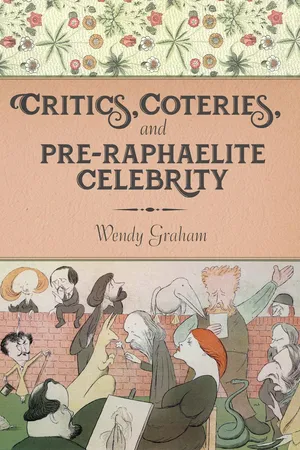 eBook - ePub
- Wendy Graham(Author)
- 2017(Publication Date)
- Columbia University Press(Publisher)
132 Former PRB members, as well as painters who exhibited at the Dudley and Grosvenor Galleries, flew under the banner “Pre-Raphaelite” and were presumed to belong to the same school, if not the same generation. Phases of the movement—nominally led by Rossetti in the 1850s and Solomon in the 1860s, and resurfacing at the Grosvenor Gallery (1877–1890)—included painters whose names are among the most conspicuous in British art: Frederic Leighton, George Frederic Watts, and Edward Burne-Jones.FIGURE 1.5 Simeon Solomon, Love and Lust , 1865. Photographic print of original drawing. Image © Beinecke Rare Book and Manuscript Library. Julia Ellsworth Ford Papers.The backlash against Wilde’s association with the movement in the early 1880s set in motion a panicked revaluation of the revolutionary aims of the PRB and a whitewashing of its contrarian character. By historicizing the divide between the PRB and its successor movements, I can home in on the characteristics (such as unmanliness, sensuality, and morbidity) that were expunged from the PRB repertoire by revisionist historiography. However, it takes dexterity and patience to sift through the testimony of period informants and later audiences with regard to the corollary formal, social, and psychological impacts of Pre-Raphaelitism. There was much disagreement among audiences about the content and character of individual works and oeuvres. Pre-Raphaelite heterogeneity made for queer strategic alliances. It stirred both avid partisanship and fierce detraction, often with its critics and partisans rising to the same bait. As Robyn Cooper notes, the controversies generated by the PRB (concerning ideas of beauty, the relation between art and religion, between art and nature, and between the art of the past and contemporary art) added to the sense of confusion reigning in critical and artistic circles: “Critics of the 1850s felt they were living in an ‘age of anarchy and disorganization’ in art.”133 Harry Quilter’s influential criticisms of “hybrid” Pre-Raphaelitism’s myriad prescriptions, so “heterogeneous as to be incapable of easy consolidation,” were tacitly acknowledged by its staunchest advocates along the broad spectrum of Pre-Raphaelite endeavor.134 eBook - ePub
- Laura Morowitz, William Vaughan(Authors)
- 2017(Publication Date)
- Routledge(Publisher)
Consciously or not, the Pre-Raphaelites acted out the now-established role of avant-garde artists, working briefly in purported union and then as individuals to carve out a new style in the quondam solid rock of British art. The perpetuation of their disunion in their later anecdotage, while on one level a kind of petty bickering amongst sadly splintered old friends, also reflects the critical importance of just who was writing their history and the larger history of nineteenth-century British art. The sheer scope and pomposity of works such as Hunt’s two-volume summation is enough to justify attention. But the inherent biases of his constructed story are worthy of continued scrutiny. And concentration on the few years of group Pre-Raphaelite activity, as distinct from later medievalism, Aestheticism, or Academicism is not at all limiting. Rather it is only by divining the specific nature of such artistic yet ostensibly social, commercial and rhetorical groups that we can better understand the mechanisms of cooperative behaviour in Britain in the period. Rooted in larger societal traditions of homosociality, inspired by the youthful ardour of its members, conveniently disparaged by the apparent world at large and then subject to natural splintering, Pre-Raphaelitism presages tropes that became familiar in histories of modernism. No naïve fraternal alignment, the PRB was representatively symptomatic of its period, originally conceived in a spirit of endeavour, set back by a lingeringly conservative art market and critical establishment, and forced into disunion in order for the members to survive economically. They eventually and cannily worked within the changing and modernizing commercial world to further their aims and, in their later constructions of their experiences, made much of their separateness over their union, a mark of alienation familiar in twentieth-century art history.Notes Thanks to Karen Gottlieb, Tim Barringer, Aruna D’Souza, Tom McDonough and the editors of this volume for their help with this essay.1 . The seven Pre-Raphaelites were James Collinson (1825–81), William Holman Hunt (1827–1910), John Everett Millais (1829–96), Dante Gabriel Rossetti (1828–82), William Michael Rossetti (1829–1919), Frederic George Stephens (1828–1907) and Thomas Woolner (1826–92).2 . Simon Schama, ‘Tunnel Vision,’ New Yorker (10 November 1997): 100.3 . Compare Timothy Hilton’s description of the group as a cosa nostra, conspiratorial young artists strong-arming older Academicians in The Pre-Raphaelites (London: Thames & Hudson, 1970), p. 32.4 . Allen Staley, The Pre-Raphaelite Landscape eBook - ePub
Nineteenth-Century Art
A Beginner's Guide
- Laurie Schneider Adams(Author)
- 2014(Publication Date)
- Oneworld Publications(Publisher)
In England, some of the ideals of Realism were taken up by a group of artists known as the Pre-Raphaelites – because they believed that the only art that was “truthful” predated Raphael, who died in 1520. In their view, by close observation and careful attention to nature they would be able to depict “truth” in their paintings. Their work is characterized by rich, pure color on a white ground (a combination which enhances brightness), meticulous detail, and clear forms.In 1848, the year that Louis Philippe abdicated in France and Marx and Engels published the Communist Manifesto in London, the Pre-Raphaelite Brotherhood (PRB) was formed. The original group was composed of young artists and poets protesting the decline of art and the conservative taste advocated by the Royal Academy; its three founders were William Holman Hunt (1827–1910), Dante Gabriel Rossetti (1828–1882), and John Everett Millais (1829–1896), who were soon joined by four more artists. In 1849 the Pre-Raphaelites had their first public exhibition.By 1848, John Ruskin had published the first two volumes of his five-volume Modern Painters . He too advocated “truth to nature,” a quality for which he praised Turner; he also defended the Pre-Raphaelites against their critics. But if we compare Turner’s work (see plate 3 ) with that of the Pre-Raphaelites, we see that the notion of truth can appear very different in the styles of different artists. In contrast to Turner’s expansive use of paint and dynamic depiction of landscape, the Pre-Raphaelite style is precise, linear, and crowded with details.The Pre-Raphaelites often turned to literature for their iconographic sources – notably Shakespeare, the Arthurian legends, and the Bible. The latter inspired John Everett Millais’ Christ in the House of His Parents of 1850 (figure 29 eBook - ePub
The Princeton Encyclopedia of Poetry and Poetics
Fourth Edition
- Stephen Cushman, Clare Cavanagh, Jahan Ramazani, Paul Rouzer, Stephen Cushman, Clare Cavanagh, Jahan Ramazani, Paul Rouzer(Authors)
- 2012(Publication Date)
- Princeton University Press(Publisher)
Pre-Raphaelite Vision , ed. A. Staley and C. Newall, exhibition catalog (2004).E. K. HELSINGERPRE-RAPHAELITISM. The term is loose but useful to describe shared ideals and practices in circles around D. G. Rossetti and William Morris in the later 1850s and 1860s, after the dissolution of the original *PreRaphaelite Brotherhood. Pre-Raphaelitism was a site of poetic innovation and experiment, beginning with Morris’s 1858 The Defense of Guenevere ; D. G. Rossetti’s trans. from Dante and his circle, The Early Italian Poets (1861); Christina Rossetti’s Goblin Market (1862); A. C. Swinburne’s Atalanta in Calydon (1865) and Poems and Ballads, First Series (1866); and D. G. Rossetti’s Poems (1870). The influence of poetic Pre-Raphaelitism affected contemporaries (e.g., George Meredith’s Modern Love , 1862; G. M. Hopkins; Thomas Hardy) and extended to later devels. it nurtured or partly inspired (*aestheticism, *symbolism, *decadence, and significant aspects of *modernism and *postmodernism, particularly *Language poetry).Poetic Pre-Raphaelitism is characterized by sharpened attentiveness to sensory perception valued as a mode of knowledge, giving access to heightened states of psychological and visionary intensity, particularly as provoked by passion or desire. Sensuous figuration and formal design evoke affective moods and psychological conditions to explore social, sexual, political, and metaphysical ideas. Pater was probably the first and best critic of this aspect of Pre-Raphaelitism, but the poets themselves were significant critics in prose as well as verse (e.g., Swinburne, Notes on Poems and Reviews [1866], William Blake [1868], Notes on Some Pictures of 1868 ; and D. G. Rossetti, The Stealthy School of Criticism [1871]). Pre-Raphaelite crit. vigorously resisted Victorian strictures on style and subject matter, insisting on “poetry for poetry’s sake” (Swinburne, William Blake
- Josephine Guy, Ian Small(Authors)
- 2010(Publication Date)
- Routledge(Publisher)
In his 1882 book on Dante Gabriel Rossetti, William Sharp (1855–1904) attempted to define the significance of the Pre-Raphaelites’ attention to visual detail when he explained that for them representation was not a matter of providing an image that was ‘literally true’, but one that ‘would yet in another sense be true’. Pre-Raphaelite notions of ‘truth’ also contrasted with the unexpressed assumption behind the Royal Academy’s valorisation of later Italian painters: that art should produce an ideal version of, rather than slavishly imitate, the visible forms of the natural world. So although the PRB – like most of their contemporaries – continued to locate the value of pictorial art in the special form of knowledge it vouchsafed to the viewer, they argued that it was only through an accurate delineation of natural forms that such a spiritual truth could be exhibited. For Ruskin, like the PRB, the business of the artist, as he put it in the third volume of Stones of Venice (1853), was ‘to be a seeing and feeling creature; to be an instrument of such tenderness and sensitiveness, that no shadow, no hue, no line, no instantaneous and evanescent expression of the visible things around him … shall be left … unrecorded’. In this emphasis on felt experience Pre-Raphaelitism also picks up ideas associated with some Romantic-period writers like Wordsworth. In the late 1850s the Brotherhood effectively dissolved as the careers of its members developed along different paths. Millais, for example, later became a Royal Academician and was appointed the president of that institution in 1896. The influence of the Pre-Raphaelite aesthetic continued to be felt, however, throughout the century in a wide range of artistic and decorative practices eBook - ePub
Ruskin's Artists
Studies in the Victorian Visual Economy
- Robert Hewison(Author)
- 2017(Publication Date)
- Routledge(Publisher)
Fors.The politics of The Three Colours is also a gender politics. Inscribing the Brotherhood with an overtly masculine identity in 1853, Ruskin’s thinking about the Pre-Raphaelites in 1878 dwells upon their representations of the female. Each picture in Dunira is read as presenting elements of a social ideal with which a female form is variously associated through her modest plainness, orderliness, naturalness, tidy domestic labour, peaceful disposition, or her decorous simplicity. Suggesting a link between the political values he commends and these female forms, Ruskin is implying a political ideology in a continuum from the lecture ‘Of Queens’ Gardens’ (1864) in which the female bears a particular burden of responsibility as the regulator of daily life; he is also fashioning models which implicitly serve as guides to what he sees as harmonious female behaviour which, in the case of Ecce Ancilla Domini , is notably desexualized.16 The Pre-Raphaelites, as they are interpreted in The Three Colours, are makers of artifacts which assist Ruskin’s regulation of appropriate female behaviour and facilitate the connection between the virtues of his alternative society and the unassuming, ‘natural’ female body: the Guild bears the name of St George, certainly, but in The Three Colours it is the woman’s – not the knightly – body which does the chief work of giving fleshly form to ideology.17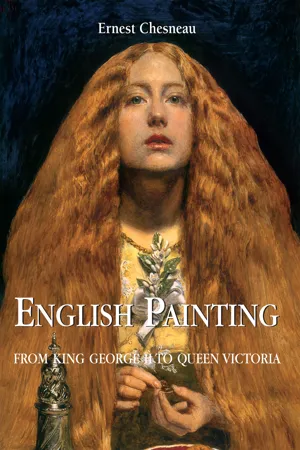 eBook - ePub
English Painting
From King George II to Queen Victoria
- Ernest Chesneau(Author)
- 2023(Publication Date)
- Parkstone International(Publisher)
A mind of this stamp, endowed with so much strength, activity, and faith, was bound to make converts. With cogent reasoning he laid bare and waged war against the folly that employed skill and manual dexterity in substituting formality for truth; and in this there was a great deal that was true. The only fault in the system, so far, was the severe inflexibility with which it was carried out. Ruskin, with a logic like that of Pierre-Joseph Proudhon and Henry Rousseau, advanced boldly from one inference to another, to the farthest bounds of the principle laid down. His extremely daring opinions led him to look upon Raphael as the first traitor to religious art, which had been understood and represented in all its sublimity by his predecessors. As he was the first traitor, so, according to this view, was he also the first apostle of the illusory style, an apostle only too well imitated by his disciples of every school, and faithfully followed in the path in which Ruskin could see nothing but posturing and beautiful deceit. Hence it was that the name Pre-Raphaelites was adopted by this little band of reformers, who possessed firm faith in their views, although their enthusiasm was somewhat youthful.A section of our romantic school has also entertained fainter aspirations of the same kind. In painting, sculpture, and architecture we have also had our Pre-Raphaelites. In the last of these three arts we could mention eminent men who have made use most splendidly of similar systems. As far as painting and sculpture are concerned, the movement was not of serious moment, nor was it based on any very clear or elevated principles. The ornamental painting of the Mediaeval Ages was all that it concerned itself with, and it never entered into the spirit of early art at all. It was a fleeting excitement which came to nothing, and was promptly given up. In Germany, too, a similar movement was started by Franz Overbeck, and has not yet ceased.The English, on the contrary, sought with almost fanatical eagerness to apply their opinions, and bring them to perfection. They had been already attacked by Parisian ridicule, which had announced, through Joseph Prudhomme, that “art is a priesthood”. But they did not laugh. To them, their mission was an earnest matter, and they established something approaching a military order, an order of knight-templars on a small scale, fighting for the regeneration of art in the midst of unbelievers. The religious and even mystical element of the Pre-Raphaelite school entered, not only into the works, but into the very life of its followers. They separated themselves from the world, worked in solitude, the feeblest of them for some time tried a cloistered life, and at the time “when their austere enthusiasm was at its height, that is, in the earliest days of their union, they added to their names below their pictures, as a sort of confession of faith, a distinguishing mark, the three letters P.R.B. – Pre-Raphaelite Brother. Now, however, the three letters have disappeared, the church is dissolved, and the flock scattered. A few of them, although solitary cases, held firmly to their convictions, and have struck out from time to time the most diverse styles, mingling with the pure doctrine their own personal feeling. Let us study them at their work. eBook - ePub
The Victorian Period
The Intellectual and Cultural Context of English Literature, 1830 - 1890
- Robin Gilmour(Author)
- 2014(Publication Date)
- Routledge(Publisher)
Out of Shakespeare’s plays came (among others) Puck (1847) by the sculptor Thomas Woolner (1825–92); Ferdinand Lured by Ariel (1849) and Ophelia (1852) by John E. Millais (1829–96); Claudio and Isabella (1853) by William Holman Hunt (1827–1910); Twelfth Night (1850) by Walter Deverell (1827–54). Shakespeare and Tennyson provide the subject for Millais’s Mariana (1851), while the poems of Keats, especially his narrative poems ‘Isabella’ and ‘The Eve of St Agnes’, were the inspiration for Millais’s Isabella (1849), Hunt’s Eve of St Agnes (1848) and Isabella and the Pot of Basil (1867), and The Eve of St Agnes (1856) by Arthur Hughes (1832–1915). In fact, if one includes paintings on Biblical subjects and religious allegories, like Hunt’s The Light of the World (1853), in the category of the historical, the first and most creative phase of Pre-Raphaelitism, the decade or so from 1848, could almost be said to be creating more from the past than from the present. It is notable, however, that Brown, Hunt, and Millais combined their interests in the historical with a commitment to painting contemporary life. So what was the Pre-Raphaelite movement, and what was it about it that made this strange combination of the literary, the historical, the biblical and allegorical, and the contemporary, seem challengingly modern in 1848? First and foremost, it was a movement of young men. When the original Pre-Raphaelite Brotherhood (PRB) was formed in Millais’s house in 1848, Millais himself was only nineteen, Hunt twenty-one, and the other moving spirit, Dante Gabriel Rossetti (1828–82), twenty. With his Italian blood, Rossetti may have been responsible for the secret society element and the use of the initials ‘P.R.B.’ on canvases, which as much as anything was responsible for the hostility their work attracted initially. To these three central figures were added four others to make up the magic figure of seven: Woolner the sculptor, F.G eBook - ePub
Victorian Painting
Essays and Reviews: Volume Two 1849-1860
- John Charles Olmsted(Author)
- 2018(Publication Date)
- Routledge(Publisher)
Ruskin’s prediction, by laying their Pre-Raphaelitism at the feet of the ancient mother-church, in whose service the early artists produced the paintings they so much admire. Mr. Millais in a man of too fine a poetic nature, and too full of sympathies with what in modern, to have retained more than an evanescent tinge, such as any artist may gracefully have, of the spirit of medioeval ecclesiasticism ; and, if a little more of it still adheres to Mr. Hunt, his strong sense will soon throw it off. After all, what seems mediævalism in such stronger Pre-Raphaelites as Hunt, Millais, and Rossetti, may be nothing more than the inadequate manifestation of that aspiration after spirituality and religious meaning in art, which, in common with all the Pre-Raphaelites, they possess. For, in addition to the various characteristics of Pre-Raphaclitistn which we have hitherto noticcd, this also in to be taken into account, that it aims at rescuing Art from the degraded position of being a mere minister to sensuous gratification, and elevating it into an agency of high sjiiritual education. That Art should be pervaded with the Christian spirit,—that it should convey and illustrate the highest truths relating to man’s being, in a maxim of the Pre-Raphaelites for which, and for their endeavours to carry it out, they ought to be held in honour. But it in easier to hold by such a maxim theoretically, than to devise the appropriate artistic means for giving effect to it, in an age when the human intellect has torn up and huddled together, as a mere heap of relics, much that the feet of the ancients walked on as solid pavement, that the eyes of the ancients gazed on as indestructible walls, and that the artists who worked for the ancients had nothing to do but assume, and be in everlasting relation with, and everlastingly and obdurately point to eBook - ePub
The Spiritual Dynamic in Modern Art
Art History Reconsidered, 1800 to the Present
- C. Spretnak(Author)
- 2014(Publication Date)
- Palgrave Macmillan(Publisher)
The P. R. B. painted on a wet white field on which they applied thin layers of oil paint, a technique devised by Millais that caused their colors to appear luminous. They often painted en plein air so as to be able to capture botanical detail. They exhibited several paintings in the Royal Academy and Free Exhibitions in 1849, bearing a cryptic stamp for the back of their paintings, as had the Nazarenes 40 years earlier. Alas, the stinging rebukes by the art critics were deeply wounding to the young artists and shook their confidence. They continued to paint as a brotherhood and also published five issues of a periodical, The Germ, during 1850. Yet each began moving in separate directions with his artistic development. In 1854 Millais proposed that the brotherhood be disbanded as they no longer had common aims. The seeds for a new grouping of Pre-Raphaelite painters had been planted during 1853–1855, however, when two divinity students at the University of Oxford— William Morris (1834–1896) and Edward Burne-Jones (1833–1898) —eagerly read and discussed Ruskin’s books, especially the chapter “The Nature of Gothic,” and his article “Pre-Raphaelism” defending the new art. After a walking tour of the medieval cathedrals of northern France, the two friends settled in London in 1856, where Burne-Jones sought out Rossetti. The three of them spent time together, visiting art galleries and discussing the virtues of the medieval aesthetic. After taking painting lessons from Rossetti, who considered each of them a genius, the young men abandoned their career plans for the ministry and decided to become painters. They then assisted Rossetti in a commission in the new Oxford Union
Index pages curate the most relevant extracts from our library of academic textbooks. They’ve been created using an in-house natural language model (NLM), each adding context and meaning to key research topics.

