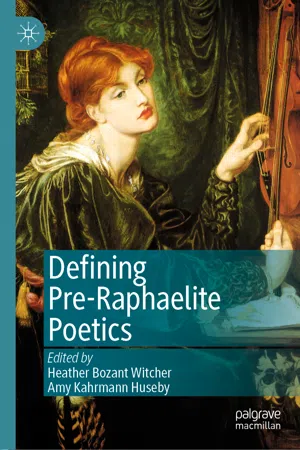
Defining Pre-Raphaelite Poetics offers a range of Pre-Raphaelite literary scholarship, provoking innovative discussions into the poetic form, gender dynamics, political engagement, and networked communities of Pre-Raphaelitism. The authors in this collection position Pre-Raphaelite poetics broadly in the sense of poiesis, or acts of making, aiming to identify and explore the Pre-Raphaelites' diverse forms of making: social, aesthetic, gendered, and sacred. Each chapter examines how Pre-Raphaelitism takes up and explores modes of making and re-making identity, relationality, moral transformations, and even, time and space. Essays explore themes of formalist or prosodic approaches, expanded networks of literary and artistic influence within Pre-Raphaelitism, and critical legacies and responses to Pre-Raphaelite poetry and arts, codifying the methods, forms, and commonalties that constitute literary Pre-Raphaelitism.
eBook - ePub
Defining Pre-Raphaelite Poetics
- English
- ePUB (mobile friendly)
- Available on iOS & Android
eBook - ePub
Defining Pre-Raphaelite Poetics
About this book
Information
© The Author(s) 2020
H. B. Witcher, A. K. Huseby (eds.)Defining Pre-Raphaelite Poetics https://doi.org/10.1007/978-3-030-51338-2_11. Introduction: Defining Pre-Raphaelite Poetics
Heather Bozant Witcher1 and Amy Kahrmann Huseby2
(1)
Auburn University at Montgomery, Montgomery, AL, USA
(2)
Florida International University, Miami, FL, USA
From its inception in 1848, the Pre-Raphaelite movement was regarded by its founders as an artistic rebellion, meant to shock and destabilize. Initially publicized through the visual arts, the self-styled Pre-Raphaelite Brotherhood rejected the classical conventions of the London Royal Academy of Arts. Pre-Raphaelites opted instead for a return to nature, as famously memorialized by William Michael Rossetti in his sketch of the movement’s primary aims:
1, to have genuine ideas to express; 2, to study Nature attentively, so as to know how to express them; 3, to sympathize with what is direct and serious and heartfelt in previous art, to the exclusion of what is conventional and self-parading and learned by rote; and 4, most indispensable of all, to produce thoroughly good pictures and statues.1
But what, specifically, is meant by this well-trodden understanding of Pre-Raphaelitism’s connection to nature as a means of returning to “genuine ideas” and sympathetic feeling, notably constructed post factem through memoir? John Holmes pays particular attention to the Pre-Raphaelite emphasis on natural history and geology in The Pre-Raphaelites and Science (2018), tracing the movement’s engagement with the nineteenth century’s capacious understanding of science. Pre-Raphaelitism, Holmes argues, “was one manifestation of a widespread mid-Victorian aspiration to establishing truth through unprejudiced and scrupulous observation.”2 While Holmes elucidates further implications for the forms of empirical observation, it is our belief that scholarship can do more to emphasize the diversity and variance afforded by the attentive study of nature as a means of “making new.” Such a concept links Pre-Raphaelite poetics to the early twentieth-century avant-garde. The early Pre-Raphaelite Brotherhood underscore honest observation to promote a sense of “establish[ed] truth” in their art in the same way that empiricism allows for the truths of science . But what “truths” do Pre-Raphaelite poetics reveal?
We contend that political truths are one of the strengths of Pre-Raphaelitism. In particular, our volume connects the poets’ respective use of prosodic elements and radical themes to at once critique nineteenth-century traditions of poetic expression and to deliver political views from the perspective of everyday life. Pre-Raphaelite political objectives are certainly underresearched and underexplored. Indeed, one is hard-pressed to locate any references to politics or the political in the indices to most scholarly work on the Pre-Raphaelites. Even in a vital and refreshing study like Eleonora Sasso’s The Pre-Raphaelites and Orientalism: Language and Cognition in Remediations of the East (Edinburgh UP, 2018), these categories are notably absent. As a result, we read in W. M. Rossetti’s call to “sympathize with what is direct and serious and heartfelt” a language of political action, one which we explore further in Chapter 2 and throughout this volume. Although largely considered in terms of the second stage of Pre-Raphaelitism, due in part to William Morris’s political engagement, we acknowledge the political nature inherent in a distinctly Pre-Raphaelite poetics. What’s more, the political investments of the Pre-Raphaelites are another ligature between their work and that of later creative groups. In addition to a similar quotidian political orientation, the Pre-Raphaelites and members of the twentieth-century avant-garde shared a central aim that involved innovating Victorian style and culture by resisting binaries and embracing diversity, hybridity, and multimodality.
Although Pre-Raphaelitism began as a group of male painters committed to resisting traditional approaches to visual art—a view upheld above in W. M. Rossetti’s program—the works created by its artists underscore intertextuality, with poetry and art intertwined from the group’s conception, and a desire for destabilization. Nowhere is this destabilization of categories more apparent than in the short-lived periodical, The Germ (1850). Lindsay Smith suggests that the change in title—from The Germ: Thoughts Towards Nature in Poetry, Literature and Art to Art and Poetry, Being Thoughts Towards Nature, Conducted Principally by Artists—be perceived as “radical intertextuality that presents the journal as questioning its categorization as discourse.”3 More to the point, in the first issue, sculptor John Lucas Tupper proposes the unsettling of categories traditionally deemed “High Art” and “Low Art” in his essay “The Subject in Art.” To eliminate the dichotomy between artistic categories, Tupper turns to the integrity of nature and the necessity of multiplicity: “we then have the artist, instructed of nature, fulfilling his natural capacity, while his works we have as manifold yet various as nature’s own thoughts for her children.”4 Tupper’s essay promotes the democratic spirit of Pre-Raphaelitism and aligns with the views elaborated by Dante Gabriel Rossetti’s “Hand and Soul,” an essay newly discussed by Holmes in terms of Chiaro’s sexuality in Chapter 3 of this collection . Such works of prose in The Germ’s initial issue identify the core of the Pre-Raphaelite manifesto: literary, visual, and material art as an innovative means of self-expression—or “instinctive impulse”—through the study of natural appearances, while embracing plurality.5
* * *
This edited collection defines Pre-Raphaelite poetics by its plurality. That is not to say that Pre-Raphaelitism is all things and, as a consequence, to impute to the category less integrity. Instead we place their forms of self-expression under this rubric of plurality to designate heterogeneity, cultural borrowing, innovation, and evolution as the substrate for all Pre-Raphaelite forms of making. Moreover, we position Pre-Raphaelite poetics broadly in the sense of poiesis, or acts of making. Poiesis, the originary term from which poetry takes its name, initially intended all art forms involved in creative making. Our collection, therefore, like the Pre-Raphaelites, returns to these origins in our endeavor to understand their poetics. In so doing, the definitional capacity of this collection extends from poetry to music to visual arts, as well as to the making of the Pre-Raphaelites as a society themselves. In short, Defining Pre-Raphaelite Poetics identifies and explores the Pre-Raphaelites’ diverse forms of making: social, aesthetic, and gendered. Such forms emerge as the recognizable content, imagery, and aesthetics of Pre-Raphaelitism. Broadly, these include homosocial networks, genealogies of inspiration, and collaboration; multimedial and intertextual borrowing, homage, and reference; reaching backward and forward historically, drawing on the past and becoming inspiration for the future; political commentary and activism; complex gender dynamics, which include sensual love and the idealization of women, and women creators writing against precisely those ideals; nature and representations of inner experience; and the use of legend (Arthurian, Celtic, and Norse). Each chapter examines how the Pre-Raphaelites and Pre-Raphaelitism take up and explore modes of making and remaking identity, relationality, moral transformations, and even time and space. Ultimately, this edited collection argues that the plurality—or interlacing a variety of artistic forms—of Pre-Raphaelite poetics is its consummate defining quality.
To accommodate this comprehensive understanding of poetics, Defining Pre-Raphaelite Poetics takes up the question of Pre-Raphaelite form. In the Fall/Winter 2018 volume of Victorian Literature and Culture, which provides keywords for the Victorian field, Stephen Arata and Herbert Tucker assert the prominence of form and formalism as a burgeoning field of literary study. As Arata and Tucker note, the concept of form is capacious, and should be celebrated for its openness.6 In our collection, we celebrate form’s extensive range through our emphasis on literary Pre-Raphaelitism as a conscious act of making through poetic experimentation and social networking. Extending Caroline Levine’s concept of “affordances” to link literature and politics, many of our contributors use form as an organizing principle, one which connects the literary, musical, and visual art to social and political life.7 Form thereby offers a method of defining Pre-Raphaelite poetics not as a what but as a how—as a verb, rather than as a noun. In other words, beyond the list of elements and anticipated subject matter offered above, form reorients the definition of Pre-Raphaelitism away from components and toward an awareness of method, process, and action. We conceptualize form broadly to encompass poetry’s inception from artistic conventions, and in recognition of how form shapes lived experience.
Literary Pre-Raphaelitism especially uses form to unsettle artistic representations of reality. Our contributors pay close attention to this generic destabilization in their re-examination of well-known Pre-Raphaelite poets. Each chapter emphasizes literary Pre-Raphaelitism as open-minded in terms of gender, sexuality, and political influence; collaboratively experimental in technique and structure; and intermedial, using aesthetics as a way of engaging with moral and social concerns. In this way, we apprehend Pre-Raphaelitism as engaging with, and responding to, social and political life. Broadening beyond the traditional cast of Pre-Raphaelite poets, our contributors are attuned to less acknowledged Pre-Raphaelite voices. The chapters consider both the influences and departures from the recognized Pre-Raphaelite school to draw attention to innovation in terms of prosody and style—metrical patterning, rhythm and rhyme—all of which contribute to a sense of Pre-Raphaelite formal density as a precursor to Modernist poetics. Our contributors, thus, offer a broader range of Pre-Raphaelite literary scholarship, provoking innovative discussions into the poetic form, gender dynamics, political engagement, and networked communities of Pre-Raphaelitism. That said, we recognize the hubris of attempting to codify a definition of an artistic movement that so many scholars agree is marked by “protean shifts in membership, parameters, and objectives.” As Dinah Roe rightly observes, such a task is a “tricky business,” indeed.8
In truth, there has been no critical consensus, until now, on what constitutes Pre-Raphaelitism, due in large part to the diversity of subject matter an...
Table of contents
- Cover
- Front Matter
- 1. Introduction: Defining Pre-Raphaelite Poetics
- 2. Gender Work: The Political Stakes of Pre-Raphaelitism
- 3. Investigating Intersexuality: Pre-Raphaelite Poetics and the Hermaphrodite Self
- 4. Second Generation Pre-Raphaelitism: The Poetry of The Oxford and Cambridge Magazine
- 5. “Of Chivalry and Deeds of Might”: Reviving F. G. Stephens’s “Lost” Arthurian Poem
- 6. Musico-Literary Pre-Raphaelite Poetry
- 7. Christina Rossetti’s Emblematic Poetics
- 8. Elizabeth Siddall: Pre-Raphaelitism, Poetry, Prosody
- 9. Swinburne’s Expansive Poetics
- 10. “Afar from My Own Self I Seem”: D. H. Lawrence, Persephone, and Pre-Raphaelite Poetics
- 11. Afterword
- Back Matter
Trusted by 375,005 students
Access to over 1.5 million titles for a fair monthly price.
Study more efficiently using our study tools.
Frequently asked questions
Yes, you can cancel anytime from the Subscription tab in your account settings on the Perlego website. Your subscription will stay active until the end of your current billing period. Learn how to cancel your subscription
No, books cannot be downloaded as external files, such as PDFs, for use outside of Perlego. However, you can download books within the Perlego app for offline reading on mobile or tablet. Learn how to download books offline
Perlego offers two plans: Essential and Complete
- Essential is ideal for learners and professionals who enjoy exploring a wide range of subjects. Access the Essential Library with 800,000+ trusted titles and best-sellers across business, personal growth, and the humanities. Includes unlimited reading time and Standard Read Aloud voice.
- Complete: Perfect for advanced learners and researchers needing full, unrestricted access. Unlock 1.5M+ books across hundreds of subjects, including academic and specialized titles. The Complete Plan also includes advanced features like Premium Read Aloud and Research Assistant.
We are an online textbook subscription service, where you can get access to an entire online library for less than the price of a single book per month. With over 1.5 million books across 990+ topics, we’ve got you covered! Learn about our mission
Look out for the read-aloud symbol on your next book to see if you can listen to it. The read-aloud tool reads text aloud for you, highlighting the text as it is being read. You can pause it, speed it up and slow it down. Learn more about Read Aloud
Yes! You can use the Perlego app on both iOS and Android devices to read anytime, anywhere — even offline. Perfect for commutes or when you’re on the go.
Please note we cannot support devices running on iOS 13 and Android 7 or earlier. Learn more about using the app
Please note we cannot support devices running on iOS 13 and Android 7 or earlier. Learn more about using the app
Yes, you can access Defining Pre-Raphaelite Poetics by Heather Bozant Witcher, Amy Kahrmann Huseby, Heather Bozant Witcher,Amy Kahrmann Huseby in PDF and/or ePUB format, as well as other popular books in Literature & Art Theory & Criticism. We have over 1.5 million books available in our catalogue for you to explore.