History

Civil War Military Strategies of North and South
During the Civil War, the North (Union) focused on blockading Southern ports, capturing the Mississippi River, and using its larger population and industrial resources to wear down the South. The South (Confederacy) relied on defensive tactics, seeking to outlast the North and gain foreign recognition and support. Both sides utilized a mix of traditional and innovative military strategies.
Written by Perlego with AI-assistance
Related key terms
1 of 5
10 Key excerpts on "Civil War Military Strategies of North and South"
 eBook - PDF
Writing the Civil War
The Quest to Understand
- James M. McPherson, William J. Cooper, James M. McPherson, William J. Cooper, Jr.(Authors)
- 2021(Publication Date)
- University of South Carolina Press(Publisher)
Here the principal actors included the president and a group of senior generals, but Congress, public opinion, and the press also played noteworthy roles. Planning at both levels proceeded concur-rently, and decisions about political goals dramatically shaped the ways in which the North applied its military power against the Confederacy. 3 Because literally thousands of books have addressed northern strat-egy and military policy, coverage in this essay must be highly selective. For example, Abraham Lincoln, Ulysses S. Grant, William Tecumseh Sherman, Winfield Scott, George B. McClellan, and Henry W. Halleck stood out among leaders who influenced northern strategy, but a survey of the biographical literature on these figures is impossible (virtually ev-ery biography of Lincoln devotes some attention to his role as Union strategist). A review of the myriad general works on the Civil War that inevitably accord some attention to strategy is equally infeasible. The fo-cus will be on twentieth-century works specifically addressing issues relating to national or operational strategy and to the individuals who shaped and directed them. The most important questions examined in this historiography may be summarized quickly. Did the North win because of sound strategic planning and execution, or would the Confederacy have lost in any event because it struggled against impossible odds? The latter view, propounded by southern Lost Cause writers in the late-nineteenth and early-twentieth centuries, has proved remarkably tenacious (as suggested by Shelby Foote's image of a North using just of half its energy and resources). It depends in large measure on interpreting Grant's contribution to victory as simply committing without limit Union manpower and material resources. This 9 GARY W. GALLAGHER conception conceded minimal skill to northern military planners and held sway in much of the literature until the third and fourth decades of the twentieth century. eBook - PDF
- Keith D. Dickson(Author)
- 2022(Publication Date)
- For Dummies(Publisher)
Strategy directs armies into designated geographical regions to accomplish broad objectives defined by the political leadership. Armies in turn design campaigns — a series of battles and engagements intended to accomplish the assigned strategic objectives. Tactics deal with the way battles are fought, usually by organizations below army level (a corps, division, or brigade, for example). In summary: » Strategy: The art and science of designing military campaigns to achieve the objective of the war » Tactics: The art of employing armed units on the battlefield The last few paragraphs give you the basics — a definition of war and the three concepts that determine the conduct of war: Strategy determines how a state’s military capabilities will be used to achieve the objectives of the war. Campaigns are designed to employ military forces to fulfill the strategic objective. Tactics are the method military units employ to fight battles. CHAPTER 4 Civil War Armies: Structure and Organization 57 Creating a Strategy: Three Basic Questions A state or nation must have a strategy to fight a war. Otherwise the war has no direction or purpose. To determine a strategy, leaders must answer three basic questions that form the base of a wartime strategy: » What are you trying to do? In war, an ironclad connection exists between political objectives and the conduct of war. Both President Lincoln and President Davis had to determine their political objectives for the war. For Lincoln and the North, the initial political objective was to end the rebellion of the Southern states and restore the Union. For Davis and the Confederacy, the political objective was to gain and maintain its independence as a sovereign nation. These broad political goals become the means to determin-ing a military strategy. War aims can change, depending on the outcome of campaigns and battles.
- Lt.-Col. Kay Brinkmann(Author)
- 2015(Publication Date)
- Golden Springs Publishing(Publisher)
CHAPTER 6 — ESSENTIAL LESSONS FROM THE CIVIL WAR
The U.S. Civil War may at its core have been a gigantic war among brothers aiming at reconstituting the Union; it nevertheless was the classic struggle of two antagonistic wills wrestling for victory, generating generally applicable military lessons. After having evaluated the assessments of the German observers, this chapter analyzes essential lessons the Civil War and relates them to the developments in contemporary Germany up to the First World War.Lessons at the Strategic Level
The Significance of Political-Military Relations
The ultimate success of the Union was based extensively on the recognition that political and military objectives are closely interrelated and require continuous coordination through a dynamic process. President Abraham Lincoln became the synonym for enforcement of this principle. From the outset of the war he set the strategic imperatives, while simultaneously balancing the different domestic, foreign and socio-economic influences. Lincoln was aware of the close reciprocity between the national strategic objectives on one side and the operational aims, methods and situation within the theaters on the other side. Consequentially, political and military leadership agreed that the duration of the war would strongly influence the dimension of violence and suffering as well as the conditions for a peace settlement.{154} Lincoln’s active interference during the first three years of the war resulted from two reasons. First, promising military strategic concepts were not executed energetically and decisively enough (McClellan). Second, unsuccessful concentration of effort and lack of synchronization of the operations reflected a failed appreciation of the overall strategic situation and purpose (Halleck). In addition, the policy of appointing commanders oftentimes less on military competence rather than on the grounds of political influence and partisanship certainly resulted in extensive friction that affected the conduct of military operations.{155} Despite his own lack of military experience, Lincoln early became aware of the significance of synchronized military operations in time and space.{156} eBook - ePub
The Ephemeral Civilization
Exploding the Myth of Social Evolution
- Graeme Snooks(Author)
- 2002(Publication Date)
- Routledge(Publisher)
The reason the North went to war against the South was not to free the slaves, but to prevent the fragmentation of the North American market by the creation of a new nation, the Confederacy, in the South. By breaking away from the Union, the South might provide an example, together with financial and military support, for the central territories and for the Far West to do the same. Like the South these new nations could have pursued a dependent strategy by developing staples, such as wool, wheat, meat, and minerals, that could be exported to Europe. If the USA was transformed into a multitude of nation-states as in Europe, the technological strategy of the North would collapse. To prevent this the North was prepared to pay whatever it might cost.And the cost was high. In four years of bitter warfare much infrastructure together with the lives of more than 600,000 men were destroyed (Engerman 1966). This amounted to the staggering proportion of about one-quarter of young men eligible for military service. Had the war been fought over any issue other than control of the dynamic strategy of North America these high costs would have quickly led to a negotiated peace. Following its expensive victory, the North imposed its dynamic strategy on the South – with the dramatic consequences feared by the seceding states – and attained its vision of a mega-state in North America. No one would ever challenge the technological strategists again. And, just as the Northern strategists had hoped, there were immense riches to be garnered. This can be seen reflected in the great mansions they built in New York over the following generation (Hughes 1997). The Civil War had achieved its objectives.While the American Civil War can be explained by my dynamic-strategy model, it provides a stumbling block for other mega-theories. It is, therefore, a litmus test for dynamic models of human society. How, one might ask, would Marx explain it? It is quite clear that the Civil War was not a struggle between classes – both societies were dominated by prosperous elites who invested in ‘capitalist’ enterprises – but, rather, a struggle between supporters of different dynamic strategies. Nor was it a struggle between the forces of good and evil as implied by those, like Robert Fogel, who argue that it was a conflict over the moral issue of slavery. Robert Fogel (1989), joint Nobel Laureate with Douglass North, is the best-known exponent of the popular argument that the Civil War was fought over the ‘moral’ issue of slavery. His recent discussion of this issue is surprising because, in contrast to his earlier work (Fogel and Engerman 1974), he employs an ethical rather than an economic argument. This approach, which in my opinion leads him into error, is the outcome of not employing a dynamic framework for his static neoclassical approach to slavery. Moral arguments are employed to fill the void left by deficiencies in the neoclassical approach to history. eBook - ePub
Rethinking the Civil War Era
Directions for Research
- Paul D. Escott(Author)
- 2018(Publication Date)
- The University Press of Kentucky(Publisher)
proportion of its men? Was the crucial variable the damage inflicted or which side ended up in control of the battlefield? General McClellan was always prolific in arguments to defend his record, and some of his reasoning had the sound of an excuse. Nevertheless, there was some uncertainty about which army prevailed in a number of battles. Civil War historians might benefit from discussion with scholars who have analyzed this issue for other eras and other wars.At a more fundamental level, there also was uncertainty—on both sides—about what constituted the proper strategy, and strategic questions constitute one of the most interesting areas of the war’s history. Although Abraham Lincoln was unschooled in military matters, he read and studied military texts and deserves the credit historians have given him for grasping one crucially important point: that the North, with its superior numbers and military resources, should apply pressure at all points and in all regions simultaneously in order to deprive the South of any chance to concentrate its men against any single threat. If the opposed armies were similarly competent, simultaneous pressure by the numerically superior side would wear down and defeat the Confederacy. By exhausting the South’s armies and diminishing its resources through occupation of territory, the North eventually prevailed—an example of the “persisting or logistic” strategy known to Julius Caesar.6Nevertheless, Lincoln’s strategic thinking had to go through a process of trial and error before he identified the key element for victory. Early in the war he went along with the thinking that the capture of Richmond or some other vital point was extremely important. He later realized that the Confederacy’s true center of gravity was not a specific place. Yet he always had great difficulty in convincing his generals that destroying the enemy’s army, rather than just stopping it, was essential. What explains that gap between Lincoln’s thinking and his generals’ behavior time and time again? Donald Stoker has argued that Lincoln also sometimes allowed himself to be distracted from the basic goal. In the spring and summer of 1862, says Stoker, the Union missed a good chance to seize Chattanooga. Early in 1863, Lincoln and his generals focused on controlling the Mississippi River even though the Union’s “‘real’ war was in Tennessee.” When the French intervened in Mexico, Lincoln wanted to mount a Texas expedition for foreign-policy and domestic reasons, but this idea indicated that he was “los[ing] sight of the main goal.” It also was true that he was skeptical about the large-scale raids that General William Tecumseh Sherman proposed. The March to the Sea might not have occurred but for the fact that in 1864 Sherman and General Ulysses S. Grant had accumulated enough prestige to override the president’s doubts.7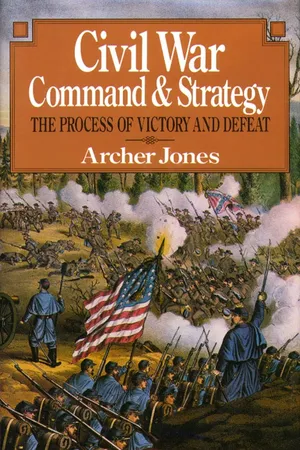 eBook - ePub
Civil War Command And Strategy
The Process Of Victory And Defeat
- Jones Archer(Author)
- 2010(Publication Date)
- Free Press(Publisher)
CHAPTER 11THE STRATEGIC FRAMEWORK
Classifying strategy makes it and the Civil War’s strategy easier to understand. Combat and logistic strategy offer the two basic means of depleting the enemy forces, either directly through combat or indirectly by depriving them of needed resources. Of course, implementing a logistic strategy usually involves combat, but this combat is a means to the end of conquering territory or otherwise undermining the adversary’s supply base.The other classification divides strategy according to its operational approach, the hit and run strategy of raiding or the persisting strategy’s goal of seizing territory. The Napoleonic operational strategy of concentration and turning movements belongs primarily to persisting strategy. Political strategy, which uses military means to accomplish political objectives directly, does not fit into these classifications of military strategy, but its military actions do.But these two pairs of classifications do apply equally well to naval warfare and help illuminate the essential unity of strategy. Early in the war the navy, with totally inadequate forces, sought to blockade southern ports. By attempting to control the water outside the ports, the navy applied a persisting strategy in pursuit of its logistic strategy of destroying the Confederacy’s foreign trade and cutting off its critical imports.The war brought phenomenal expansion to the U.S. fleet, which, in four years, increased from 90 to 670 ships and from 7,500 sailors to 51,500. Beginning with 1,300 officers, of whom 322 joined the Confederacy, the U.S. Navy’s officers numbered 6,700 at the war’s end. Much of the credit for this increase belongs to Gideon Welles, the able, energetic, and eccentric secretary of the navy. A journalist and politician who covered his bald head with a wig, he had served for three years as chief of a navy department bureau concerned with supply. This background helped the gifted secretary give perceptive direction to the navy’s contribution to waging the war. The navy diverted some ships to pursue Confederate commerce raiders and some to render crucial aid to the army by controlling the inland rivers, but concentrated most of its resources on blockading Confederate ports. This fit Scott’s anaconda strategy and constituted the contribution which a superior fleet could make to the war effort. eBook - PDF
Successful Strategies
Triumphing in War and Peace from Antiquity to the Present
- Williamson Murray, Richard Hart Sinnreich(Authors)
- 2014(Publication Date)
- Cambridge University Press(Publisher)
See Lance E. Davis and Stanley L. Engerman, Naval Blockades in Peace and War: An Economic History since 1750 (Cambridge, 2006), p. 158, and David G. Surdam, Northern Naval Superiority and the Economics of the American Civil War (Columbia, SC, 2001), pp. 83–84, 207. 2 For two recent and relevant scholarly studies of Lincoln, see David Herbert Donald, Lincoln (London, 1995); Philip Paludan, The Presidency of Abraham Lincoln (Lawrence, KS, 1994). 3 Joan Waugh, U.S. Grant: American Hero, American Myth (Chapel Hill, NC, 2009), pp. 304, 307; J. F. C. Fuller, The Generalship of Ulysses S. Grant (London, 1929). The current standard scholarly biography is Brooks D. Simpson, Ulysses S. Grant: Triumph over Adversity, 1822–1865 (Boston, 2000). 4 The strictly historical literature on Union strategy and the American Civil War cannot be summarized here, but the two most important recent books are James M. McPherson, Tried by War: Abraham Lincoln as Commander in Chief (New York, 2008), and Donald Stoker, The Grand Design: Strategy and the U.S. Civil War (New York, 2010). McPherson’s work is the sounder history, and while Stoker is more engaged with modern discussions of strategy, his book is weaker in its grasp of both the history itself and the larger literature. Herman Hattaway and Archer Jones, How the North Won: A Military History of the Civil War (Urbana, IL, 1991) remains the standard one-volume military history of the Union war 190 Wayne Hsieh should they cede the field of policy formulation to political scientists, and the American Civil War highlights to a modern audience the importance of public opinion and democratic coalition building in the formulation of grand strategy. eBook - PDF
- James C. Bradford, James C. Bradford, James C. Bradford, James C. Bradford(Authors)
- 2009(Publication Date)
- Wiley-Blackwell(Publisher)
the civil war 111 got there. Defensive firepower and the spread of entrenchment, accentuated by the ineffectiveness of cavalry, slowed down operations to the point of deadlock. The most distinguished and persuasive analysis of these trends, that bucks them to the extent that its appraisal of Robert E. Lee is admiring, is Edward Hagerman’s The American Civil War and the Origins of Modern Warfare (1988). Hagerman’s book is especially interesting and original because he attempts an analysis of the organizational methods necessary to maintain operational momentum. The problem became one of logistics, sustainability, and method over great distances to get armies moving again. Hagerman’s yardstick of “modernity” though remains the tendency of Civil War armies to evolve in directions that would culminate in the military methods and forms of the two World Wars of the twentieth century. Within this framework emerged two central works, Herman Hattaway and Archer Jones, How the North Won (1983), and the same two authors plus William E. Beringer and William N. Still Jr., who published Why the South Lost the Civil War (1986). The change of emphasis in the titles is less than coincidental. South- ern failures again were placed in the forefront of the explanatory model. To their credit, these two works exploit much more effectively than the 1941–70 genera- tion of historians (such as T. Harry Williams and David Donald) theoretical writ- ings about war produced by Baron Jomini and Carl von Clausewitz, especially the latter’s treatise, On War. They grasp the common ground shared by these two authors. In this regard Beringer, Hattaway, Jones, and Still were drawing upon the renaissance in military theory that flowered in the US Army during post- Vietnam reforms. Nonetheless, the revival in the operational art and “manoeuvre warfare” had little impact on historians’ view of the utility of military operations in the Civil War. eBook - PDF
The American Civil War
A Handbook of Literature and Research
- Steven E. Woodworth(Author)
- 1996(Publication Date)
- Greenwood(Publisher)
Certain generalized assessments are an appropriate introduction to the rela- tionship of the river war to ultimate Union victory and Confederate defeat. See both the often abstruse Herman Hattaway and Archer Jones, How the North Won (1983), and a more felicitous Richard Beringer et al., Why the South Lost (1986), especially chapter 9. Military application also connotes strategy, with Archer Jones, Civil War Command and Strategy (1992), Edward Hagerman, The American Civil War and the Origins of Modern Warfare (1988), and Thomas Connelly and Archer Jones, The Politics of Command (1973) as appropriate beginnings. Janet Coryell, Neither Heroine Nor Fool: Anna Ella Carroll of Maryland (1990), delicately disposes of the myth that the distaff side actually initiated the river war strategy that saved the Union. None of these studies quite approaches definitive clarification of the river- 300 Strategy and Tactics land relationship as defined by original documents in the army and navy Official Records. The wealth of factual detail and nuance in those published documents can be only partially captured in limited narrative syntheses. Nowhere are the joint operational difficulties of river control, logistics, counterguerrilla warfare, and civil-military relations (exemplified in population control) as richly laid out as in the original documents. Some of that detail has been visually conveyed superbly in periodic illustrations first provided in Francis Miller's classic The Photographic History of the Civil War (1911), especially volumes 1, 2, 4, and 6, and carried forward by William Davis in the first volume of Touched by Fire (1985), as well as the modern update of Miller, The Image of War (1981), volumes 1, 2, 4, and 5. Stephen Sears, The American Heritage Century Collec- tion of Civil War Art (1974), also builds upon that visual tradition. Detail is the theme of key reference works for tracking the chronology and topics of the river war, such as E.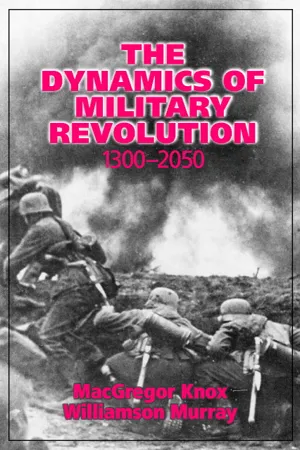
- MacGregor Knox, Williamson Murray(Authors)
- 2001(Publication Date)
- Cambridge University Press(Publisher)
5 Surviving military revolution: The U.S. Civil War MARK G R I M S L E Y Commanders seek control, the more absolute the better. The best way to achieve it is to obtain a crushing, unanswerable advantage. Clausewitz put it with his habitual pithiness: "The best strategy," he wrote, "is always to be very strong." 1 Warring states greedily seize and ruthlessly exploit any weapon, method, or technology that offers crushing advantage. Supremacy is the Holy Grail of warfare. Yet despite ceaseless search, advantages that produce lasting victory have appeared only rarely in the history of war. When they have, their most cherished attribute, asymmetry - the fact that one side has them while the other does not - has been fleeting. Belligerents adopt innovations with a conviction proportionate to their fear; new developments spread so swiftly that battlefield imbalances are usually brief. Genuine earthquakes in warfare are of a different nature entirely, and are largely independent of purely military factors. It is rather political, social, and economic changes, like the movement of vast tectonic plates, that most readily revolutionize war in all its aspects, from weapons and tactics, to methods of raising manpower, to the fundamental purposes the state pursues through war. Changes of that magnitude are truly military revolutions, and have little in common with the predictable, domesticated technological asymmetries that Pentagon commentators, with some conceptual help from Soviet the- orists, have designated as "revolutions in military affairs." Individuals or groups do not control military revolutions: they merely seek to survive them. The U.S. Civil War exemplifies - unlike the Prusso-German wars of 1866 and 1870-71, which it dwarfed in both duration and magnitude of effort - 1 Carl von Clausewitz, On War, eds. and trans. Michael Howard and Peter Paret (Princeton, NJ, 1976), p. 204 [book 3, Chapter n ] . 74
Index pages curate the most relevant extracts from our library of academic textbooks. They’ve been created using an in-house natural language model (NLM), each adding context and meaning to key research topics.

