History

Northern Strategies in the Civil War
The Northern strategies in the Civil War focused on leveraging their industrial and population advantages to defeat the Confederacy. These strategies included blockading Southern ports, capturing key Confederate territories, and ultimately, the Anaconda Plan, which aimed to suffocate the South by cutting off its resources. The North also utilized its superior infrastructure and transportation networks to support its military campaigns.
Written by Perlego with AI-assistance
Related key terms
1 of 5
8 Key excerpts on "Northern Strategies in the Civil War"
 eBook - PDF
Writing the Civil War
The Quest to Understand
- James M. McPherson, William J. Cooper, James M. McPherson, William J. Cooper, Jr.(Authors)
- 2021(Publication Date)
- University of South Carolina Press(Publisher)
47 The best broad treatment of northern military strategy is Herman Hattaway and Archer Jones's How the North Won: A Military History of the Civil War. Exhaustive, perceptive, and often revisionist, it might have come first among the books discussed in this essay. Because it plays off much earlier literature, however, it seems a good candidate for a position closer to the end. Hattaway and Jones dedicated their book to T. Harry Williams, adding that they sometimes disagreed with him but sought to continue the same tradition of Civil War military history that he did much to establish. Departing from Williams's Jominian/Clausewitzian classifications, they assessed the roles of Lincoln and all of his principal generals in harnessing northern resources to crush the Confederacy. The authors gave well-deserved credit to Winfield Scott, who focused his powerful intellect and vast experience on the North's infinitely complex 28 BLUEPRINT FOR VICTORY strategic problem. Analyzing both the Anaconda Plan and Scott's ideas about what else might be needed to achieve victory, Hattaway and Jones observed that [e]xcept for underestimating by one-half the number of men and the time needed, the old general had provided a fairly accurate forecast of most of the ... elements of the strategy ultimately used. 48 Lincoln's generals understood that the rifled musket gave defenders the tactical advantage and rendered decisive battlefield victories unlikely. Avoiding a futile pursuit of the strategy of annihilation, wrote the au-thors in opposition to some of Russell F. Weigley's points, Union generals sought to conquer the Confederacy to deprive its armies of their source of supplies, weapons, and recruits. This strategy of exhaustion initially worked well in the West, where Henry W. Halleck coordinated brilliant offensives along the Mississippi, Tennessee, and Cumberland rivers. eBook - PDF
Successful Strategies
Triumphing in War and Peace from Antiquity to the Present
- Williamson Murray, Richard Hart Sinnreich(Authors)
- 2014(Publication Date)
- Cambridge University Press(Publisher)
7 The strategy of Lincoln and Grant Wayne Hsieh Abraham Lincoln’s primary grand strategic aim during the Civil War, to preserve the Union, contained within itself a deceptive simplicity. On the one hand, it meant preserving the Federal Union of 1860 and the results of the 1860 presidential election, which had elected a Republican Party committed not to abolishing slavery, but to restricting it to the states where it existed. On the other hand, the outbreak of war in 1861 raised questions within the states loyal to the Union as to whether or not the Republican Party’s ante- bellum goals could provide a lasting political and military solution to the rebellion. Some Republicans hoped to strike at what they saw as the root cause of Confederate treason – a social system dominated by slaveholding planters – with punitive measures most would have disavowed during the 1860 election, while many Democrats and even some conservative Republicans feared the consequences of harsh measures for both domestic liberty in the free soil states and the prospects of long-term reunion. Lincoln eventually determined that only “hard war” measures could break Confederate resistance, but he had to manage a divided Northern public opinion even as his own views evolved. In 1864, in accordance with his commander-in-chief ’s political ends, Ulysses Grant selected a military strategy of coordinated and simultaneous military movements against Confederate military power that had the virtues of simplicity and inherent flexibility. Grant adapted his military methods to Lincoln’s need to manage his political coalition, even when it required overriding Grant’s own professional prefer- ences as to military priorities and personnel. eBook - ePub
War, Peace and International Relations
An introduction to strategic history
- Colin S. Gray(Author)
- 2013(Publication Date)
- Routledge(Publisher)
Societies as well as states wage war. Despite the persuasiveness of a large historical scholarship that attributes Confederate defeat to the many weaknesses in Southern society, in fact both societies, North and South, stayed the military course to the bitter end. There was much evidence of war weariness and demoralization. How could there not be? But the war ended only when Lee was in a position where his Army of Northern Virginia could not fight on. Both he and enough of his men were willing, but literally unable, to continue the by-then plainly hopeless struggle. A great deal that has been written about the lack of a strong enough sense of Southern nationhood is definitively contradicted by the facts of the ferocity of the fighting and its continuation for four years. Southern soldiers believed for years that they were better men in most senses than were their Northern counterparts. One needs to be careful in handling cultural argument that can slide into a somewhat metaphysical and dubious culturalism (Porter, 2009), but there is some basis in believing that the Southern soldier, ‘Johnny Reb’, was more of a warrior than was his Northern foe, ‘Billy Yank’. Much more to the point is the apparent fact that both Reb and Yank believed this to be so, certainly until quite late in the war. On a less happy note for the South, its society bred an independence of spirit, a lack of discipline and even an inclination to idleness that were not conducive to good order in an army. Lee and other Confederate generals had a command and control problem with military discipline that was far more serious for them than it was for their Federal opponents.In an important sense the victory of the Union was a distinctly strategic one (Stoker, 2010). Bluntly stated, the North eventually discovered what it needed to achieve in order to win, and then proceeded to design and execute a strategy worthy of the name to secure victory; and the Confederacy did not. Both sides began the war with the Napoleonic paradigm of decisive battle as the goal. And not decisive battle per se, but a single such encounter that should decide the war's outcome. The South discovered that while it could and did win battles, those victories did not suffice to decide the war's outcome. Moreover, the quest for such decision was disproportionately debilitating to the South, because it was always on the wrong side of an assets imbalance.The Union Army proved able to absorb a great deal of damage. Political commitment to the Union cause, as well as the more generic fuels of military cohesion and combat motivation, was sufficiently robust to withstand the hard military knocks that Lee and his better lieutenants (notably the iconic Confederate tactician Thomas ‘Stonewall’ Jackson) inflicted on the North in 1862 and early 1863 in particular. Belligerents in all wars have to try to find a way to win. The all-important strategy function commands war-makers to orchestrate and execute the eternal triptych of ends, ways and means. The American Civil War was a war of principle, belief, even ideology. This meant that a compromise peace was never likely. The issue was union or disunion, two plain alternatives. Moreover, unfortunately, no clever short cuts to victory were available to either side. Single-battle, even single-campaign, victories did not produce sufficient military victory to translate readily into political victory in the war. There was a notable asymmetry in the war aims of the belligerents. The South simply wished to be left alone with its newly proclaimed statehood. It had to persuade the Union to let it leave in peace. It physically could not, and politically had no need to, defeat the North in a conclusive military fashion. Washington had to be encouraged to believe that the cost of the effort to return the Confederate States to the Federal fold was unsustainable. But, for its part, the North discovered that it would not suffice only to hurt the South on the field of battle, or by imposing some potentially serious hardship on Southern society. Instead, it was unmistakably clear by 1864 that the South (meaning, primarily, its premier-by-far military force, Lee's Army of Northern Virginia) would have to be conclusively defeated militarily. In order to do that, the whole of the fabric and assets of the South would need to be severely damaged. The total war waged by Sherman in his iconic march through Georgia (and then the Carolinas in 1864–5) fortunately fell some way short of the historical standard for awfulness that would be set, say, by the Wehrmacht in Russia in 1941–4, but it was still an early marker on that grim historical road. eBook - PDF
Financing Armed Conflict, Volume 1
Resourcing US Military Interventions from the Revolution to the Civil War
- Thomas M. Meagher(Author)
- 2016(Publication Date)
- Palgrave Macmillan(Publisher)
One involved the protection of states’ rights at the expense of a weaker central government. Adherence to such a policy limited the government’s ability to obtain loans, float notes, and precluded an aggressive internal tax program, increasing the chances of defeat and the elimination of slavery. The second option relinquished control to the central government. However, while this action increased the chances for a stale- mate with or even victory over the North, thus preserving slavery, the result meant a loss of states’ rights and implicit recognition of the central govern- ment as the primary political power in the Confederate States of America (CSA). The struggle between traditional states’ rights advocates and those who recognized the Confederate government needed to play the dominant role in the war had dire consequences for the South, particularly from an economic and financial standpoint. 1 WAYS Pre-War Grand Strategy To achieve independence, the South had one major objective: winning by not losing. Confederate grand strategy therefore was based upon three objectives: adopting a cordon strategy that called for defending all south- ern territory regardless of its political or economic value; maintaining the Confederate army in being as a military force; and summoning the politi- cal will to outlast the Union. The use of a cordon strategy, whereby the defender commits to holding his lines regardless of the value of the territory to the overall effort, supplemented by superior Southern military leader- ship (some 286 officers, 184 of them West Point graduates, who resigned or were dismissed from the U.S. Army and joined the South) would prove to be the undoing of the Confederacy, particularly given the South’s man- power disadvantage.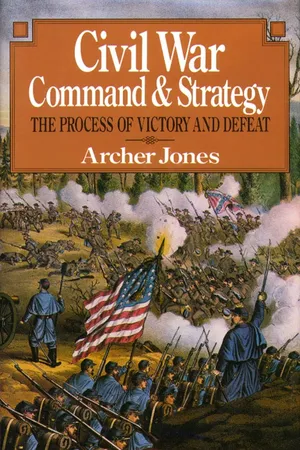 eBook - ePub
Civil War Command And Strategy
The Process Of Victory And Defeat
- Jones Archer(Author)
- 2010(Publication Date)
- Free Press(Publisher)
CHAPTER 11THE STRATEGIC FRAMEWORK
Classifying strategy makes it and the Civil War’s strategy easier to understand. Combat and logistic strategy offer the two basic means of depleting the enemy forces, either directly through combat or indirectly by depriving them of needed resources. Of course, implementing a logistic strategy usually involves combat, but this combat is a means to the end of conquering territory or otherwise undermining the adversary’s supply base.The other classification divides strategy according to its operational approach, the hit and run strategy of raiding or the persisting strategy’s goal of seizing territory. The Napoleonic operational strategy of concentration and turning movements belongs primarily to persisting strategy. Political strategy, which uses military means to accomplish political objectives directly, does not fit into these classifications of military strategy, but its military actions do.But these two pairs of classifications do apply equally well to naval warfare and help illuminate the essential unity of strategy. Early in the war the navy, with totally inadequate forces, sought to blockade southern ports. By attempting to control the water outside the ports, the navy applied a persisting strategy in pursuit of its logistic strategy of destroying the Confederacy’s foreign trade and cutting off its critical imports.The war brought phenomenal expansion to the U.S. fleet, which, in four years, increased from 90 to 670 ships and from 7,500 sailors to 51,500. Beginning with 1,300 officers, of whom 322 joined the Confederacy, the U.S. Navy’s officers numbered 6,700 at the war’s end. Much of the credit for this increase belongs to Gideon Welles, the able, energetic, and eccentric secretary of the navy. A journalist and politician who covered his bald head with a wig, he had served for three years as chief of a navy department bureau concerned with supply. This background helped the gifted secretary give perceptive direction to the navy’s contribution to waging the war. The navy diverted some ships to pursue Confederate commerce raiders and some to render crucial aid to the army by controlling the inland rivers, but concentrated most of its resources on blockading Confederate ports. This fit Scott’s anaconda strategy and constituted the contribution which a superior fleet could make to the war effort.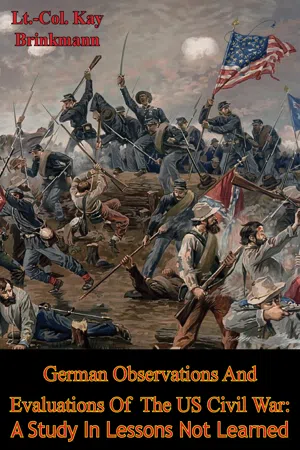
- Lt.-Col. Kay Brinkmann(Author)
- 2015(Publication Date)
- Golden Springs Publishing(Publisher)
CHAPTER 6 — ESSENTIAL LESSONS FROM THE CIVIL WAR
The U.S. Civil War may at its core have been a gigantic war among brothers aiming at reconstituting the Union; it nevertheless was the classic struggle of two antagonistic wills wrestling for victory, generating generally applicable military lessons. After having evaluated the assessments of the German observers, this chapter analyzes essential lessons the Civil War and relates them to the developments in contemporary Germany up to the First World War.Lessons at the Strategic Level
The Significance of Political-Military Relations
The ultimate success of the Union was based extensively on the recognition that political and military objectives are closely interrelated and require continuous coordination through a dynamic process. President Abraham Lincoln became the synonym for enforcement of this principle. From the outset of the war he set the strategic imperatives, while simultaneously balancing the different domestic, foreign and socio-economic influences. Lincoln was aware of the close reciprocity between the national strategic objectives on one side and the operational aims, methods and situation within the theaters on the other side. Consequentially, political and military leadership agreed that the duration of the war would strongly influence the dimension of violence and suffering as well as the conditions for a peace settlement.{154} Lincoln’s active interference during the first three years of the war resulted from two reasons. First, promising military strategic concepts were not executed energetically and decisively enough (McClellan). Second, unsuccessful concentration of effort and lack of synchronization of the operations reflected a failed appreciation of the overall strategic situation and purpose (Halleck). In addition, the policy of appointing commanders oftentimes less on military competence rather than on the grounds of political influence and partisanship certainly resulted in extensive friction that affected the conduct of military operations.{155} Despite his own lack of military experience, Lincoln early became aware of the significance of synchronized military operations in time and space.{156}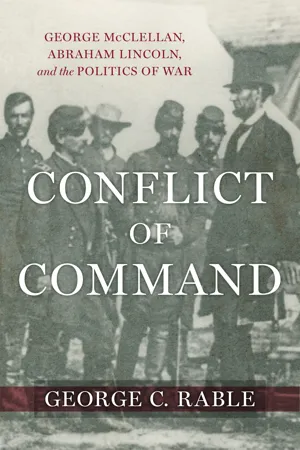 eBook - ePub
Conflict of Command
George McClellan, Abraham Lincoln, and the Politics of War
- George C. Rable, T. Michael Parrish(Authors)
- 2023(Publication Date)
- LSU Press(Publisher)
3 STRATEGY AND POLITICSOn August 2, 1861—less than two weeks after being summoned to Washington—George B. McClellan presented to Abraham Lincoln a memorandum laying out not only a military strategy but also his thoughts on the nature of the war. Here, not for the first and certainly not for the last time, McClellan offered a combination of military and political recommendations, but of course the two cannot be so neatly separated (as the Prussian theorist Clausewitz and many others have observed).1 During the American Civil War, distinctions between military and political advice were often ignored.“In this contest it has become necessary to crush a population sufficiently numerous, intelligent, and warlike to constitute a nation,” McClellan began. Terming the Rebels a “nation” may have alarmed Lincoln, but the general was simply acknowledging the fact that the United States faced more than a limited insurgency. Therefore, the task at hand was formidable: “We have not only to defeat their armed and organized forces in the field, but to display such an overwhelming strength as will convince all our antagonists, especially those of the governing, aristocratic class, of the utter impossibility of resistance.” McClellan feared that the recent defeat at Bull Run “will enable the political leaders of the Rebels to convince the mass of their people that we are inferior to them in force and courage.” The proper response was “overwhelming physical force” and a “rigidly protective policy” toward property and persons.Virginia would likely become the main battleground, though McClellan also proposed movements in the West and along the Mississippi River. For what he called the “main Army of Operations,” McClellan proposed raising a force of 273,000 men, which in cooperation with the navy would attack various points along the southern coastline—not only driving the Confederates out of Virginia but also eventually capturing Charleston, Savannah, Montgomery, Pensacola, Mobile, and New Orleans. Combined with offensives in the West, McClellan’s great army would bring overwhelming pressure to bear on the Rebels. The object was to end the war in “the shortest possible time” by “crush[ing] the rebellion at one blow, terminate the war in one campaign.”2 eBook - PDF
- Keith D. Dickson(Author)
- 2022(Publication Date)
- For Dummies(Publisher)
For a large part of the war, Confederate cavalry outperformed Union cavalry, because most of the troopers already had well-developed horsemanship skills. In the early part of the war, most of the Union troopers were still learning how to ride a horse, let alone fight on one. 72 PART 2 Making War Comparing the Science versus the Art of War Anyone can master the principles of war. There is no secret to conducting military operations according to the principles of war. This is the knowledge base all mili-tary leaders use when employing military forces in war. But not every military leader is successful in war. The science of war alone cannot win battles — the art is what makes the difference. The mystique of warfare and its attraction, some may say, is in observing how well a military leader translates principles of war into action in real situations of life and death when the fate of the nation is at stake. A number of generals throughout history have gained immortality through their ability to take the science of warfare and translate it into something uniquely theirs, something that people call art. The American Civil War displays the talents of some of these masters of the art of war. CHAPTER 5 Union and Confederate Strategy 73 Chapter 5 Union and Confederate Strategy W ars are fought with armies. But what guides the actions and purpose of armies in war? That’s where strategy comes in. Strategy is developed at the national level. In the case of the Civil War, the president and his military advisors dictated the strategy. Strategy takes into account a number of important considerations. One of these is an assessment of the resources of the nation — essentially a measurement of its ability to conduct a war and sustain armies in the field. Another is the analysis of the geography. Geographical features can serve as an advantage or disadvantage, depending on your strategic approach.
Index pages curate the most relevant extracts from our library of academic textbooks. They’ve been created using an in-house natural language model (NLM), each adding context and meaning to key research topics.

