History

Southern Strategy
The Southern Strategy refers to a political strategy employed by the Republican Party in the United States to appeal to white Southern voters by focusing on issues such as states' rights, law and order, and opposition to civil rights legislation. This strategy aimed to capitalize on racial tensions and the backlash against the Civil Rights Movement, ultimately leading to a shift in Southern political allegiance from the Democratic to the Republican Party.
Written by Perlego with AI-assistance
Related key terms
1 of 5
8 Key excerpts on "Southern Strategy"
 eBook - ePub
The Southern Strategy Revisited
Republican Top-Down Advancement in the South
- Joseph A. Aistrup(Author)
- 2021(Publication Date)
- The University Press of Kentucky(Publisher)
ECTION 1THE SOUTHERN STRATEGY IS MORE THAN JUST A RECIPE TO ATTRACT VARIOUS disparate political groupings to the Republican party’s presidential ticket; it is an ideological carrot for wooing presidential supporters into the Republican party. Reinforcing the South Strategy’s messages are the Grand Old Party’s (GOP) efforts to build on their presidential triumphs by transferring this success at the top to other levels of electoral competition (Bass and De Vries 1976, 31). Once the party has built a successful presidential coalition in a state, it concentrates its resources to build a winning coalition at the lower levels of competition—contests for the U.S. Senate, state gubernatorial offices, congressional seats, and, lastly, state legislature posts. For purposes of this book, this mode of party development is labeled as “Republican top-down advancement.”At one political level, the wisdom of this strategy is apparent. By 1980 the Republicans possessed ten of the twenty-two Senate seats, five of the eleven governorships, and little over 30 percent of the U.S. House seats (Bullock 1987). By 1994, Southern Republicans had increased their control to 13 of 22 U.S. Senate seats, 6 of 11 governorships, and 64 of 125 U.S. House seats. However, at another political level, the wisdom of this strategy is less than lucid. The conservative, sometimes racial, sometimes religious, content of the Southern Strategy’s messages entices many conservative reactionaries into the party who clash with the Republicans’ natural base, the upwardly mobile, business and professional classes who have come to typify the “new South” (Sundquist 1983, ch. 18). This has led to the situation where some Republican state parties are strife-torn and lack ideological coherence on social issues.In addition, the top-down advancement process means that while the GOP now possesses a majority of national offices and governorships, it still only controls three of twenty-two state legislative chambers. Despite this tension and its significance for the GOP’s efforts in the South, there has been a relative lack of attention among scholars as to the precise nature of this strategy and its goals, or how it is shaping the future of Southern politics. This book identifies the fundamental issues of the Southern Strategy, traces its evolution since its conception in the early 1960s, and shows how this strategy affects patterns of GOP top-down advancement in the South in ten of eleven formerly Confederate states (excluding Louisiana) from 1964 to 1994.1 eBook - ePub
Black in America
The Paradox of the Color Line
- Enobong Hannah Branch, Christina Jackson, Christina Jackson(Authors)
- 2020(Publication Date)
- Polity(Publisher)
Fully aware of the race-fueled disaffection of Southern Democrats, and their fear that theirs was now “the party of Blacks” in the South (Herman and Peterson 2008), Republican strategist Kevin Phillips introduced a plan to capitalize on this disaffection, literally appealing to racists by targeting anti-Black sentiments among Southern White voters (Jacobs and Tope 2008). The ensuing racialized discourse (including a renewed emphasis on crime) resonated with its target audience, and ultimately allowed Republicans to “peel large numbers of southern White voters away from the Democratic Party” (Drakulich and Crutchfield 2013:9). This migration continued from the 1970s through the end of the twentieth century, and culminated in a near-total racial split in the electorate (Hawley 2015). Despite – or, perhaps, due to – the popularity of colorblind politics, this realignment completely changed the role of race, both in policy and in the “rules of the game” of campaigning. Following the success of the “Southern Strategy” and the resulting realignment, there have been persistent, well-organized ideological and legal campaigns to scale back the gains achieved by the Civil Rights Movement, with both the means and goals of diversity under assault (Cokorinos 2003). This anti-civil rights agenda operates on the principle that the government should have little or no role in ensuring racial equity. The 1970s saw significant challenges to the policies of the 1960s, including the Bakke decision, which called into question the fairness of race as a determining factor in admissions (with implications for hiring as well) eBook - ePub
The Persuadable Voter
Wedge Issues in Presidential Campaigns
- D. Sunshine Hillygus, Todd G. Shields(Authors)
- 2014(Publication Date)
- Princeton University Press(Publisher)
This chapter also offers a careful look at the use of wedge issues prior to the contemporary hyperinformation environment examined in the next chapter. Compared to the information available to campaign strategists today, candidates in the 1960s and 1970s largely had to infer the policy preferences of voters based on region, race, or other broad characteristics, so that strategic policy decisions were made on this rather imprecise information. Likewise, candidates’ campaign messages were primarily communicated through broadcast television or stump speeches, so that message targeting was much less precise than we see today. And stump speeches were often covered by the national press, making it more difficult to communicate unique messages to different audiences and inevitably making wedge issues part of the national campaign dialogue. Thus, given the blunt nature of campaign targeting during this era, candidates faced clear electoral tradeoffs in staking a particular position on a divisive policy, and such tradeoffs were often explicitly discussed as part of the candidates’ strategic planning during the campaign.A great deal has been written about the Republican Southern Strategy and we make no attempt to provide a complete chronology here.3 We begin this chapter with a brief historical examination of the origins of and motivations behind the Southern Strategy, but then focus our attention on empirically evaluating how changes in GOP campaign rhetoric influenced white Democratic voters, and particularly white Democrats who embraced issue positions at odds with their national party. Thus, we analyze both the extent to which Republican campaign strategies were based on reaching cross-pressured Democratic voters and the effect of emphasizing wedge issues on their voting behavior.By most accounts, the Republican Southern Strategy was successful. After losing nearly all of the southern states to the Democrats in 1960, Richard Nixon returned to carry five of eleven southern states in 1968 and won each and every Confederate state in his lopsided 1972 presidential victory. The Republicans’ improved showing across the South is often taken as evidence that the Southern Strategy was effective at winning over southern Democrats. For many observers, the twelve years between Nixon’s loss in 1960 and his landslide victory in 1972 represented the beginning and end of the transformation of the once solidly Democratic South to the current GOP stronghold.4 Much of the rich literature on southern politics focuses on the partisan realignment of the South during this time period, as the conservative South switched allegiances from the Democratic to the Republican Party.5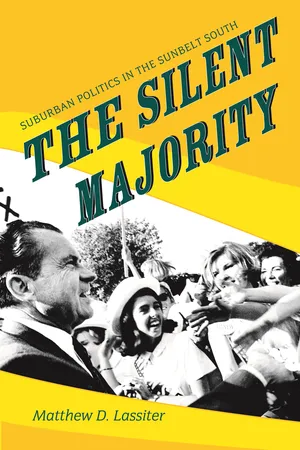 eBook - PDF
The Silent Majority
Suburban Politics in the Sunbelt South
- Matthew D. Lassiter(Author)
- 2013(Publication Date)
- Princeton University Press(Publisher)
By counting on a mono-lithic white South obsessively focused on racial integration, by courting an Suburbanization of Southern Politics . 249 imaginary Silent Majority that transcended class and ideological boundaries, the fundamental premise of the Southern Strategy proved to be deeply flawed. During an era of social crisis and racial turmoil, the GOP voters in the suburbs and the Wallace voters in the countryside would not fit comfort-ably into a stable political coalition. 250 . Chapter 9 CHAPTER 10 The Failure of the Southern Strategy The Southern Strategy won’t work. The only way to outflank George Wallace is to go into the Gulf of Mexico. —Charles Morgan (1970), director of the Southern Regional Office, American Civil Liberties Union The Wallace Challenge Kevin Phillips was the false prophet of reactionary populism. After the 1968 election, the Nixon administration abandoned its centrist suburban strategy and embraced a genuine race-based Southern Strategy as a defensive ma-neuver to neutralize George Wallace and a top-down offensive to transform the presidential base into a Republican majority in regional politics. During 1969–70, as the pace and scope of court-ordered school desegregation ac-celerated dramatically throughout the South, the administration responded by aligning the GOP with reactionary politicians who preached defiance of the federal judiciary. The White House aggressively recruited and financed candidates across the region, rejecting moderate GOP leaders for segrega-tionist former Democrats, many of whom had switched parties as Goldwater Republicans. But instead of the next stage in an inexorable Republican realignment, the midterm elections of 1970 demonstrated the intellectual bankruptcy of the Southern Strategy in the electoral climate of the Sunbelt South. eBook - ePub
Perspectives on the American South
An Annual Review of Society, Politics, and Culture
- Merle Black, John Shelton Reed, Merle Black, John Shelton Reed(Authors)
- 2021(Publication Date)
- Routledge(Publisher)
A second difficulty in estimating the cohesiveness of the white vote lies in the fact that data on black cohesiveness exist for the region through the SRC/CPS national surveys but are ordinarily unavailable for individual states or subregions. I have employed the regional percentage for the partisan distribution of the black vote in a given election for each state and subregion and have thereby ignored any interstate or intersubregional differences in the partisan division of the black vote. However, in view of the exceptionally skewed distribution of the black vote that has existed in recent presidential elections, with almost all blacks voting Democratic, it is doubtful that there have been significant variations among the states or subregions in patterns of black solidarity.The Republican Southern Strategy
It is scarcely hyperbole to describe the central tendency of Republican efforts in the South since the early 1960s as an attempt to construct a new "white man's party."10 Even though none of the Republican candidates from Goldwater to Ford openly campaigned in the explicitly segregationist style so common in southern politics through the mid-1960s, the working assumption of most Republican activists has been that whites, especially the region's more conservative whites, should be the primary targets of Republican campaign efforts.An electoral strategy that ignores almost totally one sizeable bloc of voters while concentrating on a second group must assume that the latter group will vote with sufficient unity to compensate for the absence of support from the first group. In terms of Republican strategy, the larger the size and the greater the cohesiveness of the black vote conceded to the Democrats, the larger the white majority required by the Republican candidate to win a given electoral unit. Estimates of the minimum white vote needed for a Republican majority as well as estimates of the percentage of the total white vote actually won by each Republican presidential nominee in the 1964-76 elections are presented in Table 2 eBook - ePub
In Search of Another Country
Mississippi and the Conservative Counterrevolution
- Joseph Crespino(Author)
- 2021(Publication Date)
- Princeton University Press(Publisher)
Chapter Seven Southern Strategies in MississippiIN 1964, the challenge of the Mississippi Freedom Democratic Party to the traditional all-white Mississippi delegation combined with Mississippi’s record vote for Barry Goldwater marked a watershed year in Mississippi and American politics. The migration of white Mississippians from the Democratic to the Republican Party, however, did not flow inevitably from those seminal events. Party realignment in Mississippi was a process full of contingency, conflict, and uncertainty. In the years following the Atlantic City challenge, liberal Democrats, including African Americans, labor, and a handful of white liberals, struggled to forge a more progressive biracial coalition in the Mississippi Democratic Party. They did not achieve all that they wanted, but their efforts, combined with dictates coming from the national party, elicited a more moderate white leadership among Mississippi Democrats, one that by the 1970s was resolutely committed to biracial Democratic Party politics.In the Republican Party, conservative and moderate Republicans in both the state and national party were divided over the question of how vigorously the GOP should pursue southern Dixiecrat voters. To many national observers, President Nixon’s election in 1968 and his administration’s close attention to the concerns of segregationist leaders in a state like Mississippi led to charges that the administration was pursuing a “Southern Strategy.” When asked about such a strategy, Richard Nixon readily admitted that he targeted white southern voters, but he distinguished between the Deep South states that Barry Goldwater won in 1964 and the border South states that helped put Nixon over the top four years later. Nixon argued that by going after “foam-at-the-mouth segregationists,” Goldwater weakened Republican appeals among moderates. For Nixon, at least in retrospect, the Southern Strategy meant targeting not the segregationist Dixiecrat followers of George Wallace but rather moderate suburban and upper South whites who readily identified with the fiscal and social conservatism of the Republican Party.1 eBook - PDF
How the South was won and the nation lost
The roots and repercussions of the Republican Party's Southernization and Evangelicalization
- Philipp Adorf(Author)
- 2016(Publication Date)
- V&R Unipress(Publisher)
After having been the most Democratic region in the nation for almost a century, the national Dem- ocratic shift on civil rights significantly altered Southern party dynamics. Over time, white Southerners began to feel like strangers in their own home as African Americans began to expand their role and size in the ranks of the region’s Democratic Party, leading to an electoral environment in which Democratic politicians could ill-afford to run on a racially conservative ticket. The resolutely 23 This norm represents the rejection of old fashioned racism that sees different races as inherently unequal. The norm of racial equality forces politicians to play the race card in a far subtler manner seeing as overt racial appeals are rejected by even some of the most racially conservative segments of society. Cf. Mendelberg 2001: The Race Card: Campaign Strategy, Implicit Messages, and the Norm of Equality , pp. 67ff. A success story like no other 29 © 2016, V&R unipress GmbH, Göttingen ISBN Print: 9783847106227 – ISBN E-Book: 9783847006220 liberal views of those African-American voters and activists on matters per- taining to race and economics meant that Republican partisan affiliation began to become a progressively more appealing prospect for even the staunchest Democratic white Southerner with a (racially) conservative ideological outlook. The Republican Party on its part added to this incentive through an electoral strategy that recognized this group of disaffected conservative voters could represent the foundations of Republican political dominance in both the region as well as the wider nation for decades to come. The ubiquity of race in the South and the continued framing of policy matters in a racial context both within and outside the region have led to a spillover of race into a host of other issue areas which has made it increasingly difficult to disentangle race and outwardly non-racial questions. eBook - ePub
Political Communication & Strategy
Consequences of the 2014 Midterm Elections
- Tauna S. Sisco, Jennifer C. Lucas, Christopher J. Galdieri, Tauna S. Sisco, Jennifer C. Lucas, Christopher J. Galdieri(Authors)
- 2017(Publication Date)
- University of Akron Press(Publisher)
There are five states that were under particular scrutiny during the elections, a group of five southern states, Georgia, Arkansas, Louisiana, North Carolina, and Kentucky. The Census Bureau divides the United States into four regions, and all these Senate races occurred in the contiguous region labeled the “South” (US Census Bureau 2010). While Kentucky was the only state among this group that is not a former member of the Confederacy, a majority of Americans still think of it as part of the cultural “South.” As discussed in the literature, the American South has witnessed one of the greatest reversals of electoral fortune over the course of the last thirty years, and this research captures the final demolition of a Democratic-held “Solid South.” To most accurately determine issue strategies, these races were chosen because at the start of data collection, differences in polling averages were in the single digits. If the races were close enough, campaign strategies could sway voters and play a crucial role in the race’s outcome—because of this they were important. What issues did the candidates focus on? Which issues were correlated with winning? THE STRATEGY OF CAMPAIGNS A central feature of campaigns is their use of themes to take advantage of perceived or real advantages in the campaign. In her book The Message Matters: The Economy and Presidential Campaigns, Vavreck (2009, 2) writes that in assessing the quality of campaigns, “Experts cannot precisely detail what makes a campaign ‘good,’ except maybe that it produced a winner; and, they know a good campaigner when they see one.” This research relies on the “incentive to win” to identify details about the strategies behind candidates’ strategic decisions, which can change voters’ minds and thereby the outcome (Sides and Vavreck 2013)
Index pages curate the most relevant extracts from our library of academic textbooks. They’ve been created using an in-house natural language model (NLM), each adding context and meaning to key research topics.

