History

End of WW1
The end of World War I, also known as the Great War, occurred on November 11, 1918, with the signing of the Armistice. This marked the cessation of hostilities between the Allied powers and Germany. The Treaty of Versailles, signed in 1919, formally ended the state of war and imposed significant penalties and territorial changes on Germany.
Written by Perlego with AI-assistance
Related key terms
1 of 5
11 Key excerpts on "End of WW1"
 eBook - PDF
The Politics of the First World War
A Course in Game Theory and International Security
- Scott Wolford(Author)
- 2019(Publication Date)
- Cambridge University Press(Publisher)
We’ll close by discussing why, exactly, demands for political reform might be included in states’ war aims and why crafting peace settlements, especially after multilateral wars, can prove so difficult even after apparently resounding military successes. Key Term for Chapter 14 • Armistice 14.1 ENDING WITH A WHIMPER Why did the Great War end in November 1918? Why not 1916, as many hoped, or 1920, as those same people probably feared? As usual, we can always come up with an answer that seems obvious on the surface. After Bulgaria, the Ottomans, and the Hapsburgs had already cut deals with the Entente, Germany asked for and was granted its own armistice , an end to the fighting typically intended to allow for the negotiation of a final peace treaty. 2 2 The Korean War, which ended only with an armistice in 1953, is one of the more famous examples of wars ending without a final treaty. On the Korean War, see Wada ( 2013 ) and Stueck ( 1995 , 2004 ), and on the decline in peace treaties over time, see Fazal ( 2013 ). 14.1 Ending with a Whimper 385 March 1918 Kaiserschlacht Brest-Litovsk July 1918 “Hundred Days” begins September 1918 Bulgarian armistice October 1918 Germany requests armistice November 1918 Ger., A-H armistices German revolution Figure 14.1 Endgame, 1918. definition 14.1 An armistice is a formal agreement to stop hostilities, sometimes followed by a treaty that formally ends the war. Armistices fall conceptually somewhere in between ceasefires, which can be informal and even localized agreements on a pause in fighting, and peace treaties, which are formal agreements that both end the war and specify a new set of rules for politics after the war. Where armistices entail only an end to the fighting, peace treaties tackle the thornier questions of postwar politics and the balance of power.
- Inbal Rose(Author)
- 2014(Publication Date)
- Routledge(Publisher)
Introduction: The End of the WarThe First World War, ‘enormously bigger than any other war’, had left in its wake physical devastation, political chaos and emotional suffering on an unprecedented scale.1 No European country had escaped. France, though victorious, faced a shattered economy and a ruined countryside. Defeated, exhausted and in political turmoil Germany had withdrawn into its borders. The Russian Empire, torn by revolution, appeared on the verge of disintegration. And the Austro-Hungarian Empire had fallen apart while the Ottoman Empire had finally collapsed, their place taken by a succession of small, energetic and squabbling states. The war had reduced Europe to its ‘original atoms’.2In 1918 the victorious powers were faced with the daunting task of rehabilitating Europe. Political boundaries had to be defined, nationalistic controversies defused, economic life reconstructed and internal political disorder calmed. In addition, the pre-war balance of power had now become a thing of the past. ‘Deep shifts of power had occurred’, and ‘the old diplomatic importance of Berlin, Petrograd, Vienna and Constantinople could not be maintained’.3 This meant that new diplomatic relationships and codes of behaviour, indeed an entire international system, had to be established. Thus, although the task of rebuilding Europe was one of multiple dimensions and gargantuan proportions, it was also a challenge which held out untold opportunities. The peacemakers had to devise a settlement which would not only bring about peace, but which would shape and re-mould the nature of international relations.Britain, as one of the two leading Allied Powers, was directly confronted with this challenge. In November 1918 Europe was undergoing continuous evolution, and there was the possibility of further, greater and more permanent change. The feeling was that ‘a whole world was visibly passing away before our eyes’, and the danger was recognized that unless such spontaneous, often impulsive changes be given some form and direction from above, ‘a setback [might] be given to Europe from which she will not recover for generations’.4 Europe required a new political framework and Britain was faced with the task of creating one expeditiously yet cautiously It was a task, as Churchill put it, of ‘great responsibilities’.5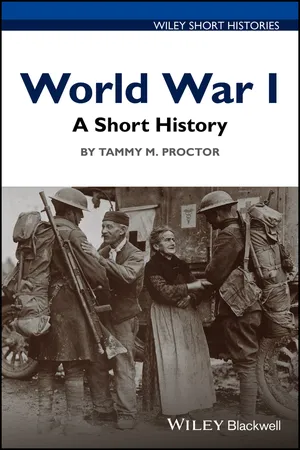 eBook - ePub
World War I
A Short History
- Tammy M. Proctor(Author)
- 2017(Publication Date)
- Wiley-Blackwell(Publisher)
This unique and relatively short example of civil war signals the fundamental change wrought in the geopolitical balance by three years of war and by the Russian Revolution. When considering how and why the war officially ended in 1918, these two factors play a crucial role. The nature of war and the revolutionary upheavals it spawned also help explain why, for many people, violence did not end with an armistice or even a peace treaty. As 1918 dawned, a series of important shifts had taken place in the nature of the war. First, Lenin’s Bolsheviks signed an armistice ending the fighting in the Russian Empire in December 1917, and they made plans for treaty negotiations in the spring. This removal of the Russian front from the war freed up a number of German units for service elsewhere and convinced Allied planners that new strategies needed to be pursued. Second, the entry of the United States into the war meant a boost in supply of almost everything for the Allies (food, munitions, soldiers), but the mobilization of the Americans was slow. Without a standing army of any size and with its distance from the battle, most American soldiers and goods could not arrive until sometime in 1918.Finally, war weariness was taking a toll on morale in every sector. Financing the war was difficult and rates of desertion had risen. In major cities, labor disputes and strikes rose in both quantity and severity, and serious problems with discipline and morale at many front‐line zones also worried officials. Most everyone involved in the war, from politicians to military planners assumed that 1918 would be decisive in some way. Everyone knew that it would be impossible to continue this war much longer without the complete destruction of the social fabric of the societies at war.In fact, it was clear to most observers that the war had become a race to achieve victory while supplies and a semblance of morale remained. As early as January 8, Woodrow Wilson delivered a speech to Congress laying out his vision of a postwar settlement. Known as the “Fourteen Points,” this series of principles excited the interest of many national and colonial liberation movements with its emphasis on the concept that populations in a state should have a voice in the creation of nations. Importantly, this speech was quite vague about whom might qualify for determining their own fates as nations, and it provided both hope and disappointment when the text was published in the international press. Major points included specific demands such as the creation of an independent Poland and broader ideological claims for self‐determination and a “League of Nations” as an international mediation force in the postwar world. Wilson doubled down on these ideas in subsequent speeches, including one in February where he explained self‐determination as a core ideal, noting that “every territorial settlement involved in this war must be made in the interest and for the benefit of the populations concerned.” eBook - ePub
The Global Economy
A Concise History
- Franco Amatori, Andrea Colli, Franco Amatori, Andrea Colli(Authors)
- 2019(Publication Date)
- Routledge(Publisher)
THE GREAT WAR: THE END OF A WORLDSUMMARY : 10.1. Interpretation of the war: discontinuity and social revolution. – 10.2. Total war: industrial planning and mobilization. – 10.3. The geopolitical and economic consequences . – Bibliography.10.1. Interpretation of the war: discontinuity and social revolution
The First World War ended a period of peace and progress that had lasted almost uninterrupted since 1870. The conflict weakened Europe, which lost its political and economic supremacy for good, and it also shaped world geopolitics until 1989. International trade was seriously damaged, and the international monetary system ceased regulating the relations between currencies.The First World War was defined as “great” not just because of the numbers of countries or troops involved, the scale of destruction and death it caused or the duration of the conflict itself, but also because it was revolutionary and levelling, cutting across all social classes. It was a kind of incubator for the transformations that were to occur in the 20th century. The war modified politics, society, culture and the economy, marking the end of positivism and liberal individualism. It led to the development of a new collectivist concept of the state, which guaranteed new rights for its citizens, redefining and reshaping the relations between political power and capitalism. The state broadened its prerogatives of intervention, vigilance and control, not only in economic affairs but also in social issues. In the period between the two wars, the state also implemented population and public health policies, entering into the most private spheres of individual and family life to compensate for the generation gap caused by the loss of so many young people in war.The 1919 constitution of the Weimar Republic was written immediately after Germany’s defeat, and was an ideal representation of the classless society born in the trenches. It was the archetype of an original conception of the national community, providing an ideal model for the new 20th century democracies. It enshrined a new concept of the citizen-state relationship, making the state responsible for satisfying citizens’ essential needs (work, education and health). It redesigned the connections between collective and individual rights and exalted the dignity of intellectual and manual work. It revolutionised the relations between capital and labour, income and profit, income and labour, to the benefit of the community. No longer available |Learn more
- (Author)
- 2014(Publication Date)
- College Publishing House(Publisher)
________________________ WORLD TECHNOLOGIES ________________________ Chapter 1 Aftermath of World War I Signing of the Treaty of Versailles in the Hall of Mirrors at the Palace of Versailles in 1919. The fighting in World War I ended in western Europe when the Armistice took effect at 11:00 am GMT on November 11, 1918, and in eastern Europe by the early 1920s. During and in the aftermath of the war the political, cultural, and social order was drastically changed in Europe, Asia and Africa, even outside the areas directly involved in the war. New countries were formed, old ones were abolished, international organizations were established, and many new and old ideologies took a firm hold in people's minds. Blockade of Germany Throughout the period from the armistice on 11 November 1918 until the signing of the peace treaty with Germany on 28 June 1919, the Allies maintained the naval blockade of Germany that had begun during the war. As Germany was dependent on imports, it is ________________________ WORLD TECHNOLOGIES ________________________ estimated that 523,000 civilians had lost their lives during the war, and a quarter-million more died from disease or starvation in this eight month period. The continuation of the blockade after the fighting ended, as Robert Leckie wrote in Delivered From Evil , did much to torment the Germans ... driving them with the fury of despair into the arms of the devil. The terms of the Armistice did allow food to be shipped into Germany, but the Allies required that Germany provide the ships. The German government was required to use its gold reserves, being unable to secure a loan from the United States. The blockade was not lifted until early July 1919 when the Treaty of Versailles was signed by most of the combatant nations. No longer available |Learn more
- (Author)
- 2014(Publication Date)
- University Publications(Publisher)
________________________ WORLD TECHNOLOGIES ________________________ Chapter- 1 Aftermath of World War I Signing of the Treaty of Versailles in the Hall of Mirrors at the Palace of Versailles in 1919. The fighting in World War I ended in western Europe when the Armistice took effect at 11:00 am GMT on November 11, 1918, and in eastern Europe by the early 1920s. During and in the aftermath of the war the political, cultural, and social order was drastically changed in Europe, Asia and Africa, even outside the areas directly involved in the war. New countries were formed, old ones were abolished, international organizations were established, and many new and old ideologies took a firm hold in people's minds. Blockade of Germany Throughout the period from the armistice on 11 November 1918 until the signing of the peace treaty with Germany on 28 June 1919, the Allies maintained the naval blockade of Germany that had begun during the war. As Germany was dependent on imports, it is ________________________ WORLD TECHNOLOGIES ________________________ estimated that 523,000 civilians had lost their lives during the war, and a quarter-million more died from disease or starvation in this eight month period. The continuation of the blockade after the fighting ended, as Robert Leckie wrote in Delivered From Evil , did much to torment the Germans ... driving them with the fury of despair into the arms of the devil. The terms of the Armistice did allow food to be shipped into Germany, but the Allies required that Germany provide the ships. The German government was required to use its gold reserves, being unable to secure a loan from the United States. The blockade was not lifted until early July 1919 when the Treaty of Versailles was signed by most of the combatant nations. eBook - ePub
Western Civilization: A Global and Comparative Approach
Volume II: Since 1600
- Kenneth L. Campbell(Author)
- 2015(Publication Date)
- Routledge(Publisher)
9 The Aftermath of World War I, 1919–1929 World War I had a dramatic impact on the culture and society of the postwar decade. Changes in almost every area of life provided a sense that a new era had begun and that the world would never be the same. For many people, the war gave way to a period of uncertainty, anxiety, and questioning of traditional customs and values. The war damaged people’s faith in progress, reason, and democracy. The British author and war veteran Robert Graves titled his 1929 autobiography and war memoir Good-bye to All That, referring to the life and world he had known before the war. Some older certainties had given way to a sense of crisis, confusion, and helplessness, if not of impending doom. At the end of 1918 Europe was economically devastated, physically exhausted, and psychologically demoralized. For other people, however, the new age meant new possibilities and the excitement of modernity. The changes that Europe experienced in the 1920s turned out to be an extension of changes that had already begun during the war itself. The war had served as a solvent of class distinctions and gender barriers, accelerating the transition to a society that would radically differ from that of even the late nineteenth century. In addition, European politics were revolutionized by a war that had called for so much sacrifice from the masses. No less important was the peace settlement that ended the war, which redrew the map of Europe and affected the fate of millions. The war changed the relationship between Europe and the rest of the world as well eBook - PDF
Belligerents, Brinkmanship, and the Big Stick
A Historical Encyclopedia of American Diplomatic Concepts
- John M. Dobson(Author)
- 2009(Publication Date)
- ABC-CLIO(Publisher)
201 SECTION 4 THE WORLD W ARS, 1914–1945 When relations among the major European nations broke down in the fall of 1914, their confrontation quickly became known as the Great War. It was only after World War II broke out in the late 1930s that the earlier conflict became known as World War I. That des- ignation was appropriate, because sev- eral of the warring nations possessed extensive overseas colonies. The fighting quickly spread to Asia and Africa, but for some time the Americas appeared to be immune. A key reason was that the United States, the most powerful nation in the Western Hemisphere, immediately announced a policy of neutrality. That assertion did not prevent economic ties from drawing Americans into a major supporting role for Great Britain and France. Emotional and historical factors strengthened the transat- lantic bond, but Germany’s announcement of unrestricted submarine warfare early in 1917 proved to be the tipping point. In April, President Woodrow Wilson obtained a war declaration from the U.S. Congress and began planning the dispatch of an American Expeditionary Force to aid the embattled Allies in Europe. To clar- ify the U.S. position in January 1918, Wilson announced the Fourteen Points, a blueprint for a postwar settlement that he hoped would ensure an end to all wars. After the defeat of Germany and Austria, Wilson’s formula served as the starting point for negotiations. Many alterations and compromises were made in the course of drafting the final peace treaty at Versailles, but it did include a Covenant for a League of Nations. Wilson optimisti- cally believed that this international col- lective security organization would preserve world peace. Among the many issues that the Versailles Conference failed to resolve was the status of the Soviet Union. Two revolutions had swept the Russian Empire in 1917, and the second installed a dedicated communist regime that most Americans considered antithetical. eBook - ePub
- John Mueller(Author)
- 2013(Publication Date)
- Cornell University Press(Publisher)
CHAPTER 3
WORLD WAR I AS A WATERSHED EVENT
European attitudes toward war changed profoundly at the time of World War I. There is no way to quantify this change except perhaps through a rough sort of content analysis. Before the First World War it was very easy, as documented in the previous chapter, to find serious writers, analysts, and politicians in Europe and the United States exalting war as desirable, inevitable, natural, progressive, and necessary. After the First World War, such pronouncements become extremely rare, although the excitement of the combat experience continued (and continues) to have its fascination to some.1This suggests that the appeal of war, both as a desirable exercise in itself and as a sensible method for resolving international disagreements, diminished markedly on that once war-racked continent. In an area in which war had been accepted as a standard and permanent fixture, the idea suddenly gained substantial currency that war there was no longer an inevitable or necessary fact of life and that major efforts should be made to abandon it.This change has often been noted by historians and political scientists. Arnold Toynbee points out that World War I marked the end of a “span of five thousand years during which war had been one of mankind’s master institutions.” In his study of wars since 1400, Evan Luard observes that “the First World War transformed traditional attitudes toward war. For the first time there was an almost universal sense that the deliberate launching of a war could now no longer be justified.” Bernard Brodie points out that “a basic historical change had taken place in the attitudes of the European (and American) peoples toward war.” Eric Hobsbawm concludes that “in 1914 the peoples of Europe, for however brief a moment, went lightheartedly to slaughter and to be slaughtered. After the First World War they never did so again.” And K. J. Holsti observes, “When it was all over, few remained to be convinced that such a war must never happen again.”2 eBook - ePub
- Robert J Maddox(Author)
- 2018(Publication Date)
- Routledge(Publisher)
The War to End All Wars (1914–1921)The guns at last fell silent on November 11, 1918. What had begun as a war of movement that both sides hoped to win in weeks or months had lasted through more than four years of appalling slaughter and physical destruction. Estimates of military casualties alone ran as high as 30 million, and an unprecedented number of civilians were killed, wounded, or left homeless. The psychic effects lasted for decades. What had happened could not be undone, but what of the future? If the armistice brought merely a pause until exhausted nations could recover sufficiently to resume fighting, the terrible sacrifices would have been in vain. But if a lasting peace could be created, the war would have served some purpose.The Great War
Although almost thirty nations took part in the conflict, with campaigns in Italy, Asia, Africa, and the Middle East, most of the fighting took place on two fronts. In the west, France and Great Britain, later joined by the United States, opposed Germany and the Austro-Hungarian Empire. The war had begun with Germany’s invasion of Belgium and its penetration of France to the outskirts of Paris. Stalemate had followed as the opposing armies kept extending their flanks until a line was established from the English Channel to Switzerland. Weapons such as the machine gun and rapid-firing artillery made bloodbaths of offensive operations, although they continued to be mounted throughout the war. The struggle became one of attrition, with each side battering away in hopes of exhausting the other.On the eastern front, Imperial Russia and its lesser allies confronted the Germans and Austro-Hungarians, who had initially permitted the Russians to advance west in order to envelop them in devastating pincer movements. Russia proved to be a major disappointment to its allies—sheer manpower counted for little in modern warfare. Although individual units often fought courageously, Russian forces were demoralized by ineffective leadership, inadequate training, and obsolete equipment. Their soldiers took hideous casualties, were captured by the tens of thousands, and deserted in droves. In fact, military disasters were instrumental in the collapse of the czarist government in March 1917 and in Russia’s departure from the war a year later. eBook - PDF
History and International Relations
From the Ancient World to the 21st Century
- Howard LeRoy Malchow(Author)
- 2020(Publication Date)
- Bloomsbury Academic(Publisher)
The result of the war and the peace was neither a rebalanced Europe nor a community of nations, but a radically changed Europe in which two of the former powers simply ceased to exist (Austria-Hungary and the Porte) and two others (Germany and Russia, the two most populous nations in Europe) became, for a while, pariah states, while the wartime “Associated” power, the United States, withdrew from any regular participation in European affairs (staying outside the League but returning in 1924 to take a role in the London Reparations Conference). Though the Weimar Republic joined the League (as a permanent member of its council) after the Locarno Conference of 1925 settled the issue of its Western boundary with France and Belgium, the Soviet History and International Relations 248 Union, deeply distrusted in the West, would remain substantially outside the European community even after Stalin moved to join the League and negotiate an anti-German treaty of “Mutual Assistance” with France in the mid-thirties. The Twenty Years’ Crisis If the European system had in some sense become a global system in the nineteenth and early twentieth century thanks to Europe’s imperialism and its worldwide commerce and finance, the period after the exhausting Great War saw an increasing erosion of overstretched European control. The British Empire may have reached its territorial zenith in the twenties as a result of its absorption of German colonies in Africa and the extension of its sphere of influence in the Near and Middle East via the system of “mandates,” but American commercial and financial interests had taken advantage of British wartime withdrawal to expand in Latin America and elsewhere.
Index pages curate the most relevant extracts from our library of academic textbooks. They’ve been created using an in-house natural language model (NLM), each adding context and meaning to key research topics.

