History

Treaty of Brest-Litovsk
The Treaty of Brest-Litovsk was a peace treaty signed in 1918 between the Central Powers and Soviet Russia, effectively ending Russia's involvement in World War I. The treaty resulted in significant territorial losses for Russia, including the ceding of large portions of land to Germany and its allies. This treaty allowed the Central Powers to focus their efforts on the Western Front.
Written by Perlego with AI-assistance
Related key terms
1 of 5
8 Key excerpts on "Treaty of Brest-Litovsk"
 eBook - ePub
Making Ukraine
Negotiating, Contesting, and Drawing the Borders in the Twentieth Century
- Olena Palko, Constantin Ardeleanu, Olena Palko, Constantin Ardeleanu(Authors)
- 2022(Publication Date)
- McGill-Queen's University Press(Publisher)
Ukraine’s Borders at the Brest-Litovsk Peace Conference , 1917–18Borislav ChernevAt two o’clock in the morning on 10 February 1918, representatives of the Central Powers (Germany, Austria-Hungary, the Ottoman Empire, and Bulgaria) signed the first peace treaty of the First World War at the half-burnt Russian fortress of Brest-Litovsk on the Bug River. This was not in the presence of their Russian counterparts, however, but with representatives of a brand-new state, the Ukrainian People’s Republic (UNR). The treaty’s provisions would be null and void within a year. “The wheel of history crushed it,” Pavlo Khrystiuk, a contemporary politician and early historian of the Ukrainian Revolution, would later remark, “[but this] does not lessen [its] importance … in the history of the Ukrainian people’s struggle for national liberation and nation building.”1The importance of the First Treaty of Brest-Litovsk for modern Ukrainian statehood is undeniable, and the fact that it came to pass is quite extraordinary. When the war began, no one foresaw the emergence of an independent Ukrainian state; as late as January 1917, almost no one did. Yet within months of the collapse of the imperial regime in Petrograd in February 1917, an autonomous and eventually fully independent Ukrainian republic had been established in the southwestern part of the defunct Russian Empire and was making bold territorial claims to the Ukrainian-speaking areas of neighbouring Austria-Hungary.This chapter argues that the Brest-Litovsk Peace Conference played an important – and somewhat underappreciated – role in the making of Ukraine’s contemporary borders. Border-making, which began at Brest-Litovsk and culminated at the Paris Peace Conference of 1919–20, was crucial to the process of territorializing ethnicity in East-Central Europe. The drawing of Ukraine’s western borders at Brest-Litovsk proved particularly problematic, for Ukraine’s national claims clashed with those of neighbouring Poland over the Kholm region and Habsburg-controlled Eastern Galicia. The negotiations also required the creation of a mental as well as physical map of Ukraine. This meant that by the end of the conference, the fledgling state had entered the European popular imagination with specific – if subject to constant revision – borders based on ethnic lines, an indispensable eBook - PDF
Making Common Cause
German-Soviet Secret Relations, 1919–22
- V. Vourkoutiotis(Author)
- 2006(Publication Date)
- Palgrave Macmillan(Publisher)
In response to the Soviet request for the reopening of negotiations, Germany offered an ultimatum in which the Soviets were allowed less than one week to agree to the terms: the Soviet state was essentially to lose all of its non-ethnic 12 Making Common Cause Russian territories: the Ukraine, Poland, Finland, Latvia, Lithuania, and Estonia. Such significant losses were deemed unacceptable to many of the higher-ranking Bolsheviks, and the signing of an onerous peace treaty—instead of continuing to press for the inevitable global revolution—was also considered by many among them to be an aban- donment of the German (and European) working class. But given the military impossibility of continuing to fight, and the menace to the regime’s very existence which a German victory would pose, Lenin persuaded the others to accept the terms, under the threat of his personal resignation. With the Treaty of Brest-Litovsk, signed between Soviet Russia and Germany on 3 March 1918, Russia lost approximately one third of its population and agricultural production, half of its industrial base, and most of its coal mines. Germany, in addition to these gains (via the friendly regimes in the newly independent states carved out of the Russian empire), freed potentially hundreds of thousands of soldiers for use in the West, and thus revived the hope that a victory of sorts (either outright, or a peace negotiated from a position of relative strength) would still be possible before the United States managed to fully mobilize and send more soldiers to Europe. The willingness of the Soviet government to accept such desperate terms made it clear to the Western powers that the new state was lost forever as an ally, and the Allies’ attention turned to reviving the Eastern Front by any means possible. As the success of the Bolsheviks had seen Russia withdraw from the war, so the defeat of the Bolsheviks might see a new government re-enter the war.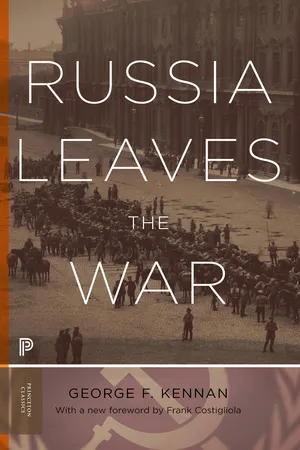 eBook - ePub
- George Frost Kennan(Author)
- 2023(Publication Date)
- Princeton University Press(Publisher)
CHAPTER XITHE FIRST BREST-LITOVSK CRISIS
If truthfulness be the first essential for the ideal diplomatist, the second essential is precision.—Harold Nicolson1THE alarums and excursions of the Kalpashnikov affair proved so absorbing to the principal American personalities in Petrograd during the days just before Christmas 1917 that they somewhat eclipsed, in the attention of these gentlemen, the beginning of the German-Russian peace negotiations at Brest-Litovsk.It will be recalled that the armistice terms, signed on December 15, 1917, had provided for a month’s cessation of hostilities and had stipulated that the two parties would immediately proceed to the inauguration of negotiations for a full-fledged peace treaty. Accordingly, the Soviet delegation and the delegations of the Central Powers (Germany, Austria-Hungary, Bulgaria, and Turkey) assembled again in Brest-Litovsk on December 20. The Soviet delegation was led by Joffe, assisted by Kamenev, Sokolnikov, and Karakhan. (It is interesting to reflect that Joffe died by his own hand; Kamenev, Sokolnikov, and Karakhan all appeared on the docket in the great purge trials of the Thirties.) The German delegation was headed by the Foreign Secretary, Baron von Kühlmann, assisted by Messrs. von Rosenberg and von Hoesch of the German Foreign Office. Major General Max Hoffmann, Chief of Staff to the Commander-in-Chief of the Eastern Front, sat at Kühlmann’s elbow, armed with the immense authority of the High Command. Although Hoffmann’s influence was of course great, Kühlmann, contrary to a widespread impression abroad, bore formal responsibility for the conduct of the talks.The first plenary session of the conference was held on the afternoon of December 22. Joffe set forth the Soviet position in a statement which, in view of the wide attention it was to receive in western countries, must be noted here. After reiterating the demand for a general “democratic” peace, based on the “Decree of Peace,” Joffe went on to list the following points as a basis for negotiation: eBook - PDF
- Ulrich Trumpener(Author)
- 2015(Publication Date)
- Princeton University Press(Publisher)
See Ziemke, p. 51; Schulthess, v. 59:2, 523. Contrary to Wheeler-Bennett, p. 265, Turkish troops were not yet in physical control of Ardahan, Kars, or Batum when the Brest-Litovsk Treaty was signed. In fact the Turks did not cross the prewar borders until the end of March. 15 On the last minute inclusion in the Brest-Litovsk peace terms of the Dissension over Transcaucasia, 1918 by the hope that the satisfaction of some of their ambitions in the east would distract the Turks from their increasingly bitter dispute with Bulgaria over the disposition of the Dobruja and the readjustment of their common border in Thrace. This hope proved illusory. To make matters worse, the Porte soon made it clear that it was not satisfied with the Brest-Litovsk set- tlement and had no intention of abiding by it. 16 As soon as the terms of the Bolshevik peace settlement with the Quadruple Alliance became known in Tiflis, the Seim served formal notice to the major belligerent powers and to Pet- rograd that Transcaucasia did not consider itself bound by the Brest-Litovsk Treaty. In pursuance of its original plan the Komissariat instead sent a delegation to Trabzon to work out a separate agreement with the Ottoman government. After some procrastination the Turks received the delegation on March 12 and immediately made it clear that Transcaucasia had no right to dispute the validity of the Brest-Litovsk settle- ment since it had never officially declared its independence from Russia. Rather unwisely the Komissariat waited almost four weeks before yielding on that point, thereby giving the Turks a theoretical justification for continuing their military advance. 17 clause regarding the 1877 frontier and the Wilhelmstrasse's refusal to support certain other, more far-reaching, Turkish claims in Trans- caucasia, see FO, Russland 97a, Bd. 11, Bernstorff to FO, 21 Feb 1918, No. 251; Schiiler to FO, 24 Feb, No. eBook - ePub
Soviet-American Relations, 1917-1920, Volume I
Russia Leaves the War
- George Frost Kennan(Author)
- 2021(Publication Date)
- Princeton University Press(Publisher)
CHAPTER XI THE FIRST BREST-LITOVSK CRISIS If truthfulness be the first essential for the ideal diplomatist,the second essential is precision.—Harold Nicolson 1THE alarums and excursions of the Kalpashnikov affair proved so absorbing to the principal American personalities in Petrograd during the days just before Christmas 1917 that they somewhat eclipsed, in the attention of these gentlemen, the beginning of the German-Russian peace negotiations at Brest-Litovsk.It will be recalled that the armistice terms, signed on December 15, 1917, had provided for a month’s cessation of hostilities and had stipulated that the two parties would immediately proceed to the inauguration of negotiations for a full-fledged peace treaty. Accordingly, the Soviet delegation and the delegations of the Central Powers (Germany, Austria-Hungary, Bulgaria, and Turkey) assembled again in Brest-Litovsk on December 20. The Soviet delegation was led by Joffe, assisted by Kamenev, Sokolnikov, and Karakhan. (It is interesting to reflect that Joffe died by his own hand; Kamenev, Sokolnikov, and Karakhan all appeared on the docket in the great purge trials of the Thirties.) The German delegation was headed by the Foreign Secretary, Baron von Kuhlmann, assisted by Messrs, von Rosenberg and von Hoesch of the German Foreign Office. Major General Max Hoffmann, Chief of Staff to the Commander-in-Chief of the Eastern Front, sat at Kuhlmann’s elbow, armed with the immense authority of the High Command. Although Hoffmann’s influence was of course great, Kuhlmann, contrary to a widespread impression abroad, bore formal responsibility for the conduct of the talks.The first plenary session of the conference was held on the afternoon of December 22. Joffe set forth the Soviet position in a statement which, in view of the wide attention it was to receive in western countries, must be noted here. After reiterating the demand for a general “democratic” peace, based on the “Decree of Peace,” Joffe went on to list the following points as a basis for negotiation: eBook - ePub
My Life
An Attempt at an Autobiography
- Leon Trotsky(Author)
- 2012(Publication Date)
- Dover Publications(Publisher)
This prisoner wrote: 29 “The result of Brest-Litovsk is not nil, even if it comes to a peace of forced capitulation. Thanks to the Russian delegates, Brest-Litovsk has become a revolutionary tribunal whose decrees are heard far and wide. It has brought about the expose of the Central Powers; it has exposed German avidity, its cunning lies and hypocrisy. It has passed an annihilating verdict upon the peace policy of the German [Social Democratic] majority—a policy which is not so much a pious hypocrisy as it is cynicism. It has proved powerful enough to bring forth numerous mass movements in various countries. And its tragic last act—the intervention against the revolution—has made socialism tremble in every fibre of its being. Time will show what harvest will ripen for the present victors from this sowing. They will not be pleased with it.” eBook - ePub
- Victor Serge, Peter Sedgwick(Authors)
- 2017(Publication Date)
- Haymarket Books(Publisher)
5 Brest-Litovsk RUSSIA AND IMPERIALISMThe development of the Russian revolution was closely linked with international politics. The autocracy collapsed at the moment when the Allied representatives, headed by Buchanan, the British ambassador in Petrograd, were cooperating with the big bourgeoisie and leading generals of Russia to engineer a palace revolution against the junta of Nicholas II, which had become a serious obstacle in the prosecution of the war.1On their side the Central Powers provided facilities for the return to Russia of Lenin and other internationalist exiles. The Provisional Government rested on Allied support. It promised the Allies that it would implement the treaties Russia had with them, and Kerensky launched the offensive of July 1917 in response to Allied pressure: this became a crucial tum in Russia’s own crisis. Immediately following the insurrection in Petrograd, the Second Congress of the Soviets broke decisively with the policy of support for the Allied war. The Military Missions from the Allied Powers intervened in the Stavka episode against Bolshevism. Now, at the hour of the Brest-Litovsk negotiations, the destinies of the Soviet Republic had become an extremely serious international problem for the two imperialist coalitions.The profound causation behind these international alignments is evident in a number of facts. The revolution was born out of war, but of a war that was in no sense Russian: the international significance of the revolution was determined by these origins, as well as by the characteristics of Russia itself. In the first chapter of this book we gave some statistics in support of the historian M. N. Pokrovsky’s dictum that Franco-Russian imperialism can be dated as an entity from the end of the nineteenth century. It is a formula which needs amplifying. The pre-war Russian Empire is one of the five Great Powers of Europe (with Britain, Germany, France and Austro-Hungary), but among these powers, who are characterized by their financial expansionism, Russia is the only one which is not an exporter of capital, eBook - PDF
The Major International Treaties of the Twentieth Century
A History and Guide with Texts
- John Grenville, Bernard Wasserstein, John Grenville, Bernard Wasserstein(Authors)
- 2013(Publication Date)
- Routledge(Publisher)
Relations between the Soviet Union and Germany Germany and Russia, once in the relationship of victor and vanquished when Brest-Litovsk was signed, had both become defeated powers after November . The war had gravely weakened the two countries. Nevertheless Russia and Ger-many remained potentially great powers. Thus despite their entirely di ff erent political complexions there was a community of interest which brought Russia and Germany together in the s. Their collaboration involved some limited secret military cooperation and limited economic assistance for Russia; joint enmity towards Poland within its post-war frontiers was the basis. In the Genoa Conference of major European powers met to reconstruct the economy of Europe and to revive world trade. It proved abortive. The most important result was that two of the participants, Soviet Russia and Germany, unable to persuade the western powers to make su ffi cient concessions, signed a treaty with each other at the neighbouring resort of Rapallo. The signi fi cance of the Treaty of Rapallo, April (p. ) lay in the fact that both Soviet Russia and Germany broke out of diplomatic isolation. Their cooperation was based not on an identity of views or genuine friendship but on self-interest. The Locarno reconciliation with the west and Germany’s entry into the League of Nations in was carefully dovetailed by Stresemann to harmonize with Germany’s undertakings to Soviet Russia. Thus Germany would not be automatically obliged to join in any action against Russia under Article , because it need only do so to an extent that was compatible with its military situation and geographical location, a phrase that left Germany the decision. Weimar Germany rea ffi rmed its relationship with Soviet Russia by the Treaty of Berlin, April (p. ); but the relative position of the two countries had changed.
Index pages curate the most relevant extracts from our library of academic textbooks. They’ve been created using an in-house natural language model (NLM), each adding context and meaning to key research topics.

