History

Russian Revolution of 1917
The Russian Revolution of 1917 was a period of political and social upheaval in Russia, resulting in the overthrow of the Tsarist autocracy and the eventual establishment of the Soviet Union. It was marked by a series of events, including the February Revolution and the October Revolution, which led to the rise of the Bolsheviks and the end of the Romanov dynasty.
Written by Perlego with AI-assistance
Related key terms
1 of 5
12 Key excerpts on "Russian Revolution of 1917"
 No longer available |Learn more
- (Author)
- 2014(Publication Date)
- White Word Publications(Publisher)
________________________ WORLD TECHNOLOGIES ________________________ Chapter-11 Russian Revolution (1917) Russian Revolution of 1917 Date 1917 Location Russia Result Abdication of Nicholas II, end of the Russian Empire, Bolsheviks' takeov er of power, start of the Russian Civil War Belligerents Russian Empire Russian Provisional Government Petrograd Soviet Bolshevik Party Commanders and leaders Nicholas II of Russia Alexander Kerensky Vladimir Lenin The Russian Revolution is the collective term for a series of revolutions in Russia in 1917, which destroyed the Tsarist autocracy and led to the creation of the Soviet Union. The Tsar was deposed and replaced by a provisional government in the first revolution of February 1917 (March in the Gregorian calendar; the older Julian calendar was in use in Russia at the time). In the second revolution, during October, the Provisional Government was removed and replaced with a Bolshevik (Communist) government. The February Revolution (March 1917) was a revolution focused around Petrograd (now St. Petersburg). In the chaos, members of the Imperial parliament or Duma assumed control of the country, forming the Russian Provisional Government. The army leadership felt they did not have the means to suppress the revolution and Tsar Nicholas II of Russia, the last Tsar of Russia, abdicated. The Soviets (workers' councils), which were led by more radical socialist factions, initially permitted the Provisional Government to rule, but insisted on a prerogative to influence the government and control ________________________ WORLD TECHNOLOGIES ________________________ various militias. The February Revolution took place in the context of heavy military setbacks during the First World War, which left much of the army in a state of mutiny. eBook - PDF
Competing Voices from the Russian Revolution
Fighting Words
- Michael C. Hickey(Author)
- 2010(Publication Date)
- Greenwood(Publisher)
8 This historiographic debate had its roots in disputes among revolution- ary émigrés, but in a sense, it also was a product of the Cold War political environment, in that how one viewed the question often reflected one’s view of the Soviet Union’s historical legitimacy. In any case, relatively few historians took stark, “either-or” positions. Most specialists argued that the stresses and strains of war, rather than disrupting an otherwise stable system, provided the final blows to the already staggering autocratic regime. The end of the Cold War and the collapse of the Soviet Union gave historians a chance to rethink many questions regarding the causes of the Russian Revolution. Historians not only gained access to previously unavailable archives and documents in Russia, but also turned their atten- tion to previously understudied geographic regions and social groups. Since the 1990s, historians have been looking for new ways to understand the Russian Revolution and its place in history. One important recent trend among historians is to rethink how we divide the story of Russia’s history into distinct chapters. Many historians now stress that instead of thinking of 1917 as a dividing line between two acutely different periods of history, it is better to think of the events of 1917 as a stage in a “contin- uum of crisis,” which lasted from the onset of World War I until the end of the Russian Civil War. 9 Doing so has opened new insights on the relation- ship between developments in Russia and those elsewhere in wartime Europe, as well as continuities in state policies (such as policies toward grain collection and toward the surveillance of populations) that link the wartime tsarist state, the 1917 Provisional Government, the Bolshevik regime, and the anti-Bolshevik territorial governments of the Civil War period (the so-called Whites). It also has important implications for the study of revolutionary social history. eBook - ePub
- Michael Löwy(Author)
- 2020(Publication Date)
- Haymarket Books(Publisher)
1917
The Russian Revolution
Rebecca Houzel and Enzo TraversoThe Russian Revolution (1917)
S oviet Russia valued the image, locating it at the center of its system of representation and transforming it into one of the pillars of the socialist order. Statues, iconography, and design privileged symbols and myths. More than ninety years later, the 1917 Revolution’s aura still resonates to a considerable degree, even if its meaning has suffered a radical inversion by the dominant trends of public opinion: in contrast to 1789, October has been converted into a date marking the birth of totalitarianism. Returning to the images from the critical year of 1917, from the fall of the tsarist regime in February to the seizure of the Winter Palace in October eight months later, may have a salutary effect. Examining these fragments in time and analyzing the instants that constitute history helps us revisit the events themselves and allows us to strip away a thick layer of retrospective projections, first hagiography and later demonization.The only figure who escaped these memory wars, at least until a relatively recent period, was Tsar Nicholas II. He was absent from St. Petersburg at the moment of the February uprising, leading to an underestimation of his importance. Unaware of the dynamic of events, he was finally forced to abdicate. It was a surprising and sudden collapse following the bloody repression from which it sprang. One celebrated photograph, dated from early 1917, in which Nicholas is surrounded by his family, including his wife Alexandra and his five children, became a symbol of the ancien régime. A strange impression of calm, of tranquil assurance, almost confidence, radiates from the figures. There is no trace of worry darkening the tsar’s face, nothing that allows us to foresee the upheavals that will annihilate him and his family some months later. Another photo shows him in military uniform, walking alongside an imperial train. He does not know that he will soon sign his abdication decree in this very same place. He appears alone, beside the train that has stopped in the middle of the countryside. The conductor waits for him, observing him through a glass door; the tsar represents no one but himself. His execution, in July 1918, would mark a point of no return. Yet, except among a minority of the exiled aristocracy, his death would not produce the same commotion that swept through Europe after the decapitation of Louis XVI. Nicholas II would not inspire an Edmund Burke or a Joseph de Maistre to idealize his legacy and celebrate his memory. This may be the reason why he never appears to us in a tragic light in these antiquated records; instead, he looks like a piece in a museum.
- Alastair Kocho-Williams(Author)
- 2013(Publication Date)
- Routledge(Publisher)
2 The Russian revolutions of 1917 and the Russian Civil War in international context
In February 1917 (OS) Russia underwent the first of two revolutions that year. The Tsar had lost control of his capital, and with military failure and supply shortages on the home front, Petrograd erupted into revolution. The Tsar abdicated, to be replaced by a Provisional Government, which was in turn swept aside in October 1917 in a Bolshevik-led coup. Both revolutions resonated internationally, and provoked responses from foreign governments.The two revolutions had different characteristics, both domestically and in terms of how they affected Russia’s relations with foreign powers. While the Provisional Government showed a commitment to the continuance of Russian involvement in the First World War, the Bolsheviks did not. While the February Revolution put Russia onto a democratic path in the eyes if its international partners, the Bolshevik Revolution led to a new, revolutionary regime that rejected diplomacy as a bourgeois practice and believed that a new era of revolutions would sweep over the globe.Beyond the revolutions, it is important to consider the international reactions to them. The new Soviet regime threw down a challenge on the global stage. Initial reactions were to hope that it would collapse, but when this failed to occur and Russia entered a period of civil war, the Russian Empire’s former allies intervened against the Bolsheviks in the Russian Civil War. This chapter will consider the international context of the Russian revolutions of 1917 and the Russian Civil War, and the development of the Soviets as an international power in the revolutionary period.The February Revolution and the world
The February Revolution began with the outbreak of unrest in Petrograd on 23 February 1917 (OS). Women workers protesting at food shortages directly challenged the regime, and protests grew. By the following day, Petrograd had been flooded with protestors, and when orders were given to the army to use force against the crowds on 26 February, it mutinied and began to go over to the side of the revolution. This was decisive, and the regime lost control of the capital of the Russian Empire. On 27 February, the bulk of the Tsar’s ministers were arrested, while Nicholas II set out to return to Petrograd from the front. On his arrival, the Tsar was advised to abdicate the throne. Following this advice, he abdicated on 2 March 1917, also abdicating for his son, the Tsarevich Alexei, who, as a haemophiliac, was not considered well enough to occupy the throne. Instead the imperial crown was offered to the Tsar’s brother, Grand Duke Mikhail, who duly refused to accept it and commanded the Russian people to obey the newly established Provisional Government. Nicholas II, now known as Nicholas Romanov, was placed under house arrest with his family at Tsarskoe Selo. With little resistance, the Russian Empire came to an end.
- Sally Waller(Author)
- 2012(Publication Date)
- Cambridge University Press(Publisher)
144 Imperial Russia, Revolutions and the Emergence of the Soviet State 1853–1924 The moment feared by every 19th-century Russian tsar eventually came in 1917. The experience of the First World War unleashed forces that had been building up for decades. The inadequacies of the autocracy were highlighted and the military death toll, combined with shortages of food and essential items both at home and on the front line, angered people to the point where they were ready to rise up against the regime. The Romanov dynasty finally came to an end in February 1917. It was replaced by a Dual Power arrangement, made up of a Provisional Government and a Workers’ Soviet. This compromise failed to work; with continuing wartime disasters, the Bolsheviks under Vladimir Lenin grew stronger. In October 1917, the Bolsheviks seized power in Russia and opened the way for a new communist future. Overview • The economic and military problems of the First World War, in addition to existing political issues, caused the tsarist system to break down. • Riots in Petrograd in February 1917 turned into revolution, when soldiers refused to fire on the crowds and joined them instead. 145 • The tsar was forced to abdicate (give up the throne) and the Provisional Government took control, working alongside the Workers’ and Soldiers’ Soviet in a system of Dual Power. • The Provisional Government’s inadequacies (particularly its continued involvement in an unsuccessful war) enabled Lenin, who returned to Russia in April 1917, to build up support for the Bolshevik Party. Other socialist radicals (the Socialist Revolutionaries and the Mensheviks) were also strong forces within the Petrograd and Moscow Soviets. • The Bolshevik cause was almost destroyed in the July Days, when an early coup (attempted seizure of power) was crushed. But Kornilov’s attempt to lead a right-wing coup in August 1917 increased support for the Bolsheviks. eBook - PDF
- Frank W. Thackeray(Author)
- 2007(Publication Date)
- Greenwood(Publisher)
Dzerzhinsky. By early spring 1921, the civil war was almost over and the triumphant Bolsheviks ruled Russia. One can only guess at the number of civil war dead, but no one doubts that the final figure reached into the millions. Nevertheless, this was a price the Bolsheviks were willing to pay for the triumph of their revolution. INTERPRETIVE ESSAY Barbara C. Allen In 1917 Russia witnessed an uprising of the dispossessed and disenfran- chised against the representatives of privilege. Long-standing peasant grievances, imperial overextension, the social stress of modernization, and a war-induced economic crisis culminated in political and social rev- olutions. The March Revolution brought down the tsarist regime, ending over 300 years of Romanov dynastic rule and ushering in a short-lived liberal leadership. The November Revolution brought to power the first self-proclaimed Communist government in world history. The Russian revolution inspired uprisings in developing countries, spurred reform in traditional liberal democracies, and influenced the rise of fascism in less stable democracies. The revolution’s history has been the subject of much debate: Why did revolution occur in Russia in 1917? Did liberal democracy have a chance? How did the Bolsheviks come to power? What diverted the Bolsheviks from their course to create a fairer society based on the equitable distribution of goods? Did the Russian Revolution constitute a bold new social experiment, or was it merely a continuation of wartime violence and social breakdown? The revolutionary project in its liberal and socialist forms was undermined and shaped by two chief develop- ments: war-induced economic crisis and a shortage of personnel capable of administering a modern state and economy. On the eve of revolution, Russia was a world leader in culture, but its economic, social, and political development lagged behind. eBook - ePub
Revolutions and the Revolutionary Tradition
In the West 1560-1991
- David Parker(Author)
- 2002(Publication Date)
- Routledge(Publisher)
9 The Russian RevolutionMaureen Perrie‘The Russian Revolution’ may be defined as a process that began in the early twentieth century and continued into the 1930s – or even to the end of the Soviet Union in 1991. In this chapter, however, I shall take a narrower approach, focusing on the three discrete political revolutions of the first two decades of the century: the events of 1905 and those of February and October 1917. Insofar as all three revolutions had their roots in the same crisis of the old regime, and in the same intellectual revolutionary tradition, I shall begin by examining these common factors before proceeding to consider and compare the specific features of each individual revolution.‘Reform from above’ and economic development
Although Robert V. Daniels has recently tried to fit Russia into a pattern in which ‘all the great revolutions of history . . . break out when the tension between a changing, modernising society and a rigid traditional government can no longer be contained’,1 Crane Brinton rightly noted, in his classic comparative study, that an ‘effort . . . to reform the machinery of government’ was an important common feature of the four societies he examined (England, America, France and Russia). He added:Nothing can be more erroneous than the picture of the old regime as an unregenerate tyranny, sweeping to its end in a climax of despotic indifference to the clamor of its abused subjects.2Indeed, an interaction between ‘reform from above’ and ‘revolution from below’ was a major feature of the last decades of Tsarist Russia. The old regime was unable to sustain the impetus of reform, or to satisfy the expectations of further amelioration that it raised – and thereby it increased the dissatisfaction of oppositional elements in society rather than appeasing it.The main ‘reforms from above’ in nineteenth-century Russia were implemented in the reign of Tsar Alexander II (1855–81). These reforms were introduced in the aftermath of Russia’s defeat by Britain and France in the Crimean War of 1854–56. The Crimean fiasco highlighted Russia’s military inferiority to the major European powers of the day, and punctured the complacency about the virtues of the Tsarist system which had characterised the reactionary reign of Nicholas I (1825–55). Liberal statesmen assumed that Russia’s military defeat reflected her social and economic backwardness; and they advised the new Tsar to take advantage of the situation in order to introduce reforms. Although Soviet historians believed that any significant reform must have been the product of a ‘revolutionary situation’, and therefore argued that such a situation already existed between 1859 and 1861 (in the form of peasant unrest and criticism from the revolutionary intelligentsia), the ‘Great Reforms’ of Alexander II were in reality a rare example of a government voluntarily embarking on a programme of changes which were designed to strengthen the state both externally and internally. Great power status, however, required economic modernisation; but economic modernisation threatened to undermine social and political stability. This dilemma was to plague Tsarist governments for the next half-century.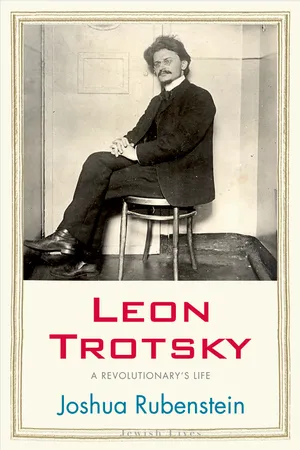 eBook - PDF
Leon Trotsky
A Revolutionary's Life
- Joshua Rubenstein(Author)
- 2011(Publication Date)
- Yale University Press(Publisher)
4 The Revolution of 1917 Speaking before tsarist judges in 1905 , Trotsky de-clared, “A popular insurrection cannot be staged. It can only be foreseen.” Twenty-five years later, in forced exile and anxious to defend the role he had played in the Bolshevik takeover, Trotsky wrote his History of the Russian Revolution. Caught be-tween the urge to sustain the Bolshevik claim that the masses had inspired the seizure of power and the unavoidable truth of his and Lenin’s fundamental roles, Trotsky wavered. He em-phasized the inevitable momentum of events—“Revolution is the inspired frenzy of history,” he wrote in My Life —and the contingent need for Bolshevik leadership. He could not claim otherwise. History, in the end, will have to agree with the more candid admission in his diary of 1935 . “Had I not been present in 1917 in Petersburg, the October Revolution would still have taken place— on the condition that Lenin was present and in com-mand [translator’s italics]. If neither Lenin nor I had been pres-83 ent in Petersburg, there would have been no October Revolu-tion.” The revolution might have been made without Trotsky, but it needed both Lenin and Trotsky to succeed. In May 1917 Trotsky returned to a Russia in turmoil. The tsar had abdicated in the wake of violent demonstrations, in-dustrial strikes, and mutinies by soldiers and sailors. Protests over lack of bread turned into a revolution. The Petrograd Soviet of Workers’ Deputies, which had once been led by Trotsky, declared its revival. On March 1 the Soviet issued its famous Order No. 1 , granting soldiers democratic rights and calling on officers to treat them with greater respect. The next day, the Provisional Government assumed power in Petrograd, leaving Tsar Nicholas II no choice but to abdicate. Russia seemed poised to establish a parliamentary repub-lic. The Provisional Government represented the coming to power of a potentially democratic Russia. eBook - PDF
Paths to a New Europe
From Premodern to Postmodern Times
- Paul Dukes(Author)
- 2017(Publication Date)
- Bloomsbury Academic(Publisher)
The situation would grow worse where Bolshevism and Prussianism were in collab-oration, assisted by propaganda and secret service activity. 29 Such fears concerning Bolshevism were never fully realised, but they never completely disappeared. On the other hand, at least a little remained of the high hopes held out for the world revolution by many people in Europe and other continents. As for the historians, even those unsympathetic to the October Revolution recognise its outstanding significance: G. H. N. Seton-Watson observed that ‘The Bolshevik Revo-lution was unquestionably one of the greatest events in all human history’; and Richard Pipes suggested that ‘a convincing case can be made that the Russian Revolution was the single most consequential event of the twentieth century, whose repercussions have been felt in every corner of the world’. 30 Indeed, we must not forget the wider setting of the great changes that occurred in Russia in 1917 and the years immediately following. The major European imperial powers had become exhausted in the struggle among themselves, bringing the period of European world dominance closer to its end. The greatest world power from 1918 onwards was the USA, which had moved during the second industrial revolution to first position in economic strength, a position confirmed at the end of the First World War by its assumption of leadership in financial affairs. These basic facts were real enough, although disguised in the short 356 PATHS TO A NEW EUROPE run by the more dramatic nature of the Russian Revolution and by the USA’s retreat towards isolation. The USA’s full emergence as a superpower would not take place until after the Second World War. Meanwhile, by external force and by internal inclination, the Soviet Union had been cut off from Europe. Some years later than the USA, it too emerged after the Second World War as a superpower, sharing control over Europe with its American rival. eBook - PDF
The Russian Revolution and Civil War 1917-1921
An Annotated Bibliography
- Jonathan Smele(Author)
- 2006(Publication Date)
- Continuum(Publisher)
9 The Revolutions of 1917 THE FEBRUARY REVOLUTION Historiography 1320 Longley, D. A. `Iakovlev's Question, Or the Historiography of the Problem of Spontaneity and Leadership in the Russian Revolution of February 1917', in E. R. Frankel, J. Frankel and B. Knei-Paz (eds) Revolution in Russia: Reassessments of 1917 . Cambridge: Cambridge University Press, 1992. pp. 365±387. A thought-provoking appeal for Western scholars to approach the question of the relative importance of spontaneity and leadership in the February Revolu-tion with greater sophistication, highlighting the weaknesses in the arguments of the early memorists historians often cite (such as Shliapnikov and Sukhanov) and potentially fruitful lines of enquiry suggested (albeit inadvertently) by Soviet historians of the 1930s (such as Ia. A. Iakovlev), whose works are usually dismissed as merely `Stalinist'. 1321 Page, S. W. `The Role of the Proletariat in March 1917: Contradictions in the Official Bolshevik Version', Russian Review Vol. 9 (1950), No. 2, pp. 146±149. A brief critique of the contradictory arguments to be found regarding proletarian participation and Bolshevik leadership in the February Revolution in the official 1939 edition of the History of the Communist Party of the Soviet Union (Short Course) . Documents 1322 La Chute du re Âgime tsariste: Interrogatoires des Ministres, Conseillers, GeÂneÂraux, Hauts Fonction-naires de la Cour ImpeÂriale russe par la Commission extraordinaire du Gouvernement provisoire de 1917 (pref. by V. A. Maklakov; transl. by J. Polonsky). Paris: Payot, 1927. 592 pp. A very useful and extensive selection of the depositions made to the investigatory commission established by Kerensky, as Minister of Justice, in March 1917. 1323 Koutchkine, A. (ed.) La ReÂvolution de fe Âvrier en Russie: Souvenirs et documents . eBook - PDF
- Richard Sakwa(Author)
- 2010(Publication Date)
- Red Globe Press(Publisher)
Russia, as a country with one leg in Europe and one in Asia, reflected these two facets of twentieth-century communism. The communist revolution in Russia represented the high water mark of one of the most ambitious eschatological projects of modern-ity [153]. The Bolshevik revolution in October 1917 revolution was an epochal event, in the sense that it endowed a parochial disturb-ance with universal significance. The emergence during the eight-eenth century of a discourse of progressive social change based on a universal model of rationality and development applicable to all societies was now implemented in a country that even during the Enlightenment had an ambiguous relationship with the new forms of modernity being devised at that time. As we have seen, this was vividly in evidence in the correspondence between Catherine the Great and Diderot. While the renowned Encyclopaedist flattered Russia and Revolution 27 Catherine in public, he expressed private reservations whether she had understood the progressive ideas that he and his fellow enlighteners were advancing; while Catherine in her letters clearly indicated that, while the ideas of freedom and perfectability were all very fine, Diderot and his associates did not understand the realities of Russian politics. Thus the tension that remains to this day was exposed between expansive ideologies claiming universal application and the particularity of the Russian tradition. This ideology in the hands of some Enlightenment thinkers (but certainly far from all) was combined with a revolutionary approach to social change – that the act of rupture itself had a liberating and progressive political effect. For want of a better term, this can be called Enlightenment revolutionism : asserting an ideology of human betterment accompanied by the development of a method – revolu-tion – to implement the idea. eBook - PDF
- Michael Charles Howard, John Edward King(Authors)
- 2014(Publication Date)
- Princeton University Press(Publisher)
Only the USA was close to being a purely bourgeois society. Elsewhere in the West, there were still aspects of the democratic revolution which had never been realised (see Chapters 4, 9 and 11 above). 55 Socialist revolution in Europe would, therefore, have to complete the democratic tasks and would not be altogether different from permanent revolution in Russia. In consequence, a Russian revolution could be expected to have a very powerful symbolic effect, even on the advanced countries. Trotsky, however, stressed the similarity of Russia to peripheral capita-list areas: before 1917 the Balkans, and in the 1920s colonial and semi-colonial territories generally. Thus he saw Russian economic development as typical of backward capitalisms, to all of which the model of permanent revolution could be applied. 56 This meant that nationalist, anti-imperialist movements were part of the struggle for socialism, for exactly the same reasons as in Russia; they could succeed only under proletarian leadership. And victory anywhere would extend working-class power geographically, and strike a blow against international capitalism by reducing its arena of exploitation, thereby hastening the spread of revolution to the metropoli-tan imperialist countries themselves. 57 Not surprisingly, Trotsky came to view the twentieth century as the age of permanent revolution. 58 V l The Strengths of Trotsky's Marxism Trotsky's major intellectual achievement was undoubtedly his perception of the political developments generated by tsarist industrialisation. He came closer than any other Marxist to correctly predicting the sequence of events that would be set in motion by the overthrow of the autocracy: the history of 1917 was broadly in accordance with his forecast of a decade earlier.
Index pages curate the most relevant extracts from our library of academic textbooks. They’ve been created using an in-house natural language model (NLM), each adding context and meaning to key research topics.

