History

Russian Empire
The Russian Empire was a historical state that existed from 1721 to 1917, encompassing a vast territory in Eastern Europe and North Asia. It was ruled by a series of emperors and empresses known as tsars and tsarinas. The empire played a significant role in European and global politics, culture, and military conflicts during its existence.
Written by Perlego with AI-assistance
Related key terms
1 of 5
12 Key excerpts on "Russian Empire"
 eBook - PDF
Russia and the World
New State-of-Play on the International Stage
- L. Cooper(Author)
- 2016(Publication Date)
- Palgrave Macmillan(Publisher)
'The Russian people fell victim to the immensity of its territory', and having acquired the world's largest empire, it had to accept a despotic regime in order to retain and organise its vast territorial possessions (Berdyayev, 1946, p. 9). The history of the Russian Empire is, therefore, a history of conquest and expansion. A fact rarely mentioned is that the status of Russia as a superpower and its position as equal among the great powers has not just been achieved since the Second World War, but since the beginning of the eighteenth century following a long struggle against foreign invaders (Cooper, 1989, p. 22). After the Revolution of 1917, the Soviet regime managed to re- tain most of the vast empire of the tsar, except Poland, Finland, the Baltic states and Bessarabia. Some years later, in September 1939, the USSR regained most of the territories which were the domain of the Russian Empire before the Revolution. It annexed western Ukraine and western Belorussia, which had been part of Poland, and in 1940 it succeeded in incorporating the three Baltic states into the Soviet Union. It has also regained part of its Finn- ish territory after a short and bloody war. In 1945 Russia acquired the northern half of east Prussia, including the German city of Konigsberg (renamed Kaliningrad), and the Kuril islands from Japan. The history of Russian expansionism is thus an important factor in the analysis of contemporary Russia. Russia's expansion continued over more than four centuries and was constant in its nature although it suffered certain reversals. No single factor can be attributed to the steady process of expansion, but the search for security has been cited as an important one. Subsequent Soviet foreign policy From the Russian to the Soviet Empire, 1917-91 9 has been justified on account of state security. eBook - ePub
The Boundaries of Europe
From the Fall of the Ancient World to the Age of Decolonisation
- Pietro Rossi(Author)
- 2015(Publication Date)
- De Gruyter Akademie Forschung(Publisher)
Alberto Masoero Russia between Europe and Asia 1 An Empire with Uncertain Boundaries The transcontinental location of the Russian state is a constant factor throughout its history. It fostered a multiplicity of religious, cultural and institutional relations, largely spontaneous and pluridirectional, and not necessarily implying a clear dichotomy between East and West. After all, Europe and Asia meant different things in different centuries. Like a sponge, Russia absorbed its military vocabulary from German and the word chay for tea – the second most popular national drink – from Mandarin Chinese. This intermediate position affected the evolution of its borders, but also influenced representations of national identity and the ideology of the state. In the sixteenth century the Tsardom of Russia began its eastward expansion by conquering the Tatar states of Kazan and Astrakhan, and to some extent it inherited the legacy of Mongol rule. It consolidated its power in the West, resisting the interference of the Polish-Lithuanian Commonwealth, a more prestigious and powerful state at the time. The Tsar would also, after the partitions of Poland in the eighteenth century, claim the title of King of Poland. The centuries-old process of territorial expansion, directed towards different regions of Europe and Asia at different times, encountered its main setbacks during periods of profound political, social and economic crisis, accompanied by significant losses of territory and by discontinuities in dynasties and in the form of the state eBook - PDF
- T. Hopf(Author)
- 2008(Publication Date)
- Palgrave Macmillan(Publisher)
Russia was not satisfied in its quest for recognition as an empire. Of course, further west, kings also struggled to establish themselves as being on par with the Holy Roman Emperor. To pick but one example, under Henry VIII, England launched a campaign to be seen as an empire. The Russian trajectory differs from the others in two key ways, however. First, the shift from seeing the king’s body to seeing the territory of his state as the locus of government, which we can already see in England in the sixteenth century (empire, not emperor), was willfully held back. Second, Europe shifted away from being accepted as an empire in the direction of being accepted as a sovereign state. There were empires, but the logic of recognition revolved around the term sovereignty, or around terms like emperor or empire. Again, there was no such development in Russia, which continued to play the old game long after others had embarked on a new one. Contacts were also hampered by cultural practices. For example, Herber- stein noted that non-Orthodox Christians were considered unclean. This meant that rank-and-file Muscovites had a reason to stay away from them, and that the aristocrats who did meet with them and followed the Euro- pean custom of shaking hands ritually washed themselves after the encounter. As late as the 1660s, when a number of European diplomats, soldiers, and merchants had been invited to the realm, a key observer talked about their separate quarters as “the diseased parts of the state and the body politic” (Krizhanich, quoted in Poe 2000, 83). It was only during this decade that ambassadors were allowed to walk the streets of Moscow alone. Poe stresses that “nonetheless, the Russian authorities realized that diplomacy and mercantile relations with European powers were necessary accoutrements of great power status” (2000, 41). eBook - PDF
The Romanov Empire and Nationalism
Essays in the Methodology of Historical Research
- Alexei Miller(Author)
- 2008(Publication Date)
- Central European University Press(Publisher)
14 As a rule, interest in alternative outcomes for historical processes arises in national historiographies only in the form of disquisitions on how history “justifies” the possible expansion of the national territory at the expense of a neighbor. In the Russian Federation the same mechanisms are enacted when historical narratives are constructed along ethnic lines — the only difference is between the institutional conditions of the functioning of such historiographies in independ-ent states and in autonomous republics within the Russian Federation. THE HISTORY OF THE Russian Empire 13 This is also manifested in contemporary Russian historiography by the dis-appearance from history textbooks of the former imperial territories that are no longer part of the present-day Russian Federation. 15 The empire as a state — with the victories of its armies, the reforms carried out by its central bureaucracies, and so forth — remains a part of the narrative, but its multieth-nic character is considerably less represented in Russian textbooks today than even in the 1930s–1950s (at least in terms of the sheer amount of space de-voted to various ethnic groups.) This is true not only of educational materials. Contemporary political geog-raphy in general invariably influences historians. It has long been observed that the Kingdom of Poland and the Grand Duchy of Finland lie outside the field of interest of foreign specialists in Russian imperial history. This is now taking place to some degree in regard to Central Asia, the Caucasus, and the Baltic region as well. During the Soviet period, serious restrictions applied: historians in Moscow and Leningrad operated under an unwritten ban on researching the history of the Soviet Union republics, that is, the former bor-der regions of empire. The historians themselves were not given a chance to make this mistake — it was made instead by those who exercised political con-trol over academia.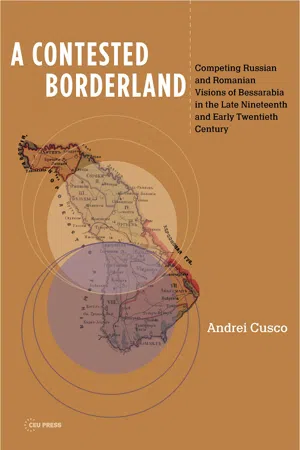 eBook - PDF
A Contested Borderland
Competing Russian and Romanian Visions of Bessarabia in the Second Half of the 19th and Early 20th Century
- Andrei Cusco(Author)
- 2017(Publication Date)
- Central European University Press(Publisher)
The East became as much a space for the crystallization and nego-tiation of Russianness as a foreign and unfriendly domain. Even in the most unambiguously colonial relationship to its various Orients, which was dis-played in Central Asia, the Russian authorities had to find a balance be-tween the Western-inspired models of colonial encounters and the compli-cated issue of advancing Slavic settlements that disrupted the region’s ecological patterns and created nearly insuperable dilemmas for imperial bureaucrats. 12 The contiguous space of the Romanov Empire and the am-biguous place of the Russian element within its ethno-social structure should prompt any researcher of Russian Orientalism to exercise extra cau-tion when approaching the subject. The Russian Empire’s colonization of steppe regions is directly relevant to the Bessarabian case. Contrary to the customary emphasis of imperial Russian and Soviet historiography on the supposedly natural and organic process of the expansion of Slavic settlements toward the south and east, 10 Burbank and Cooper, Empires in World History , 12. 11 Robert P. Geraci, Window on the East: National and Imperial Identities in Late Imperial Russia (Ithaca: Cornell University Press, 2001), 2. 12 For an analysis of Russian policy and discourse in Turkestan, see Daniel R. Brower, Turkestan and the Fate of the Russian Empire (London: Routledge, 2003); and Jeff Sahadeo, Russian Colonial Society in Tashkent, 1865 – 1923 (Bloomington: Indiana University Press, 2006). Empire- and Nation-Building in Russia and Romania 23 the emerging consensus on Russian colonization and “population politics” in steppe regions contends that “Russian expansion . . . was anything but haphazard, spontaneous, and uncontrolled”; instead, it was “a deliberate process with varying motives and policies . eBook - PDF
Russian Imperialism
Development and Crisis
- Ariel Cohen(Author)
- 1996(Publication Date)
- Praeger(Publisher)
On the other hand, not aU the aggrandizement was based on mihtary conquest either. Most of Russia's thrust along the east-west axis was undertaken against the hunters and gatherers of the Urals and Siberia and the nomads of the Asian steppes, who lacked state organization. These tribes, like the ones in the Americas, could be easUy exterminated or subjugated. Expansion along the north-south axis was characterized by the steadfast movement of fortified lines south and southeast. Russia began her expansion earlier than the northern European powers—approximately in the same time as the Spanish reconquista. InitiaUy this aggrandizement foUowed four riverheads that led the Russian settlers, 62 Russian Imperiahsm: Development and Crisis troops—and borders—toward the four seas: the Black, the Caspian, the White, and the Baltic. 79 Russian imperial growth ended about the same time as that of the other European powers. At that point, she had reached her natural geographic limitations and had experienced overextension in the Far East. Russia faUed to develop Western-style capital-driven imperiahsm. Nor is there any historical precedent to indicate that this would have saved her empire, as the experiences of Britain and France demonstrate. SimUarly to her Ottoman and Habsburg contemporaries, Russia, while succeeding in conquest, faUed at the assimUation of the major nationahties of the realm. Moreover, the Great Russian chauvinist pohcies antagonized the majority of the inorodtsy (non-Russians), who opted out of the imperial arrangement. Without the Bolshevik coup and the subsequent ruthless mihtary activities of the Red Army, the empire might not have been reconstituted in the form it existed between 1921 and 1991. The processes of Russification continued in the contiguous Russian/Soviet empire longer than simUar cultural and linguistic influences in the European dominions overseas primarily due to the "reassembly" of the empire by the Soviet regime. eBook - PDF
Nationalism, Myth, and the State in Russia and Serbia
Antecedents of the Dissolution of the Soviet Union and Yugoslavia
- Veljko Vujačić(Author)
- 2015(Publication Date)
- Cambridge University Press(Publisher)
II, pp. 111–125. 4 Richard Pipes, Russia under the Old Regime (New York: Charles Scribner’s Sons, 1974), p. 83. 5 Marc Raeff, “Patterns of Russian Imperial Policy,” in Edward Alworth, ed., Soviet Nationality Problems (New York: Columbia University Press, 1971), pp. 22–43. 6 Paul Miliukov, Russia and Its Crisis (New York: Collier Books, 1962), pp. 19–25; Henry R. Huttenbach, “The Origins of Russian Imperialism,” in Tarasz Hunczak, ed., Russian Imperialism from Ivan the Great to the Revolution (New Brunswick: Rutgers University Press, 1974), pp. 18–45. 7 Raeff, “Patterns of Russian Imperial Policy,” pp. 30–31. Empire, State, and Nation in Russia and Serbia 98 between Russia’s imperial expansion and analogous processes in the West, even denying the reality of conquest, 8 such views nevertheless found a real basis in the one indisputable fact that distinguished the Russian Empire from its British, French, or Spanish counterparts: In the geographically contiguous Eurasian expanses no clear distinction between center and periphery could be established. As Richard Pipes has written: “There were Finns and Turks under Russian rule when the national state was only beginning to take shape. Later, other nationali- ties joined them. As a result, the building of the national state and the forging of an empire, processes which in the west were clearly separated both in time and in space, proceeded in Russia concurrently and contiguously and became virtually indistinguishable.” 9 This lack of a clear distinction between center and periphery, the ethnic Russian core area and the larger multinational state, had its political correlate in the selective co-optation of indigenous elites into the tsarist military and bureau- cratic establishment and their partial cultural assimilation into the dominant “Russian” culture. Neither of these processes, however, entailed any privileging of Russian national goals, but rather their subordination to the demands of throne and altar. eBook - PDF
- Stefan Berger, Alexei Miller, Stefan Berger, Alexei Miller(Authors)
- 2015(Publication Date)
- Central European University Press(Publisher)
The Romanov Empire and the Russian Nation Alexei Miller or decades, the relationship between empire and Russian nationalism has been a blind spot of historiography for both political and methodological reasons. Russian nationalism was almost a taboo topic under the Soviet rule inside the USSR, and for-eign scholars also didn’t have much to offer. 1 The dissolution of the USSR produced a captivating impact on many historians, particularly those working in the post-Soviet space, who started to look at the Romanov Empire through the prism of the political map at the end of the twentieth century. That is also rather typical for Russian histo-rians, who write about “Russia in the Romanov Empire,” usually having in mind the contemporary Russian Federation. 2 1 Even Andreas Kappeler (in his book which deservingly became a classic) mostly covers peripheral nationalisms, and does not deal much with the Russian one. See Andreas Kappeler, The Russian Empire: A Multiethnic History (Harlow: Pearson Education, 2001). The German edition appeared much earlier— Russland als Vielvolkerreich: Enstehung, Geschichte, Zerfall (Munich: C.H. Beck, 1992). 2 A perfect example is provided by Boris Mironov’s recent study of Russian social history. See Boris Mironov, Sotsial’naia istoriia Rossii perioda imperii (XVIII–nachalo XX v.), vols. 1 and 2 (St. Petersburg: Dmitrii Bulanin , 1999). The title of the book, A Social History of Russia During the Imperial Period , already presupposes that Russia can be separated from the empire. Mironov suggests that one can write the social history of the Russians in the empire in isolation. Mironov believes that the social history of the empire as a whole can be presented as the mechanical sum of the histories of the various ethnic groups. See Boris N . Mironov, “Response to Willard Sunderland’s ‘Empire in Boris Mironov’s Sotsial’naia istoriia Rossii’,” Slavic Review 60, no. 3 (2001): 579. F eBook - PDF
Nationalizing the Past
Historians as Nation Builders in Modern Europe
- S. Berger, C. Lorenz, S. Berger, C. Lorenz(Authors)
- 2016(Publication Date)
- Palgrave Macmillan(Publisher)
233 11 Nation, State and Empire: The Historiography of ‘High Imperialism’ in the British and Russian Empires Andrew Mycock with Marina Loskoutova Introduction In the age of ‘high imperialism’ during the late nineteenth century, the size of the imperial state and its population were increasingly perceived as comple- mentary to economic and military power in asserting status in world power politics. This, however, stimulated a range of critical challenges to imperial legitimacy and cohesion for most European empires. The most pressing of these challenges was how to adapt to the spread of nationalist and democratic ideologies without dissolving their own territorial sovereignty. For a brief period during the late nineteenth century, elites in many European empires adopted similar approaches in an attempt to construct imperial states through the promotion of homogenous, though hierarchical and exclusory, national- imperial identities founded on shared racial or ethno-religious dynamics. The commonality of such challenges was particularly apparent in the British and Russian Empires, though their responses differed significantly. In Britain, political elites encouraged a pragmatic and relatively peaceful democratization of the imperial core and eventual decolonization. The Russian experience proved far more traumatic, with a series of violent revolutions leading to the establish- ment of Communist rule and, for many, an extension of imperial rule which only came to an end in 1991. For Dominic Lieven, such variations reflect differences in the way imperial power was constituted, highlighting distinctive political cul- tures and economic circumstances between ‘backward and peripheral Russia and mighty Britain’. Although the metropolitan core of both empires was situated on the periphery of Europe, Lieven suggests the British were ‘maritime and insular’ whilst Russia was ‘a great continental land empire’. eBook - PDF
Late Imperial Russia
Problems and prospects
- Ian Thatcher(Author)
- 2024(Publication Date)
- Manchester University Press(Publisher)
If we take as a succinct indicator of Russian ideology, Orthodoxy, autocracy, nationality, we can see that it was of little use to tsarism internationally. Even fellow Orthodox Slavs were averse to autocracy, while further afield the image of Bloody Nicholas and his cruel regime, however accurate or inaccurate, was clearly stamped on the public consciousness throughout Europe and beyond. The USA was especially averse to anti-Semitism and the convict system. Nationality is the customary translation of narodnost, but the term means more, something like the special character of the Russian people. In this connec- tion, we should note the fact that the Russian Empire was not as diverse as some of its fellows. According to the census of 1897, nearly half of the 125 million people in the empire were Russian and nearly three-quarters were Slavic. (In more detail, 44.31 per cent were Russians, 17.81 per cent were Ukrainian, 6.31 per cent were Poles and 4.68 per cent were Belorussians.) Asiatics constituted little more than a tenth of the whole, a far smaller minority than their equiva- lents in many other empires. 35 In the greatest of the pre-1914 empires, for exam- ple, the British constituted a minority overall, especially in India – the so-called jewel in the crown. Siberia, which Dominic Lieven calls ‘the jewel in Russia’s imperial crown’, 36 was almost empty. To put the point another way, Russia’s metropolis was much more populous than its periphery, and while its many non-Slavic peoples deserve more attention than is customarily given, say, in histories of the USA to Native Americans, their influence on the destinies of tsarism can be exaggerated. To sum up, in the years leading to its collapse, the Russian Empire was about number five in the imperial league, below Britain, Germany, the USA and France. Although beaten by Japan in the war of 1904–5, it was still ahead of Japan according to some indices. For example, its army was one of the world’s largest. eBook - PDF
- Ivan Zoltan Denes, Iván Zoltán Dénes(Authors)
- 2006(Publication Date)
- Central European University Press(Publisher)
Fol-lowing this criticism, one may contemplate crossing the border between the concepts of nation-state and multinational empire, and consider the empire as a potential nation-state. Particularly interesting may be a diachronic comparison between the early modern Western European empires and the Russian Empire in the nineteenth century. As Pocock has suggested, the crisis of the British empire in the eighteenth century 333 11 Linda Colley dwells particularly on the perception of the ‘other’ when ana-lyzing the role of the Anglo-French wars in the formation of ‘Britishness’: see Colley, 1992. 12 For the construction of this mental mapping, see Wolff, 1994. This particular vision of social characteristics connected with the region endures in the twentieth century, re-surfacing, for example, in Huntington’s scheme of the clash of civilizations. LIBERTY AND THE SEARCH FOR IDENTITY should be described as a crisis of the composite monarchy and of tradi-tional political identity rather than in terms of imperialist opposition to colonial independence. 13 Given the fact that some Russian lawyers pre-sented the Russian Empire as a European composite monarchy, lacking national identity, the comparison does not seem absolutely absurd. 14 Overall, the placement of the Russian Empire and its discourse in a proper comparative context is a task yet to be performed. II. The history of Russian liberalism is an intensely debated issue. It lies at the nexus of both the contemporary version of the philosophical ‘Sla-vophiles versus Westernizers’ controversy and the political dispute over the transition to democracy. After the fall of communism, liberalism came to constitute an alternative to the so-called ‘October Revolution’ in the narrative of pre-Revolutionary Russian history. eBook - PDF
- Alexei Miller, Alfred J. Rieber, Alexei Miller, Alfred J. Rieber(Authors)
- 2004(Publication Date)
- Central European University Press(Publisher)
It is difficult to assess from the 21st century just how successful and far-advanced Russian nationalism carried out the project of consolidating of the Russian national territory. The results of these efforts were severely 21 IMPERIAL RULE tested in the course of World War I, the revolution and the civil wars on the imperial territory, and then in some cases were “cancelled,” in others reinforced within the framework of the Soviet policy of ethnic territorializa-tion. 43 Whatever the case, better understanding of the “mental maps” of Russian and competing nationalisms in the Romanov Empire can provide insights into the logic of imperial rule in late imperial Russia, as well as new comparative perspectives. N OTES 1 A. Pypin, “Volga i Kiev,” Vestnik Evropy (July 1885): 188–215. Further refer-ences to the article in the text list the relevant pages in brackets. 2 R. Brubaker, “Myths and Misconceptions in the Study of Nationalism” in J. A. Hall, ed., The State of the Nation. Ernest Gellner and the Theory of Nationalism (Cambridge: Cambridge University Press, 1998), 272–306, here 302. 3 D. Rowley, “Imperial versus National Discourse: The Case of Russia,” Nations and Nationalism 1 (2000): 23–42, quotations from 24, 25. 4 R. J. Kaiser. The Geography of Nationalism in Russia and the USSR (Princeton, New Jersey: Princeton University Press, 1994), 85. 5 G. Hosking, Russia. People and Empire. 1552–1917 (Glasgow: Fontana Press, 1997), xix, xxi. 6 V. Tolz, Inventing the Nation. Russia (London: Arnold; New York: Co-published in the United States of America by Oxford University Press, 2001), 155.
Index pages curate the most relevant extracts from our library of academic textbooks. They’ve been created using an in-house natural language model (NLM), each adding context and meaning to key research topics.

