History

Russian Revolution 1905
The Russian Revolution of 1905 was a wave of mass political and social unrest that spread across the Russian Empire. It was sparked by a peaceful protest march to the Tsar's Winter Palace in St. Petersburg, which ended in a violent confrontation with the Imperial Guard. The revolution led to the granting of civil liberties and the establishment of the first Russian parliament, the Duma.
Written by Perlego with AI-assistance
Related key terms
1 of 5
11 Key excerpts on "Russian Revolution 1905"
 eBook - PDF
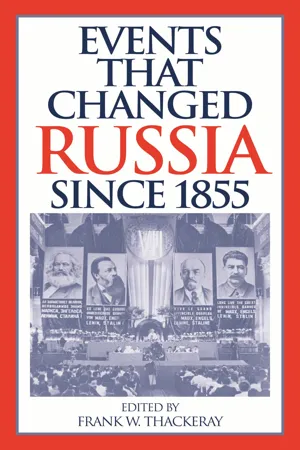
- Frank W. Thackeray(Author)
- 2007(Publication Date)
- Greenwood(Publisher)
INTERPRETIVE ESSAY Taylor Stults The revolutionary events of 1905 in Russia reveal a tumultuous period in that nation’s long history. Nevertheless, they have been overshadowed 72 Events That Changed Russia since 1855 by the events of the more famous revolution in 1917 that ended the Romanov dynasty and ultimately led to the victory of Lenin and the Bolsheviks. Both revolutions included similar destabilizing conditions: domestic unrest among the population, serious economic problems, an unpopular and costly war, ineffective leadership, emergence of numerous political movements and parties seeking change by either peaceful reform or the overthrow of the government, outbreaks of violence, and an inabil- ity or paralysis to identify solutions to respond to these very destabilizing and disruptive conditions. The participants in 1905 could not predict the upheaval to come only a few years later. To them, the dramatic and impor- tant events of 1905–1906 represented a major upheaval in their lives. It is an important story of people facing traumatic conditions and an uncertain future. Besides the disruption and occasional violence, the fundamental chal- lenge in 1905 was to find a workable solution that would maintain the integrity of the nation as a territorial entity and create a credible political system that had sufficient acceptance and support among the population. It was unlikely that everyone would be satisfied with the results, and the story therefore is one of unfinished agendas and unfulfilled aspirations. When the regime reasserted its control by the late spring of 1906, many issues remained to be resolved. This provided the prelude to the next decade, with the final collapse of the regime coming as the result of the double catastrophes of World War I and the revolutionary events of 1917. This essay focuses on four individuals who played different roles dur- ing the 1905 crisis: Tsar Nicholas II, Sergei Y. eBook - ePub
Modern European History 1871-2000
A Documentary Reader
- David Welch(Author)
- 2003(Publication Date)
- Routledge(Publisher)
Whether or not you see the October Manifesto as a genuine policy of conciliation or an attempt to ‘buy off’ the revolutionary movement, it served to split the opposition. It proved too much for the conservatives and too little for the Social Democrats, who continued with their agitation and tried unsuccessfully to organise another strike in Moscow. Liberals were also divided between moderates, who professed satisfaction with the concessions, and became known as the Octobrist Party, and ‘progressives’ (the Constitutional Democratic Party or ‘Cadets’), who continued to demand further parliamentary reforms. Above all, the Revolution of 1905 and its comparative failure forced all opponents of the tsarist regime to reappraise the nature of revolution and the tactics they should adopt in the future. As historian James Joll has stated, the Russian Revolution of 1905 was the most impressive revolutionary outbreak in Europe since the Paris Commune, and it naturally made an enormous impression on the international socialist movement.However, before the First Duma met, its powers were curtailed when the government passed the Fundamental Laws in May 1906, which allowed the Tsar to retain his autocratic powers. The Duma was declared to be merely the lower house of a twochambered legislative body, and the Tsar would be allowed to choose and dismiss ministers as he pleased. Much of the value, then, of the concessions made in the October Manifesto were undercut by the provisions of these laws. Nevertheless, the manifesto formed the basis for the 1906 Constitution, which remained the bedrock of Russian political life until the Revolution of 1917. Indeed, it could be said that between 1906 and 1912 Russia experienced a period of relative tranquillity, due largely to reforms undertaken by Peter Stolypin, who was appointed Prime Minister in 1906.The outbreak of war was initially supported with enthusiasm in Russia. Although the tsarist regime had survived the crisis of 1905, it was vulnerable to a long-drawn out military conflict. In economic terms, Russia’s position in 1914 was characterised by low productivity in agriculture, and an uneven performance in industry. Starting from a low industrial base, some sectors had achieved considerable growth, but Russian industry was highly dependent on foreign capital, whose flow would now be interrupted by war. Moreover, Russia was ill prepared to fight a modern war; its superiority in numbers could not compensate for the fact that only 30 per cent of Russian troops were armed. As a result, Russia suffered greater casualties than any other belligerent nation. By the summer of 1917 the Russian war effort was spent. However, reports from within Russia reveal that discontent was mounting before 1917. eBook - ePub
Revolutions and the Revolutionary Tradition
In the West 1560-1991
- David Parker(Author)
- 2002(Publication Date)
- Routledge(Publisher)
It is often asked whether the events of 1905 justify their conventional description as a ‘revolution’. In terms of outcome it can be argued that little changed. The autocracy survived, modified only slightly by the existence of the State Duma. Social changes too were minimal: the main reform package, Stolypin’s agrarian legislation of 1906 onwards, which encouraged the breakup of the peasant commune, may even be regarded as counter-revolutionary, insofar as the measures which it introduced corresponded more to the interests of the government than to the demands of the peasants. Even viewed as a bourgeois-democratic revolution, 1905 was abortive and incomplete. Yet the nature of the events of 1905 must be regarded as revolutionary, with widespread resort to violence on both sides. Contemporaries had little doubt that what they were experiencing was the long-awaited revolution, even if they were eventually to conclude that its relative lack of success made it Russia’s 1848 rather than her 1789.The failure of the revolutionaries to achieve their aims has often been blamed on the weakness and divisions of the opposition to Tsarism, and especially on the inability of the socialist parties to organise and coordinate their actions and those of their supporters. While these criticisms are undoubtedly valid, a comparison with the next round of the assault on Tsarism suggests that they were not the most crucial factors. The socialist parties were little stronger during the First World War than they were in 1905, yet Tsarism was to collapse in a matter of days from the start of the first strikes and demonstrations in February 1917. This indicates that the significant difference lay not so much in the strength of the revolutionary movement as in the weakness of the state. In particular, Tsarism in 1905 retained the loyalty of sufficient troops to suppress the Revolution, and the support of senior officials and generals with the will to use them. In February 1917, as we shall see below, neither of these conditions prevailed.After 1905, a similar pattern of events unfolded to that of the post-Crimean period. The unsuccessful war was followed by a series of ‘reforms from above’ (although the post-1905 reforms, unlike those of the 1860s and 1870s, were forced from the government by a real revolutionary situation) and by a new wave of economic expansion: there was a marked revival of industrial growth from about 1908, largely stimulated by the demands of rearmament. Symptoms of a renewed and potentially revolutionary crisis appeared between 1912 and 1914, even before Russia’s disastrous involvement in another war led to a new attack on Tsarism in February 1917. eBook - ePub
Russia And The Soviet Union
An Historical Introductionsecond Edition
- John M Thompson(Author)
- 2019(Publication Date)
- Routledge(Publisher)
The early twentieth-century popular uprising against the tsarist government is known as the Revolution of 1905 because the peak of revolutionary activity occurred in that year. In fact, however, its first manifestations date to 1904, and the revolutionary movement in the countryside and in the army continued into 1907. During these years the tsarist regime faced a major challenge to its authority, the breadth and intensity of the opposition reflecting in part the enormous socioeconomic changes that had taken place in Russian society in recent decades. Comparing the Revolution of 1905 to the Decembrist Revolt only eighty years earlier, one is struck by how isolated from and unrepresentative of the whole society the Decembrists were and how by contrast almost every social group participated in the 1905 revolution.Some of the participants came from totally new classes: industrial workers and people from the professions and business. Others, such as the national minorities, were newly aroused, whereas the peasants had a long tradition of rebellion but had never acted countrywide and en masse before. Finally, mutinies in the army and navy marked the first time that military rank and file had risen against authority. The very breadth of the revolutionary forces in 1905 was also of course an element of weakness. Each group had somewhat different aims and favored different methods of struggle. Yet the wide range of revolutionary cadres—middle-class liberals, workers, peasants, non-Russian minorities, soldiers, and sailors—and the spontaneous nature of much of their antigovernment activity clearly foreshadowed the Revolution of 1917, and for these and other reasons Lenin called 1905 a “dress-rehearsal” for the more decisive uprising twelve years later.Russia’s war with Japan in 1904–5 triggered the Revolution of 1905 but did not cause it. The revolution grew out of long-standing grievances, social injustices, and political frustrations in Russian society; the strain and sacrifice of war, coupled with the humiliation of Russian losses and the country’s final defeat by Japan, provided the immediate pretext to attack the government. eBook - ePub
Revolution, Democracy, Socialism
Selected Writings of V. I. Lenin
- V. I. Lenin, Paul Le Blanc(Authors)
- 2008(Publication Date)
- Pluto Press(Publisher)
Novoya Zhizn ) Lenin bluntly restates a common Marxist rejection of religion as inconsistent with science and the intellectual achievements of the Enlightenment, and also reiterates the revolutionary-democratic demand for separation of church and state, especially important in the face of the close and official link between the tsarist regime and the Russian Orthodox Church. At the same time, he emphasises the importance of defending religious freedom (especially from state persecution), stressing the need to work with and assist religious revolutionary activists, and positively noting the acceptance of religious activists into the ranks of the RSDLP.There were many currents and counter-currents during the revolutionary year of 1905. The tsarist regime wavered between unleashing savage repression and mobilising extreme reactionary sentiments in the population through an organisation known as the Black Hundreds (which glorified the desire ‘to kill revolutionists and Jews’2 ), and on the other hand – in the face of the rising revolutionary wave of workers, peasants, and other social sectors – finally issued the ‘October Manifesto’ which seemed to promise a democratic constitution, going so far as to establish (with many limitations, to be sure) a representative assembly, the Duma. At the same time, Tsar Nicholas and those around him had no intention of actually making a transition away from monarchist autocracy, and were obviously prepared to assert their authority, violently and murderously – which they did in the bloody suppression of the uprising of the Moscow soviet in December, and in the quelling of various peasant disturbances.1905: The Beginning of the Revolution in Russia1
Geneva, Wednesday, 25 (12) January
Events of the greatest historical importance are developing in Russia. The proletariat has risen against tsarism. The proletariat was driven to revolt by the government. There can hardly be any doubt now that the government deliberately allowed the strike movement to develop and a wide demonstration to be started more or less without hindrance in order to bring matters to a point where military force could be used. Its manoeuvre was successful. Thousands of killed and wounded – such is the toll of Bloody Sunday, 9 January, in St Petersburg. The army defeated unarmed workers, women, and children. The army vanquished the enemy by shooting prostrate workers. ‘We have taught them a good lesson!’ the tsar’s henchmen and their European flunkeys from among the conservative bourgeoisie say with consummate cynicism.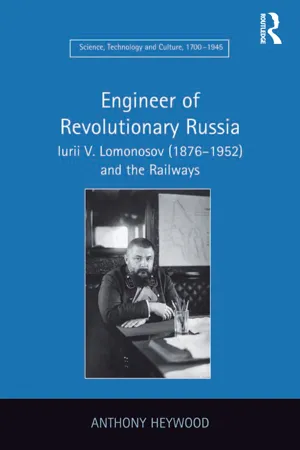 eBook - ePub
Engineer of Revolutionary Russia
Iurii V. Lomonosov (1876–1952) and the Railways
- Anthony Heywood(Author)
- 2016(Publication Date)
- Routledge(Publisher)
Chapter 4The Russian Revolution of 1905The outbreak of revolution in 1905 was a moment of truth for Lomonosov, as for many of his compatriots. After months of rising political tension the regime’s ‘Bloody Sunday’ massacre of unarmed petitioners in St Petersburg on 9 January 1905 sparked a wave of protest demonstrations and strikes in Russia. For the first time, liberals and radicals made common cause against the autocracy – a crucial change for fostering a popular sense of revolutionary purpose and momentum. In this unprecedented situation Lomonosov had to decide whether actively to support the revolutionary cause in line with his student vow. In the event, he played a leading role in efforts to build liberal–socialist cooperation in Kiev, and then participated in the revolutionary activity of the Russian Social Democratic Workers’ Party (SD Party), risking his life by helping this Marxist organization to make bombs and guns.This chapter explores these personal experiences in two sections that reflect the two main phases of Lomonosov’s political activities. So doing, it also attempts to cast new light on wider issues in the history of the revolution. For example, the course of events in the provinces has had less attention from Western historians than events in St Petersburg and Moscow: what do his activities reveal about the political situation in the major city of Kiev?1 Also, it is generally thought that the regime managed to regain the political initiative in late 1905 largely because the Tsar’s Manifesto of 17 October 1905 drove a wedge between the liberal and radical camps, effectively halting their cooperation: what light does Lomonosov’s first-hand experience cast on this analysis? A third issue is the nature of political violence in late Imperial Russia: does Lomonosov’s experience help us to understand why at least some revolutionaries opted for terrorism, and in particular does it support the contention that psychological factors, not ideology, were the main reason?2
- Sally Waller(Author)
- 2012(Publication Date)
- Cambridge University Press(Publisher)
Trouble on the streets of St Petersburg rapidly spread to other major cities, causing new disturbances in the countryside and even in the military forces. Wartime disaster, a naval mutiny and striking workers forced Nicholas to make concessions. A manifesto in October 1905 promised constitutional reform. This appeased the moderates and appeared to give the masses some hope of better times ahead. Sadly for the Russian people, this hope turned out to be unjustified. Between 1905 and 1914, Nicholas and his ministers tried to take back much of what they had conceded. Russia therefore entered the First World War as an economically powerful but politically undeveloped state. Overview • War with Japan brought economic problems and further national humiliation, and highlighted government incompetence. • The revolution that broke out in 1905 was the result of both long-term economic, social and political issues and more immediate factors relating to the war and conditions in St Petersburg. • In January 1905, Father Gapon led a group of workers to the tsar’s Winter Palace and they were shot at by the authorities (an event that became known as Bloody Sunday). • Bloody Sunday led to a breakdown in order, including a mutiny on the battleship Potemkin. • Liberals and revolutionaries pushed for change, and the revolutionaries created the first St Petersburg Soviet. • The tsar’s October Manifesto promised an elected State Duma. This, combined with repressive action, brought the revolution to a close. • There were four State Dumas in the years to 1914 but their power was progressively reduced, leaving them unable to force through any fundamental changes. • Stolypin began a new programme of reform in the countryside, but was assassinated in 1911. • The coming of the First World War in 1914, combined with military failures and the tsar’s decision to take command on the front line in 1915, weakened the tsarist government. No longer available |Learn more
- (Author)
- 2014(Publication Date)
- White Word Publications(Publisher)
While many notable historical events occurred in Moscow and St Petersburg, there was also a broad-based movement in cities throughout the state, among national minorities throughout the empire, and in the rural areas, where peasants took over and redistributed land. ________________________ WORLD TECHNOLOGIES ________________________ Background Bolshevik forces marching on Red Square. The Russian Revolution of 1905 was said to be a major factor to the February Revolutions of 1917. The events of Bloody Sunday triggered a line of protests. A council of workers called the St. Petersburg Soviet was created in all this chaos, and the beginning of a communist political protest had begun. World War I prompted a Russian outcry directed at Tsar Nicholas II. It was another major factor contribution to the retaliation of the Russian Communists against their Royal counterparts. After the entry of Turkey on the side of the Central Powers in October 1914, Russia was deprived of a major trade route through Turkey, which followed with a minor economic crisis, in which Russia became incapable of providing munitions to their army in the years leading to 1917. However, the problems were merely administrative, and not industrial as Germany was producing great amounts of munitions whilst constantly fighting on two major battlefronts. The war also developed a weariness in the city, owing to a lack of food in response to the disruption of agriculture. Food had become a considerable problem in Russia, but the cause of this did not lie in any failure of the harvests, which had not been significantly altered during war-time. The indirect reason was that the government, in order to finance the war, had been printing off millions of rouble notes, and by 1917 inflation had sent prices up to four times what they had been in 1914.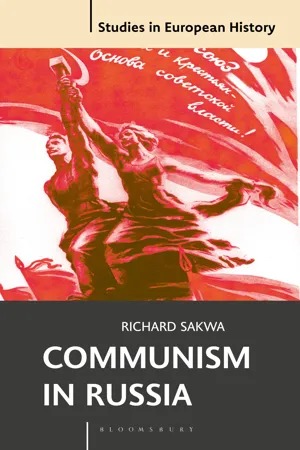 eBook - PDF
- Richard Sakwa(Author)
- 2010(Publication Date)
- Red Globe Press(Publisher)
13 Following the defeat of Napoleon in 1815 the armies of the Russian tsar reached Paris. The military triumph was followed by hopes for constitutional reform at home as the ideas that had inspired the French revolution filtered back to Russia [110]. The Decembrist uprising in 1825 signalled the beginning of a revolu-tionary movement for political change: the Russian revolution had begun. The partial and disappointing land reform of 1861 and the continued blockage on political reform that could ensure effective and meaningful popular participation and the rudi-ments of executive accountability inspired an increasingly strong radical movement that looked to revolution as the solution to the country’s problems. Quite why the siren call of revolution should have been so strong in Russia is still not clear. The classic Leninist formulation suggests that political and economic backwardness breeds radical solutions as a way of overcoming the resistance of the ruling elites. The argument undoubtedly contains an ele-ment of truth, but this is to formulate the problem in a Leninist way. While Russia certainly lacked the extensive civic traditions and increased popular representation that was developing in western European and the United States, the extent of Russian civic backwardness has been exaggerated by opponents of the old regime. In fact, on the eve of the political maelstrom of 1917 Russia was developing a complex civil society and extensive forms of civic engagement. This was a race between the evolutionary development of a more robust and hegemonic ancien regime and a militant revolutionary movement, with liberal reformers and moderate revolutionaries in between. The onset of war in 1914, however, polarised the situation, and defeats on the battlefield and dislocation at home in the end gave victory to the most extreme revolutionaries. 1 Russia and Revolution eBook - PDF
Russian Central Asia 1867-1917
A Study in Colonial Rule
- Richard A. Pierce(Author)
- 2023(Publication Date)
- University of California Press(Publisher)
In 1902, 800 railroad workers at the Mugod- zhar station struck for two months' back pay. The strikes were all local in origin and spontaneous in nature, but the Russian revolutionists made the most of them as chances to display leader- ship and to gain support. On December 5, 1902, the governor- general of the Steppe reported "continuous underground activity by local agitators along the railroad, especially in the towns of Omsk, Petropavlovsk, and their vicinities." 1 During the same period small revolutionary circles began to form in various towns in Turkestan. In 1902 the first of these gathered under the leadership of V. D. Korniushin, a carpenter from Kazan who had been exiled to Tashkent because of member- ship in a Social Democratic organization. He and a few kindred 236 The Revolution of 1905 spirits held evening discussions in their rooms, or on holidays gathered out of town purportedly on fishing trips. Occasionally they received illegal literature from Social Democratic organiza- tions in central Russia and Transcaucasia. Before long, two similar groups arose in the Tashkent railroad repair shops, and in 1903 Korniushin organized a circle among the students at the Tashkent trade school. 2 Few in number, and volatile and heterogeneous in composition, such groups must have seemed insignificant at that time, but their members were heirs of a hard purpose, already ruthlessly pursued for over a generation, of bringing down an empire and a way of life. Not until after the outbreak of Russia's ill-starred conflict with Japan in January, 1904, did the minute revolutionary groups have an opportunity to strike at the Imperial regime. Then, with dis- illusionment added to the already existing economic distress and chronic social unrest, resentment focused more strongly than ever on the government and ruling class. eBook - PDF
Sources of European History
Since 1900
- Marvin Perry, Matthew Berg, James Krukones, , Marvin Perry, Matthew Berg, James Krukones(Authors)
- 2010(Publication Date)
- Cengage Learning EMEA(Publisher)
THE RUSSIAN REVOLUTION AND THE SOVIET UNION C H A P T E R T H R E E Vladimir Lenin announces the end of the Provisional Government and the advent of Communist power before the Second Congress of Soviets in Petrograd on November 8, 1917 (New Style). (Sovfoto) Copyright 2009 Cengage Learning, Inc. All Rights Reserved. May not be copied, scanned, or duplicated, in whole or in part. 84 O n the eve of World War I, the Russian Empire faced a pro-found crisis. Ever-closer contact with the West, industrial-ization, and socioeconomic mobility resulting from a new railroad network were undermining the traditional foundations of state and society. Peasant unrest was mounting, while the new fac-tories had spawned a rebellious working class. The tsar had never trusted the country’s intellectuals—too many of them had turned into revolutionaries. Defeat in the war with Japan had led to the revolution of 1905, nearly toppling the tsarist regime. Less than a decade later, as worldwide war approached, conservatives recognized and dreaded the prospect of military collapse followed by revolutionary anarchy. Lib-erals, less realistically, hoped for a constitutional regime that would let backward Russia catch up to the West. Radicals of utopian vision, like V. I. Lenin, expected the Russian workers to become the vanguard of a revolutionary advance that would bring freedom and justice to oppressed peoples all over the world. Toward the end of World War I, the conservatives’ fears came true. Nicholas II was overthrown in the March revolution of 1917; in the ensuing civic disorganization, the Russian state faced dissolution. The Germans were ready to partition the country. The liberal coalition that had formed a provisional government after the abdication of Nicholas II broke apart in early November. At that point, Lenin’s Bolsheviks seized power, supported by the workers and soldiers in the country’s capital of Petrograd (formerly St. Petersburg and once again St. Petersburg today).
Index pages curate the most relevant extracts from our library of academic textbooks. They’ve been created using an in-house natural language model (NLM), each adding context and meaning to key research topics.

