History

Bolshevik
The Bolsheviks were a faction of the Russian Social Democratic Labour Party, led by Vladimir Lenin, that eventually seized power in the October Revolution of 1917. They advocated for a revolutionary overthrow of the existing social and political order, and their rise to power marked the beginning of communist rule in Russia.
Written by Perlego with AI-assistance
Related key terms
1 of 5
6 Key excerpts on "Bolshevik"
 eBook - ePub
Russia Under Soviet Role
Twenty Years of Bolshevik Experiment
- N. de Basily(Author)
- 2017(Publication Date)
- Routledge(Publisher)
1What was the cause of this split within the Russian Social-Democratic Party? At a first glance it was due to a mere quibble. When the first article of the Party statutes was being discussed, the Mensheviks, led by Martov, suggested the following wording: “A person is regarded as a member of the Russian Workers’ Social-Democratic Party if he adheres to its programme, affords it material assistance, and gives it constant personal support under the direction of one of its organizations.” Lenin and his followers introduced, on the other hand, the following formula: “A person is regarded as a member of the Party if he adheres to its programme, affords it material assistance, and personally participates in one of its organizations.”The whole difference thus lay in the words: “personal support” and “personal participation.” This would seem to be a purely scholastic distinction. But behind this quarrel about words there existed a deep-seated conflict, a psychological clash of two types of politicians. Lenin knew what he wanted when he demanded from every Social-Democrat that they should personally participate in the party organization, and perform definite tasks within it.In creating the Russian Bolshevik Communist Party Lenin did not model it on the customary type of European political parties. He instituted, under his own leadership, a kind of militant sect whose members were convinced that they were the only depositaries of absolute truth in the wide world.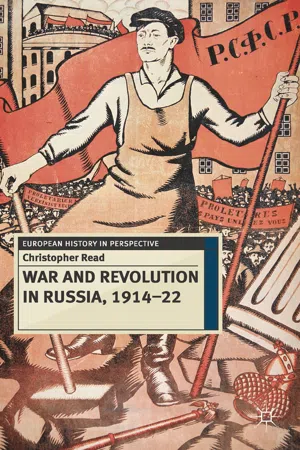 eBook - PDF
War and Revolution in Russia, 1914-22
The Collapse of Tsarism and the Establishment of Soviet Power
- Christopher Read(Author)
- 2017(Publication Date)
- Red Globe Press(Publisher)
In a sense, Lenin had long resembled THE EMERGENCE OF Bolshevik ORDER 169 a kind of fundamentalist Marxist ayatollah following a set of dogmas and fighting with friend and foe over nuances of interpretation and implementation. For a true Bolshevik, ideological rectitude was the supreme virtue, overriding everything, including personal feelings such as friendship. In Lenin’s life, for instance, in 1903 he severed relations with his close friend Martov over ideology and, in 1917, welcomed his arch-critic Trotsky, back into the camp after more than a decade of denunciation since the ideological differences seemed to have disappeared. For a party so prone to enter into sometimes vicious factional polemics, it is no surprise that the pressures of early 1918 ensured that acrimonious divisions would emerge. Essentially, there was, on one hand, a left-communist faction which claimed the revolutionary programme of 1917 was being abandoned and, on the other, the bulk of the party, which clung to Lenin, who was moving from a centrist position to one further to the right. One of the first major issues, sparked off by Brest-Litovsk, was ‘world revolution’. The party had assumed that, without it spreading at least to Germany, the Russian revolution would fail. On 26 October, Trotsky had been unambiguous in his address to the Second Congress of Soviets: ‘The Russian Revolution will either cause a revolution in the west, or the capitalists will strangle our [revolution]’ (Bunyan and Fisher 1934: 136). The argument was rooted in Marxist dogma. Marx had argued that socialism could only come about in an ‘advanced’, that is, highly developed, capitalist country which had exhausted capi-talism’s extraordinary ability to find new ways to make profits and had ended up impoverishing its own workers who could not then provide a market for the system’s goods. Of all the major European countries, Russia was the one that least fitted the Marxist prediction. eBook - ePub
Revolutionary Democracy
Emancipation in Classical Marxism
- Soma Marik(Author)
- 2018(Publication Date)
- Haymarket Books(Publisher)
7 BOLSHEVISM IN 1917Since Marx, Engels, the Social Democracy, and Bolshevism alike subscribed to the view that the socialist party was an instrument of the proletariat in its struggle for emancipation from the tyranny of capital, it is necessary to study the strategy, as well as the organizational structure and functioning of Bolshevism in 1917—the moment of truth not only for Russian socialists of all hues, but for all who profess socialist creeds of any kind the world over. Yet what is most significant in any study of the events that happened in Russia in that year, is the yawning chasm between most recent specialized academic historiography and the received wisdom of the age—which includes hostile historians who have allowed their outlook to mar their objectivity. Rigorous academic research has substantially vindicated the Bolshevik claims about their adherence to workers’ democracy (a statement which should not be confused with the belief that any apologia for Stalinist interpretations will be accepted as a good narrative). But at the same time, even many socialists and communists of earlier years have since 1991 increasingly joined the bandwagon of those who claim that the October Revolution was a coup, and that Bolshevism led ineluctably to Stalinist authoritarianism.How did Lenin and his supporters, who had rejected all talk of going beyond the bourgeois democratic stage in 1905, shift to a call for socialist revolution while retaining their commitment to a majority revolution? What sort of democratic class and party relations were worked out in course of mass mobilizations in 1917? How were Soviets reconceptualized in Bolshevik theory and in organizational outlook?Another question, whose answer will be sought in connection with the discussion on class and party relationship, as well as in connection with the October insurrection, is the question of the role of violence. In the discussion on Marx’s strategy of revolution, a distinction was made between the possibility of violence to put down the minority who own the means of production and who may refuse to submit to the majority when basic class interests are at stake, and the valorization of violence. It is necessary to examine afresh the widely held “self-evident” view that Bolshevism did not care for democratic norms and was committed to violence as a matter of course. eBook - PDF
- Robert V. Daniels(Author)
- 2008(Publication Date)
- Yale University Press(Publisher)
From the theoretical standpoint, these are seri-ous aberrations, which call into question either the truth of Marxism or the Marxist legitimacy of Communist power. There were various Marxist attempts to resolve this problem. The simplest was the view of the Mensheviks that Russia was in fact only ripe for a bourgeois regime in which the Social Democrats would become the loyal opposition. In a vain attempt to make this theory stand up in , the Mensheviks threw away their chance to lead a truly popular revolution. A more sophisticated adjustment of Marxism to Russia was Trotsky’s “theory of permanent revolution,” his proposition of that the “uneven development” of Russia would cause the bourgeois revolution to swing directly into a workers’ takeover. This, in turn, would inspire international proletarian revolution and assure the foreign support required for the survival of the Rus-sian Revolution. This messianic hope was practically official Bolshevik doctrine in , and it predicted events in Russia remarkably well, though on the inter-national side it fell through. In the chaotic circumstances of , it is not surprising that the Bolsheviks, as the most radical force in the country, could capitalize on the hopes and fears of the masses and strike for power while their rivals were divided. The unique-ness of Lenin’s movement, however, was its ability to hang onto power after the takeover against the forces of a prospective military dictatorship. No one on the entire political spectrum, from the Far Right to the Zinoviev-Kamenev faction of Bolsheviks, expected Lenin’s party to be able to hold out alone. It may be argued that Bolshevik success was historically necessary in a sense different from the Marxian, as a national requirement to deal with just those problems of backwardness that made the dictatorship of the proletariat so anomalous from the Marxian standpoint. eBook - PDF
- Liliana Riga(Author)
- 2012(Publication Date)
- Cambridge University Press(Publisher)
But the Bolshevik revolutionary narrative rejected this ethnic narrowing and social deepening of what it meant to be Russian in favor of something loosely resembling the old model of a multi- ethnic elite of Petrine Russia. Where the intelligentsia or educated society was previously excluded from nationalist-imperialist narratives, Bolshevism placed it center stage in a key nation-building moment. And where Tsarist elites were Russifying and Russianizing, Bolshevism was purposely and openly multieth- nic and rossiiskii. As we saw in Table 2.2, Chapter 2, overall the socialist (and liberal) move- ments were highly multiethnic political mobilizations, in contrast to those on the political right. Even in St. Petersburg, which was overwhelmingly ethnically Russian, the SD Petrograd Committee had fifty-eight Russians and forty-two non-Russians in 1917 (Smith 1999: 190). To the extent that some ethnic minor- ity Bolsheviks were chosen for leadership positions for strategic reasons, so too were certain Russian peasant-workers. It fact, arguably it was the Russian worker Bolsheviks who might have been strategically recruited for ideolog- ical and “narrative” purposes, in a search for actual workers as the public face of the revolutionary movement. The scarcely educated and semiskilled worker Badaev, for instance, was sent to the Duma as a Bolshevik. He had minimal education in a rural primary school and struggled with the theoreti- cal aspects of socialist ideology. But the Bolsheviks needed a worker to repre- sent them, and as Molotov later recounted, “they began to look for the least offensive man, someone who had participated only slightly in revolutionary Imperial Strategies and Routes to Radicalism 262 actions… he turned out to be an honest man, tough, poorly educated and not very active” (Chuev 1991: 178). There were certainly well-documented class tensions between the workers and the intelligentsia leadership of the movement (see Kanatchikov 1986; Hogan 1993: ch. 2). eBook - PDF
- Michael Charles Howard, John Edward King(Authors)
- 2014(Publication Date)
- Princeton University Press(Publisher)
The ultimate result was the State and Revolution , 84 which was written in the months preceding the October revolution, but its conclusions had already been reached before the overthrow of tsarism in February 1917, and they went beyond those of Bukharin. Not only must the capitalist state be 'smashed', Lenin maintained; it must also be replaced by institutions of mass participatory democracy analogous to those of the Paris Commune in 1871. The socialist order was to be forged through a union of the management apparatus developed from above by state capitalism and the organs of popular democracy emerging from below. 85 No sooner had Lenin made his break from orthodoxy as he had previously understood it, than his new idea received apparent empirical confirmation. Soviets and factory committees mushroomed in 1917 and placed Russia at the forefront of revolutionary Europe. Socialist initiative in Russia, Lenin now argued, could provide the trigger for world revolu-tion. As a concrete embodiment of proletarian power, serving as the home base for a new International, and by marshalling the means of revolution-ary warfare, the R ssian revolution could be extended internationally. This would be made all the easier by the fact that such a revolution would deprive Britain and France of a major source of exploitation, as well as a wartime ally. Essential elements of Bukharin's political economy thus came to be incorporated in Leninism. Nevertheless, the alignment was imperfect and important theoretical issues continued to separate them. Lenin's position remained very much more concrete than that of Bukharin. While he came Imperialism and War: Bukharin and Lenin 255 to accept that the 'maximum programme' applicable to socialist revolution ruled the day, he did not thereby jettison the 'minimum programme' relevant to democratic revolution, as Bukharin had done.
Index pages curate the most relevant extracts from our library of academic textbooks. They’ve been created using an in-house natural language model (NLM), each adding context and meaning to key research topics.

