History

Lenin
Lenin, also known as Vladimir Ilyich Ulyanov, was a Russian revolutionary, politician, and political theorist who led the Bolshevik Party to power during the October Revolution of 1917. He was a key figure in the establishment of the Soviet Union and served as its first leader, playing a crucial role in shaping the ideology of Marxism-Leninism.
Written by Perlego with AI-assistance
Related key terms
1 of 5
12 Key excerpts on "Lenin"
 eBook - ePub
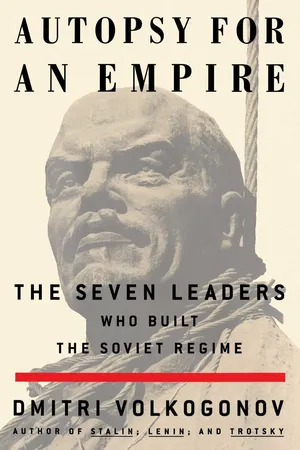
Autopsy For An Empire
The Seven Leaders Who Built the Soviet Regime
- Dmitri Volkogonov(Author)
- 1999(Publication Date)
- Free Press(Publisher)
The First Leader: Vladimir LeninVladimir Ilyich Ulyanov-Lenin was the founder of the Communist Party, the Soviet state and the Bolshevik system in Russia. Not only like-minded revolutionaries, but also his countless enemies saw in him the leader of a movement which threatened in time to swathe the world in the red flag.It is surely indisputable that no single leader in the twentieth century exerted as great an influence on the course of world history as Lenin. And he managed to make his mark in a little over six years, from the moment of the October coup in 1917 to his premature death in 1924, at the age of fifty-three. Given that for nearly two of those six years he was seriously ill, and took an increasingly limited and eventually purely symbolic part in the political life of the country, his achievement seems monumental.The historical role of this unattractive, bald, stocky man, with piercing eyes and the look of an intelligent craftsman, was enormous, if only because the entire world, except Russia herself, benefited from his experiment. Having seen the appalling methods Lenin’s government was applying to make the Russian people ‘happy’, many leaders, thinkers and public figures in other countries recoiled in horror from what they saw.The movement for a just and classless society in Russia began with unbridled violence, denying millions of people all rights except the right to support Bolshevik policy. Even those who at first sympathized with the revolution soon saw that it would culminate in a monopoly of political power, domination of the public mind by Bolshevik-inspired myths, guaranteed poverty, physical and psychological violence and compulsory atheism, and recoiled from such a prospect. Most of the countries of the world, although not all, managed to avoid their own ‘October’.The role of accident in history is great. A rare combination of military, political, social and personal factors in the Russia of autumn 1917 had created a situation in which it was necessary only to determine the time at which to seize the power that was, in Trotsky’s words, lying on the streets of Petrograd. And Lenin fixed the time precisely. Had it not been for his perceptiveness, the coup might never have taken place. This view was advanced by ‘the second man of the revolution’ himself, Leon Trotsky. After he had been deported from the Soviet Union in 1929, he wrote that if Lenin had not been in Petrograd in October 1917, there would have been no seizure of power. In those pre-October days, Lenin expended superhuman energy and exerted maximum pressure, demanding, inspiring, exhorting, threatening and insisting that his organization take the initiative and seize power. And he got his way.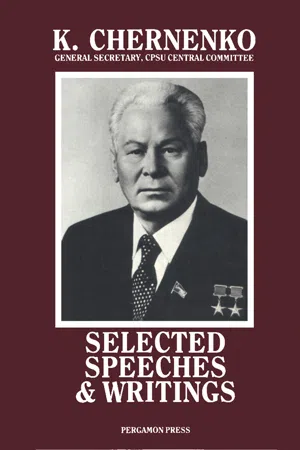 eBook - PDF
- Konstantin Chernenko(Author)
- 2016(Publication Date)
- Pergamon(Publisher)
Decades and centuries that pass throw into ever more salient relief their role in history, and their influence on the destiny of mankind is ever more clearly appreciated. In the galaxy of such stars of the first magnitude Lenin, a great son of Russia, occupies a distinctive, one might say unique, place. An unusually talented man, a genius in the true sense of the word, Lenin amazes one by the wealth of his creativity and individuality. It is visible in every trait of his character : his manner of thinking and political activities, his wide and varied interests, the inimitable combination of his qualities as a thinker and as a professional revolutionary. Lenin's brilliant mind absorbed the finest achievements of world culture and gave a powerful impulse to the all-round development of Marxism. His fiery heart beat in unison with the hearts of millions upon millions of oppressed people longing for freedom and justice. And Lenin applied his willpower, all his knowledge, and his hatred of the exploiters to the achievement of one goal : to demolish the old world and to build a new world of freed labour. Lenin and the party he had founded performed this titanic task. Lenin's doctrine, his vigorous dedicated activities as a revolutionary brought about an epoch-making turn in the history of social relations: the Great October Socialist Revolution. The entire history of this socialist country is linked with Lenin's name and teaching. Lenin was with us in the stormy years of the early Five-Year Plans. Lenin was with us in the battles of the Great Patriotic War. Lenin is with us today, when the peoples of the Soviet Union have advanced to new historical frontiers and are handling the tasks of communist construction—this is what Leonid Brezhnev said of Lenin. A precise and meaningful statement indeed. Lenin was destined to live less than 54 years.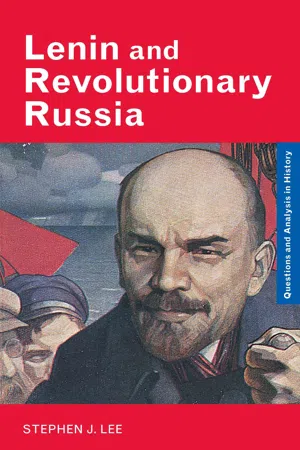 eBook - ePub
- Stephen J. Lee(Author)
- 2008(Publication Date)
- Routledge(Publisher)
The official Soviet view is that Lenin was at the same time part of a general historical trend but sole interpreter of that trend. His importance was that, in recognising what was historically inevitable, he made the inevitable happen: in this way he made history. The official biography of Lenin is full of references to his intellect and deeper understanding. For example, his interpretation of the economy in The Development of Capitalism in Russia ‘dealt the deathblow’ to Russia’s other revolutionary tradition, 1 populism, and set in motion the trend towards Marxism. What Is to Be Done? and Two Tactics of Social Democracy in the Democratic Revolution show Lenin at his creative best, designing ‘an entirely different kind of party, a truly revolutionary party capable of organising and leading the working class of Russia to the assault of the Tsarist autocracy and capitalism’. 2 His strategy of using the First World War to hasten the revolution (as argued in Imperialism: The Highest Stage of Capitalism) was ‘a great scientific discovery of tremendous significance’, 3 while The State and Revolution gave all the necessary guidance for the future, providing a ‘clear understanding of what the workers’ and peasants’ state should be like and what programme the Soviet government should carry out.’ 4 Overall, Lenin’s intellect clarified the situation Russia that was in and showed the way in which it could be changed. A second alternative is that Lenin was using ideas to justify, rather than plan, his policy. His ideas were reactive rather than proactive and were based on pragmatic considerations such as the justification of autocratic leadership. The majority of Western historians have seen Lenin as a manipulator rather than a creator eBook - ePub
A Documentary History of Communism in Russia
From Lenin to Gorbachev
- Robert V. Daniels(Author)
- 2001(Publication Date)
- University Press of New England(Publisher)
CHAPTER ONE
Leninism and the Bolshevik Party, to 1917
The background of the Communist movement was dominated by one powerful figure, Lenin. The disciplined organization, the revolutionary mission, and stern enforcement of Lenin’s version of doctrinal orthodoxy were all firmly established in the Bolshevik faction of the Russian Social-Democratic Party long before 1917. The reactions of other Marxists testify eloquently to the unique impress which Lenin’s personality made in the movement. When revolution came in 1917, Lenin was prepared to strike for power and hold it at any cost.Lenin as a Marxist
As early as 1894, when he was twenty-four, Lenin (born Vladimir Ilich Ulyanov) had become a revolutionary agitator and a convinced Marxist. He exhibited his new faith and his polemical talents in a diatribe of that year against the peasant-oriented socialism of the Populists led by N. K. Mikhailovsky.. . . Now—since the appearance of Capital—the materialist conception of history is no longer a hypothesis, but a scientifically demonstrated proposition. And until some other attempt is made to give a scientific explanation of the functioning and development of any form of society—form of society, mind you, and not the mode of life of any country or people, or even class, etc.—another attempt which would be just as capable as materialism of introducing order into the “pertinent facts” and of presenting a living picture of a definite formation and at the same time of explaining it in a strictly scientific way, until then the materialist conception of history will be synonymous with social science. Materialism is not “primarily a scientific conception of history,” as Mr. Mikhailovsky thinks, but the only scientific conception of history. . . .. . . Russian Marxists . . . began precisely with a criticism of the subjective methods of earlier socialists. Not satisfied with merely stating the fact that exploitation exists and condemning it, they desired to explain it. Realizing that the whole post-Reform* history of Russia consisted in the impoverishment of the mass and the enrichment of a minority, observing the colossal expropriation of the small producers side by side with universal technical progress, noting that these opposite tendencies arose and became intensified wherever, and to the extent that, commodity production developed and became consolidated, they could not but conclude that they were confronted with a bourgeois (capitalist) organization of social economy, which necessarily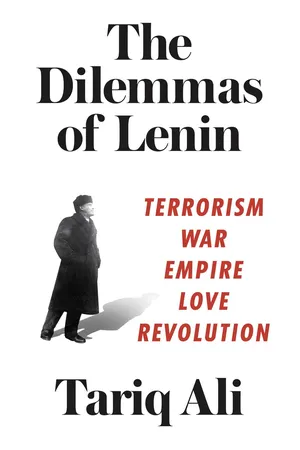 eBook - ePub
The Dilemmas of Lenin
Terrorism, War, Empire, Love, Revolution
- Tariq Ali(Author)
- 2017(Publication Date)
- Verso(Publisher)
The Lenin cult, which he loathed even in its most incipient form, was a disaster for his thought. His texts, never intended or written as a catechism, were mummified, making it difficult to understand his political formation. This phenomenon must be situated at the confluence of two historical processes. Lenin was a product of Russian history and the European labour movement. Both posed questions of class and party, of agency and instrument. The synthesis developed by Lenin was thus determined by the intermingling of two very different currents that can be characterised, broadly speaking, as anarchism and Marxism. He played a crucial role in the triumph of the latter.That is why, before moving on to discuss some specific problems confronted by Lenin and the Bolsheviks, I will explain at length the history and prehistory of both currents. Without this excavation, it’s not easy to understand the dilemmas that confronted Lenin.It takes imagination to misread Lenin and Trotsky or present them as liberals underneath the mask. Whatever one might think of them, the lucidity of their prose leaves little room for political misinterpretation. As Perry Anderson has recently reminded us, the fate of Gramsci, the third major thinker produced by the Communist tradition of the Third International, has been somewhat different and for specific reasons relating to his imprisonment by the Italian fascists.1First things first. Without Lenin there would have been no socialist revolution in 1917. Of this much we can be certain. Fresh studies of the events have only hardened this opinion. The faction and later the party that he painstakingly created from 1903 onward was simply not up to the task of fomenting revolution during the crucial months between February and October 1917, the freest period ever in Russian history. A large majority of its leadership, before Lenin’s return, was prepared to compromise on many key issues. The lesson here is that even a political party – specifically trained and educated for the single purpose of producing a revolution – can stumble, falter and fall at the critical moment.This is where the Bolsheviks as a party were headed strategically and tactically before April 1917. No party can ever be right all the time. Nor can a political leader, not even one with the most exceptional qualities and strength of will. In this particular case, however, Lenin understood that if the moment were not seized, reaction would triumph once again. Events favoured him. He dragged a reluctant party leadership behind him by winning the support of grassroots Bolsheviks and, more importantly, soldiers completely alienated from the war. For the latter it was the slogans from frontline Bolshevik agitators that articulated what they themselves were thinking and whispering to each other in the trenches or as they participated in mass desertions. History handed Lenin a gift in the shape of the First World War. He grasped it with both hands and used it to craft an insurrection. It is revolutions that make history happen. Liberals of every sort, with rare exceptions, are found on the other side.2 No longer available |Learn more
- Vladimir Tismaneanu, Marc Morje Howard, Rudra Sil, Vladimir Tismaneanu, Marc Morje Howard, Rudra Sil(Authors)
- 2016(Publication Date)
- University of Washington Press(Publisher)
The bolshevik revolution was applied eschatological dialectics, and the Third International symbolized the universalization of the new revolutionary matrix. Lenin’s crucial institutional invention (the Bolshevik Party) and his audacious intervention in the praxis of the world socialist movement enthused Georg Lukacs, who never abandoned his deep admiration for the founder of bolshevism. Referring to Lukacs’s attachment to Lenin’s vision of politics, Slavoj Zizek writes, “His Lenin was the one who, apropos of the split in Russian Social Democracy into bolsheviks and mensheviks, when the two factions fought over a precise formulation of who can be a Party member as defined in the Party programme, wrote: ‘Sometimes, the fate of the entire working class movement for long years to come can be decided by a word or two in the party programme.’” 1 We need to remember that Leninism, as an allegedly coherent, homogenous, self-sufficient ideological construct, was a post-1924 creation: It was actually the result of Gregory Zinoviev’s and Joseph Stalin’s efforts to delegitimize Leon Trotsky by devising something called “Leninism” as opposed to the heresy branded as “Trotskyism.” At the same time, bolshevism was an intellectual and political reality, a total and totalizing philosophical, ethical, and practical-political direction within the world revolutionary movement. 2 It was thanks to Lenin that a new type of politics emerged in the twentieth century, one based on elitism, fanaticism, unswerving commitment to the sacred cause, and complete substitution of critical reason through faith for the self-appointed “vanguards” of illuminated zealots (the professional revolutionaries). Leninism, initially a Russian then a world-historical cultural and political phenomenon, was in fact the foundation stone of the system that came to an end with the revolutions of 1989–91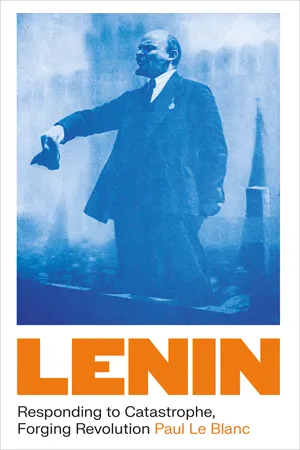 eBook - ePub
Lenin
Responding to Catastrophe, Forging Revolution
- Paul Le Blanc(Author)
- 2023(Publication Date)
- Pluto Press(Publisher)
We must bear in mind that the struggles with the government for partial demands and the gain of certain concessions are merely light skirmishes with the enemy, encounters between outposts, whereas the decisive battle is still to come. Before us, in all its strength, towers the enemy fortress, which is raining shot and shell upon us, mowing down our best fighters. We must capture this fortress, and we will capture it, if we unite all the forces of the awakening proletariat with all the forces of the Russian revolutionaries into one party which will attract all that is vital and honest in Russia. 16 This appeal is at the heart of what has been named “Leninist” thought. The political organization, known globally as the Bolshevik party, that Lenin played such a central role in helping to forge, would prove capable of bringing into being the 1917 Revolution that—for many—was seen as an amazing triumph over the enemy fortress of oppression and exploitation. Yet “the Bolshevik party that emerged by February 1917 was not a personal creation of Lenin,” notes the careful scholar Soma Marik. “While he was its foremost theoretician, the party was created by protracted interactions between practical workers and theorists, and repeatedly remodeled.” 17 It was the culmination of an interactive process between Ulyanov/Lenin and “people like himself” who shared his commitments. It may be helpful, then, to conclude this initial chapter with further reflections on qualities of the person and relationships from which such perspectives would flow. Lenin AND HIS COMRADES In some ways his closest comrade was Nadezhda Krupskaya, a serious-minded young activist he met at a small political meeting in 1894. She was impressed by young Ulyanov’s reputation in activist circles as “a very erudite Marxist,” but perhaps less impressed by what seemed harsh laughter and sarcasm aimed at someone at the meeting with whom Ulyanov disagreed eBook - PDF
The Russian Revolution and Civil War 1917-1921
An Annotated Bibliography
- Jonathan Smele(Author)
- 2006(Publication Date)
- Continuum(Publisher)
324 pp. A scholarly and critical study of Lenin's thoughts and actions, describing Leninism as combining `doctrinaire rigidity with opportunistic adaptability' and concluding that Lenin's faith in organization and centralization ignored the human fallibilities of party leaders and betrayed his own pessimistic estimation of the creative and self-organizational abilities of the working class. The volume is notable as a rare example of an American cold war-era work on the subject which treats Leninism as something more than merely a means to gain and keep power. 3535 Mieli, R. `Lenin and the Revolution', Problems of Communism Vol. 16 (1967), No. 6, pp. 71±76. The author, formerly a high-ranking member of the Italian Communist Party, argues that `the history of communism's birth and successful establishment in Russia [can] be reduced to the sole dimension of the man who was its principal architect ± Vladimir Ilich Lenin'. 3536 Mirsky, D. S. Lenin . Boston: Little, Brown and Co., 1931. 236 pp. A generally sympathetic account of Lenin's life by an e migre White officer turned Marxist. On the author see Lavroukine, N. and Tchertkov, L. D. S. Mirsky. Profil critique et bibliographique . Paris: Institut d'E  tudes Slaves, 1980. 109 pp. 3537 Morgan, M. Lenin . London: Edward Arnold, 1971. 236 pp. A general and fairly objective introductory account, based upon English-language sources, which argues that Lenin's aim was to `create a saner, healthier, better world', and that, for all his ruthless-ness, Lenin was `essentially a constructive, not a destructive personality'. The volume concentrates in particular upon the years 1917 to 1921. 3538 Myakotin, V. `Lenin (1870±1924)', Slavonic and East European Review Vol.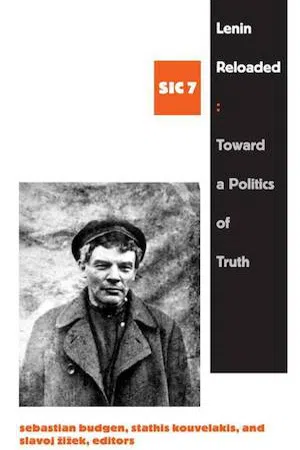
- Stathis Kouvelakis, Slavoj Zizek, Sebastian Budgen, David Fernbach(Authors)
- 2007(Publication Date)
- Duke University Press(Publisher)
Revolutions have their own tempo, marked by accelerations and slow-downs. They also have their own geometry, where the straight line is broken in bifurcation and sudden turns. The party thus appears in a new light. For Lenin, it is no longer the result of a cumulative experi- ence, nor the modest teacher with the task of raising proletarians from the darkness of ignorance to the illumination of reason. It becomes a strategic operator, a sort of gearbox and point man of the class struggle. As Walter Benjamin very clearly recognized, the strategic time of poli- tics is not the homogeneous and empty time of classical mechanics, but a broken time, full of knots and wombs pregnant with events. Without any doubt there is, in the formation of Lenin’s thought, an interplay of continuities and breaks. The major breaks (which are not epistemological breaks) can be placed in 1902, around What Is to Be Done? and One Step Forward, Two Steps Back, or again in 1914– 16, when it was necessary to rethink imperialism and the state amid the twilight of the war and by taking up again the thread of Hegelian logic. At the same time, from The Development of Capitalism in Russia, a foundational work, Lenin will establish the framework that will allow him subsequently to make theoretical corrections and strategic adjust- ments. 152 Bensaïd The confrontations in the course of which Bolshevism was defned are an expression of this revolution in the revolution. From the polemics of What Is to Be Done? and One Step Forward, Two Steps Back, the classic texts essentially preserve the idea of a centralized vanguard with mili- tary discipline. The real point is elsewhere. Lenin is fghting against the confusion, which he describes as disorganizing, between the party and the class. The making of a distinction between them has its context in the great controversies then running through the socialist movement, especially in Russia.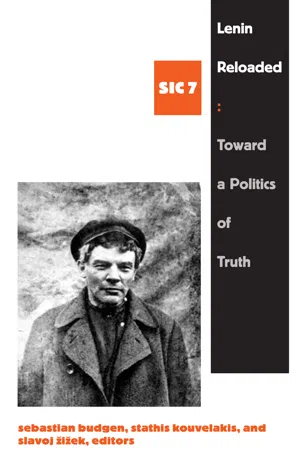 eBook - PDF
Lenin Reloaded
Toward a Politics of Truth, sic vii
- Sebastian Budgen, Stathis Kouvelakis, Slavoj Zizek, Sebastian Budgen, Stathis Kouvelakis, Slavoj Zizek, David Fernbach(Authors)
- 2007(Publication Date)
- Duke University Press Books(Publisher)
Revolutions have their own tempo, marked by accelerations and slow-downs. They also have their own geometry, where the straight line is broken in bifurcation and sudden turns. The party thus appears in a new light. For Lenin, it is no longer the result of a cumulative experi-ence, nor the modest teacher with the task of raising proletarians from the darkness of ignorance to the illumination of reason. It becomes a strategic operator, a sort of gearbox and point man of the class struggle. As Walter Benjamin very clearly recognized, the strategic time of poli-tics is not the homogeneous and empty time of classical mechanics, but a broken time, full of knots and wombs pregnant with events. Without any doubt there is, in the formation of Lenin’s thought, an interplay of continuities and breaks. The major breaks (which are not epistemological breaks) can be placed in 1902, around What Is to Be Done? and One Step Forward, Two Steps Back , or again in 1914– 16, when it was necessary to rethink imperialism and the state amid the twilight of the war and by taking up again the thread of Hegelian logic. At the same time, from The Development of Capitalism in Russia , a foundational work, Lenin will establish the framework that will allow him subsequently to make theoretical corrections and strategic adjust-ments. 152 Bensaïd The confrontations in the course of which Bolshevism was defined are an expression of this revolution in the revolution. From the polemics of What Is to Be Done? and One Step Forward, Two Steps Back , the classic texts essentially preserve the idea of a centralized vanguard with mili-tary discipline. The real point is elsewhere. Lenin is fighting against the confusion, which he describes as disorganizing, between the party and the class. The making of a distinction between them has its context in the great controversies then running through the socialist movement, especially in Russia.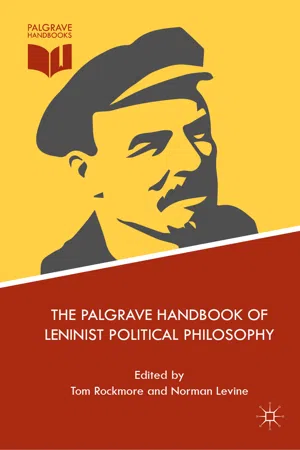
- Tom Rockmore, Norman Levine, Tom Rockmore, Norman Levine(Authors)
- 2018(Publication Date)
- Palgrave Macmillan(Publisher)
In the little Lenin book, he employs “historical materialism,” which he defines, following Lenin, as “the theory of the proletarian revolution” 21 (L 9). According to Lukács, the importance of a proletarian thinker is measured by the depths of his or her grasp of the problem. He suggested that, by this criterion, Lenin was the greatest thinker produced by the revolutionary working-class movement since Marx. He went on to compare Lenin to Marx within the context of revolutionary Marxism. Lukács believed that Marx ’s genius lies in his grasp of capitalism as a whole, including the whole of modern Russia as “the onset of the last phase of capitalism” in reaching—now employing religious language—“human salvation.” (L 11). In HCC, Lukács has an ambiguous view about realizing Marx ’s theory in practice. He hesitates between economic grounds associated with Luxemburg or organizational grounds linked to Lenin. In HCC, he develops an original extension of the Hegelian analysis of master and slave to suggest a theory of revolution that in practice is unrelated or at least not clearly related to tensions in capitalism, but is clearly related to the Hegelian theory of self-consciousness. In the study of Lenin, Lukács resolves this tension as well as his relation to Marxist political orthodoxy in favor of a view of historical materialism that, like Lenin, turns away from the economic dimension. Lukács ’ resolution of his earlier hesitation has two results. First, the Leninist organizational question becomes more important than Luxemburg ’s penchant for spontaneity and, second, Lenin, whose strictly philosophical credentials are weak at best, now appears not as a philosopher but rather as a genius of practice. In anticipating the cult of personality that later surrounded Stalin, Lukács abjectly extols Lenin without qualification of any kind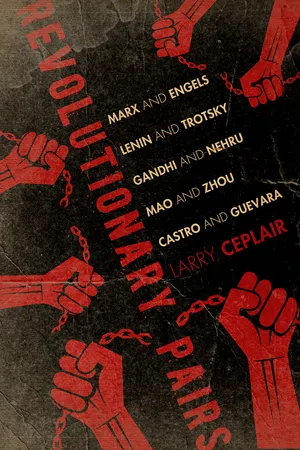 eBook - ePub
Revolutionary Pairs
Marx and Engels, Lenin and Trotsky, Gandhi and Nehru, Mao and Zhou, Castro and Guevara
- Larry Ceplair(Author)
- 2020(Publication Date)
- The University Press of Kentucky(Publisher)
Petersburg where he became part of a budding movement with international ties. During his years there, he made, for the first time, close contacts with workers’ groups. He continued to work on his economic study and launched a series of attacks on the populist movement. Like Marx and Engels, he insisted on the need to expose the errors of competing groups and theorists. His reputation as an accomplished Marxist theorist rose, he helped organize the League of Struggle for the Emancipation of the Working Class, and he traveled to Europe in 1895, to meet Russia’s leading Marxist theorist, Georgi Plekhanov. Plekhanov and the other exiled Marxists emphasized the leading role of the proletariat in the coming democratic revolution and insisted on the role of the intelligentsia in bringing to the proletariat knowledge of the political situation and organization. At first, Lenin idolized Plekhanov as Trotsky would later, also at first, idolize Lenin. On his return to Russia, Lenin, along with Julius Martov, oversaw the transition from the strategy of using workers’ study groups to raise consciousness to entering directly into workers’ strikes, to what they termed “agitation.” But he was also focused on moving from economic struggles to a political struggle for democracy. In 1897, he urged the formation of a cohesive all-Russian socialist party. 8 Fig. 2.1 Vladimir Lenin The founding congress of the Russian Social Democratic Labor Party (RSDLP) was held at Minsk in March 1898, but the participants were quickly arrested, and Lenin was exiled to Shushenskoye. Worried by the increasing fragmentation of Russian socialists and by the emergence of a strong current of revisionist thinking, centered on promoting the bread-and-butter economic demands of the workers, Lenin wrote a series of pamphlets and articles sharply criticizing what he termed economism
Index pages curate the most relevant extracts from our library of academic textbooks. They’ve been created using an in-house natural language model (NLM), each adding context and meaning to key research topics.

