Politics & International Relations

Joseph Stalin
Joseph Stalin was a Soviet leader who ruled the USSR with an iron fist from the mid-1920s until his death in 1953. He implemented policies of rapid industrialization and collectivization, but also carried out brutal purges and repression, resulting in millions of deaths. His aggressive foreign policy and role in World War II significantly shaped global politics and international relations during his time in power.
Written by Perlego with AI-assistance
Related key terms
1 of 5

8 Key excerpts on "Joseph Stalin"
 eBook - PDF
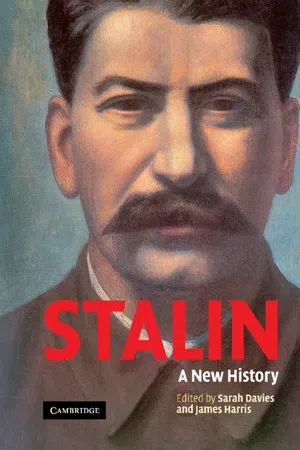
Stalin
A New History
- Sarah Davies, James Harris(Authors)
- 2005(Publication Date)
- Cambridge University Press(Publisher)
1 Joseph Stalin: power and ideas Sarah Davies and James Harris Stalin, like the other ‘evil dictators’ of the twentieth century, remains the subject of enduring public fascination. 1 Academic attention, however, has shifted away from the study of ‘Great Men’, including Stalin, towards the little men and women, such as the now celebrated Stepan Podlubnyi, and towards Stalinist political culture more generally. 2 Ironically this is at a time when we have unprecedented access to hitherto classified material on Stalin, the individual. 3 The object of this volume is to reinvigorate scholarly interest in Stalin, his ideas, and the nature of his power. Although Stalin certainly did not single-handedly determine everything about the set of policies, practices, and ideas we have come to call Stalinism, it is now indisputable that in many respects his influence was decisive. A clearer understanding of his significance will allow more precise analysis of the origins and nature of Stalinism itself. 1 Note the interest in several recent publications aimed primarily at a popular readership: Martin Amis, Koba the Dread: Laughter and the Twenty Million (London: Jonathan Cape, 2002); Simon Sebag Montefiore, Stalin: The Court of the Red Tsar (London: Weidenfeld and Nicolson, 2003); Donald Rayfield, Stalin and his Hangmen (London: Viking, 2004). 2 Podlubnyi has been made famous by Jochen Hellbeck in a number of publications, including ‘Fashioning the Stalinist Soul: The Diary of Stepan Podlubnyi, 1931–1939’, Jahrbucher fu ¨r Geschichte Osteuropas 44 (1996), 344–73. On the ‘cultural turn’ in Soviet history, see the introduction by Sheila Fitzpatrick in Stalinism: New Directions (London: Routledge, 2000).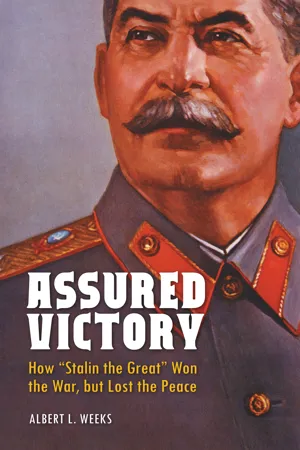 eBook - PDF
Assured Victory
How "Stalin the Great" Won the War, but Lost the Peace
- Albert L. Weeks(Author)
- 2011(Publication Date)
- Praeger(Publisher)
1 Stalin: The Twentieth Century’ s Second Dictator Josef Stalin inherited the mantle of Vladimir Lenin, modern times’ first dictator, to become the twentieth century’s second dictator of the world’s largest country. As the years passed, Stalin kept steadily increasing his authority. By the crucial pre-World War II years of 1938–1939, Stalin’s dictatorial rule had reached a peak. By then, his power more than matched that of the supreme leaders of Italy, Germany, Japan, or Spain, as well as of the dictator-led countries of eastern Europe. This was, after all, the age of dictators. Stalin, leader of a wide, contiguous empire with 11 time zones, most of whose population was ethnically non-Russian, operated in those times more effectively than any of the rest of the autocrats of the era. In many ways, his style of leadership was quite different from any of the other modern dictators. This was especially seen in the way Stalin dealt with the rest of the world. He executed his grand strategy carefully and thoughtfully while displaying a high degree of foresight of the type used in playing chess, or, better, the Oriental game of Go. UNIQUE DICTATOR Above all, no reckless adventurer, the Vozhd’ always kept two goals in mind: namely, using all means to preserve his personal power while protecting at whatever cost the security of the Soviet state against any perceived internal and external enemies. In defending his coun- try against the menace of the aggressive, well-armed Axis, his foreign 4 Assured Victory policy outclassed the slow-moving democracies of the time as well as the other armed dictatorships that became enemies of the USSR. In the end, Stalin defeated all of the Axis powers that had threatened his country while far outliving their leaders. The key to Stalin’s and the Soviet army’s victory over Germany by 1945 was the foresight the Soviet dictator had shown in the prewar period.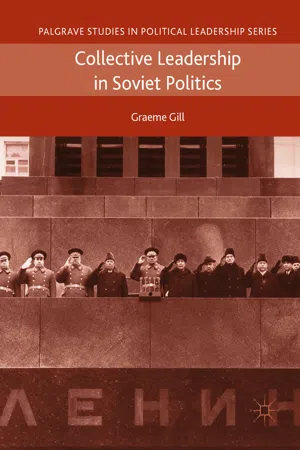 eBook - ePub
- Graeme Gill(Author)
- 2018(Publication Date)
- Palgrave Macmillan(Publisher)
4 This sort of assumption denies the complexity that can occur within authoritarian leadership, a complexity in terms both of structure and process. This is clear if we look at the Soviet experience.As the longest lasting authoritarian regime of the twentieth century and the one which, for much of its life, was seen as posing a major geopolitical and ideological threat to the West, the state of leadership in the Soviet Union was a matter of central scholarly and international political concern. However, for much of its life, the secretive modus operandi of the Soviet system prevented the sort of systematic analysis of political leadership that emerged in the study of more open polities. This lack of transparency, combined with the assumption that in dictatorial regimes like the USSR political institutions had little role to play in the structuring of the political life of the elite , meant that much of the early study of Soviet leadership has been conducted through the prism of personal biography.5Much of the study of elite politics in the 1917–53 period was presented through the biographies of Lenin and Stalin. It was not really until the Khrushchev period beginning with Stalin’s death that the focus of analysis broadened from a primary concentration upon the leader .This broadening of approach was welcome because the focus on the leader personally often obscured the nuances of Soviet political life and exaggerated the power that the individual leader could exercise. In part, this was a function of the dominance Stalin was widely perceived to have,6but it also reflected the under-developed nature of political science as an academic discipline . As this discipline expanded after 1945, it became increasingly concentrated upon structures, processes and policies. Individuals still had a part to play, but within a broader compass, and as a result “leadership studies” developed as a sub-theme within the broader discipline . This sought to place leaders within their institutional and policy contexts, and could thereby present a more sophisticated and nuanced analysis of leadership than the focus purely on leaders was able to do. Unfortunately, this development was somewhat retarded in the study of Soviet politics because of the above-noted secrecy of the regime’s operating procedures. This is reflected in the characterization of the study of Soviet leadership politics as “kremlinology” and as a form of study akin to ancient history eBook - PDF
The Nature of Stalin's Dictatorship
The Politburo 1928-1953
- E. A. Rees(Author)
- 2003(Publication Date)
- Palgrave Macmillan(Publisher)
Molotov remained the dominating influence in foreign policy until sacked unceremoniously from the Ministry of Foreign Affairs in 1949. 216 Stalin as Leader, 1937–1953 E. A. Rees 217 In the field of internal security, Stalin managed the main institutions of control carefully. In 1941, the NKVD (headed by Beria) was split with the creation of the NKGB (headed by V. N. Merkulov). In 1945, the leadership of the MVD (former NKVD) was transferred to Beria’s deputy, S. N. Kruglov, while V. S. Abakumov took over the MGB (former NKGB). While the MVD managed the Gulag, the MGB, which remained always directly accountable to Stalin, was responsible for surveillance and political repression. In party organisational matters and appointments, Stalin relied on Zhdanov, and later Malenkov, in the Secretariat/ Orgburo. Zhdanov also for a time acted as Stalin’s surrogate in the field of ideology. Scholars in the past have speculated with regard to factional struggles in the leadership over the direction of Soviet foreign policy after 1945. 47 Stalin, in his dealings with foreign statesmen, played on the notion that he had to satisfy his own people. Certainly, different for- eign policy options were considered, as we now know, regarding the work of the Litvinov commission in 1945 into the possibility of continuing the war-time alliance. 48 Stalin was not simply a victim of circumstances; he also helped to shape circumstances. The Cold War was not simply a product of Western anti-Soviet paranoia on the part of Churchill or Truman – it was also shaped by Soviet policies in Eastern Europe, and Stalin’s calculation of the costs and benefits of the various options available to him. The Politburo’s demise greatly weakened the position of its members in their dealings with Stain. But membership of the Politburo, and indeed membership of the Central Committee, within the Soviet polit- ical system remained a mark of great status.
- Hubertus Jahn(Author)
- 2020(Publication Date)
- De Gruyter Oldenbourg(Publisher)
In: Kristof Van Assche/Joseph Salukvadze/Nick Shavishvili (eds.): City culture and city planning in Tbilisi. Where Europe and Asia meet. Lewiston 2009, pp. 71 – 102; Katrine Bendtsen Gotfredsen: Evasive politics. Paradoxes of history, nation and everyday communication in the republic of Georgia. Copenhagen 2013; Tamta Khalvashi: Peripheral affects. Shame, publics and performance on the margins of the republic of Georgia. Copenhagen 2015. Soviet, national, local? 25 facts of Stalin’s reign as repressive of nationalities and Orthodox Christianity, or of Stalin having denounced his Georgian origins and “become Russian”, the doc-ument in the “religious corner” was used as an illustration that Stalin was proud of his Georgian nationality and the implied Orthodox roots. One of the most powerful men of the 20 th century did, in fact, acknowledge that he was a Georgian from Gori, and that the Orthodox Church supported one of his greatest achieve-ments, the victory in World War II. In short, the parallel narratives in the original exhibition and the fact that the recent additions to the exhibition only explicitly address one of them – the legacy of the Soviet state – makes it possible to interpret Stalin as being both, Soviet and national, ruthless and religious, powerful and poetic. De-politicization and ambivalence In the majority of the guided tours I attended, focus was placed on Stalin as a per-son, his personal history, personal characteristics and powerful position in world politics, rather than the actual political practices that took place during his reign. In that sense, the “lectures” of the guides reflected a similar logic to that of Nino – Stalin was an interesting character due to his personal qualities and origin rather than the political system he had represented. Now and then, there would be an add-on drawing attention to the newly added objects in the exhibition. eBook - ePub
- Stephen J. Lee(Author)
- 2005(Publication Date)
- Routledge(Publisher)
This book argues that Stalin was not guilty of mass first-degree murder from 1934 to 1941 and did not plan or carry out a systematic campaign to crush the nation. This view is not one of absolution, however: his policies did help to engender real plots, lies, and threats to his position. Then this fear-ridden man reacted, and over-reacted, to events. All the while, he could not control the flow of people within the country, job turnover, or illegal acts by managers and many others. He was sitting at the peak of a pyramid of lies and incomplete information, and he must have known it. His power was constrained in fundamental ways, which contributed to his anxiety and tendency to govern by hit-and-run methods. His attitudes and deeds must be situated in the context of vast, popular suspicion generated in part by World War I and the Russian Civil War. Several conclusions follow: Stalin becomes more human than others have portrayed him. And his regime becomes less malevolent but possessed of greater public support than is usually argued.Source B: from Children of the Arbat by A.Rybakov (this had been suppressed in the USSR for twenty years before being published in Britain in 1989).
Stalin mused… Yes, the history of mankind was the history of class struggle, but the leader emerged as the expression of class, and therefore the history of mankind was the history of its leaders and its rulers. Idealism did not come into it. The spirit of an epoch was determined by the man who made the epoch himself……all opponents, past, present and future, had to be liquidated and would be liquidated. The sole socialist country in the world could survive only if it were unshakably stable, and this would also be seen as a sign of its stability by the outside world. The state must be strong in case of war; the state must be mighty if it wants peace. It must be feared.In order to turn a peasant society into an industrialised country, countless material and human sacrifices were necessary. The people must accept this. But it would not be achieved by enthusiasm alone. The people would have to be forced to accept the sacrifices, and for this a powerful authority was needed, an authority that inspired fear…the theory of undying class war provided for all such possibilities. If a few million people had to perish in the process, history would forgive Comrade Stalin… All the great rulers had been harsh. eBook - ePub
- Harold Shukman(Author)
- 2004(Publication Date)
- Routledge(Publisher)
4This essay explores the core nature of Stalinism’s relationship with, and place in. Soviet society, focusing especially on the notion of the politics of ‘perfect control’, as it is here that much of the debate still resides: was it the dictator or Soviet society that provided the all-important framework for Stalinism and the extreme forms of political conduct this brought with it? The implications are considerable, as this inevitably reverts to the issue of how to reconcile the excesses of Stalinism with the immense nation-building process that was at its heart.One of the more interesting and concise efforts to disentangle the web of explanations for the phenomenon of Stalinism remains that of Mary McAuley in her Politics and the Soviet Union.5 Her conclusion, on the basis of a thorough reading of the various theoretical perspectives then available to her (her book was first published in 1977), is that economic and political characteristics of Stalinist Russia cannot be separated in the search for a definition of Stalinism:Implicit in the analysis is the suggestion that they cannot be understood one without the other or, to put it more strongly, that in talking about Stalinism one is talking about a phenomenon in which the ‘political’ cannot be separated from the ‘economic’. If one tries to separate the two, one runs into problems of trying to explain how Stalinism worked or what provided the system with its momentum.6However, McAuley tends to undermine the principle she herself lays down, when she eventually succumbs to the temptation of accounting for the ‘cult of personality’ in purely political and historical terms:Stalin and his subordinates assiduously cultivated the Stalin myth in a manner reminiscent of Louis XIV and his court. Stalin was thanked, praised for each and every event; all achievements were attributed to him. If one reads the hymns to Stalin, the references to his greatness and goodness by any public speaker or writer, one is forcefully reminded of the eulogies made, at all levels, to the Sun King. This phenomenon, that of sincere adulation by large sections of society, is something that is hard to comprehend; something that seems to fit, in some sense, into a period when people still believed in the Divine Right of Kings, but is out of place in twentieth-century Europe. Yet it happened, and added another dimension to the strange combination of old and new ideas that made up the theory of time.7 eBook - ePub
Russia
A Short History
- Abraham Ascher(Author)
- 2017(Publication Date)
- Oneworld Publications(Publisher)
A brief sketch of Stalin’s system of rule in the 1930s will demonstrate this. But first it may be instructive to touch upon another vexing issue in modern Russian history, the relationship between what are now known as Stalinism and Leninism. Put differently, was Stalinism a mere continuation of Leninism, or did the two represent quite different polities? Scholars who take the latter position argue that Lenin was far more pragmatic and tolerant and much less ruthless than Stalin. They also argue that Lenin would probably have continued the New Economic Policy and almost certainly would not have embarked on so radical a program as the Five Year Plan and collectivization. There may be some merit to this line of reasoning, but it should not be forgotten that Lenin resorted quite freely to terror during his period in power and that War Communism, his creation, was also an extraordinarily harsh social and political system. Moreover, throughout the eleven years of Bolshevik rule before Stalin’s ascendancy there was no legal order in the Soviet Union. The best evidence for this is the Criminal Code of 1922, which adopted the essence of Lenin’s draft of a statement on governmental discretionary power. It stated that any action – be it merely propaganda, agitation, or support of anti-communist organizations – by a citizen ‘helping in the slightest way that part of the international bourgeoisie’ that is committed to overthrowing the communist system is ‘punishable by death or imprisonment’. So vague a formulation is a citizen’s nightmare and a policeman’s dream. There can be little doubt that Lenin’s legacy, ideological as well as institutional, helped pave the way for Stalinism. The terror, the absence of a legal order, and rule by a hierarchically organized party not only facilitated Stalin’s rise to power but also constituted central features of both Leninist Bolshevism and Stalinism.And yet it cannot be denied that Stalin’s ‘excesses’ went well beyond those of Lenin and hence it is appropriate to consider the Stalinist polity of the 1930s distinctive. In its determination to control society from above it marked the apotheosis of totalitarianism, unmatched at the time by any other regime. Stalin was the paramount leader, or dictator, without whose approval no major initiative was undertaken, but even he had to rely on a vast apparatus to implement his directives and to maintain order. The Soviet system had three pillars that kept it functioning for several decades: the Communist Party, the secret police, and what might be called the system of incentives.
Index pages curate the most relevant extracts from our library of academic textbooks. They’ve been created using an in-house natural language model (NLM), each adding context and meaning to key research topics.

