History

Stalin's Economic Policies
Stalin's economic policies, implemented in the Soviet Union during the 1920s and 1930s, aimed to rapidly industrialize the country and collectivize agriculture. This involved the forced consolidation of small farms into large state-run collective farms and the implementation of central planning in industry. The policies led to significant economic growth but also resulted in widespread human suffering, including famine and political repression.
Written by Perlego with AI-assistance
Related key terms
1 of 5

12 Key excerpts on "Stalin's Economic Policies"
 eBook - ePub
- Stephen J. Lee(Author)
- 2005(Publication Date)
- Routledge(Publisher)
Some, however, considered that a more appropriate strategy would be rapid industrialisation and the introduction of collective farming. Trotsky, in particular, favoured this approach as part of his strategy of Permanent Revolution. At first, Stalin supported the continuation of the NEP, which he associated with ‘Socialism in One Country. By 1928, however, he had reversed the NEP and associated Socialism in One Country with rapid industrialisation—an apparent turnabout in policy. This followed an agricultural crisis in 1926 and 1927, during which only 17 per cent of the grain produced actually reached the cities. Stalin used this as a reason—or possibly a pretext —to introduce a policy of compulsory collectivisation of peasant land in 1928. In the same year he introduced the first Five-Year Plan, which was designed to transform the industrial base of the Soviet Union. The organisation of this was the responsibility of the State Planning Bureau, or Gosplan. The emphasis was placed on heavy industry rather than on consumer goods, and especially on coal, steel, oil, electricity and armaments. The second and third Five-Year Plans followed in 1933 and 1937, the third being interrupted by the German invasion of the Soviet Union in 1941.The collectivisation of land proceeded very rapidly—indeed, ahead of Stalin’s target. The resulting chaos made Stalin call for a period of consolidation, after accusing the enforcers of the programme of being ‘dizzy with success’. The process was, however, started up again from 1932, only to overlap a major famine. This was exacerbated by the widespread slaughter of cattle, sheep and goats by peasants resisting the enforcement of the collectivisation decrees. The recovery of agriculture subsequently proved extremely difficult; indeed, the legacy of the 1930s proved a long-term liability for the Soviet economy. The industrialisation programme, meanwhile, involved a huge increase in the workforce, which was swelled by impoverished peasants from the rural areas. New industrial centres developed, such as Magnitogorsk, while Siberia acquired a new industrial infrastructure. The usual interpretation, therefore, is that heavy industry developed within the Soviet Union at the expense of agriculture. Is this true?ANALYSIS (1): WHAT WERE THE REASONS FOR AND EFFECTS OF STALIN’S AGRICULTURAL POLICIES?
Reasons
Most explanations for Stalin’s agricultural changes start with the procurement crisis of 1926–7. The release of only 17 per cent of the total grain harvest to the cities convinced the leadership that it was essential to reintroduce requisitioning, a measure last used during the period of War Communism between 1918 and 1921. This led inexorably to the longer-term policy of collectivisation, which was intended to reverse the whole policy of the NEP and move Russian agriculture into a collectivist phase. eBook - ePub
The Russian Revolution
A Beginner's Guide
- Abraham Ascher(Author)
- 2014(Publication Date)
- Oneworld Publications(Publisher)
7 Stalin’s completion of the revolutionSome historians have referred to Stalin’s economic and political policies as a second revolution—often described as a ‘revolution from above’—because he abandoned the New Economic Policy, vastly increased the state’s role in the national economy, and sought to eliminate inequality of income. Stalin and his supporters claimed, correctly, that they were finally establishing the kind of socio-economic system envisioned by Marx and his earliest supporters.There can be no doubt about the radicalism of Stalin’s policies and achievements. Within a few years, the Soviet Union became an industrial state and a majority of the population could be classified as proletarian. Industry was tightly controlled by the government, which saw to it that the pay scale of workers would not encompass large differences. At the same time, the government introduced a program of collectivization of agriculture, which meant the elimination of privately-owned farms. The peasants, too, were provided with incomes that did not vary greatly from one to another.Although these changes were far-reaching, it is not self-evident that they constituted a second revolution. They may more accurately be seen as the fulfillment of Lenin’s plans and those of the Bolshevik Party generally in 1917–18. In its basic thrust, collectivization of agriculture was not all that far removed from War Communism, the economic system imposed on the Soviet Union between 1918 and 1921. At that time, economic power was also concentrated in the hands of the central government. Lenin abandoned his radical economic program not because he had changed his mind about its legitimacy or desirability, but because the economy had declined to a dangerous level. Whether or not he intended the partial return to capitalism that year to be permanent is not clear, but Stalin’s accomplishment in the economic sphere did not contradict Lenin’s earlier dreams for Russia and for the rest of the world. eBook - PDF
The Nature of Stalin's Dictatorship
The Politburo 1928-1953
- E. A. Rees(Author)
- 2003(Publication Date)
- Palgrave Macmillan(Publisher)
The members of the Politburo as individuals also retained their functions in their branch of economic administration. Let us take agriculture as an example. Stalin as an individual, and the Politburo as a collective entity, were liable to intervene in all aspects of policy, and to authorise the dismissal, and even arrest, of agricultural specialists whose behaviour was unacceptable. However, they were quite unable to control many major agricultural processes, which never appeared on the Politburo agenda, and were administered within the Commissariat of Agriculture (NKZem), or left to the collective farms and the peasants. Although Stalin could impose his will on the Politburo, there were many important matters on its agenda to which he paid little attention. Whole spheres of economic activity – for example, heavy industry – were in practice largely delegated to Stalin’s colleagues. Against this background, in this chapter we examine some aspects of the operation of the Politburo, and various influences bought to bear on 110 The Politburo and Economic Policy-making R. W. Davies, Melanie Iliˇc and Oleg Khlevnyuk 111 its economic decisions, with particular attention to the role of Stalin. We first summarise the results of four studies we have undertaken of major economic decisions in the years 1931–36; and then present an analysis of the letters and telegrams sent by Stalin during his vacations in the same years to Kaganovich, his deputy in the Politburo. These years witnessed the conclusion of the First Five-Year Plan (October 1928–32) and the second stage of the collectivisation of agri- culture and of ‘dekulakisation’, followed by the launch of the Second Five-Year Plan (1933–37) and significant shifts in investment priorities. In 1931–33 a profound economic crisis and widespread famine were induced by the collectivisation and exploitation of agriculture, and by the vast expansion of capital investment. eBook - ePub
Was Stalin Really Necessary?
Some Problems of Soviet Economic Policy
- Alec Nove(Author)
- 2014(Publication Date)
- Routledge(Publisher)
Then, too, Stalin’s régime (unlike the Indian Government) paid a great deal of attention to so arranging the economy as to achieve certain ideological and political objectives, and this was often given priority over elementary efficiency considerations. The most obvious example is agriculture. Collectivization, control over peasants, repression of private-property instincts, were of great importance, as was the squeezing of produce out of the villages to feed the growing towns. As for efficiency, it was very largely ignored, a fact that was reflected in the total neglect of problems of costs of production in agriculture until well after Stalin’s death.Much more could be said about the economic policies of the Stalin epoch, but I am confining myself here merely to emphasizing the elements in these policies that helped to produce a climate in which economic rationality did not prosper. It is true that Stalin himself—in 1941 and again in 1951–52—drew attention to the ‘law of value’ and its significance in Soviet society. But he appeared merely to be warning his subordinates that some attention must be paid to objective reality, that not everything was wholly under control. For instance, he ‘discovered’ that peasants who were offered excessively low prices for cotton, in relation to bread, would probably produce less cotton. Yet he left unchanged the monstrously unfair prices at which the villages had to deliver produce to the state. This was typical: whatever may be the dictates of the ‘law of value’, priority was nevertheless given to the politically determined task of exploiting the peasantry to the uttermost in order to maximize resources for the expansion of heavy industry.So much, then, for Stalin’s epoch. What has changed since? A whole paper could be devoted to this question alone. Little more than a bare enumeration of the relevant factors can be attempted here.First of all, underlying the whole problem, is the frequently repeated aim of Soviet economic policy: to overtake the West in economic might at the earliest moment. This is, of course, a political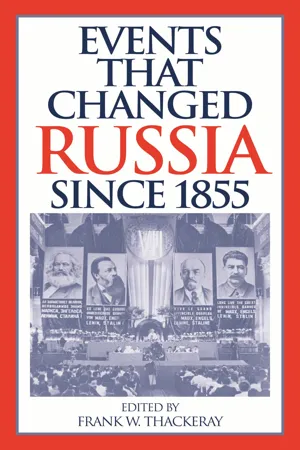 eBook - PDF
- Frank W. Thackeray(Author)
- 2007(Publication Date)
- Greenwood(Publisher)
Stalinism was power politics. Its essence was the destruction of enemies, both real and imag- ined, in a quest to attain unchallenged personal power. From this unassail- able position Stalin would be able to realize the transformation of Russia from a backward peasant country to a mighty industrial power capable of exercising influence in world affairs. Even if the international revolution anticipated by the Bolsheviks failed to materialize abroad, under Stalin there would still be “socialism in one country.” The Stalin era began in 1928 with the introduction of “emergency mea- sures” to forcibly take grain from the peasants, who objected to the low prices being offered by the state. Resolving to abolish the compromises of the New Economic Policy (NEP), which allowed a degree of capitalism to flour- ish in the countryside, Stalin, whose psychological need to match Lenin’s revolution with one of his own outweighed all practical and human consid- erations, launched a new socialist offensive intended to transform all Soviet citizens into servants of the state. In turn, this would harness the country’s limitless resources. The very existence of a prosperous peasant “class”—the members of which were labeled kulaks —able to withhold its grain from the market served as a constant reminder to party activists that the socialist rev- olution had stalled; thus, many Communists viewed the campaign against the peasantry as a necessary step in eliminating the barriers that blocked Russia’s path to industrialization and, hence, to modernity. Robert Conquest’s Harvest of Sorrow (1986), a classic treatment of Soviet collectivization, shows how the policies of collectivization and “dekulakization”—the fomenting of class warfare in the countryside that involved the killing or deportation of millions of relatively prosper- ous peasants—were combined with an all-out attack on the Ukrainian nation.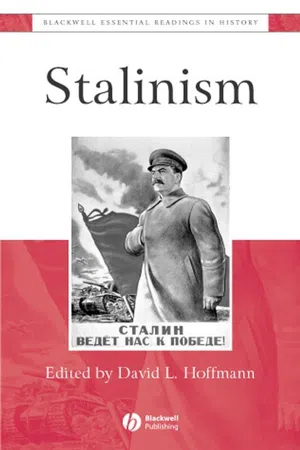 eBook - PDF
Stalinism
The Essential Readings
- David Hoffmann(Author)
- 2008(Publication Date)
- Wiley-Blackwell(Publisher)
Economic policies resting on the underdevelopment of the service sector and social policies designed to strengthen the family as a reproductive and socializing institution assigned a set of functions and roles to women that in some respects intensified the sexual division of labor both in public arenas and within the family itself. Family Policy and the Redefinition of Female Roles The economic pressures on the household associated with Stalinist industrialization were accompanied by new political demands as well. Since they contradicted the central assumptions on which early Soviet orientations toward the family rested, it is not surprising that a reassess-ment of family policy followed. The new family legislation of the Stalin era was marked by certain conservative, even authoritarian, features that constituted a significant departure from earlier precedents. In the face of such massive social transformations as those brought about by industrialization and collec-tivization, and the new opportunities for social mobility these changes created for women, a focus on the conservative features of Stalinism may appear puzzling. Yet the central feature of Stalinism – the feature that distinguished it most sharply from the preceding regime – was pre-cisely its amalgam of radical transformation and social conservatism. Massive social dislocation called forth efforts at stabilization and inte-gration that drew heavily on the values, behavioral patterns, and orga-nizational mechanisms of traditional Russian society while adapting them to new purposes. The “revolution from above” of 1928–32, which marked the first phase of Stalinism, was characterized by a militance and radicalism evocative of the civil war period. 19 Rapid industrialization and agricul-WOMEN IN SOVIET SOCIETY 225 19 For a collection of studies dealing with the effects of these events in different areas of Soviet politics and society, see Fitzpatrick, Cultural Revolution in Russia .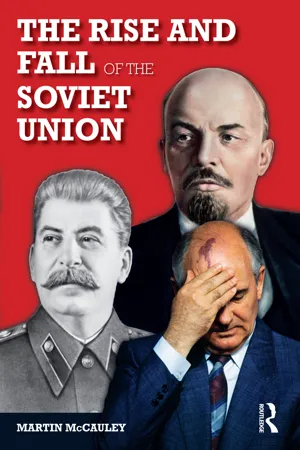 eBook - ePub
- Martin Mccauley(Author)
- 2014(Publication Date)
- Routledge(Publisher)
Chapter 10Industrialisation‘Human will is the essential factor in achieving the economic plan.’ Stalin (This is the placebo principle)‘Our task is not to study the economy but to change it . . . we prefer to stand for higher tempi rather than sit [in prison] for lower ones.’ Strumilin‘There are no fortresses which Bolsheviks cannot storm.’ StalinThe four Bolshevik core values are:state ownership;a planned economy;primitive capital accumulation;the leading role of the Party.These were in place by 1929. Inevitably, a Stalin-like figure was needed to drive this system forward. Workers were promised a glorious tomorrow but wanted a fair wage. In 1929 and 1930, they felt that fair wages were not being paid and economic growth suffered. In came food rationing. Stalin wanted to reward those who put in more effort and cut the rations of the rest. It proved unmanageable. It led to greater fraud and corruption as ration cards became currency. Along came Stakhanov and his miraculously high labour productivity. Workers would be paid for higher productivity. This did not work as it drove up wages as well. Draconian labour laws had to be introduced. Clearly most workers felt they were not being paid a fair wage.Stalin was a strong leader in 1929 but he still had to consult his team. He could not run the economy on his own. Gosplan was responsible for drafting plans. However it had no executive power. An operational plan was needed, one which would implement the national plan. The main plan was the Five Year Plan. However, it was more for show than anything else. Eugene Zaleski (1980) showed that FYPs were not turned into operational plans and the record of fulfilment was poor. They were ‘visions of growth’ to inspire the population. There were none during the war (1941–45) but they were resurrected afterwards because they were useful propaganda tools.To Stalin, planning meant that he and his team set targets which Gosplan and the government implemented. The talented economists in Gosplan were ruthlessly weeded out and replaced by new comrades who would not tell Stalin that he was attempting the impossible. He found that the Supreme Council of the National Economy, responsible for the whole industrialisation portfolio, was too unwieldy. It was split up into various commissariats in 1932. Sergo Ordzhonikidze switched to become Commissar for Heavy Industry, the key ministry. Lazar Kaganovich became Commissar for Transport. This was also a very important ministry as it had to solve the logistics of the industrialisation drive. Vyacheslav Molotov became Prime Minister in December 1930. Stalin and Molotov took a general view of the economy but Ordzhonikidze became a strong advocate of the interests of heavy industry This dismayed Stalin. Other ministers also lobbied for their own commissariats. This led to fierce debates in the Politburo with Stalin playing the role of conciliator.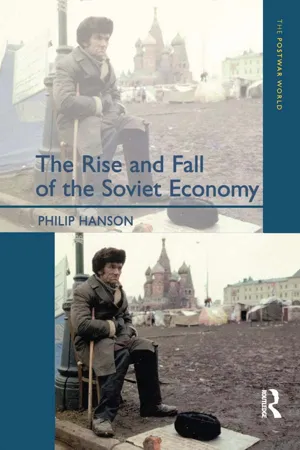 eBook - ePub
The Rise and Fall of the The Soviet Economy
An Economic History of the USSR 1945 - 1991
- Philip Hanson(Author)
- 2014(Publication Date)
- Routledge(Publisher)
CHAPTER ONEThe Starting Point: the Stalinist Economic System and the Aftermath of War
The inheritance from the 1930s: the Soviet economic planning system
The basic institutions of the Soviet economic system took shape in the First Five-Year Plan (1928/29–32). Subsequent modifications were numerous, but not substantial. Basically, the whole economy was run like a single giant corporation – USSR Inc. As corporations go, USSR Inc. was of exceptional workforce size and was a conglomerate with the most extreme range of activities, yet it was run in a more centralised way than most.The fundamental difference from a market economy was that decisions about what should be produced and in what quantities, and at what prices that output should be sold, were the result of a hierarchical, top-down process culminating in instructions ‘from above’ to all producers; they were not the result of decentralised decisions resulting from interactions between customers and suppliers. Producers were concerned above all to meet targets set by planners. They had no particular reason to concern themselves with the wishes of the users of their products, nor with the activities of competitors. Indeed the concept of competition was absent: other producers in the same line of activity were simply not competitors but fellow-executors of the state plan.Production was controlled by the state. This control was exercised through a layered hierarchy. The central policy-makers were at the top, like a board of directors. Ultimately these top policy-makers were the Politburo of the Central Committee (CC), the inner ruling group of the Communist Party of the Soviet Union (CPSU). Most of the detail and many important matters of substance were decided by the government or, more precisely, those members of the government with economic portfolios. The Politburo and the government (known for most of our period as the USSR Council of Ministers) overlapped in membership. eBook - ePub
The Revolutionary Russian Economy, 1890-1940
Ideas, Debates and Alternatives
- Vincent Barnett(Author)
- 2004(Publication Date)
- Routledge(Publisher)
Overall the plan projected a significant increase in national income – by 80 per cent by 1942 – and a large rise in gross industrial production – by 92 per cent by 1942. However the average money wage of workers and employees was to grow by only 37 per cent over five years, and the portion of consumption in total national income was to be less in 1942 that it was in 1937. Zaleski described the plan as one of great austerity. Perhaps this was partly so due to the looming shadow of war, and since goals for labour productivity were set quite high – an average increase of 65 per cent over five years – no slackening was to be allowed in the further development of labour discipline. The third five-year plan was of course disrupted by the outbreak of war in 1940, although a concerted effort to preserve many of the initial goals of the plan was made.The results achieved by Stalinist economyFigures vary widely for the actual annual rate of growth of Soviet industry that was achieved between 1929 and 1940. Some official Soviet figures claimed an annual rate as high as 21.7 per cent, whilst some more conservative Western estimates put the figure at 7.1 per cent.19 Even this lower figure is certainly impressive in itself, especially when compared with many Western economies that were in depression in the 1930s, but it does not give much indication of the quality of products that were manufactured or of changes to labour productivity. New industries such as armaments and agricultural machinery had been established in the USSR virtually from scratch, together with significant improvements in those industries making their raw material inputs such as iron and steel, but progress in the manufacture of consumer goods was much less significant. Important demographic changes also occurred, with large-scale factories absorbing workers from declining small-scale manufacture. The fact that the production of capital goods received significant priority had led to some spectacular technical achievements, but as those victims of the 1932–1933 famine in the Ukraine might attest, human beings cannot eat iron and steel.What of the more intangible elements of Stalinist economy? Were the new forms of socialist economy created in the 1930s clearly less exploitative than their capitalist counterparts? As might be expected, it all depends on how you interpret the term exploitation. The living conditions of most Soviet workers actually declined in the first half of the 1930s, with poor housing, falling real wages and inadequate diet being common, but on the other hand some public services such as education and health provision improved. It is very likely true that some workers at least genuinely believed in the idea that they were working for the socialist future, and hence their state of mind in the workplace might well have been more positive than it was in Tsarist times. Whether ordinary people in fact had more control over their daily work activities than they did in capitalist forms of economy might be disputed, but they were probably a little happier than (at minimum) their unemployed counterparts in the USA at this time.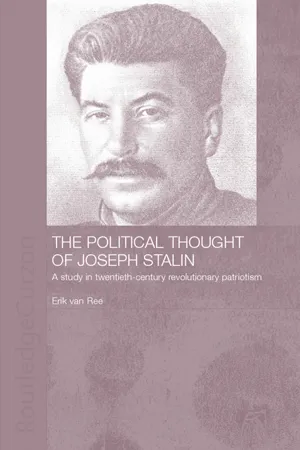 eBook - ePub
The Political Thought of Joseph Stalin
A Study in Twentieth Century Revolutionary Patriotism
- Erik van Ree(Author)
- 2003(Publication Date)
- Routledge(Publisher)
However, this extremism did not last. Under the impression of economic dislocation caused by his extremism, the leader finally put an end to the madness in January 1933. He claimed that in the future industrial growth rates would still remain higher than in capitalist countries, but it was now possible to return to a policy of “less accelerated tempos.” 12 In July 1934, Stalin distributed an angry letter to the Politburo, criticising a recent article by Bukharin in Izvestiia for, among other points, having covered up the fact that heavy industry was the “leading and reorganising” branch of the economy. 13 Thus Stalin did not abandon such fundamental points, but the time of pure extremism was over. Next to accelerated industrialisation, with a heavy industrial focus, the second pillar of early Stalinist economics was the twin campaign of collectivisation and dekulakisation. Stalin interpreted the unpreparedness of the peasants in the winter of 1928 to sell their grain against the price he found acceptable as a form of class struggle, and he was prepared to meet the challenge head-on. In July 1928, he famously noted that: as we move forward, the resistance of the capitalist elements will grow, the class struggle will become sharper, and Soviet power, of which the forces will grow ever more, will carry out a policy of isolation of these elements, …a policy of suppression of the resistance of the exploiters. 14 In 1923, Lenin had proposed to shift the “centre of gravity” of the party’s activities to “peaceful organisational ‘cultural’ work” as the way to convince the peasants to join the co-operatives. 15 The leader of bolshevism did not make a pledge that under different circumstances a violent course in the countryside would be excluded. Nevertheless, Stalin’s new course represented a major tactical change compared with the course set in the early 1920s eBook - PDF
- Richard Sakwa(Author)
- 2010(Publication Date)
- Red Globe Press(Publisher)
66 The New Economic Policy represented the abandonment (temporarily) of the ‘revolutionary’ strategy of War Communism in favour of a ‘reformist’ approach, but this reformism was of a distinctive and highly ambivalent sort. It was a tactical rather than a strategic retreat. As Lenin put it, NEP ‘would last a long time but not forever’. How long ‘long’ would be was not defined, and in 1928–9 the regime once again went on the offensive. Communism in Russia remained a type of crusade, with a two-fold project designed to transform its own society and the individuals who composed it, while at the same time calling for revolutionary change in the world at large. The tension between involution, the adaptation of a trans-formative agenda into the inward-looking maintenance of an exist-ing order, and revolution was to remain until the end. When this tension disappeared and world revolution was abandoned, in both rhetoric and practice, the domestic order also dissolved. Stalin’s revolution from above In the jockeying for power that followed Lenin’s death in January 1924, Stalin proved the most adept at exploiting the fissures in the regime to secure his power against Trotsky, Bukharin and other Bolshevik leaders. At first Stalin supported Bukharin’s moderate policies within the framework of NEP, but by the late 1920s, despite the evident success of NEP in restoring industry and prosperity to the countryside, sought ways to go beyond its limitations. The regime was effectively hostage to the peasants’ willingness to sell grain on the market. At the same time, already in 1924 Stalin had announced the idea of ‘socialism in one country’, modifying Lenin’s internation-alism and establishing the priority of Soviet state interests against 3 Stalinism and Communist Reform Stalinism and Communist Reform 67 those of the international revolution. eBook - PDF
Historical Narratives in the Soviet Union and Post-Soviet Russia
Destroying the Settled Past, Creating an Uncertain Future
- T. Sherlock(Author)
- 2007(Publication Date)
- Palgrave Macmillan(Publisher)
99 The official reformers also linked the debate over the origins of Stalinism more closely to a new campaign to advance their political and economic program. In his major address on ideology in early October, Vadim Medvedev lamented that Soviet socialism had been reduced to a statist economy and repeated earlier calls for the development of a socialist market, urban and rural cooperatives, family leaseholds in agriculture, and broad-based economic incentives. Medvedev also argued on behalf of the political reforms introduced at the Nineteenth Party Conference that were designed to create a “substantially new system of power and management.” 100 The previous month, at the September plenum of the CPSU Central Committee, Gorbachev pressed for a major realignment of power by transferring many of the executive functions of the Central Committee Secretariat to the rejuvenated Supreme Soviet and to the new office of Soviet president. The Supreme Soviet was scheduled to convene in November to implement these and other decisions, but Gorbachev’s conservative colleagues attempted to postpone the session. 101 The intensification of the drive for political and economic reform was accompanied by the publication of new assessments of Soviet history by reformers in the party’s ideological apparatus. The most important contri- bution was a lengthy article on Stalinism written by two members of the Institute of Marxism-Leninism and edited by Georgii Smirnov, the director of the institute and the most authoritative official expert on the history of the CPSU. 102 In their article, Gennadii Bordyugov and Vladimir Kozlov maintained that NEP was, in principle, an authentic alternative to the Stalinist developmental model. 103 Why, then, did it fail? The authors held that a key problem was the initial conceptualization of socialism embraced by Lenin, who in 1917 viewed socialism as a rigidly centralized economic system relying on direct commodity exchange.
Index pages curate the most relevant extracts from our library of academic textbooks. They’ve been created using an in-house natural language model (NLM), each adding context and meaning to key research topics.

