Politics & International Relations

Stalinism
Stalinism refers to the political and economic policies, as well as the cult of personality, associated with Joseph Stalin's leadership of the Soviet Union from the late 1920s until his death in 1953. It is characterized by centralized control, authoritarianism, forced industrialization, collectivization of agriculture, and widespread use of state terror. The term also encompasses the pervasive propaganda and censorship that defined the era.
Written by Perlego with AI-assistance
Related key terms
1 of 5

12 Key excerpts on "Stalinism"
 eBook - PDF
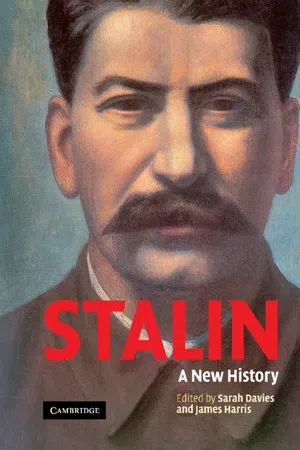
Stalin
A New History
- Sarah Davies, James Harris(Authors)
- 2005(Publication Date)
- Cambridge University Press(Publisher)
Until the 1960s it was almost impossible to advance any other interpretation, in the USA at least. It was the changing political climate from the 1960s, as well as the influence of new social science methodologies, which fostered the development of revisionist challenges to the totalitarian orthodoxy. Over the course of these years, a number of influential studies of Stalin appeared, whose interpretations hinged on particular understandings of the relationship between the individual and his political, social, economic, ideological, and cultural context. One of the earliest was that of Trotsky, who advanced the notion of the ‘impersonal Stalin’ – a mediocrity who lacked any of his own ideas but who acted as the perfect representative of the collective interests of the new bureaucracy. 8 The Trotskyist sympathi- ser, Isaac Deutscher, writing after the war, was much more willing than Trotsky to credit Stalin’s achievements, yet his Stalin was also to a great extent a product of circumstances. In Deutscher’s view, the policy of collectivisation was dictated by the danger of famine conditions at the end of the 1920s. Stalin was a necessary agent of modernisation a man of ‘almost impersonal personality.’ 9 Likewise, E. H. Carr, while recognising Stalin’s greatness, nevertheless stressed the historical logic of rapid mod- ernisation: collectivisation and industrialisation ‘were imposed by the objective situation which Soviet Russia in the later 1920s had to face’. 10 While these analyses focused on the socio-economic circumstances which produced the Stalin phenomenon, totalitarian theories accentuated the functioning of the political and ideological system. In 1953, Carl Friedrich characterised totalitarian systems in terms of five points: an official ideology, control of weapons and of media, use of terror, and a single mass party 6 H. Barbusse, Stalin: A New World Seen Through One Man (London: John Lane The Bodley Head, 1935); B. eBook - ePub
- Paul G. Lewis(Author)
- 2014(Publication Date)
- Routledge(Publisher)
CHAPTER FOUR The Politics of Stalinism Stalinism AND THE ECLIPSE OF NATIONAL COMMUNISMThe unity of the Soviet bloc was progressively strengthened following the establishment of the Cominform in 1947. Internal political uniformity within the Central European states was enforced with the amalgamation of the communist and remaining socialist parties in 1948 and the elimination of any lingering political significance attached to the government coalitions that survived. Although the different areas of Central Europe had been exposed to Soviet influence and experienced the rigours of communist dictatorship well before 1947, the establishment of Stalinism as an international system encompassing the region can be dated from the middle of that year. Its onset meant the strengthening and more direct exercise of Soviet power within Central Europe; growing uniformity and social regimentation; stronger central control over political and all social organizations (involving purges of their membership) the development of mechanisms of detailed surveillance; greater repression and ultimately terroristic intimidation of the population; growing prominence of the leadership cult, both around Stalin and national leaders; and policy changes which involved the acceleration of industrial development and collectivization of agriculture.The imposition of Stalinism in Central Europe contained its own paradoxes, however. As one-party communist rule became firmly established the party became less significant as an institution – its discussions and meetings were ridiculously formal, official internal procedures fell into disuse and governing bodies ceased to meet, while members – and particularly many of its leading personnel – were increasingly subject to police surveillance and victimization. Ideological dogma and mass propaganda monopolized public life, but they evoked little positive response among the population and carried less and less credibility. Constant propaganda and official enthusiasm produced private cynicism; the promotion of international communist amity was accompanied by growing national isolation and fostered popular resentment; and many Central Europeans became disillusioned and bitter about the outcome of the ‘liberation’ they had so recently experienced. When possible, individuals tended to retreat from public life and protect the values and private interests that remained to them. The atmosphere this created struck party activist and Comintern agent Adam Rayski on his return to Poland from France in the early 1950s: ‘Man was degraded. The harshness of the everyday battle for life carried him back several centuries … An egocentrism which had nothing in common with the individualism of bourgeois society and was rent by the laws of competition dominated everyday relations.’1 By the time George Orwell’s Nineteen Eighty-Four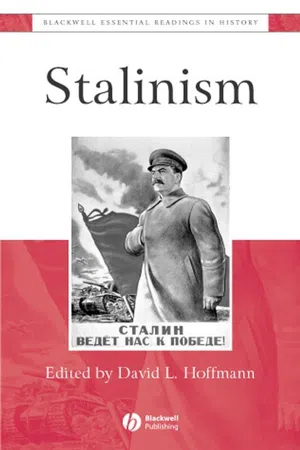 eBook - PDF
Stalinism
The Essential Readings
- David Hoffmann(Author)
- 2008(Publication Date)
- Wiley-Blackwell(Publisher)
4 Thus Stalinism represented a reversion to the more extreme phases of Russian autocracy, as under Ivan the Terrible or Peter the Great. And at a superficial glance this explanation seems eminently plausible. Indeed, Stalin himself liked to compare his rough nation-building with that of these two tsars, Peter for the Plan and Ivan for the Terror. Yet it would be prudent to reserve judgement on this matter until Stalin’s own record has been examined, and to seek the sources of Stalinism, in the first instance, not in remote centuries but in the actual circumstances that produced the revolution from above. Here, in this line of inquiry, Stalin’s personality is far more germane than are the ghosts of autocrats past. Even so, caution is in order on this score, too, for Stalin’s lugubrious figure, like Hitler’s equally macabre one, can easily overshadow his period and the system he represented. Thus “Stalinism” in common par-lance too often means a style of rule – an extreme personal tyranny, an exceptional despotism, or a superdictatorship – created and sustained by the man, Stalin. But these Greek and Roman terms do not do justice, any more than does the invocation of Genghis Khan, to the historical par-ticularity of the Stalin phenomenon. So Stalinism must also be viewed as a system of hyperbureaucratic and terroristic control. Yet even when this is done, the system’s genesis is still too often explained not by structural factors but by the tyrant’s overweening ambition. The consequence of this is that once the evil author of the “ism” has disappeared, the system itself may be consid-ered to have ended. Thus in both Western and Soviet usage, as we have seen, Stalinism was at times held to be a completely different phenome-non from Bolshevism and Leninism. 5 In Soviet parlance this assessment was expressed as “the cult of personality,” which meant that an other-wise sound socialism was “distorted” by the undue and accidental power of one leader. eBook - ePub
- Harold Shukman(Author)
- 2004(Publication Date)
- Routledge(Publisher)
3Stalinism, Totalitarian Society and the Politics of ‘Perfect Control’Felix PatrikeeffIntroduction: The Riddle of StalinismCan Stalinism be adequately defined? Elaborate early attempts were made to explain the phenomenon and its period, ranging from the crude model-making of Friedrich and Brzezinski (linking it to the genus of totalitarianism), to Sartre’s intricate politicophilosophical analysis.1 None of these was especially successful, as most of these efforts were ultimately limited by the inability to find the balance between the man, the system that he presided over and the practical aspects of the exercise of power during this distinctive period. More recent work on the subject has added important dimensions to our understanding of the riddle of Stalinism, but the riddle nonetheless remains. The study of Stalinism has, beyond the work of the older totalitarian school and distinctive treatments such as that by the existentialist Sartre, split into the ‘traditionalists’, ‘neo-traditionalists’ and ‘revisionists’. ‘Which one of these’, concludes Sheila Fitzpatrick (a scholar very much at the heart of recent scholarly debate on Stalinism in the post-Soviet era), ‘will become the dominant paradigm of scholarship…is anybody’s guess’.2 Invariably, an examination of Stalinism boils down to essences, for, as Ian Kershaw and Moshe Lewin put it, ‘in human affairs only entities with a history are subject to theorization and are definable’.3 The historical tableau associated with Stalin and his regime is vast, and touches on virtually every aspect of human existence in the Soviet Union. And yet frustratingly simple questions still arise in studying it, such as, for example, ‘How did Stalin rule?’4This essay explores the core nature of Stalinism’s relationship with, and place in. Soviet society, focusing especially on the notion of the politics of ‘perfect control’, as it is here that much of the debate still resides: was it the dictator or Soviet society that provided the all-important framework for Stalinism and the extreme forms of political conduct this brought with it? The implications are considerable, as this inevitably reverts to the issue of how to reconcile the excesses of Stalinism with the immense nation-building process that was at its heart.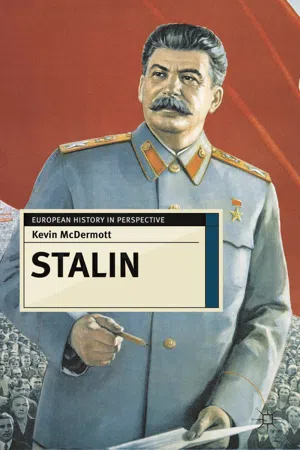 eBook - PDF
Stalin
Revolutionary in an Era of War
- Kevin McDermott(Author)
- 2006(Publication Date)
- Red Globe Press(Publisher)
We saw in chapter four how many thousands of loyal foreign Stalinists were brutally re-pressed in the USSR in the late 1930s, and during the Spanish Civil War Stalin’s long arm extended to decimating large numbers of Catalan ‘Trotskyites’ and anarchists. But Stalin’s authority, mainly pernicious, went far beyond the Terror. He introduced the bitter Soviet inner-party struggles of the 1920s into the Comintern, resulting in demotions, expul-sions and the general weakening of many communist parties; he did much to shape the German communists’ disastrous response to the Nazi threat thereby, so it is often argued, actively contributing to Hitler’s machtergreifung ; he delineated the changing relationships between com-munists and social democrats, invariably exacerbating tensions between them; and he determined the attitude of foreign communists to the out-break of war in September 1939, causing major rifts in several parties. STATESMAN 145 These were crucial interventions with long-lasting ramifications. In short, a significant aspect of Stalin’s statesmanship relates to his activities in the international communist movement as well as in conventional foreign diplomacy. Indeed, for Stalin the two – revolutionary prospects and the defence of Soviet state interests – were inextricably interwoven and mutually reinforcing. Ever since the great debates in the mid-1920s with Trotsky over ‘perma-nent revolution’ versus ‘socialism in one country’, Stalin has frequently been seen as the gravedigger of world revolution and a traitor to the Leninist cause of revolutionary internationalism, solely motivated by the construction of socialism in the USSR. It is certainly true that Stalin held the Communist International in fairly low esteem and regarded the defence of the USSR as the prime duty of foreign communists. As he pointedly announced as early as August 1927: An internationalist is one who is ready to defend the U.S.S.R. eBook - ePub
- Mark Lupher(Author)
- 2018(Publication Date)
- Routledge(Publisher)
In the Russian civil war and throughout the 1920s, the Bolsheviks built increasingly formidable military and administrative structures; yet these processes of concentration and control occurred in a setting of mounting societal flux and conflict. As an inchoate constellation of social forces contested the imposition of the new order and a nationwide struggle to control power and resources broke out, Soviet rulers sought to consolidate their still-tenuous grip in the 1920s by allying with and attempting to bring into existence supportive social forces. This pattern of expanded mass involvement in power-restructuring processes, first manifested in the revolutionary upheavals of 1917, accelerated during the 1920s and figured pivotally in the cataclysmic sociopolitical collisions of the 1930s. The genesis and dynamics of the Stalin revolution and the Stalin system must be understood in the context of these societal conflicts, three-way power contests, and sociopolitical collisions. Viewed in this light, Stalinism was neither a horrible aberration nor an unfathomable mystery. Without minimizing the violence and trauma of the power-restructuring events of the 1920s and 1930s, my discussion shows how familiar aspects of czarist autocracy were fused with essential features of Marxist-Leninist ideology and organization in the system that arose out of the turmoil and dislocation of the 1920s. But Stalinism was not simply a preordained scheme imposed on Russian society from on high; Stalinist power restructuring was a manifestation of the societal tensions, structural upheavals, and new demands of the day.Conceptualizing Stalinism
There is no scholarly consensus on the historical origins of the Stalin system or its connection with Leninist ideology and organization. In the conventional totalitarian terminology of Carl J. Friedrich and Zbigniew Brzezinski, “The first to formulate and set in motion the operational principles of the totalitarian party was Lenin” who thereby laid the ideological and organizational foundations of Stalinism.1 In the wake of the Soviet collapse, this argument was put forward with renewed force by conservative analysts such as Martin Malia and Richard Pipes.2 Yet in the 1970s, revisionist historian Stephen F. Cohen persuasively attacked the notion that Leninism foreshadowed Stalinism and argued that a deep divide separated important “liberal” and “pluralistic” strains in Bolshevism from the horrors of the Stalinist collectivization and terror campaigns.3 In Cohens view, the gradualist, market-oriented policies of the defeated Nikolay Bukharin were more consonant with Vladimir I. Lenin’s developmental vision than with the coercive Stalin program that was implemented in the late 1920s and 1930s.4 This positive assessment of Leninism was repeatedly aired in the Soviet Union in the period of perestroika, and Gorbachev always framed his liberalizing reform program in terms of reviving Leninist principles and restoring the Leninist vision of democratic centralism.5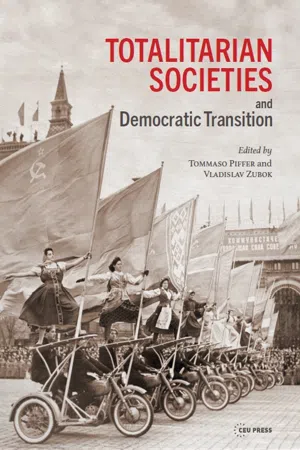 eBook - PDF
Totalitarian Societies and Democratic Transition
Essays in Memory of Victor Zaslavsky
- Tommaso Piffer, Vladislav Zubok, Tommaso Piffer, Vladislav Zubok, Riccardo James Vargiu(Authors)
- 2017(Publication Date)
- Central European University Press(Publisher)
The results of Stalin’s Dictatorship 181 Stalin’s politics in the final years of his regime—which, judging from certain facts, were marked by a profound systemic crisis—are almost entirely ignored. The manifestation of this crisis was the main reason Stalin’s successors immediately refused to continue carrying out the most odious aspects of his system. Only a country as rich in natural and human resources as the Soviet Union could physically withstand “modernization” in the Stalinist variant, and—to use a subtle metaphor—not only pay the “price” of its socio-economic experiments, but actually yield visible results. How-ever, the importance of these results was mostly strategic. According to an aphorism widely circulating in contemporary Russia, attributed to Churchill (who, incidentally, never said such a thing), Stalin took over the country when it was still using the wooden plow and left it equipped with atomic weapons. In truth, Stalin left Russia with both atomic weapons and the wooden plow, which is precisely why the strategic model of “modernization” created by Stalin was doomed to failure. The hypertrophy of the repressive state generated by Stalinist politics, an economic relations system that rejected efficiency and innovations, and many other factors left a long-lasting mark on the development of the country, which was condemned to reproduce an ever-delayed model for advancement. All the facts that are now known make it possible to recognize beyond a shadow of a doubt that the Stalinist dictatorship was an extremely violent political regime, capable of reaching its goals mainly by way of terror and abuse. Becoming aware and acknowledging this basic fact must be the starting point for the further development of research on the other key aspects of the Stalinist system. First among these is the issue of the relative autonomy of social processes, and the considerable diffusion of social phenomena opposing the dictatorship.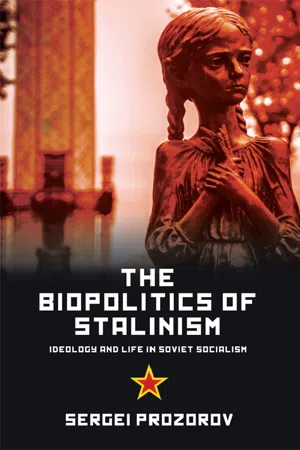 eBook - PDF
The Biopolitics of Stalinism
Ideology and Life in Soviet Socialism
- Sergei Prozorov(Author)
- 2016(Publication Date)
- Edinburgh University Press(Publisher)
Stalinism in the Theory of Biopolitics 57 for understanding twentieth-century politics. He reads theories of totali-tarianism, from Hannah Arendt to Jacob Talmon and François Furet, as problematic attempts to identify the origins of the catastrophes of the twentieth century. Arendt (1973) finds these origins in the decline of the Greek polis and the ensuing depoliticisation throughout the history of Western civilisation, which took a particularly intense and lethal form with the late nineteenth-century crisis of the nation-state, the emergence of imperialism and the appearance of racism as a political force. In con-trast, Talmon (1970) (as well as, in different ways, Furet (1981) and Lefort (1986, 2007)) finds the origins of totalitarianism in the egalitarian excesses of democracy that give rise to formerly unseen forms of despo-tism (Esposito 2008b: 636–8). According to Esposito, both of these theo-ries fail to provide a coherent account of a single origin (or set thereof) of the two distinct phenomena of Nazism and Stalinism that they subsume under the notion of totalitarianism. Arendt’s analysis traces the genealogy of Nazism in nineteenth-century European anti-Semitism, early twentieth-century imperialism and colonial administration and the post-World War I decline of the nation-state. Yet, while it is certainly plausible in the case of Nazism and other European fascisms, this account is difficult to apply to the Soviet case, since anti-Semitism and imperialism did not play the same role in revolutionary and post-revolutionary Russia as they did in Cen-tral Europe. Moreover, Esposito plausibly wonders how [we] are to hold together in a single categorical horizon a hypernatu-ralistic conception such as that of Nazism with the historicist paroxysm of communism. eBook - ePub
The Soviet Empire Reconsidered
Essays In Honor Of Adam B. Ulam
- Sanford R. Lieberman, David E Powell, Carol R Saivetz, Sarah M Terry(Authors)
- 2019(Publication Date)
- Routledge(Publisher)
This forces us to examine once again the value of that label as an analytical tool in comparative politics. 1 During the 1960s the concept of totalitarianism was severely criticized for its use as a weapon in the Cold War, its imprecise conceptual foundations, and its lack of "coherence, clarity and a single meaning." 2 By the end of the 1970s, however, new assessments of totalitarianism had appeared that found the concept useful not only as an explanation of past regimes, but also as a warning of dangers "attendant upon the modernization process." 3 There remained two major problems with the term: It was applied indiscriminately to states hostile to the West in the Cold War, and it was no longer applicable to most post-Stalinist communist states. The value of the concept requires a reexamination of it as originally defined, 4 and our recognition that most communist states after Stalin's death were no longer totalitarian. In totalitarian systems, the state 5 attempts to invade all aspects of public and private life and justifies that invasion to loyalists and to the masses by a chiliastic ideology, such as communism or fascism. This combination of ideological fervor and popular mobilization separates totalitarianism from traditional forms of authoritarianism, such as patrimonialism or sultanism. 6 The specific structures of a totalitarian state may vary 7 from one country to another and from one ruler to an-other, but what is crucial is that an individual leader comes to person-ify the ideology. 8 He rejects any fundamental rights outside his own political goals, refuses to accept any basis for morality separate from the ideology as he arbitrarily interprets it, and demands active demonstrations of popular support--mobilized participation in achieving ideological goals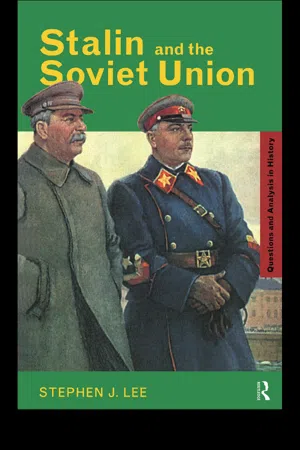 eBook - ePub
- Stephen J. Lee(Author)
- 2005(Publication Date)
- Routledge(Publisher)
4 ) The situation was given further instability by the constant expansion of local officialdom. This made it increasingly difficult for the centre to control local officials without creating more off icials, and hence compounding the problem. Ironically, Stalinism, supposedly confined to the centre, in practice created the ideal conditions for ‘little Stalins’ in the localities. These were not a threat to the basis of Stalin’s power. But they did inhibit the effective enforcement of his policies.These points have a particularly important bearing on the phenomenon with which Stalinism is most commonly associated: terror and the purges.This argument, emphasising the contrast between dictatorship at the centre and still powerful local initiatives, has two overall implications. First, Stalin was less completely in control of policy than is generally supposed. He certainly intended to direct the economy and foreign policy through periodic decisions and adjustments, just as he was determined to remove all opposition and democracy within the Party. But he frequently lost control of what he had started: the complexity of the administration defeated the attempts of the centre to monitor the changes, with the result that there was as much chaos and anarchy as there was order and direction. And second, the impetus, as opposed to the inspiration, for change came as much from below as from above. The result could be violent changes, oscillations and swings as the top tried to correct the bottom’s attempts to adapt to the direction imposed from above. Seen in this light, Stalin spent as much of his time adjusting as he did initiating.Questions
- Was Stalin in control of his political system?
- How could the same regime produce the 1936 Constitution and the purges?
ANALYSIS (2): WHAT WERE THE REASONS FOR THE STALINIST TERROR?
More than anything else, Stalin’s regime is associated with terror. This existed on a scale unparalleled, in terms of the number of casualties, in the twentieth century—which is to say, in the whole of human history. Until very recently the reasons for this terror attracted very little controversy: the driving force was considered to be, solely and uniquely, Stalin himself, who created a ruthlessly totalitarian system. Current historians are not, however, content with stereotypes, even if they are largely true. The Stalinist terror was too complex to admit a single explanation. This analysis will attempt to integrate traditional views and recent research into an overall synthesis. The argument progresses stage by stage. eBook - ePub
- Roger Pethybridge(Author)
- 2021(Publication Date)
- Routledge(Publisher)
CHAPTER IIIStalinism ABROAD
In the period between the end of the war and Stalin’s death in March 1953, the most dynamic changes affecting Russia occurred in the sphere of foreign policy. Apart from the dramatic upsurge of the Soviet economy, the domestic scene was static, merely witnessing the reaffirmation of the Stalinist policy that had characterized it before the war—although some new developments as a result of the up-heaval were woven into the old pattern. Domestic policy has been treated first, however, because it served as a prototype for Communist governments in the emergent Soviet bloc, especially after 1947. An understanding of the internal situation in Russia during these years helps to illuminate the system that was imposed on the territories occupied by Soviet troops during the war. It is often said that a country’s foreign policy is merely the extension of its domestic policy. This was certainly the case with regard to the Soviet bloc, since it was shielded from the reaction of the outside world and was unusually susceptible to Russian control.In this chapter we shall deal in turn with the three world crisis areas as they appeared at the close of the war—Europe, Asia, and the Near East. In addition Soviet behaviour in the United Nations, the embryo focal point of world politics, will have to be considered. Most of our attention will be directed toward the scene in Eastern Europe, since it remained the centre of Soviet interest until Stalin’s death. This was the case for two reasons. The presence of Soviet troops in Eastern Europe permitted active intervention that would have been more dangerous in other areas of crisis. Secondly, Stalin’s dichotomic view of the world prevented Soviet diplomacy from making any headway in the emerging countries of Asia and the Middle East, which, despite their newly-won freedom from the imperialist yoke, were still put in the same category as their old capitalist masters in Western Europe. Only after the death of Stalin and the great upsurge of the Soviet economy, buttressed by a Sovietized Eastern Europe, did Russian interest in Asia and the Middle East come to life under the banner of peaceful coexistence. Some scholars have argued recently that a major shift in Soviet foreign policy took place in the last year or so of Stalin’s life. It is true that there were signs of resistance from below to the dictator’s outdated methods shortly before his death, but the author is inclined to agree with those scholars who interpret the mainstream of Soviet policy in traditional terms, viewing it as the product of a tired, rigid mind that still dominated the conduct of government. eBook - PDF
The Nature of Stalin's Dictatorship
The Politburo 1928-1953
- E. A. Rees(Author)
- 2003(Publication Date)
- Palgrave Macmillan(Publisher)
To pose such questions is to raise the matter of policy alternatives. In this it is also impossible to divorce an assessment of policy-making from the question of the regime’s ideology. In terms of ideology, the collectivisation of agriculture was rational, overriding considerations of economic, social and political costs. But ‘dekulakisation’ inevitably meant the creation of the Gulag. Moreover, we cannot avoid posing the question of whether the ideology distorted reality, created a one- sided consideration of policy options, and inclined the regime to adopt policies with high collateral costs. It might also be argued that the ideology possessed its own self-fulfilling, self-confirming logic (the Soviet conception of the hostile capitalist world, and its conception of hostile anti-socialist classes in the USSR was made real by the actions and behaviour of the Soviet government itself). At the same time, the management of the Soviet economy became more rational and predictable: they learnt from their mistakes in 1928–33. Similar arguments might be made regarding policies in other fields. The success of the war-time industrial economy, the speed of the post-war economic recovery and the success of the atomic programme suggest that in these priority areas the regime was capable of spectacular advances. Factional in-fighting The war left Stalin physically and mentally exhausted, but placed him in a position that was unassailable. He remained dependent on his subordinates, and in the latter years this dependency increased greatly. But he continued to dominate the political sphere and to control the policy agenda. He did this through direct intervention, but increasingly through the management of his subordinates. In the post-war period, Stalin’s paranoia and suspiciousness became more acute.
Index pages curate the most relevant extracts from our library of academic textbooks. They’ve been created using an in-house natural language model (NLM), each adding context and meaning to key research topics.

