Politics & International Relations

Mussolini Fascism
Mussolini Fascism refers to the political ideology and authoritarian regime established by Benito Mussolini in Italy during the early 20th century. It emphasized nationalism, militarism, and the centralized power of the state, while suppressing political opposition and promoting a cult of personality around Mussolini. Mussolini's Fascism also sought to revive Italy's imperial glory and expand its influence through aggressive foreign policies.
Written by Perlego with AI-assistance
Related key terms
1 of 5
12 Key excerpts on "Mussolini Fascism"
 eBook - ePub
- Stephen J. Lee(Author)
- 2016(Publication Date)
- Routledge(Publisher)
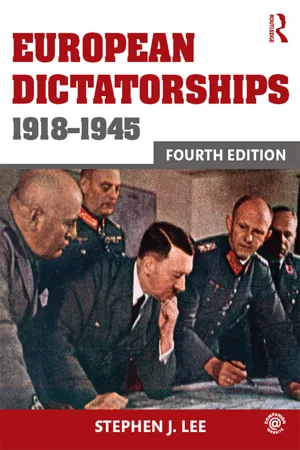
The problem was that the regime needed a more obvious appearance of success. Mussolini sought this in a more active foreign policy, which involved his dictator ship in a series of wars. This meant another round of radical changes in the late 1930s; these were the result partly of domestic pressures and partly of influences from Nazi Germany. The result was, in Morgan’s words, that ‘Between 1936 and 1940 the regime consciously stepped up and intensified its attempts to “fascistise” Italian society.’ 25 This broke the earlier balance and consensus within Italy and meant the intensification of repression on the one hand and of opposition on the other. 4 Benito Mussolini, photo taken in 1923 (© Hulton Archive/Getty) Meanwhile, Italy’s economic infrastructure, seriously weakened between 1936 and 1939 by constant exposure to war, was tested to the point of collapse by Mussolini’s disastrous decision to enter the Second World War. Although Mussolini attempted between 1943 and 1945 to recreate something of the original dynamism of Fascism, by this time he had become no more than a Nazi puppet within a small part of northern Italy. The ideology of Fascism In 1932 Mussolini penned the basic ideas of the movement, clearly and emphatically, in his Political and Social Doctrine of Fascism. Fascism, he said, was anti-communist, anti-socialist and strongly opposed to an economic conception of history. He denied that class war can be the preponderant force in the transformation of society. Fascism was also anti-democratic, denouncing the whole complex system of democratic ideology. It was certainly authoritarian: ‘The foundation of Fascism is the conception of the State eBook - PDF
The Modern State
Theories and Ideologies
- Erika Cudworth, Timothy Hall, John McGovern(Authors)
- 2020(Publication Date)
- EUP(Publisher)
In place of force, a political edu-cation in fascist ideology, propagated through the PNF, was to bind the individual to the state, just as a religion binds together individ-uals through ritual and doctrine without using force. In this way, because it represented a politicised version of Christianity, totali-tarianismo was moderated. Practical politics Fascism 1918–1945 Only in Italy, after Mussolini formed his first government in 1922, and in Germany after 1933, could it be said that there were Fascist regimes. Even that is debatable. Historians have questioned the extent to which Mussolini’s internally divided regime was genuinely Fascist. Payne has noted that ex-Marxists and syndicalists militated for a revolutionary national socialism, revisionists saw fascism as providing a new elite to command the existing political system, paramilitary groups used terror to establish a dictatorship, and nationalists worked for an authoritarian state under the monarchy. De Felice’s distinction between fascism ‘as movement’ and ‘as regime’ draws to our attention the disparity between the clerical, corporatist, capitalist and conservative Mussolini state and the revolutionary, anti-bourgeois and national-socialist Fascist move-ment (de Felice 1976). To fascist revolutionaries the Mussolini regime represented an imperfect embodiment of the fascist ideals which inspired the movement because of its alliances with the monarchy and the Church and its accomodation of capitalism. Contemporary historians tend to agree that, even at the height of his power, Mussolini was unable to institute a fully fascist regime. As early as 1927, the PNF was widely perceived by revolutionary Fascists as having become conservative (Payne 1980: 68–9). The Italian state before the Fascist seizure of power had been weak, divided and, especially in the aftermath of the First World War, barely capable of governing. eBook - PDF
- Giuseppe Finaldi(Author)
- 2014(Publication Date)
- Routledge(Publisher)
In theory anything that purported to further these goals was good, anything that hindered them was bad. It is difficult to see this as an original and novel political doctrine. Rather it was the alive and kicking Vittorio Veneter pro-gramme writ large, and in its essentials the agenda of late nineteenth-century nationalism. What Mussolini rightly defined as new was the level of activism and participation expected of the people: above all, he wrote, ‘The Fascist disdains an “easy” life’ (in Delzell, 1970: 93). For Mussolini to have some-thing to offer, for his Regime to dispel rumours of middle-aged redundancy, ‘going to the people’ meant dispelling the Regime’s and the Duce ’s built-in obsolescence. Even in Mussolini’s own definition of Fascism his greatest fear was a lapse back to liberalism, as if, by default, crises having been overcome and emergencies solved, Italy would, like any civilized country, automatically return to the liberal fold. Mussolini was aware of his own expendability if, as he stated, ‘[liberalism is classified] as outside the judgement of history, as though history were a hunting ground reserved for the professors of Liberalism alone – as though Liberalism were the final unalterable verdict of civilization’ (in Delzell, 1970: 102). 66 MUSSOLINI AND ITALIAN FASCISM The Fascist Regime, 1926 –36 67 In practice, the way in which most Italians understood Fascism as it was fed to them and as they themselves developed it in the 1930s was very much as an activation or an intensification of those agendas of the ‘nationalisation of the masses’ (Mosse, 1975) that had been such a central feature of Italian life since unification. There had already been parades, there had already been uniforms, drill, speeches, patriotic songs and celebrations. There had already been cults of national heroes, the myth of ancient Rome, the construction of national monuments and preparation for war. eBook - PDF
- (Author)
- 2018(Publication Date)
- Alma Books(Publisher)
The idea was rather to ignore class differences and economic interests, insisting rather on solidarity with all its advantages. At its simplest, one might say that Mussolini’s Fascism, as it was soon being called, aimed to create, in peacetime, the embattled, nationalist solidarity he had experienced during the war (a “fascio” is a bundle of things tied together). So all differences of opinion would be subordinated to the principle of the good of the nation. In reality, at least initially, this meant sub-ordination to the principle of taking power over the nation. Every “divisive” party, and in particular the Socialists, would be attacked and denigrated until all parties were dissolved and the people bound together in the solidarity of Fascism. Expelled from every organi-zation he had been a member of, Mussolini would now absorb all organizations into his own. 176 a literary tour of italy Despite Mussolini’s remarkable journalism and powerful public speaking, the new movement polled only 5,000 votes in the 1919 election. Very soon afterwards, however, it found a role in trans-forming widespread public resentment towards Socialist strikes into orchestrated punitive raids. While the police stood by reluctant to intervene, all over northern and central Italy groups of the Fasci di Combattimento set out in their black shirts and black trucks to break strikes, beat up opponents and burn down Socialist headquarters. There were deaths on both sides. Nicholas Farrell, in his Mussolini, A New Life , is sanguine about all this. Bolshevism was a real threat, he points out, and the Social-ists “gave as good as they got”. He repeats this formula three times. Anyway, “the Fascists,” Farrell writes, “opposed the bourgeoisie as much as they opposed the Socialists, because both exalted one class at the expense of the other. eBook - PDF
Fascism
Comparison and Definition
- Stanley G. Payne(Author)
- 1980(Publication Date)
- University of Wisconsin Press(Publisher)
The specific content is my own. WHAT DO WE MEAN BY FASCISM? 17 Table 1 TYPOLOGICAL DESCRIPTION OF FASCISM A. The Fascist Negations: Antiliberalism Anticommunism Anticonservatism (though with the understanding that fascist groups were willing to undertake temporary alliances with groups from any other sector, most commonly with the right) B. Ideology and Goals: Creation of a new nationalist authoritarian state based not merely on traditional principles or models Organization of some new kind of regulated, multiclass, integrated na- tional economic structure, whether called national corporatist, na- tional socialist, or national syndicalist The goal of empire or a radical change in the nation's relationship with other powers Specific espousal of an idealist, voluntarist creed, normally involving the attempt to realize a new form of modem, self-determined, secular culture C. Style and Organization: Emphasis on esthetic structure of meetings, symbols, and political chore- ography, stressing romantic and mystical aspects Attempted mass mobilization with militarization of political relation- ships and style and with the goal of a mass party militia Positive evaluation and use of, or willingness to use, violence Extreme stress on the masculine principle and male dominance, while espousing the organic view of society Exaltation of youth above other phases of life, emphasizing the conflict of generations, at least in effecting the initial political transformation Specific tendency toward an authoritarian, charismatic, personal style of command, whether or not the command is to some degree initially elective ments while still setting them apart from other kinds of revo- lutionary or nationalist movements. Individual movements might then be understood to have possessed further beliefs, characteristics, and goals of major importance to them that did not contradict the common features but were simply add- ed to them or went far beyond them. eBook - PDF
Latin Fascist Elites
The Mussolini, Franco, and Salazar Regimes
- Paul H. Lewis(Author)
- 2002(Publication Date)
- Praeger(Publisher)
The launching of Fascism took place in a hall rented from the Associa- tion of Industrial and Commercial Interests, located on Milan's Piazza San Mussolini's Political Elite 17 Sepulcro. Many of the 100 or so participants were the same anarchosyndi- calists who had joined Mussolini in the interventionist campaign in 1915. Ex-servicemen from the Italian "special forces"—the arditi—formed another important element. Psychologically unwilling to return to peace- time conditions, they were attracted to Mussolini by his combative attitude, which promised excitement. Besides them, there was a sprinkling of radical intellectuals known as "Futurists," and some ultranationalists. Fascism's original program, as laid down at this first meeting and elaborated in Octo- ber 1919 at a congress held in Florence, reflected its left-wing origins. It advocated abolishing the monarchy, confiscating the property of the Catholic Church, an aggressive pursuit of Italy's territorial claims, worker participation in industrial management, the partial expropriation of all wealth, and heavy taxes on the rich. 3 Mussolini hoped to win over the proletariat from the Socialists, and to achieve this he pursued a dual strategy of organizing the party for the forth- coming parliamentary elections scheduled for November 1919, while at the same time using the arditi in street battles with his Socialist rivals. The elec- toral side of this strategy proved a failure when the Fascists failed to win a single seat. Even in Milan, where Mussolini had counted on his personal popularity, the Fascist ticket got only 5,000 votes out of 270,000 cast. Cesare Rossi, one of Mussolini's aides, observed that the results showed that the proletariat and socialism were an inseparable whole: you could not oppose one without opposing the other. 4 Realizing that the proletariat could not be captured from the Socialists, Mussolini concentrated on expanding the paramilitary side of his move- ment.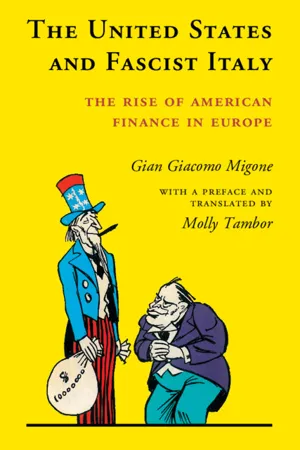 eBook - PDF
The United States and Fascist Italy
The Rise of American Finance in Europe
- Gian Giacomo Migone, Molly Tambor(Authors)
- 2015(Publication Date)
- Cambridge University Press(Publisher)
. . Leninism. But in Britain we have not yet had to face this danger in the same poisonous form . . . but I do not have the least doubt that, in our struggle, we shall be able to strangle communism.” (Corriere della Sera, Jan 21 1927). 36 R. W. Child, “Preface,” in B. Mussolini, My Autobiography, London: 1928. 37 The Literary Digest, vol. 75, November 18, 1922, p. 17. 38 The Boston Evening Transcript, October 30, 1922, p. 14. 39 Ibid., November 1, 1922, section II, p. 2. 40 The United States and the Rise of Fascism in Italy Although a dictator and the leader of a successful coup, Signor Mussolini has shown no disposition to remain indefinitely as a dictator, nor to rely permanently upon the Fascisti to keep him in office. His coalition government was proof of this claim, according to an editorial the following day, which praised the conservative character and patriotism of the Fascist movement and predicted that it would not show such folly as to pursue imperialist expansion. 40 The qualities attributed to Fascism and to its “duce” were by now characterized by normalcy – that is to say by the ideology of normalization that dominated American politics after the war, when a wave of anti- Wilsonian restorationism swept the country. Mussolini’s energy would frequently be compared to that of Theodore Roosevelt. 41 The essentially conservative and restorationist character of the Fascist seizure of power corresponded well with the orientation of the incumbent Republican administrations during the twenties. Equally reassuring were Mussolini’s business-oriented proposals and his “frank patriotism,” especially in the eyes of the industrial and financial interests that also happened to control a large section of the U.S. eBook - PDF
- Stanley G. Payne(Author)
- 1996(Publication Date)
- University of Wisconsin Press(Publisher)
emotion and faith; "7) a police apparatus that prevents, controls, and represses dissidence and opposition, even by using organized terror; "8) a political system organized by a hierarchy offunctions named from the top and crowned by the figure of the 'leader,' invested with a sacred charisma, who commands, directs, and coordi- nates the activities of the party and the regime; "9) a corporative organization of the economy that suppresses trade union liberty, broadens the sphere of state intervention, and seeks to achieve, by principles of technocracy and solidarity, the collaboration of the 'productive sectors' under the control of the regime, to achieve its goals of power, yet preserving private property and class divisions; "10) a foreign policy inspired by the myth of national power and greatness, with the goal of imperialist expansion." (Quoted with the kind permission of Professor Gentile.) 7. The idea of a tripartite definition was first suggested to me by Juan J. Linz at a conference in Bergen, Norway, in June 1974. The specific content is my own. Introduction 7 Table 1.1. Typological Description of Fascism A. Ideology and Goals: Espousal of an idealist, vitalist, and voluntaristic philosophy, normally involving the attempt to realize a new modern, self-determined, and secular culture Creation of a new nationalist authoritarian state not based on traditional principles or models Organization of a new highly regulated, muIticlass, integrated national economic structure, whether called national corporatist, national socialist, or national syndicalist Positive evaluation and use of, or willingness to use, violence and war The goal of empire, expansion, or a radical change in the nation's relationship with other powers B. The Fascist Negations: Antiliberalism Anticommunism Anticonservatism (though with the understanding that fascist groups were willing to under- take temporary alliances with other sectors, most commonly with the right) C. eBook - PDF
What History Tells
George L. Mosse and the Culture of Modern Europe
- Stanley G. Payne, David J. Sorkin, John S. Tortorice, Stanley G. Payne, David J. Sorkin, John S. Tortorice(Authors)
- 2004(Publication Date)
- University of Wisconsin Press(Publisher)
For Mosse fascism was neither an aberration from the course of European history nor the sudden irruption of a movement void of ideas, a “revolution of nihilism” exclusively prompted by a naked and brutal will to power, a contingent re- action triggered by World War I. Mosse saw in fascism, as a general phe- nomenon embodied primarily in Italian fascism and in National Social- ism, the product of cultural, political, and moral currents that had accompanied the transformation of society and of the ways of life in the age of the traumatic upheavals caused by industrialization, modernity, and the birth of mass society. Moreover, fascism had been successful not only thanks to its resort to violence but also because it had known how to effectively interpret—through its ideology, its organization, and the 54 e m i l i o g e n t i l e charisma of its leader—the longing for security, authority, and belonging strongly felt by many alienated people in an age of rapid changes, people who were disoriented and deeply troubled by the challenges of moder- nity. Millions of people saw in fascism the solution to the dilemmas and conflicts of modernity, a promise of security, stability, and order that par- liamentary institutions no longer seemed capable of providing. Fascism promised to put an end to alienation by reintegrating the individual in the collectivity of the nation while sacrificing the individual’s freedom. For these reasons, Mosse argued that fascism was anti-parliamentary but not anti-democratic, in the sense that it represented a form of popular par- ticipation alternative to parliamentary democracy. Popular consensus to fascism and the forms in which consensus was obtained became other fundamental pillars of his interpretation. At this point, however, it is ap- propriate to let Mosse himself speak: There can be little doubt about the popularity of fascism, especially in the beginning. eBook - PDF
Routes Into the Abyss
Coping with Crises in the 1930s
- Helmut Konrad, Wolfgang Maderthaner(Authors)
- 2013(Publication Date)
- Berghahn Books(Publisher)
C HAPTER 4 F ASCISM IN I TALY BETWEEN THE P OLES OF R EACTIONARY T HOUGHT AND M ODERNITY Karin Priester Introduction In his work ‘A Brief History of Fascism in Italy’ Brunello Mantelli summa-rizes the key structural problem of the Mussolini Regime as follows: ‘Even if one were to take the official data and statistics of the “Achievements” and workings of the Fascist Regime in Italy as genuine, it becomes appar-ent that the will of Mussolini and his cohorts was to create the illusion of “Modernity” while not actually “Modernizing” the nation at all.’ 1 Modernity without Modernization – in this and similar paradoxes, the researchers of Fascism have tried to identify the ambivalent character of Fascism as a reactionary, populist trend. Jeffrey Herf labelled National Socialism as ‘Reactionary Modernism’; Ralf Dahrendorf described it as an intended thrust into Modernity; Timothy Mason spoke of the social policies of the Third Reich as being structured around the idea of ‘Mod-ernization without Modernity’; and Nicola Tranfaglia described Italian Fascism as being ‘contradictory modernization’. On the other hand, when interviewed by the British Sunday Times in May 2008, the new mayor of Rome, Gianni Alemanno, of the neo-Fascist Alleanza Nazionale Party, claimed that Fascism had played a positive role in the modernization of Italy. As examples, he cited measures against malaria, the reclaiming of swampland (bonifica integrale) and the partial 56 Karin Priester erection of the EUR (Eusposizione Universale Roma) quarter in south-west Rome, meant to be completed for the 1942 World Fair (but never completed due to the Second World War). 2 Alemanno not only reassessed Fascism historically with his view, but conscientiously masked and glossed over historical fact. eBook - PDF
Modernism and Fascism
The Sense of a Beginning under Mussolini and Hitler
- R. Griffin(Author)
- 2007(Publication Date)
- Palgrave Macmillan(Publisher)
Under the influence of Benjaminian theories of aesthetic politics and postmodernist concern with semiotic texts there has been a tendency for a recognition of Fascism’s modernism to skew the study of its history towards an exclusive concern with its ‘spectacular’, religious, aesthetic aspects. 44 Such a distortion is precluded by the fully historiographical approach adopted to modernist nationalism by Emilio Gentile, who stresses how important it is ‘to avoid letting emphasis on the “aestheticization of politics” lead to a kind of “aestheticization” of Fascism itself, privileging only its literary, aesthetic, and symbolic aspects while losing sight of motivations and matrices that are essentially political in nature’. For him this risks ‘trivializing the fundamentally political nature of Fascism, its culture, its ideology, and its symbolic universe’ to a point ‘where it obscures Fascism’s other important feature, its “politicization of aesthetics”’. 45 In the light of the ideal type elaborated in Part One, the modernism of early twentieth-century Italy becomes an even more extended and less ‘artistic’ family than it does for Gentile, for it embraces not just various forms of aestheticized politics but ‘Nietzschean’, Dionysian forms of Marxism – notably the revolutionary syndicalism that Zeev Sternhell makes so central to his insuf- ficiently reflexive metanarrative of the birth of Fascism. 46 It also recognizes 204 Modernism and Fascism the kinship of cultural with scientistic projects for purging modern society of degeneracy or stimulating national renewal. No longer available |Learn more
Fascism without Borders
Transnational Connections and Cooperation between Movements and Regimes in Europe from 1918 to 1945
- Arnd Bauerkämper, Grzegorz Rossoliński-Liebe, Arnd Bauerkämper, Grzegorz RossoliÅ"ski-Liebe(Authors)
- 2017(Publication Date)
- Berghahn Books(Publisher)
3 Nor did the “Italian Fasci Abroad” (Fasci italiani all’estero) intend to propose a New European Order (NEO). This network, which was officially acknowledged in 1922, primarily focused on foreign groups and movements, and not on governments. Its aim was to “inform” Italian emigrant communities about the basic tenets of Fascist ideology 244 • Monica Fioravanzo so as to promote consent of Fascist ideals in other countries as well. 4 Mussolini continued to feel the need to consolidate his regime, isolating any possible dissent and imposing the power and prestige of Fascism on competing powers such as the Church and the Crown. Although the Fascist conception of the State, intended as a “will to power and will to govern,” essentially contained the idea of a preeminent international role for Fascist Italy, initially these concepts remained latent. 5 The idea of a NEO and plans for an economic, political, and social “balance” in Europe were introduced by the Fascist movement in the early 1930s, after the regime had become internally consolidated (partially as a consequence of the Lateran Pacts with the Catholic Church in 1929). On the one hand, the 1929 crisis and its social and economic effects led to a sense of profound upheaval in Europe, and the leitmotif was in fact the perception of a European crisis. 6 On the other hand, Italian Fascism feared the growth of National Socialism in Germany. It certainly perceived the Nationalsozialistische Deutsche Arbeiterpartei (National Socialist German Party, NSDAP) as an ideological ally in its opposition to Western democracies. Yet Mussolini also saw the NSDAP as a contender for the leading role over other rightist European movements, which up to then had been held by Italian Fascism. Hence, the particular urgency to propose a “Fascist solution” to cope with the decline of Europe before Germany could have a say in the matter.
Index pages curate the most relevant extracts from our library of academic textbooks. They’ve been created using an in-house natural language model (NLM), each adding context and meaning to key research topics.

