History

Nazi Control
Nazi control refers to the totalitarian rule established by the National Socialist German Workers' Party (Nazi Party) in Germany from 1933 to 1945. Under the leadership of Adolf Hitler, the Nazis implemented a regime characterized by censorship, propaganda, persecution of minorities, and the suppression of political opposition. This control extended to all aspects of society, including the economy, education, and culture.
Written by Perlego with AI-assistance
Related key terms
1 of 5
4 Key excerpts on "Nazi Control"
 eBook - PDF
- Oron James Hale(Author)
- 2015(Publication Date)
- Princeton University Press(Publisher)
III. The Organization of Total Control A Strait Jacket for Editors and Publishers In the Nazi party leadership it was an accepted view that the new order would require establishment of a control system for the German press. In Mein Kampf Hitler dwelt at length upon the theme that the national interest re- quired firm control of this instrument of guidance and education. The credulous masses easily fell under the influ- ence of ignorant, stupid, and ill-disposed leaders; it was the duty of the state to prevent this. The press, he said, must be carefully supervised because it had a continuing and not an intermittent impact upon the masses. "The state therefore must proceed with ruthless determination and take control of this instrument of popular education and put it in the service of the state and nation." 1 The first steps taken to realize this objective came within the general movement of Gleichschaltung, the coordination of all organizations with the new regime, which was ruth- lessly pursued during 1933. Professional groups, business and trade associations, sports organizations, cultural and educational institutions, in short, the whole range of organ- ized life was brought under Nazi party control. This was accomplished voluntarily or under pressure, and was usually signaled by the election or appointment of Nazis to the leadership positions and executive committees. Throughout the land the little as well as the big Nazis had their moments of triumph. The gloom of the depression, massive unemployment, and deep political unsettlement had a tiring, depressing effect. Many who disapproved fell into line because there appeared to be no other course. Each day the papers recorded actions of corporate bodies 1 Mein Kampf, i, 264 (Volksausgabe, 1933). The Organization of Total Control 77 and groups which had voluntarily reorganized and aligned themselves with the new regime. The foreign observer was reminded of lemmings rushing blindly toward the sea.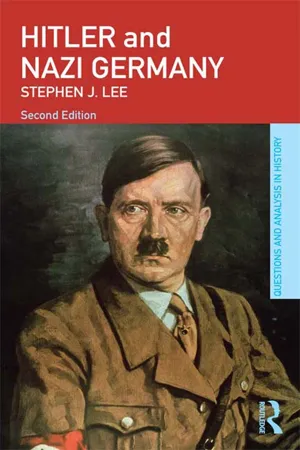 eBook - ePub
- Stephen J. Lee(Author)
- 2013(Publication Date)
- Routledge(Publisher)
Volksgemeinschaft. Others were excluded: social ‘deviants’, hereditarily ‘diseased’, ‘undesirable’ groups and racial ‘inferiors’ – especially Romanies and Jews. For some of these the state exercised punitive powers, for others the protection normally conferred by the state on behalf of its citizens was removed altogether. The implications were huge, with the passing of discriminatory legislation such as the Nuremberg Laws (1935), the growth of a network of concentration camps, the compulsory sterilisation of targeted individuals and groups, and, in extreme cases, the application of ‘euthanasia’. Above all, a policy of extermination was adopted from 1941 onwards. In the Nazi dictatorship the role of the state was therefore not only that of ‘selector’, but also of ‘eliminator’. This is the most extreme function – or malfunction – that any state is capable of fulfilling.Questions
- In what ways did the Nazi dictatorship differ from the ‘Presidential dictatorship’ of the last two years of the Weimar Republic?
- To what extent did the Nazis change Germany institutionally after 1933?
Analysis 2: How Effective was the Nazi Political System?
The nazification of the whole system of government in Germany might suggest that the organisation was tight and carefully structured. The precision with which the Nazi legal revolution occurred also infers that Hitler had full control over the whole process. The Third Reich, in other words, might be seen as a model of efficiency precisely because the effort taken to establish it had been so minimal.Such an approach would, however, be open to fundamental question and a number of historians have presented a very different picture. It is generally argued that, far from being orderly, the Nazi dictatorship was actually prone to internal conflict which resulted in a surprising degree of chaos. The basic problem was that the Third Reich was a hotchpotch of overlapping institutions and structures. This was the result of the minimalist approach to constitutional change. Instead of knocking down the old structure, the Nazis had simply constructed another on top of it. The effect was the duplication of functions and the conflict between officials in central and local government. This was apparent even to contemporaries; Otto Dietrich, Hitler’s press chief, later wrote in his Memoirs: ‘In the twelve years of his rule in Germany Hitler produced the biggest confusion in government that has ever existed in a civilized state.’ (See Source 1.3 eBook - ePub
Children's Literature in Hitler's Germany
The Cultural Policy of National Socialism
- Christa Kamenetsky(Author)
- 2019(Publication Date)
- Ohio University Press(Publisher)
PART IV Methods and Limitations of Control Passage contains an image
14
The System of Censorship
The control over children’s literature in Nazi Germany was closely linked with the control over literature in general. In both cases, the authority was divided between Goebbels and Rosenberg representing the State and the Party respectively. The Reichsschrifttumskammer (Reich Literature Chamber) with its various subdivisions had the executive power to prohibit books and to punish authors, publishers or booksellers who did not abide by its rules. The various documents published by the Reich Literature Chamber became laws to the nation. According to a decree of November 1, 1933, everyone in Germany had to submit to its screening process all materials that were connected with “the creation, reproduction, recital, spiritual or technical interpretation, distribution, maintenance, trade or sale of cultural goods.”1 The following document, dating from 1935, may convey an idea of the all-embracing nature of censorship as Goebbels had designed it:The Reich Literature Chamber issues a list of harmful and undesirable literature containing all works of literature opposed to the cultural and political goals of the National Socialist State. It is prohibited by law to publish, sell, lend, borrow, issue, advertise, sell, or store these books. This prohibition applies to works of authors of Jewish or semi-Jewish origin, even if their works are not included in the above mentioned list, and it is also applicable to the literature in the newly acquired territories in the east.2Goebbels issued such a list periodically, which was consulted by Rosenberg’s various censorship offices. On occasion, it referred to books for young people under the age of eighteen, although it made no special provisions for children’s literature.
Passage contains an image
14
The System of Censorship
The control over children’s literature in Nazi Germany was closely linked with the control over literature in general. In both cases, the authority was divided between Goebbels and Rosenberg representing the State and the Party respectively. The Reichsschrifttumskammer (Reich Literature Chamber) with its various subdivisions had the executive power to prohibit books and to punish authors, publishers or booksellers who did not abide by its rules. The various documents published by the Reich Literature Chamber became laws to the nation. According to a decree of November 1, 1933, everyone in Germany had to submit to its screening process all materials that were connected with “the creation, reproduction, recital, spiritual or technical interpretation, distribution, maintenance, trade or sale of cultural goods.”1 The following document, dating from 1935, may convey an idea of the all-embracing nature of censorship as Goebbels had designed it:The Reich Literature Chamber issues a list of harmful and undesirable literature containing all works of literature opposed to the cultural and political goals of the National Socialist State. It is prohibited by law to publish, sell, lend, borrow, issue, advertise, sell, or store these books. This prohibition applies to works of authors of Jewish or semi-Jewish origin, even if their works are not included in the above mentioned list, and it is also applicable to the literature in the newly acquired territories in the east.2Goebbels issued such a list periodically, which was consulted by Rosenberg’s various censorship offices. On occasion, it referred to books for young people under the age of eighteen, although it made no special provisions for children’s literature.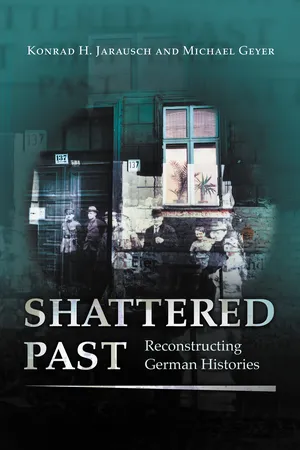 eBook - PDF
Shattered Past
Reconstructing German Histories
- Konrad H. Jarausch, Michael Geyer(Authors)
- 2009(Publication Date)
- Princeton University Press(Publisher)
6 Ian Kershaw, The Nazi Dictatorship: Problems and Perspectives of Interpretation (London, 1993); Ju ¨ rgen Kocka, ed., Historische DDR-Forschung. Aufsa ¨tze und Studien (Berlin, 1993). 7 The term is from Klaus-Michael Mallmann and Gerhard Paul, Herrschaft und Alltag: Ein Industrierevier im Dritten Reich (Bonn, 1991), 327 ff. 8 Hannah Arendt, The Origins of Totalitarianism , 3rd ed. (New York, 1973), 305 ff. T O T A L I T A R I A N T E M P TAT I O N 1 5 1 of the nobility and the Großbu ¨ rgertum resorted to populist countermo-bilization strategies of acclamation, Bonapartism, and manipulation from above. 9 At the same time, the desire of the poor and exploited for greater prosperity and security necessitated an expansion of the role of government by reducing economic risks and regulating social changes. This clamor for increased public assistance, when amplified by aca-demic reformers, led to the establishment of a social service bureau-cracy that produced an “authoritarian welfare state,” trading paternal-ist aid for political acquiescence. 10 Competing attempts at conceptualization, inspired by the subse-quent contest between dictatorship and democracy, might offer a theo-retical starting point for solving this puzzle. Already during 1933 Klemperer “equated National Socialism and Communism: both are materialist and tyrannical, both disregard and negate intellectual and personal freedom.” 11 After World War I, political theorists who were fascinated by these similarities of both dictatorships developed the concept of “totalitarianism” to account for the novelty in the extent and methods of repression. 12 During the 1970s liberal analysts, seeking to soften the German division, proposed a less judgmental comparison between various policies of the Communist and the western demo-cratic systems so as to analyze their actual functioning.
Index pages curate the most relevant extracts from our library of academic textbooks. They’ve been created using an in-house natural language model (NLM), each adding context and meaning to key research topics.

