Politics & International Relations

Fascist Italy
Fascist Italy refers to the period of Italian history from 1922 to 1943 when the country was under the authoritarian rule of Benito Mussolini and his National Fascist Party. The regime was characterized by its strong emphasis on nationalism, militarism, and totalitarian control, as well as the suppression of political opposition and the promotion of a cult of personality around Mussolini.
Written by Perlego with AI-assistance
Related key terms
1 of 5

10 Key excerpts on "Fascist Italy"
 eBook - PDF
- C. Celli, M. Cottino-Jones(Authors)
- 2007(Publication Date)
- Palgrave Macmillan(Publisher)
2 The Fascist Years (1922–43) 1921 Founding of Italian Fascist Party and Italian Communist Party. 1922 Fascist March on Rome Victor Emanuel III invites Fascist leader Benito Mussolini to form a government as prime minister 1924 Giacomo Matteotti, Socialist parliamentarian, murdered by Fascists Secession of the Aventine, opposition parties abandon the parliamentary hall to protest Fascist policies. 1925 Mussolini assumes responsibility for the Matteotti murder, further steps to dictatorhip 1926 Autarkical economic system: Quota 90 assigns value of 1 British Pound Sterling equal to 90 Italian Lire 1928 The Statuto Albertino, the Kingdom of Italy Piedmontese era constitution is attenuated 1929 Lateran accords/Concordat between Fascist state and Roman Catholic Church 1935 Invasion of Abyssinia and Ethiopia prompting League of Nations economic sanctions 1936 Aid to Falangists (Francisco Franco) in Spanish Civil War Mussolini refers to an “Axis” between Fascist Italy and Hitler’s Nazi Reich in Germany in November 1 speech 1937 Communist leader Antonio Gramsci dies shortly after release from prison Italy leaves the League of Nations 1938 Mussolini takes no action against German annexation of Austria. Leggi razziali (racial statutes) restrictions on the civil liberties of Italy’s Jewish population 1939 Italy occupies Albania with Mussolini’s son-in-law Galeazzo Ciano as regent Pact of Steel between Germany and Italy A number of countries (13) in Europe underwent right-wing revolutions/ change between 1922 and the 1940s. 1 In this period, politics and economics were conditioned by the social and psychological repercussions of WWI and con- troversy regarding subsequent peace treaties. In Italy, the standing down of the wartime economy brought about structural displacements as well as demands from workers for a reduced work week, salary increases, and land redistribution. eBook - PDF
- Philip Morgan(Author)
- 2017(Publication Date)
- Bloomsbury Academic(Publisher)
Who governed Spain and how Spain was governed made a difference to the promotion of Italian interests in the Mediterranean. This, after all, was the rationale of the Axis. A simi-larity in political systems was some measure of the mutual support which each could expect from the other in the international arena. The Axis brought together warmongering dictatorships, whose ‘totalitarian’ structures were designed to mobilise the populations behind the regimes and prepare them for war. Any agreement with the Western democracies not only meant Italy abandoning Great Power ambitions and dreams of Mediterranean supremacy. Peace also made it difficult to continue the Fascist ‘totalitarian’ state, whose premise and justification was organising the nation for conflict. The interdependence of domestic and international politics for the Fascist regime was directly and immediately felt on at least two emblem-atic occasions. At the time of the Czech crisis in late summer 1938, Mussolini was clearly not ready for war, and this partly explains his willingness to ‘arbitrate’ the dispute at the Munich conference. But his contempt for the democracies was reinforced by his perception that they were capitulating to German demands, without war. Yet Mussolini was equally disgusted at the popular enthusiasm in Italy for his role in avoiding a European war. The response was one of his periodic tirades to Ciano about the unwarlike demeanour of the Italian people, and especially of the country’s establishment and bourgeoisie, whose values and conduct were still modelled on those of the pacifist and cowardly democracies. The popularity of peace in Italy was to be a further ‘FASCISTISATION’ OF ITALIAN SOCIETY, 1936–40 187 stimulus to the ‘fascistisation’ of society, in the shape of the ‘anti-bourgeois’ campaign confirmed in Mussolini’s speech to the PNF National Council in October 1938. eBook - PDF
Fascism
Comparison and Definition
- Stanley G. Payne(Author)
- 1980(Publication Date)
- University of Wisconsin Press(Publisher)
Fascism is probably the vaguest of contemporary political tenns. This may be because the word itself has no implicit political reference, however vague, as do democracy, liberal- ism, socialism, and communism. To say that the Italianfascio (Lat. fasces, Fr. faisceau, Sp. haz) means "bundle" or "union" cannot tell us much. Some of the most common infonnal def- initions of the term seem to be "violent," "brutal," and "dic- tatorial," but if those were the primary points of reference communist regimes would probably have to be categorized as the most fascist. Definition bedeviled the original Italian Fascists from the beginning, since they developed a formal codified set of doctrines only ex post facto, some years after Mussolini came to power, and then only in part. The prob- lem is compounded by the fact that whereas nearly all com- munist parties and regimes prefer to call themselves commu- nist, most of the political movements in interwar Europe commonly tenned fascist did not in fact use that name for themselves. The problems of definition and categorization that arise are so severe it is not surprising that some scholars prefer to call putative fascist movements by their specific in- dividual names alone without applying the categorical adjec- tive. Still others deny that any such general phenomenon as fascism or European fascism-as distinct from Mussolini's Italian Fascism-ever existed. If fascism is to be studied, it has first to be identified, and it is doubtful that can be done without some sort of working definition. Such a definition, or better, description, must be derived from empirical study of the interwar European movements. It must be of course to a certain extent a theoret- WHAT DO WE MEAN BY FASCISM? 15 ical construct or abstraction, since no single movement of the group under observation would necessarily be found to have announced a program or self-description couched in the ex- act terms of this definition. eBook - PDF
- Giuseppe Finaldi(Author)
- 2014(Publication Date)
- Routledge(Publisher)
The Vittorio Veneters wanted national self-assertion, the glorification of the First World War dead and veterans, possibly a larger African empire and intolerance towards other ethnic groups on Italy’s bor-derlands, but there was little here on which to base the actual running of a very large and complex European country. Much of what Fascism tried to do and what it left alone in the 15 years after 1925 was of course about ready-ing Italy for future ‘self-assertion’ (including full-scale military engagement in Europe) but, apart from the tell-tale sign of Italy’s appalling performance in the Second World War, which rated much below that of Giolittian Italy’s in 1915–18 and which seriously calls into question the seriousness of this plank of the Fascist Regime’s raison d’être, Fascism’s malleability can also be put down to Mussolini’s need to reassert himself as the keystone of the political system he had created. The permanent elimination of the subversives involved as its first step the closing down of the liberal order in terms of the functioning of democracy and the unhindered run of free speech and press. In the months that followed his January ‘clarification’, Mussolini put some punch into his posturing: all political parties were outlawed except for the PNF, and openly anti-Fascist newspapers were closed down. Although the overseeing role of the state, at first through newspaper ownership ‘readjustments’ and occasional coercion by the prefecture of the Interior Ministry, ensured that no deviation from pre-scribed opinions found its way into print, there was clearly much willingness to come to terms with what the Regime stood for on the part of hundreds of newspapers up and down the peninsula. The destruction of the Socialist Party political press, which had a vast array of local newspapers throughout Italy, must have been welcome news to many a newspaper owner competing for readers in a circumscribed market. eBook - PDF
- Stanley G. Payne(Author)
- 1996(Publication Date)
- University of Wisconsin Press(Publisher)
Introduction Fascism: A Working Definition At the end of the twentieth century fascism remains probably the vaguest of the major political terms. This may stem from the fact that the word itself contains no explicit political reference, however abstract, as do democracy, liberalism, socialism, and communism. To say that the Italianfascio (Latinfasces, French fa isceau , Spanish haz) means "bundle" or "union" does not tell us much. I Moreover, the term has probably been used more by its opponents than by its proponents, the former having been responsible for the generalization of the adjective on an international level, as early as 1923. Fascist has been one of the most frequently invoked political pejoratives, normally intended to connote "violent," "brutal," "repressive," or "dictatorial." Yet if fascism means no more than that, then Communist regimes, for example, would probably have to be categorized as among the most fascist, depriving the word of any useful specificity. Definition in fact bedeviled the original Italian Fascists from the begin- ning. 2 The problem is compounded by the fact that whereas nearly all Commu- nist parties and regimes have preferred to call themselves Communist, most of the movements in interwar Europe commonly termed fascist did not in fact use I. One of the first German works on Italian Fascism, by the Social Democrat Fritz Schott- hofer, aptly observed that "Fascism has a name that tells us nothing about the spirit and goals of the movement. No longer available |Learn more
Fascism without Borders
Transnational Connections and Cooperation between Movements and Regimes in Europe from 1918 to 1945
- Arnd Bauerkämper, Grzegorz Rossoliński-Liebe, Arnd Bauerkämper, Grzegorz RossoliÅ"ski-Liebe(Authors)
- 2017(Publication Date)
- Berghahn Books(Publisher)
35 Moreover, for the specific purpose of overcoming that diffidence inherent in public opinion in terms of a future Europe based on the Axis, the regime facilitated and intensified exchange and contact of the political, recreational, and cultural nature. Not only leaders and higher-ranking members of society, but also Italian and German youth and mass organizations were involved, with “twin” arrangements established between cities, and the development of common German–Italian projects in view of the World Exhibition that was to be held in Rome in 1942. 36 The War (1939–1945) With the outbreak of war, the issue became even more important in the cultural, political, and economic debate. In view of a victory that was held for certain in 1939–40, the Fascist plan for Europe was becoming inevitable, even urgent. Geopolitica , a monthly journal, was first published in 1939 with the initiative of the minister of education, Giuseppe Bottai, and the biweekly journal Primato was launched in 1940. These journals provided a means by which the economic, territorial, political, and cultural aspects of peace might be contemplated. In these “war journals” the Fascist intellectual elites laid out the theoretical foundations of Italian hegemony in the new Europe. 37 Geopolitica and Primato documented the planning of a large Euro-Afro-Asian “vital space,” seen as “the union of the two imperialisms in the Axis,” under whose control the nations were subordinate to a hierarchy established by Italian Fascism from a Transnational Perspective • 251 Italy and Germany. The liberal principle of an “expected parity among states” was negated, as “only the Fascist and Socialist interpretations of the State are adequate for the new tasks … and for the vast areas” of Axis Europe. The war clearly made manifest the crisis of the liberal system, and thus justified the claim of the “revolutionary” powers to impose their values in light of the failure of Great Britain and France.
- Josef Becker, Franz Knipping, Josef Becker, Franz Knipping(Authors)
- 2011(Publication Date)
- De Gruyter(Publisher)
The Shaping of Italian Foreign Policy during the Formation of the East-West Blocs. Italy between the Superpowers by Ennio Di Nolfo In studying the years immediately following World War II, the years of Italy's defeat, it is no longer possible to adopt the interpretive scheme utilized for the years 1938—40. On the eve of the Second World War, military strength and military policy were, together with developing economic factors, the basis for Italy's presumed power. Fascist culture had for years endeavored to make cred-ible the warlike virtues of the Italians. To become one of the leading powers on the Continent and in the imperial dominions had been the chief ambition of Fascist foreign policy. In 1943 these elements were devoid of all meaning. Of the various concepts interwoven in the interpretive scheme of power politics, only a few still had some importance: the ideas of some political leaders, the remnant of a cultural tra-dition incapable of perceiving change, some aspects of the activity of political parties or (within the limits of what could be applied to Italy) of the Vatican. Nothing else. The economy was no longer, if it ever had been, an instrument of power; it was if anything an element of weakness whose condition did not encourage but rather hindered international activity. As for military strength, in spite of the contributions made by the Corpo volontari della libertä (CVL) and the Resistance to the struggle against Nazism, the prevailing image remained that of the instantaneous dissolution of the Italian army on the morrow of the Armistice. Italy was thus so irremediably defeated and overwhelmed by the war that the very idea of its having a power policy seems paradoxical. In this sense the Italian situation was, after 1943, radically different from that of the French or English, and tended to resemble that of Germany in 1945. eBook - PDF
Routes Into the Abyss
Coping with Crises in the 1930s
- Helmut Konrad, Wolfgang Maderthaner(Authors)
- 2013(Publication Date)
- Berghahn Books(Publisher)
C HAPTER 4 F ASCISM IN I TALY BETWEEN THE P OLES OF R EACTIONARY T HOUGHT AND M ODERNITY Karin Priester Introduction In his work ‘A Brief History of Fascism in Italy’ Brunello Mantelli summa-rizes the key structural problem of the Mussolini Regime as follows: ‘Even if one were to take the official data and statistics of the “Achievements” and workings of the Fascist Regime in Italy as genuine, it becomes appar-ent that the will of Mussolini and his cohorts was to create the illusion of “Modernity” while not actually “Modernizing” the nation at all.’ 1 Modernity without Modernization – in this and similar paradoxes, the researchers of Fascism have tried to identify the ambivalent character of Fascism as a reactionary, populist trend. Jeffrey Herf labelled National Socialism as ‘Reactionary Modernism’; Ralf Dahrendorf described it as an intended thrust into Modernity; Timothy Mason spoke of the social policies of the Third Reich as being structured around the idea of ‘Mod-ernization without Modernity’; and Nicola Tranfaglia described Italian Fascism as being ‘contradictory modernization’. On the other hand, when interviewed by the British Sunday Times in May 2008, the new mayor of Rome, Gianni Alemanno, of the neo-Fascist Alleanza Nazionale Party, claimed that Fascism had played a positive role in the modernization of Italy. As examples, he cited measures against malaria, the reclaiming of swampland (bonifica integrale) and the partial 56 Karin Priester erection of the EUR (Eusposizione Universale Roma) quarter in south-west Rome, meant to be completed for the 1942 World Fair (but never completed due to the Second World War). 2 Alemanno not only reassessed Fascism historically with his view, but conscientiously masked and glossed over historical fact. eBook - PDF
Rethinking the Nature of Fascism
Comparative Perspectives
- António Costa Pinto(Author)
- 2010(Publication Date)
- Palgrave Macmillan(Publisher)
The Italian Fascist state was less totalitarian than the Nazi one, in particular in its use of violence against its own citizens-but it was a dictatorship none the less. 41 Violence In a recent work, A. ]. Gregor has written that no major Italian Fascist intellectual celebrated violence for its own sake, and that those who are commonly cited as champions of violence, like the futurist, Marinetti, were marginal to the movement and regime. 42 Although a useful cor- rective to the continued tendency to see fascism as a 'revolution of nihilism', Gregor's claim relates mainly to the writings of fascist regime theorists like Gentile. However, even within this context he ignores the way in which the clear Fascist commitment to an imperial war of aggression was linked to domestic socialization, especially the militarization of new genera- tions through a panoply of youth organizations as well as compulsory military service. Indeed, the importance of military service to forging a post-bourgeois youth was deeply embedded in the radical national- ist thought of the turn of the twentieth century-a view epitomized by Roger Eatwell 175 Maurice Barres' resonant epitaph for French manhood: 'born a man, died a grocer'. Moreover, Gregor glosses over the celebration of violence in the writ- ings of key thinkers who influenced early Italian Fascism. In particular, Sorel saw working-class violence as a necessary counter to the power the state could exert through its monopoly of the forces of law and order. This distinction between different types of violence was also central to the thought of the legal philosopher Carl Schmitt who, during 1933-4, developed a sophisticated defence of the Fuhrer state. Schmitt distin- guished between a foundational Politische-a fight to death between friend and enemy-and Politik-in which politics as usual takes place once the enemy has been expelled beyond the bounds of the political community.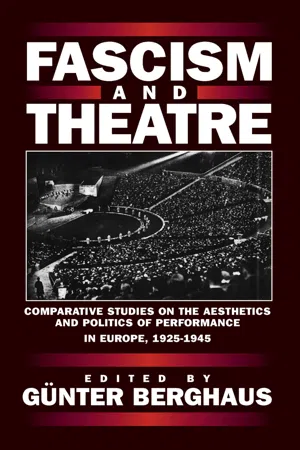 eBook - PDF
Fascism and Theatre
Comparative Studies on the Aesthetics and Politics of Performance in Europe, 1925-1945
- Günter Berghaus(Author)
- 1996(Publication Date)
- Berghahn Books(Publisher)
12 This concept led Fascism to assert the supremacy of mythical thought in mass politics. Il popolo d’Italia maintained that the true force of a political movement came from the suggestive potency of its myths, which would propel people to live and die for it. 13 The Fascist leadership was fully aware of the connection between myth, symbol and rite as a necessary precondition to instil and keep alive a collective faith. The Fascists had probably learnt the lesson of Le Bon, an author much admired by Mussolini: ‘A reli-gious or political belief is based on faith, but without rites and symbols, faith would not last.’ 14 They knew that the masses could be more enthused by ‘a beautiful symbol than a mediocre reality of fact’. 15 The dramatisation of myth by means of collective cere-monies was therefore essential to the politics of Fascism, which primarily aimed at moulding the Italian masses and transforming them into a community of believers : In its celebration of solemn rites in accordance with austere, simple and strong forms, which themselves have so much fascination sim-ply through their single exterior appearance, Fascism itself, even before Art, has given aesthetic expression to the new myth by which it shall speak more profoundly to hearts and minds. (...) But today, when classical mythology is perhaps more than ever a sign of cultural dilettantism and artificial symbolism, a whole new mythology adorns the immense Pantheon of our faith. 16 Theatre of Politics in Fascist Italy 75 The rites of communion of the Fascist action squads From its very inception, Fascism developed its own political style and placed particular emphasis on the theatrical aspects of its public events. The Fascists boasted that they had restored the so-called ‘art of mass ceremonies’. On the eve of the March on Rome, Il popolo d’Italia proclaimed: Public demonstrations before Fascism were extremely anti-aes-thetic.
Index pages curate the most relevant extracts from our library of academic textbooks. They’ve been created using an in-house natural language model (NLM), each adding context and meaning to key research topics.

