History

Nazi Collaboration
Nazi collaboration refers to the cooperation or support provided by individuals, groups, or governments in Nazi-occupied territories during World War II. This collaboration took various forms, including military, political, and economic assistance to the Nazi regime. It often involved local authorities or organizations working with the Nazis to implement their policies, including the persecution and extermination of Jews and other targeted groups.
Written by Perlego with AI-assistance
Related key terms
1 of 5
11 Key excerpts on "Nazi Collaboration"
 eBook - ePub
Dangerous Liaisons
Collaboration and World War Two
- Peter Davies(Author)
- 2014(Publication Date)
- Routledge(Publisher)
8 As will become apparent in due course, this book also seeks to analyse collaboration as a broad, multi-faceted phenomenon rather than as something with stricter parameters.Up until now, we have focused almost exclusively on collaboration at the ‘top’ of society. However, in many states, the reality of the wartime situation was that ordinary people, groups and institutions, as well as political leaders and governments, had to wrestle with the ethical dilemma that could be summarised in the following question: to collaborate or not? Alternatively, they could take up a position somewhere in between.Ordinary people going about their normal everyday lives were forced to address the most terrible of quandaries. To frequent café bars used by German soldiers, or not? To form relationships, whether platonic or sexual, with representatives of the Nazi regime, or not? To trade with, and make money out of, the occupiers, or not?Likewise, across Europe, social groups and institutions had to examine their collective consciences. The Church: should it grant any legitimacy at all to Hitler and his puppet leaders? Trade unions: should they simply make way for Nazi-style industrial relations? The press: should it simply toe the line of (or put less kindly, ‘sell out to’) the rigorous censorship regime imposed by the occupying authorities? At the time, these were major dilemmas, and from the relative comfort of the twenty-first century, with hindsight on our side, we should not belittle their scale and gravity. The end result was a lot of ‘grey’. Only a minority of people engaged in full-blown collaboration; only a minority could claim to have avoided any contact with the Germans. eBook - ePub
World War Two
Crucible of the Contemporary World - Commentary and Readings
- Lily Xiao Hong Lee(Author)
- 2016(Publication Date)
- Routledge(Publisher)
Part II Life under Nazi Occupation: Collaboration and the Holocaust- Introduction
- 3. Collaboration and Cooperation Jan Thomasz Gross
- 4. Conclusion: Collaborationist Profiles Bertram M. Gordon
- 5. The Final Solution Michael R. Marrus
- Further Reading for Part II
The precipitous German takeover of Western Europe from Norway to the Pyrenees in the late spring of 1940 shook western civilization to its core. It also brought on an unexpected new phenomenon of apparently willing cooperation with the enemy. Resistance to the Germans that summer was sporadic and easily contained. Commentators quickly refurbished the neutral word collaboration to let it now signify shameful cooperation with the enemy. This meaning soon established itself in most European languages and in popular usage. Collaboration and resistance, which at about the same time also took on a new connotation as an organized, covert opposition to German rule, became the twin poles of response to the German occupation.Certainly, cooperation with the enemy was not new—how else could one explain the growth of the European territorial states throughout the last few centuries as they incorporated new populations into previously foreign regimes? What was new was that in an age in which nationalism reigned supreme, collaboration spread so rapidly and settled in almost naturally as the norm, at least in Western Europe. Moreover, the Germans were greeted by vocal fascists and racists whose enthusiasm for Nazism was exceeded only by their own ambitions for a New Order at home. That this ideological commitment to a fascist Europe, which was largely compounded from the illusions of an odd assortment of local, radical rightists, played no important part in German plans suggests that the phenomenon of collaboration reflected a deep malaise in European society. When coupled with its opposite, the resistance, it supports the notion that the Second World War was in some respects a civil war within European nations as well as a struggle against the occupier. eBook - PDF
The Kings and the Pawns
Collaboration in Byelorussia during World War II
- Leonid Rein(Author)
- 2011(Publication Date)
- Berghahn Books(Publisher)
C HAPTER 1 C OLLABORATION IN O CCUPIED E UROPE : T HEORETICAL O VERVIEW R A study that aims to analyze the various forms of collaboration in Byelorussia under Nazi occupation requires two preliminary steps by way of introduction: the first is to define the term col-laboration, and the second, to compare the phenomenon of col-laboration in various countries under German occupation during World War II. Both of these goals are pursued in the brief description provided in this chapter, since a detailed compara-tive analysis is beyond the scope of this volume. Defining the Collaboration “Was Kollaboration ist, weiß jedermann,” wrote German histo-rian Hans Lemberg ironically in an article published in 1972. 1 Yet, to this day, historians focusing on this topic have not reached an agreement on the exact definition of the term col-laboration nor on the activities that this term encompasses. The term as used in this work was first coined in a radio address to the French nation by the aged Marshal Pétain, the head of the Vichy regime, after his meeting with Hitler in Montoire-sur-le-Loir in October 1941. Pétain stated then that “collaboration had been envisaged between our two countries [that is, France and Germany—L.R.]” and that he “accepted it in principle.” 2 What Pétain meant by “collaboration” was an arrangement between victorious Germany and defeated France, by which the latter wished to preserve as much independence as possible. 3 As the occupation continued, the activities that could be defined as collaboration between victors and vanquished proceeded from the macro, i.e., the interstate level, to the micro, affecting spheres of life such as culture, the economy, and the individual. Such activ-ities were not peculiar to France but were part of the occupation reality in every country that found itself under Nazi rule. Never-theless, as the Polish historian Czes ∏ aw Madajczyk demonstrated, during World War II the term collaboration as such was not widely used. eBook - ePub
Complicated Complicity
European Collaboration with Nazi Germany during World War II
- Martina Bitunjac, Julius H. Schoeps, Martina Bitunjac, Julius H. Schoeps(Authors)
- 2021(Publication Date)
- De Gruyter Oldenbourg(Publisher)
In all of these countries different kinds of opposition and resistance to the ambitions and presence of Nazi Germany took place, and in all of them various forms of cooperation with Nazi Germany also took place. Readers who seek insights into the complexities of how each of the countries more specifically related to Nazi Germany during World War II are referred to the many very careful and detailed empirical research studies there are in each of the countries on both their respective resistance movements and collaborationism. 1 For the purpose of the present analysis, it will suffice to present a rough summary. Many elements of resistance and collaborationism that – from other perspectives than adopted for the purpose of this article – might be quite salient in the history of the respective nation will not be reported in this article. Collaborationism: Offensive and Defensive Cooperation Collaborationism refers to cooperation with the enemy against your own country in wartime. Usually it is regarded high treason. “Traitorous cooperation with the enemy” is a term often used with reference to the French Vichy Government, which cooperated closely with the Nazis from 1940–1944. Stanley Hoffman in his classic work on collaborationism in France (1968) 2 subdivided collaboration into involuntary, meaning reluctant recognition of the necessity to cooperate, and voluntary. Another distinction can be made between forced and ideological collaborationism. Both of these comprise deliberate services to an enemy. Whereas the first kind is service to an enemy based on perceived necessity for survival or avoidance of suffering, the second kind, ideological collaborationism, is advocacy for cooperation with an enemy power because this is seen as a champion of some desirable domestic transformations. The terms “collaborationism” and “collaboration” in the present essay will be used without any immediate implications of treason eBook - ePub
- Gelinada Grinchenko, Eleonora Narvselius, Gelinada Grinchenko, Eleonora Narvselius(Authors)
- 2017(Publication Date)
- Palgrave Macmillan(Publisher)
11Apart from this institutional network of collaboration we should also mention the armed units of resistance of various political orientations, which fought against the Nazis but sometimes, for various reasons, persecuted the victims of the Nazi terror. There were also the regular men and women who tried to secure their existence under the German occupation of their country, and in some circumstances collaborated, either actively (for example by reporting the presence of Roma) or passively (for example by not offering assistance to those who tried to find a shelter). Eventually, in some rare situations, there were Roma people who collaborated with the Nazis in the persecution of their brethren.9.2 Forms of Collaboration
The phenomenon of collaboration should be perceived as a complex one and involving the whole spectrum of activities and attitudes located between ardent resistance and enthusiastic support of Nazi rule based on ideological affinity.12 Even the extremes of this spectrum could be morally ambiguous because it happened sometimes that anti-Nazi fighters acted violently against the victims of the Nazis and, on the other hand, individuals who had been part of collaborating institutions sometimes offered assistance to those victims.It seems, therefore, that it would be useful to develop the concept of collaboration in the genocide of the Roma as an interactive, negotiable process of changing and often contingent dynamics,13 in which we experience intertwined layers of personal, local, and institutional policies or initiatives. This approach takes up the proposal of “re-examining the concept of collaboration,” expressed in the introduction to this volume (Chap. 1 ), in line with Jan T. Gross’s idea of the “interactive nature of betrayal”.14 No longer available |Learn more
- (Author)
- 2014(Publication Date)
- Research World(Publisher)
________________________ WORLD TECHNOLOGIES ________________________ Chapter-6 Collaboration with the Axis Powers during World War II Within nations occupied by the Axis Powers, some citizens, driven by nationalism, ethnic hatred, anti-communism, anti-Semitism or opportunism, knowingly engaged in collaboration with the Axis Powers during World War II . Some of these collaborationists committed the worst crimes and atrocities of the Holocaust. Collaboration ranged from urging the civilian population to remain calm and accept foreign occupation without conflict, organizing trade, production, financial and economic support to joining various branches of the armed forces of the Axis powers or special national military units fighting under their command. Requirements for collaboration The Nazis did not consider everyone equally fit for cooperation. Even people from closely related nations were often valued differently in accordance with Nazi racial theories. The Jews were considered to be worst of all nations and thus unfit for cooperation, although some were used in concentration camps as Kapos to report on other prisoners and enforce order. Others governed ghettos and helped organize deportations to extermination camps (Jewish Ghetto Police). By country Albania In April 1943, Reichsfuhrer -SS Heinrich Himmler created the 21st Waffen Mountain Division of the SS Skanderbeg (1st Albanian) manned by Albanian and Kosovar Albanian volunteers . From August 1944, the division participated in operations against Yugoslav partisans and local Serbs. The discipline in the division was poor, so, in the ________________________ WORLD TECHNOLOGIES ________________________ beginning of 1945, it was disbanded. The emblem of the division was a black Albanian eagle. Belgium The 373rd infantry battalion of Wehrmacht, manned by Walloon Belgians, took part in anti-guerrilla actions in the occupied territory of the USSR from August 1941-February 1942.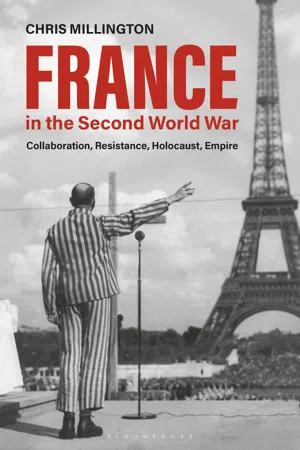 eBook - ePub
France in the Second World War
Collaboration, Resistance, Holocaust, Empire
- Chris Millington(Author)
- 2020(Publication Date)
- Bloomsbury Academic(Publisher)
As some French believed in 1940, it was a collaboration between a farmer and his pig. 5 Collaboration took a number of forms. Stanley Hoffmann termed the collaboration between the Vichy regime and the Occupier ‘state collaboration’ or ‘collaboration d’Etat’. Historians have identified other forms of collaboration, from ideological imitation (termed ‘collaborationism’) to economic, military, sexual and emotional collaboration. The term ‘collaboration’ itself is therefore problematic. The word is a blunt instrument and a label whose association with co-operation between the Axis powers and indigenous populations during the Second World War has rendered it ‘synonymous with treason’. 6 Such an understanding both obscures the many motivations behind the behaviour and implies a value judgement based on its opposition to the virtue of ‘resistance’. Vesna Drapac and Gareth Pritchard have argued that ‘[t]he historiography of World War II has never escaped from this need to identify resisters to celebrate and collaborators to castigate’. 7 Consequently, in the case of France, Philippe Burrin casts doubt on the validity of the term ‘collaboration’ in contexts other than the political, seeing in it a tool used to denounce, blacken and tarnish. Burrin contends that some form of co-operation between French and Germans was inevitable because a whole nation cannot resist. He prefers the word ‘accommodation’, defined as, ‘a regular phenomenon in almost any occupation, where certain points or interfaces of contact are inevitably created and some adjustment to the new situation has to be made’, to better describe Franco-German relations during the Second World War. 8 Burrin in turn defined different forms of accommodation. Structural accommodation allowed the country to continue to function; it encompassed, for example, the continued delivery of public services such as the mail. Deliberate accommodation looked to assist the policy of the Occupier, whether directly or indirectly No longer available |Learn more
- (Author)
- 2014(Publication Date)
- College Publishing House(Publisher)
________________________ WORLD TECHNOLOGIES ________________________ Chapter 12 Collaboration with the Axis Powers during World War II Within nations occupied by the Axis Powers, some citizens, driven by nationalism, ethnic hatred, anti-communism, anti-Semitism or opportunism, knowingly engaged in collaboration with the Axis Powers during World War II . Some of these collaborationists committed the worst crimes and atrocities of the Holocaust. Collaboration ranged from urging the civilian population to remain calm and accept foreign occupation without conflict, organizing trade, production, financial and economic support to joining various branches of the armed forces of the Axis powers or special national military units fighting under their command. Requirements for collaboration The Nazis did not consider everyone equally fit for cooperation. Even people from closely related nations were often valued differently in accordance with Nazi racial theories. The Jews were considered to be worst of all nations and thus unfit for cooperation, although some were used in concentration camps as Kapos to report on other prisoners and enforce order. Others governed ghettos and helped organize deportations to extermination camps (Jewish Ghetto Police). By country Albania In April 1943, Reichsfuhrer -SS Heinrich Himmler created the 21st Waffen Mountain Division of the SS Skanderbeg (1st Albanian) manned by Albanian and Kosovar Albanian volunteers . From August 1944, the division participated in operations against Yugoslav partisans and local Serbs. The discipline in the division was poor, so, in the beginning of 1945, it was disbanded. The emblem of the division was a black Albanian eagle. ________________________ WORLD TECHNOLOGIES ________________________ Belgium The 373rd infantry battalion of Wehrmacht, manned by Walloon Belgians, took part in anti-guerrilla actions in the occupied territory of the USSR from August 1941-February 1942.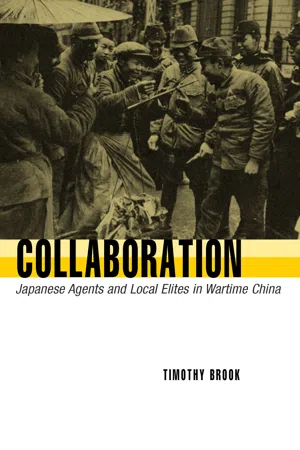 eBook - PDF
Collaboration
Japanese Agents and Local Elites in Wartime China
- Timothy Brook(Author)
- 2007(Publication Date)
- Harvard University Press(Publisher)
The term leaves no middle range between innocuity and damnation, no space in which ambiguity might arise, no reason to look back and ask what might actually have been going on. With the flood of interest since the 1980s in wartime collaboration in Europe have come disputes as to where the boundaries of the word “col-laboration” lie. At its broadest extreme, the word is allowed to cover all manner of cooperation, active or passive, shown to the occupier; anything, in fact, that enables an occupation to continue. At the far opposite extreme lies the narrowest definition that restricts the use of the word to supportive engagement in the tasks and ideology of the occupier, for which the more specialized “collaborationism” has been proposed. 10 The first definition has the disadvantage of leaving no alternative position for ordinary people who had no choice in the matter: everyone under the condition of occupa-tion becomes a collaborator. The invention of “collaborationism” to tag willing collaboration protects most people under an occupation state from the charge of selling out their country, but it does not make the more usual type of collaboration—selling not to the highest bidder but to the only au-thority doing the bidding—disappear as a problem. Indeed, differently construed, this isolation of activists as a separate category has left the way open for a universal condemnation of everyone who survived the war, not just the occupied. Pushed to an extreme, all Germans become “Hitler’s willing executioners,” as one historian of the Holocaust has argued. The same logic could be used to charge the majority of French who accepted German rule as “Pétain’s willing collaborators.” 11 Widespread complicity gets totalized into an explanation for the Holocaust that looks in the mir-ror of the Final Solution and sees Germans as the Final Problem—and, if we look deeply enough, the Vichy French as well: pure victims getting the pure victimizers they require. eBook - ePub
Treason
Meanings and Motives
- Eric Carlton(Author)
- 2019(Publication Date)
- Routledge(Publisher)
Chapter Seven Treason and Accommodation: Dutch Collaboration under Nazi Pressure One authority on collaboration in Nazi-occupied Europe (Rings: 1982) suggests the following typology:- Neutral collaboration, as was to be found in Holland and Belgium.
- Unconditional collaboration, as was the case of Quisling in Norway.
- Conditional collaboration, the sort of thing to be found in Czechoslovakia under Reinhard Heydrich (assassinated May 1942).
- Tactical collaboration, as was to be seen in Denmark.
- 5. Symbolic resistance, which amounts to signalling one's reluctance to cooperate with the enemy.
- 6. Polemical resistance, including organized protests, strikes and so forth.
- 7. Defensive resistance, which is much like (6) but extends to support for prisoners, and the production of subversive publications.
- 8. Offensive resistance, such as sabotage and assassination.
This fairly straightforward typology is useful in a limited sort of way; the snag is that the categories necessarily overlap and it is rather simplistic in that actual situations in the countries that Rings cities were very much more complex than the typology would indicate - a point which Ring's text acknowledges. These issues are well exemplified by the wartime situation in Holland which had always had generally good relations with Germany, and which in terms of the proportion of its overtly co-operative citizens ranks high on the collaborationist list.Various kinds of Fascist-cum-national socialist organizations had existed in Holland well before Hitler's takeover of power in Germany in January 1933. There were several minor parties which only attracted a tiny number of adherents, but overshadowing these were two major parties which were able to recruit on a disturbingly large scale. Although alike in a number of respects, they differed in certain significant ways. eBook - PDF
Consumed by War
European Conflict in the 20th Century
- Richard C. Hall(Author)
- 2014(Publication Date)
- The University Press of Kentucky(Publisher)
Chapter 11 COLLABORATION, NEUTRALITY, RESISTANCE, AND GENOCIDE At the onset of the second European war, the Germans had begun to dominate eastern European economics. After their victories in eastern and western Europe in the first year of the war, the Germans exercised an unprecedented control over all of Europe. Never in European history had any one power dominated the continent to such an extent. In this way, Nazi Germany surpassed even Napoleonic France. German domination of Europe increased after the June 1941 invasion of Soviet Russia, when large areas of that country came under the direct rule of German civilian or military authorities. The year 1942 marked the acme of German control of Europe. After the defeat at Stalingrad, the proportion of Europe under direct or indirect German rule steadily diminished. It did not entirely disappear, however, until the end of the war. Collaboration In addition to direct rule and military and economic alliances, the Ger- mans maintained control through the collaboration of individuals residing in countries overrun by German armies. The Germans annexed parts of the sovereign states of Czechoslovakia, France, Lithuania, Poland, and Yugoslavia. They established alliances with Bulgaria, Croatia, Denmark, Hungary, Italy, Romania, Slovakia, and Spain. Notable collaborationist regimes emerged in France, Greece, Norway, and Serbia. Finally, indi- viduals from all over Europe assisted and supported the Germans' control of Europe by various means, often by serving in German-sponsored mili- tary formations. The largest number of these individuals came from Soviet Russia. Hitler's Greater Germany expanded considerably beyond the Wei- 172 Consumed by War mar frontiers and even beyond those of the Second Reich. To the Weimar frontiers Hitler had appended Saarland, Austria, Sudetenland, Eupen and Malmedy, Alsace-Lorraine, Luxembourg, Danzig, Memel, and parts of western Poland and northern Slovenia.
Index pages curate the most relevant extracts from our library of academic textbooks. They’ve been created using an in-house natural language model (NLM), each adding context and meaning to key research topics.

