Politics & International Relations

Eco Fascism
Eco-fascism is a political ideology that combines elements of environmentalism with authoritarianism and ethnonationalism. It often promotes the idea of preserving the environment through extreme measures, including population control and the exclusion of certain groups from environmental resources. Eco-fascism has been criticized for its dangerous and discriminatory implications, as it seeks to prioritize the environment at the expense of human rights and equality.
Written by Perlego with AI-assistance
Related key terms
1 of 5
5 Key excerpts on "Eco Fascism"
 eBook - ePub
- Imogen Richards, Gearóid Brinn, Callum Jones(Authors)
- 2023(Publication Date)
- Routledge(Publisher)
However, the most critical aspect of ecological fascist groups, as evidenced poignantly in the Australian context, is that the underlying logic of much of the violence in question is centred on the re-establishment of ‘white power’, not a holistic preservation of ecology. Where holistic ecological preservation emphasises the sustainable interdependence between humans and non-human elements, contemporary ecofascists adopt an interpretation of ecology in which ‘we are all connected’, but this connection is characterised by death, destruction and domination, predicated on spurious ‘natural hierarchies’ (Eatwell 1996 ; Staudenmaier 2021). The following chapter shifts focus to consider the ideological landscape that gives rise to various right-wing climate responses within the Australian setting. Providing a critical examination of the origins of climate change denialist ideologies, it examines how Global North exclusivity and dominance in relation to the impacts of global heating are maintained and supported by political messaging in Australian news and political media industries. The analysis specifically investigates how denialism, delay and obfuscation in relation to the anthropogenic causes and impacts of global heating are both supported by and persist through these institutions’ historical and continued backing of fossil fuel industries. Notes Griffin (2003) describes how the ‘groupuscular right’ represents the extreme right’s sophisticated transnational adaptation towards metapolitical strategies, away from party political ones, after 1945, which allowed ultranationalist groups to persist despite attempts to suppress them eBook - PDF
Environmental Political Thought
Interests, Values and Inclusion
- Robert Garner(Author)
- 2018(Publication Date)
- Bloomsbury Academic(Publisher)
Elements of the National Socialist party in Germany, for example, displayed some concern with ecological issues from the 1920s and, having gained power, the Nazis were environmentally active, setting up nature reserves and experimenting with alternative forms of energy, among other things. There are ideological similarities between ecologism and fascism too. As Hay ( 1988 : 23), points out: ‘Use of biological met-aphors, stress on the organic community and the individual’s need to merge with it, elevation of ritual, intuition and the mystical, and distrust of the rational’ are all elements that can be found in both Green writing and fascist ideology. However, it is wrong to take the association too far. As Andrew Vin-cent ( 1993 : 266) comments: ‘Because national socialists used socialist methods or favoured ancient German traditions does not mean that either socialism or conservatism are eternally besmirched. The same qualification holds for ecology.’ When critics label Green thinking as fascist they are more often than not referring to the authoritarian strain that does exist in some Green writing. This authoritarian strand, par-ticularly prevalent in the 1970s, emphasises the need for drastic coercive solutions – particularly in the areas of reducing consumption and cutting population size – thought necessary to deal with the severity of the envi-ronmental crisis (Hardin, 1968 ; Heilbroner, 1974 ; Ophuls, 1973 ). These accounts tend to be based on a Hobbesian model of Man as ultimately selfish and individualistic, requiring an authoritarian state (the Levia-than) to keep order (see Box 9.2 ). Box 9.2 Hardin and the Tragedy of the Commons One well-known exponent of an authoritarian solution to the envi-ronmental crisis is Garrett Hardin, whose articles ‘The Tragedy of the Commons’ and ‘Living on a Lifeboat’ (1968, 1977) are among the Continued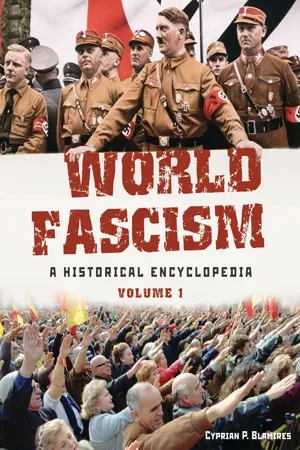 eBook - PDF
World Fascism
A Historical Encyclopedia [2 volumes]
- Cyprian Blamires(Author)
- 2006(Publication Date)
- ABC-CLIO(Publisher)
1972. Myth of the Master Race: Alfred Rosenberg and Nazi Ideology. London: Batsford. Clark, J. M. 1949. The Great German Mystics: Eckhart, Tauler and Suso. Oxford: Blackwell. Whisker, James B. 1990. The Philosophy of Alfred Rosenberg. Newport Beach, CA: Noontide. Woods, R. 1990. Eckhart's Way. Collegeville, MN: Liturgical Press. ECOFASCISM: See ECOLOGY ECOLOGY Although usually associated with newer forms of leftwing politics and social movements, ecological thought also has a distinctive rightwing variant that intersects with fascism and neofascism. Like many of their leftwing counterparts, political ecologists of the extreme Right suggest that global capitalism and a culture of consumerism have led to an environmental crisis characterized by massive destruction of the natural world. Similarly, too, both argue that the roots of this environmental crisis are to be found in the ways in which modern humans (especially those in the West) conceptualize their place in nature and carry out practices based on such understandings. Finally, both draw upon concepts and models of modern ecological science to frame their politicalecological worldview and to argue for particular solutions. Yet the left and rightwing varieties of ecological thought part ways dramatically over the theoretical conclusions that can be drawn from these assumptions, as well as the practical solutions needed to halt the crisis. According to what can be called "rightwing ecology," different human cultures are shaped by unique geographic and environmental features. eBook - ePub
Destroying Democracy
Neoliberal capitalism and the rise of authoritarian politics
- Jane Duncan, Linda Gordon, Gunnett Kaaf, Dale T McKinley, Alf Gunvald Nilsen, Devan Pillay, Mandla J Radebe, Alfredo Saad-Filho, Ingar Solty, Michelle Williams, Vishwas Satgar, Michelle Williams, Vishwas Satgar(Authors)
- 2021(Publication Date)
- Wits University Press(Publisher)
1944 ), the countermovement of fascism, the New Deal and Soviet planning emerged as a response to marketisation. Western-centred capitalism did not learn the lessons of market-driven economics from the late nineteenth century and how it contributed to World War I. Instead, it repeated the same mistake in the 1920s and reinstated the market-centred gold standard as the basis for international trade and finance. This led to World War II. In 2007, almost three decades of marketisation produced the worst financial crash in modern history. After massive bailouts to the US-centred financial system and Obama in the White House, it was business as usual. The poor were declared ‘big enough to fail’, homelessness shot up due to repossessions, and stabilisation and austerity policies became the norm in a volatile global financial system. Neoliberalism (as a class project of financial and transnational capital) took its next big leap from market democracies (hegemonic from 1980 to 2000 and co-optive from 2000 to 2007) in the liberal world to authoritarian market democracies in the global North and South: Trumps' USA, Poland, Turkey, Israel, Italy, Brazil (largest democracy in Latin America), Philippines, Australia and India (largest democracy in the world). Hard-right parties and movements have also broken into the mainstream in countries such as France and Germany. In Bolivia a coup in 2019 deposed a democratically elected indigenous president and US-supported destabilisation of Venezuela continues by right-wing forces.In March 2019, a mass shooter in Christchurch, New Zealand, killed 51 people and declared he was an eco-fascist. Similarly, on 28 July 2019 a man killed three people at Californias' Gilroy Garlic Festival motivated by environmental concerns, and on 3 August 2019 a gunman killed 22 people at an El Paso, Texas, Walmart and provided a link to environmentalism in his manifesto. These killings by hard-right extremists break with the climate crisis denialism of the Trump current within hard-right neoliberalism, but at the same time share a conception of migration as a problem. For these more eco-conscious fascists, population causes environmental problems and hence migrants/immigrants are objects of hate (Achenbach 2019 ; Hansman 2019 ).This idea as part of white nativist nationalism dates back in the US to the late nineteenth century, when conservationists believed that race purity was also about purity of the land, and hence Native Americans could not be part of conservation spaces. Hitler and the Nazis also had romantic conceptions of ‘blood and soil’ and romanticised the agrarian past. Their relationship to modernity was also contradictory, rejecting aspects but also embracing the technological and scientific side of it. The ‘greening of hate’ has historical roots but is also expressing itself ideologically in a new context.A new contemporary fascism is on the march in the world, different from twentieth-century fascism. It has continuities and discontinuities and sometimes expresses itself in unprecedented ways, thus posing a methodological challenge in how it is analysed. The dominant understandings of fascism in historical sociology and political science are derived from the interwar years of the twentieth century. These definitions, ideal types and models are blunt instruments to understand contemporary fascism. Instead, it is crucial to historicise and situate contemporary fascism to appreciate its specificity. The approach adopted in this chapter is based on three methodological premises (Satgar 2019 : 588–591). First, contemporary fascism can be understood not through transhistorical definitions but rather through a definitional approach that does not define fascism but situates it in relation to capitalism. This means: ‘It is a tendency within the monopoly and contemporary transnational techno-financial stages of capitalism, enabled by particular conditions of crisis and takes on an organized form as part of the struggle to achieve a monopoly on state power’ (Satgar 2019 eBook - PDF
- Andrew Vincent(Author)
- 2009(Publication Date)
- Wiley-Blackwell(Publisher)
For historical reasons, socialism (and thus eco-socialism) has declined as a viable ideological option since the late 1990s. This has, in consequence, led to a spate of writings focusing on the relation between ecology and conventional social liberal concerns: for example, social justice, civil and human rights, active citizen-ship and deliberative conceptions of democracy. All these issues have been under intense discussion over the last decade, primarily as integral to a social liberal vision of a constitutional ecological state (see, for example, Gillroy 2002; Minteer and Taylor eds 2002; Baxter 2004; Bullard 2005; Dryzek 2005; Dobson 1998, 1999 and 2006; Schlosberg 2007). It is worth noting, though, that there are still many unre-solved difficulties with the extension of terms like justice, citizenship, rights or democracy to the environment. 32 One final, much smaller group are the eco-capitalists (Elkington and Hailes 1988; Elkington and Burke 1989; Anderson and Leal 2001). Again, this perspective sees the state forming a minimalist rule-of-law background to the basic procedures of the market and consumer choice to protect the environment. By definition this perspec-tive views the state as having an important but strictly limited role. Eco-capitalism, in effect, utilizes the more classical liberal and right-wing libertarian vision of the minimal state, as discussed in chapter 2. It also places a tremendous weight upon role of the free market as the way of resolving economic, political and environmental issues. It should be noted that many critics, including more social liberal environ-mentalists, see this conception of classical liberalism and capitalist free markets as undermining ecology. 33 The second political vision – of the frugal-sustainable society – is most character-istic of the deep ecologists. It is a society devoted to what Erich Fromm called a ‘being’ as opposed to a ‘having’ society (see Fromm 1979).
Index pages curate the most relevant extracts from our library of academic textbooks. They’ve been created using an in-house natural language model (NLM), each adding context and meaning to key research topics.

