Politics & International Relations

Ethnic Nationalism
Ethnic nationalism is a political ideology that emphasizes the importance of a shared ethnic identity as the basis for a nation. It often promotes the idea that a particular ethnic group should have its own independent political and territorial entity. This ideology can lead to exclusionary policies and conflicts, as it prioritizes the interests of one ethnic group over others within a society.
Written by Perlego with AI-assistance
Related key terms
1 of 5
10 Key excerpts on "Ethnic Nationalism"
 eBook - PDF
Nationalism in International Relations
Norms, Foreign Policy, and Enmity
- D. Woodwell(Author)
- 2007(Publication Date)
- Palgrave Macmillan(Publisher)
PART I CHAPTER 2 NATIONALITY, NATION, AND ETHNICITY D ue to the role nationalism plays in international relations, patterns of increased hostility between states often arise when those states share a common national group. In reviewing alternate understandings of nationalism, this chapter establishes the central common elements that make the concept an important causal factor in modern international relations. In particular, it seeks to provide an understanding of nationalism that is both parsimonious enough to be analytically useful, yet broad enough to provide explanatory leverage over a wide variety of situations. The chapter first establishes how nationalism, which represents the injection of politics into a cultural context, differs from the apolitical concept of ethnicity. Next, the chapter looks at the conditions leading from the development of communal nationalist preferences to the translation of such preferences into potentially revi- sionist state behavior within the international arena. Finally, the chapter examines why members of the international communal are selectively tolerant of such chal- lenges to the status quo due to the normative ambiguity surrounding the concept of national self-determination. The politics of nationalism is the politics of identity. Webster’s New Dictionary and Thesaurus lists one definition of identity as “who or what a person is.” Such a broad conception, however, does not do justice to the constructivist aspects of social identity. As a social construct, identity is necessarily a relative term—one cannot form self-identity without gauging ones traits vis-à-vis others whom one observes. Views of identity concerning one’s self and others form through a process of social comparison that results in perceptions of distinctiveness as well as similarity and connection. Some group identities, such as those based on political affiliation or class, are apt to change from generation to generation—or within a given generation. eBook - PDF
Ethnicity as a Political Resource
Conceptualizations across Disciplines, Regions, and Periods
- (Author)
- 2015(Publication Date)
- transcript Verlag(Publisher)
The link between ethnicity and politics is not a historically new phenomenon. The question of whether ethnically based claims should be considered socially important, and, if so, how this should be achieved and regulated, is a fundamental political question, and has undergone several conjunctures and variations throughout history. An important break in this history of the intertwining of ethnicity and politics is the birth of modern nationalism. During the late 18th and early 19th centuries the creation of the nation state was accompanied by the “invention of the ethnic paradigm” (Kaschuba 2006: 139 – 143). For over a century, it was taken for granted, first in Europe and then in America, that the territorial unity of the nation-state should be based on the correspondence of ethnic and political boundaries. But in other parts of the world too, the entanglement of ethnicity and politics was the model for the founding, political design, and reform of states. In the decolonization process in Africa and Asia during the 1960s, the last global boom of this political doctrine can be observed (Smith 1983). But since the 1970s, the ideal of the ethnic homogeneity of the nation-state was increasingly questioned by various social movements worldwide. By the 1990s, the protection of minorities, multiculturalism, and pluriethnicity had become key concepts within global political debates. Following Max Weber (1976) the concept of ethnicity refers to the belief that the cultural identity of a person or a group is based on the idea of belonging to a specific community of descent. It should be emphasized that ethnic and other social identities are essentially based on a combination of self-perception and external attribution. eBook - PDF
Constructing Ethnopolitics in the Soviet Union
Samizdat, Deprivation and the Rise of Ethnic Nationalism
- D. Zisserman-Brodsky(Author)
- 2003(Publication Date)
- Palgrave Macmillan(Publisher)
And finally, there are colour and “pan”- nationalisms, still a vital force in some parts of the world. 49 Within the broad range of nationalist developments one important trend should be indicated, namely, the shift from “civic” or “state nationalism” of the nineteenth century 50 to “ethnic” or “sub-state nationalism” of the twen- tieth century. “An idea of the nation as an association of citizens each pos- sessing certain rights which should be guaranteed and safeguarded by the state” 51 dominated the nationalist doctrines of the nineteenth century. In the twentieth century, particularly in its second half, the “national unit,” or nation is predominantly described in ethnic terms. “In brief, nationalism is a theory of political legitimacy, which requires that ethnic boundaries should not cut across political ones, and, in particular, that ethnic boundaries within a given state . . . should not separate the power-holders from the rest.” 52 This description not so much defines nationalism, but rather traces realities of our time, indicating both ethnic stratification and politicization along ethnic lines. This is because ethnic revival has, since the late 1960s, become a world- wide phenomenon, 53 central to the political arena not only in the countries possessed of long-standing state structures, but in the newly established states of Asia and Africa, which gained their independence under the banner of anti-colonial nationalism. Today, nationalist movements are primarily ethnic movements, which tend to be defined “as referring to the efforts of ethnic groups, which are not identified with the state to reshape state structures . eBook - PDF
Introduction to Comparative Politics
The State and its Challenges
- Robert Hislope, Anthony Mughan(Authors)
- 2012(Publication Date)
- Cambridge University Press(Publisher)
This is especially the case when political parties organize around ethnic cleavages. Ethnic parties often gain electoral advantage by raising the temperature of ethnic relations and saturating the national discourse with a rhetoric based on interethnic 205 206 INTRODUCTION TO COMPARATIVE POLITICS suspicion, stereotype, and chauvinism. Under these circumstances, a polity can expect little relief from ethnic tensions. At its most extreme, Ethnic Nationalism promotes secession, which is a political act designed to divide the territory of the state so as to allow the aggrieved group to acquire its own independent state. The desire of ethnic groups to signal their political independence by possessing their own state is a powerful political goal encapsulated neatly in the slogan of the nineteenth-century Italian nationalist Giuseppe Mazzini, “for every nation a state.” This goal still resonates around the globe today. It is also true that states challenge ethnic groups just as much as the other way around. Dominant groups who rule the state are frequently loath to concede equal recognition to minorities for fear that it will jeopar-dize their constitutional monopoly of sovereignty and undermine their sta-tus as the preeminent national grouping within the state. Consequently, such groups are commonly the main promoters of ethnic tension and per-petrators of violence. Programs of genocide and expulsion are typically the work of states, or of actors and groups who enjoy state support. States can also act as third-party instigators and interveners who stir the ethnic cauldron of neighboring states in the hope of benefiting coethnics who reside in them. In sum, the state is a both a prized object and repressive agent over and against which ethnic groups struggle in their demand for rights, recognition, and self-rule. This chapter explores the multiple and complex frictions between Ethnic Nationalism and states in the modern world. eBook - PDF
- Don Doyle, Marco Pamplona(Authors)
- 2010(Publication Date)
- University of Georgia Press(Publisher)
Nationalism, then, is the use of the category “nation” to organize perceptions of basic human identities, grouping people together with fellow nationals and distinguishing them from members of other nations. It is influential as a way of helping to produce solidarity within national categories, as a way of deter-mining how specific groups should be treated (e.g., in terms of voting rights or visas and passports), and as a way of seeing the world as a whole. We see this representation in the different colored territories on globes and maps and in the organization of the United Nations. At the same time, clearly the boundaries of nations are both less fixed and more permeable than nationalists commonly recognize. Central to nationalist discourse is the idea that there should be a match be-tween a nation and a sovereign state; indeed, the nation (usually understood as nationalism matters 27 prepolitical and always already there in historical terms) constitutes the ground of the legitimacy of the state. This is Kedourie’s point in the passage I quoted near the beginning of this chapter. Ernest Gellner likewise avers that national-ism is “a political principle, which holds that the political and the national unit should be congruent.” 25 Yet nationalism is not merely a “political principle,” and its reproduction is a matter of banal practices (Olympic competitions, pace Michael Billig) and imaginative construction (museums, censuses, and habits of reading, pace Anderson) as well as political ideology. 26 Moreover, whether or not ethnicity explains nationalism (or the origins of nations, pace Smith), com-mon language and culture facilitate national integration and identification. 27 And whether nationalism was born first as a doctrine or as less articulated prac-tices or indeed born in Europe rather than, say, Spain’s American colonies is also subject to dispute. A variety of claims are made about what constitutes “proper” nations. eBook - PDF
- R. Taras(Author)
- 2002(Publication Date)
- Palgrave Macmillan(Publisher)
2 Nationalisms Conceptually No one questions the importance of nationalism in giving life to individual nations, securing them homelands, and affecting much of international politics. 1 Investigating what the term actually means has generated an enormous body of scholarship over the past century. Defining nationalism is problematic for two general reasons. First, there is such a variety and large number of theories concerned with nationalism. Second, the concept is closely connected to other terms like nation, nationality, nation-state, na- tional identity, national self-determination, and ethnicity. Scholars disagree not only about the meaning of nationalism but how it is related to these other terms. This chapter approaches nationalism conceptually. It reviews different definitions, typologies, and schools of nationalism. The focus is on the most influential frameworks developed to study the phenomenon. The concept of nation The term nation has been understood in two main ways in modern times ± cultural nation (Kulturnation) and political nation (Staatsnation). Cultural nation emphasizes the spirit of community based on objective characteristics such as common heritage and language, a distinct territory, shared religion, customs, and history. Individuals have little or no choice as to which cultural nation they adhere to: membership in it is determined by nature and history. Generally a cultural nation precedes the establishment of a state; the experi- ence of Italy ± precocious culturally, a latecomer politically ± serves as a vivid example. The transition to political nation occurs when a nation identifies political objectives and develops statist ideas. 2 A political nation is one based on shared political will, political values, citizenship, and loyalty and affection for the nation. 3 This is what the French historian Renan had in mind when, in his famous 1882 lecture `Qu'est-ce qu'une nation?' (`What is a nation?') he described it as a `daily plebiscite'. eBook - PDF
Nationalism
Theories and Cases
- Erika Harris(Author)
- 2009(Publication Date)
- EUP(Publisher)
The individual, the state, the legitimacy of the state and the identity of the political community, and thus the ability to pursue the interests of the people and legitimise the actions on their behalf all merge into the politics of the nation state. This political approach can also explain better the success or failure of nationalist movements seeking greater autonomy within Theories of Nations and Nationalism 59 the state or even the separation from the state and the unification with the neighbouring kin state – once the sentiment is translated into political action, nationalism makes more sense in terms of its aspirations. 31 So, whether we are observing separation-seeking nationalisms of the former Yugoslav republics, or an autonomy-seeking Hungarian minority in post-communist Europe, or the Palestinian struggle for the extrication from Israeli occupation, nationalism is an action-orientated political movement seeking control of a territory. All of those movements will be discussed at greater length in the following chapters. The tools of the nationalist trade, however, are not always forward looking. Nairn spoke of nationalism as being a ‘modern Janus’ – Janus was the Roman god with two faces, one looking forward and one back. The backward glances are looking into the past of the nation to seek joys of victories, recall pains of defeats and appeal to the wisdom of the people who have survived the past and must ‘gather strength’ for the struggle ahead. 32 This, of course, assumes that the story of the nation is a real one and that there is a past that can be tapped into in a constructive way for the task in hand. I don’t want to spend much time reminding the reader that the power of nationalist elites to spin a story is not limitless – it needs the audience to respond and to respond with a sense of recogni-tion and emotiveness which reinforces a sense of common destiny, and therefore a common future. eBook - PDF
- Gerard Delanty, Krishan Kumar, Gerard Delanty, Krishan Kumar(Authors)
- 2006(Publication Date)
- SAGE Publications Ltd(Publisher)
The second section deals with legitimate forms of nation-building. Here the central question is whether, and how, the state can create a unified body politic without demeaning or discri-minating against certain people within the community – people from a different ethnic or religious community, for example. The third section deals with the aspirations for collective self-determination that are felt by territorially concentrated minority national communities who are encapsulated within a state territory, those nations who do not have states. There has recently been a great deal of work on the ethics of secession, which primarily concerns the conditions under which a national group can justifiably secede to form its own state, although of course self-determination can occur within a state context. IS NATIONAL IDENTITY AN ACCEPTABLE FORM OF IDENTITY? One recent debate in the philosophical litera-ture on nationalism centres on the question of whether any value should attach to nations, or to the sentiment that people sometimes feel that nations, or their nation, are an important source of value. In the immediate post-war period, national-ism was inextricably linked with the aggressive expansionism and racism of Nazi Germany. Nationalism was regarded almost universally in negative terms, which progressive people should eschew, where possible, in favour of more universalist, cosmopolitan sentiments. In cases where cosmopolitanism was not an option, the idea was that nationalism was bad, but that patriotism, or fidelity to constitutional principles, was acceptable. Since that time, and especially following the demise of communism, the kind of nationalism that has been defended has been principally minority nationalism, which is justified in defending itself against the homogenizing expansionism of American capitalism and statist coercion.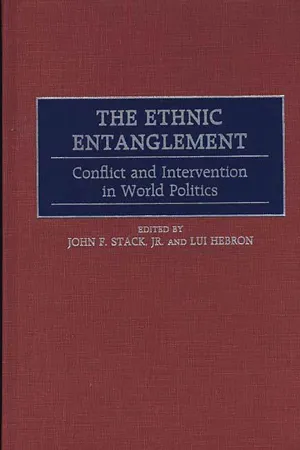 eBook - PDF
The Ethnic Entanglement
Conflict and Intervention in World Politics
- Lui Hebron, John F. Stack(Authors)
- 1999(Publication Date)
- Praeger(Publisher)
As a result, the major disagreement that lies within the research program on ethnicity is also the most basic—how to define the concept. Is ethnicity best seen as a primordial element World Politics: Primordial and Structural Perspectives 35 of group identity that persists over time in radically different environments pro- viding the underlying movement toward subgroupism, or as an instrumental tool for increasing group solidarity to attain political, economic, and other social interests and goals? The choice has important implications. In its most basic definition, ethnic conflict is the struggle between rival organizations seeking to maintain or gain control of political power within a given territory. To under- stand ethnic conflict, therefore, one must understand the role ethnicity plays in mobilizing, structuring, and managing these contending groups. In this section, the core logic and derived solutions to ethnic conflict of each variant are ex- amined. The Rational Viewpoint The foundation of the rational model is based on the assumption that material interests define group behavior, that is, ethnic ties are used to advance the ma- terial well-being of the group. This assumption leads to the proposition that the salience of ethnic identity and the emergence of an us-them dichotomy results from objective intergroup inequalities in the distribution of economic resources and authority among groups in heterogenous societies due to structural and/or institutional impediments that do not permit the accommodation of the perceived vital economic or political interests to the achievement of its interests (Stack, 1986). Rational explanations detail how rivalry over economic and political resources generate or degenerate into ethnic conflict. One of the most pronounced and growing cleavages in global politics is the widening ecological, demographic, and material gap within and among nation-states. eBook - PDF
The Politics of Croatia-Slavonia 1903-1918
Nationalism, State Allegiance and the Changing International Order
- Fernando Veliz(Author)
- 2014(Publication Date)
- Harrassowitz Verlag(Publisher)
60 Brubaker focuses on the complexities involved in the formulation of nationhood and empha-sises that it should not be regarded as an objective category but as a contingent 56 This question is relevant to the relationship between democratic states and ethnic minorities. While liberal nationalists advocate integration through the protection of universal citizenship rights, see Tamir, Y. Liberal Nationalism (Princeton, 1993), the advocates of a multi cultural society emphasise the need to supplement these with the consolidation of cultural rights for na-tional minorities and protection of ethnic groups in poly-ethnic states, see Kymlicka, W. Multi-cultural Citizenship: a Liberal Theory of Minority Rights (Oxford, 1995). 57 Schöpflin, G. Nations, Identity, Power: The New Politics of Europe (London, 2000) p. 35. 58 Ibid. p. 42. 59 For an alternative conceptualization in the study of ethnic groups, see: Calic, Marie-Janine “Zur Sozialgeschichte ethnischer Gruppen: Fragestellung und Methoden” in Hösch, E. und Seewann, G. Aspekte ethnischer Identität. Ergebnisse des Forschungsprojekts „Deutsche und Magyaren als nationale Minderheiten im Donauraum“ (München, 1991). 60 Brubaker, R. Nationalism Reframed: Nationhood and the National Question in the New Europe (Cambridge, 1996) p.19. See also Brubaker, R. Ethnicity without groups (Cambridge, MA, 2004). 37 37 © 2014, Otto Harrassowitz GmbH & Co. KG, Wiesbaden ISBN Print: 978-3-447-06700-3 — ISBN E-Book: 978-3-447-19252-1 Introduction 38 event. 61 This position recognises the importance of considering the interaction be-tween political and historical factors in the development of nationhood but also points out in the direction of the analysis of nationhood as something that not only develops but also happens and is activated at a specific moment in time. He high-lights the need to develop a “sophisticated eventful perspective” 62 in the study of nationhood and its dependence on the specific political context.
Index pages curate the most relevant extracts from our library of academic textbooks. They’ve been created using an in-house natural language model (NLM), each adding context and meaning to key research topics.

