Social Sciences

Ethnic Identity
Ethnic identity refers to an individual's sense of belonging to a particular ethnic group, often based on shared cultural, linguistic, or historical characteristics. It encompasses the ways in which people perceive and express their cultural heritage, traditions, and customs, and can influence their sense of belonging, self-esteem, and social interactions within their ethnic community and the broader society.
Written by Perlego with AI-assistance
Related key terms
1 of 5

11 Key excerpts on "Ethnic Identity"
- Dennis M. McInerney, Shawn Van Etten, Dennis M. McInerney, Shawn Van Etten(Authors)
- 2004(Publication Date)
- Information Age Publishing(Publisher)
Ethnic Identity has been defined as the ethnic component of an individ-ual's social identity (Patchen, 1995; Phinney, 1992). Ones social identity derives from the knowledge of membership in a social group (or groups) together with the value and emotional significance attached to that mem-bership (Tajfel, 1981, p. 255). Extending that definition, Ethnic Identity is also a learned aspect of our overall personality development (Smith, 1991, p. 185) which incorporates cultural knowledge and behavior that defines particular group membership. It is a psychological construct com-bining self-perceptions along three dimensions defined by Bernal and Knight (1993): Ethnic Identity and the Sociocultural Playing ield 25 a. self-identification, b. cultural knowledge of an identified ethnic group, and c. preferences, feelings, and values people hold about their ethnic group. The ethnic and cultural features characterizing group identity become the basis for intergroup comparisons and can play a role in the construc-tion of positive and negative self-images. These self-images become incor-porated into ones self-concept, a multifaceted construct that combines, among other things, a persons own perceptions of their various experi-ences with other peoples perceptions of that person (Shavelson & Bolus, 1982). School is one of the most influential contexts for acquiring and pro-cessing these types of self-evaluations (erdman, 1990; Davidson, 1996). A REVIEW O RELATED RESEARCH erdmans (1990) description of an ethnic groups cultural identity incor-porates aspects of the psychological and perceptual nature of identity con-struction along with the contribution of sociocultural stimuli: Group cultural identity has to do both with the particular features of the eth-nic group and with the significance that is attached to these features [by the individual] in a societal context (p. 190). eBook - PDF
Identity in Adolescence 4e
The Balance between Self and Other
- Laura Ferrer-Wreder, Jane Kroger(Authors)
- 2019(Publication Date)
- Routledge(Publisher)
In short, Ethnic Identity involves the intersection of personal and social identity (Cross et al., 2017), and may be more or less salient to a given adolescent depend- ing on the adolescent and her or his sociocultural context. Ethnic Identity also involves a person’s psychological and social association with an ethnocultural group. Ethnocultural groups are often defined by a shared geographical and/or genealogical origin as well as elements of a common culture based on the par- ticulars and history of the ethnocultural group in question (Liebkind, Mähönen, Varjonen, & Jasinskaja-Lahti, 2016; Worrell, 2014). Sociocultural approaches to identity An historic debate that lies underneath relevant theory, measurement, and information about identity concerns the degree to which individuals can exer- cise agency (e.g., free will, make choices about who they are) in the midst of their identity development (Burkitt, 2011). Ethnic and cultural identity makes an encounter with this debate inevitable. Are people indeed exploring identity options or making choices about who they are or are social groups and wider forces (e.g., social mobility and opportunity structures, power relations among groups in a particular society) dictating who we even have the possibility to consider becoming? This person versus context debate (see Table 5.1) has impli- cations for how identity itself has been conceptualized by different theorists and within varied disciplines (Burkitt, 2011; Galliher, McLean, & Syed, 2017; Seaman, Sharp, & Coppens, 2017). There is now a clearer recognition of the importance of examining how indi- viduals can shape their identity along with the ways that society and culture work to co-construct a person’s identity (e.g., Galliher, Rivas-Drake, & Dubow, 2017; Hammack, 2014; Seaman et al., 2017). eBook - PDF
- Warren Kidd, Alison Teagle(Authors)
- 2012(Publication Date)
- Bloomsbury Academic(Publisher)
The extensive debate about definition and context may result in one wondering where this leaves us in the study of ethnicity and identity. Eriksen (2002) argues that ethnicity serves a purpose, as it is an active creation, shaped by socialization. However, according to Eriksen, Ethnic Identity tends not to be a choice (though individuals may choose to hide it, or to play it down) – we are generally born into our ethnic group. Fenton (1999) makes the useful observation that ethnicity has different levels of intensity. Some individuals will feel strongly about their Ethnic Identity and it will be a significant part of their lives, whereas others will not consider it a central part of their self-concept (as many respondents indicated in research by Aspinall et al . (2008) by favouring age, family background and occupation as indicators of identity). Later in the chapter we shall consider the role of power and inequality in Ethnic Identity and culture. Do some ethnic groups have more power than others? If so, does this power give them greater opportunities to choose their identity? Some ethnic identities are highlighted by individuals and used to their advantage, whereas others are played down. If people have a choice, which do they choose? Gilroy’s (1993) point above is particularly useful. Ethnicity is constantly changing and evolving – but it is something ‘real’ in terms of how people experience it on a daily basis. Maintaining an abstract level of scrutiny is not helpful (as postmodernism is not always helpful in terms of further analysis). Keep these issues in mind as you read further. Exercise 13.6 Why are notions of difference important to the establishment of who we are – to I A establishing our identity? Answer this question in approximately 100 words. An Exercise 13.7 Fenton’s (1999) observation that Ethnic Identity is not an important part of an individ- I A ual’s self-concept is an interesting one. eBook - PDF
- David Block(Author)
- 2009(Publication Date)
- Continuum(Publisher)
Identities are about nego-tiating new subject positions at the crossroads of the past, present and future. Individuals are shaped by their sociohistories but they also shape their sociohistories as life goes on. The entire process is con-flictive as opposed to harmonious and individuals often feel ambiva-lent. There are unequal power relations to deal with, around the different capitals – economic, cultural and social – that both facilitate and constrain interactions with others in the different communities of practice with which individuals engage in their lifetimes. Finally, identities are related to different traditionally demographic categories such as ethnicity, race, nationality, migration, gender, social class and language. As I have made clear thus far, identity is a complex and multi-layered construct. It also is a construct that has tended to be examined from particular perspectives by theorists and researchers. In the sec-tions that follow, I examine what I consider to be the seven most common perspectives taken. I begin with a discussion of race and ethnicity together, as these two constructs are often conflated both in lay and academic discourses. I then consider, in separate sections, national identity, migrant identity, gender identity, social class iden-tity and language identity. Identity in the social sciences today 27 Ethnicity and race As May (2001) notes, most researchers who focus on ethnicity do not usually say what they mean by the term. In such cases, one is generally left to wonder if ethnicity is about culture, or if it is a polite way to talk about race. In the former case, ethnicity may be seen to be more about ‘common descent and . . . a cultural heritage shared because of com-mon descent’ (Joseph, 2004: 162). Elsewhere, Puri (2004) echoes Joseph’s cultural view of ethnicity as follows: Ethnicity is . . . a form of collective identity based on shared cul-tural beliefs and practices, such as language, history, descent, and religion.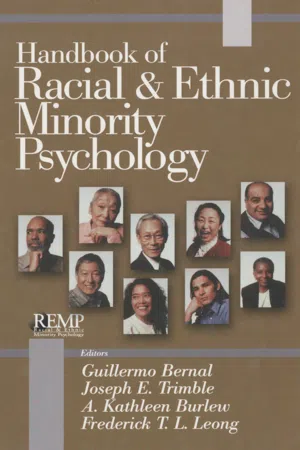
- Guillermo Bernal, Joseph E. Trimble, A. Kathleen Burlew, Frederick T. L. Leong(Authors)
- 0(Publication Date)
- SAGE Publications, Inc(Publisher)
The following chapter is a summary of the definitions, theories, research findings, speculations, controversies, and challenges presented by the study of the structural, func-tional, and dynamic characteristics of ethnic and racial identity. The topic may appear to be limited in scope, but in fact, it is a broad and expansive one. Since 1887, according to the citations found in the PsycINFO electronic database, slightly more than 3,000 articles have been written on the topic of ethnic and racial identity; two thirds of those articles have been written since 1990. Sociological Abstracts indicates that 3,648 articles have been written on the topic since 1963, and an anthropology electronic database indicates that 1,149 were written from that field's perspective, although no spe-cific time frame was provided. The literature search suggests that interest in the topic is multi-disciplinary and has accelerated considerably since 1990. The accelerated interest indicates that we must stop and take stock of the topic and its future direction; also, the content and emphasis of publications dedicated to the topic are changing strongly, pointing to the need for a summary of the findings and discussions. OVERVIEW A plethora of theories and models of ethnic and racial identity exist. Varying in emphasis, they generally define a dynamic, multifaceted construct (cf. Mio, Trimble, Arredondo, Cheatham, & Sue, 1999). Ethnic and racial identity can include personal identity, notions of belonging, knowledge of the refer-ence group, and shared values. Its expression or belonging may change across situations, points in time, and within the same people (Stephan & Stephan, 1989; Trimble, 1988; Trimble & Mahoney, 2002; Waters, 1990). The literature suggests that at least three lay-ers of context influence how these compo-nents of Ethnic Identity manifest time context (history and generation), space (size of com-munity), and place (geography or region). eBook - PDF
Ethnicity as a Political Resource
Conceptualizations across Disciplines, Regions, and Periods
- (Author)
- 2015(Publication Date)
- transcript Verlag(Publisher)
Collective identity is about perceived or experienced consistency and continuity in human collectives. Human cultures can survive trans-generationally only in the form of collectives. But as a cognitive and emotive phenomenon identity is always related to individual consciousness. The question ‘ Who are we? ’ is related to the question ‘ Who am I? ’ , and vice versa (Eriksen 1973; for overviews cp. Leary/Tangney 2012; Schwartz et al. 2012). Thus, as a research topic, collective identity should always be conceptually embedded in personal identity. The connection between both emerges from the questions ‘ to whom do I (factually) belong? ’ and ‘ to whom do I feel I belong? ’ . Increasingly, identities, be they personal or collective, have to be negotiated. In view of the multiplicity of options, more and more ‘ identity work ’ has to be done (Keupp et al. 2013). For the individual, negotiation with oneself as well as with others includes emotional issues. A central question is the extent to which identity remains subjective and internal, or else is shown openly, thus becoming quasi-objective (Taylor 1977). The main disciplines to which ethnicity is relevant are sociology, cultural anthropology and cultural studies, social psychology, political science, and the evolutionary sciences 1 . The main disciplinary divergences I see are between cultural anthropology and (a) sociology, (b) cultural studies and (c) evolutionary sciences. This paper is focused on ethnicity as it is approached and discussed in cultural anthropology (social anthropology, anthropologie culturale) today. 2 On the one hand, cultural anthropology is the discipline most often consulted if ethnicity is scientifically reflected. On the other hand, many anthropologists are 1 Sociobiology, evolutionary psychology, evolutionary ecology and paleo-anthropology. 2 On the history of the concept, which I cannot cover here, cp. e.g. Heinz 1993, and core texts in Hutchinson/Smith 1996. eBook - PDF
A Task for Sisyphus
Why Europe’s Roma Policies Fail
- Iulius Rostas(Author)
- 2019(Publication Date)
- Central European University Press(Publisher)
While the central element of Weber’s defnition—a belief in common descent and a common histo-ry—is in effect synonymous with a shared culture among the members of a particular group. This conceptual mutation is well summarized by Cornell and Hartmann: “an ethnic group has become a group of people distinguished by common culture, typically including language, religion or other patterns of behavior or belief” (1998, 17). Eriksen defned Ethnic Identity as “a notion of shared ancestry (a kind of fctive kinship),” while culture “referred to shared represen-tations, norms and practices,” emphasizing that “one can have deep ethnic differences without correspondingly important cultural differ-ences; and one can have cultural variation without ethnic boundaries” (1993, 43). He describes the relations between ethnicity and Ethnic Identity in that the latter is “the symbolic aspect of ethnicity” (Eriksen 1993, 49). In his understanding, ethnicity is not only about certain char-acteristics that build similarities and differences between individuals and groups, but also about how these differences and similarities are communicated in public (1993, 80). The development of critical social studies, especially cultur-al studies in the 1960s and 1970s provided new insights into issues of identity that focused on the meaning created by identity and the consequences of these meaning-making processes associated with different groups. In the US in the 1950s and 1960s, different groups started to challenge oppression they encountered in everyday life: Blacks, Latinos, Asians, Natives, Women, LGBTQIA. Scholars originat-ing from these groups attempted to explain the disparities between power-holders (the majority) and different minority groups. By focus-ing on existing disparities, these scholars questioned the idea of race, meaning-making systems, and the internalization of stigma associ-4 A T A S K FO R S I S Y P H U S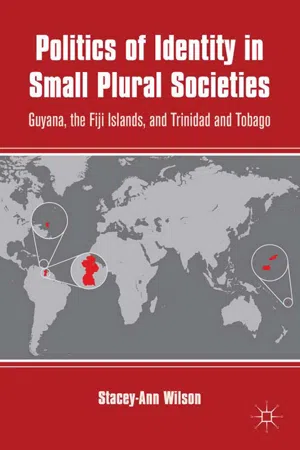 eBook - PDF
Politics of Identity in Small Plural Societies
Guyana, the Fiji Islands, and Trinidad and Tobago
- S. Wilson(Author)
- 2012(Publication Date)
- Palgrave Macmillan(Publisher)
CHAPTER 1 Conceptualizing Identity Ethnicity and Culture T he literature on politics in multiethnic states tends to focus on the cen- trality of one of two identities in the organization of political demands and competition, namely, race or ethnicity versus class. When the focus is on ethnicity, the emphasis is placed on the inability of ethnics to be detached from their communal identities. Those who focus on class argue that political elites manipulate ethnicity to secure political power thereby undermining class mobilization among the lower classes and consolidating class alliances between the business elites and the middle classes. On the other hand, there are those who see no value in group identity, be it class or ethnicity, and are in favor of seeing political calculations in terms of individualism. No political theory has come to terms with assertive ethnic consciousness, especially as it overlaps with and sometimes reinforces cultural and class differences. Conceptualizing Identity The lay perspective on identity assumes that “the human race is naturally divided into different races or tribes or nations. They assume that each of these groups is bound together by a common genetic heritage, reinforced by shared culture, and that such units have existed more or less ‘from time immemorial.’” 1 This lay perspective is not one that is held by academics. Social scientists, espe- cially, debate the “naturalness” of the divisions in society and the inherent versus constructed character of our identities. Raymond Williams argues that race and ethnicity as concepts cannot be understood outside the social context in which they are applied. 2 There is no shortage of debate on the validity and usefulness of race and ethnicity in conceptualizing identity. There is very little agreement on what is and is not meant by race, ethnicity, and culture. Even among analysts using the eBook - PDF
- Dermot Anthony Nestor(Author)
- 2010(Publication Date)
- T&T Clark(Publisher)
13 Thus, while intermarriage is a means by which individuals manage to transit ethnic boundaries, it is only after three generations of intermarriage that a person is considered a full-member of the caste or ethnic group with whom the marriages occurred. Furthermore, Gil-White’s own ethnographic research among the Torguud and Kazakh semi-nomadic pastoralists of Western Mongolia also reveals that the majority of respondents believed, and committed themselves publicly to the notion that Ethnic Identity is something which is xed at birth. 14 As one of his informants was to reveal to him, “some identities you can only get by blood.” That ethnic actors, then, do not see membership in an ethnic group as ambiguous and negotiable as the constructivist thesis maintains, but rather as based on non-negotiable, necessary and sufcient conditions of membership, metaphorically cast in terms of blood, not only allows us to revisit the anomaly in Barth’s original thesis, but, in the process, make explicit the cognitive turn which Barth’s focus on the processes of categorization and classication sought to achieve. 1. Cognitive Perspectives on Ethnicity and Identity Though Gordon Allport was one of the rst to suggest that reasoning about ethnic groups was essentialist, 15 it was Douglas L. Medin who introduced the concept of “psychological essentialism,” which states that people’s representations of things reect a belief that these things have essences , or underlying natures, that make them what they are. Thus, 12. J. Nagata, “In Defence of Ethnic Boundaries: The Changing Myths and Charters of Malay Identity,” in Ethnic Change (ed. C. F. Keyes; Seattle: University of Washington Press, 1981), 87–118. See also J. Nagata, “What is Malay? Situational Selection of Ethnic Identity in a Plural Society,” AmEth 1 (1974): 331–50. 13. N. E. Levine, “Caste, State and Ethnic Boundaries in Nepal,” Journal of Asian Studies 46 (1987): 71–88. eBook - PDF
- Guido Alpa(Author)
- 2024(Publication Date)
- Hart Publishing(Publisher)
8 ‘Identity’: A Multifaceted Self culture, his or her way of dressing, eating, observing the rules of ceremonial, etiquette and manners. Law regulates his or her affections, aspirations, intimate relationships. Here, unlike the other sciences, which construct identity on the basis of their constantly evolving categories, which are verifiable and susceptible to rectification, modification and alteration, 15 and with margins of approxima- tion, law constructs identity with binding categories: the individual cannot escape them except with the authorization, or at any rate the intervention, of authority. Law prescribes a person’s way of being and living. This consideration familiar to jurists, and to scientists concerned with legal anthropology, eludes sociologists who study the ways in which people construct themselves, as if the individual will alone could exhaust the factors that sculpt identity. Every individual has a ‘future behind him’, 16 to use Hanna Arendt’s expres- sion, because his or her past that sculpts his or her present has been constructed by the ordering categories of law. Identity then turns from fact to precept, from a real world as interpreted by the social sciences into an imaginary world constructed by norms. In this world too – according to different conceptions of law – one encounters the person in many dimensions: from the statement that must be interpreted according to canons established by law to the human being in his corporeity, from the abstract concept to concrete life. Life and rules – to use an expression dear to Stefano Rodotà – are marked by law. The relationships an individual has with others are also governed and shaped by law: family, association, community and authority law relationships. Not only the person as ‘self’, but also the self and the other, the self and others, are governed by law.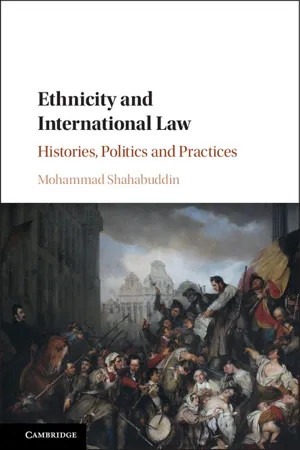 eBook - PDF
Ethnicity and International Law
Histories, Politics and Practices
- Mohammad Shahabuddin(Author)
- 2016(Publication Date)
- Cambridge University Press(Publisher)
181 Hawkins, 199. Given that all other psychological aspects of ethnicity outside the biolo- gical features are, according to Lapouge, again dependent on biology, an ethno actually equates to race. In this sense racial conflicts here mean what we understand as ethnic conflicts. 182 Lapouge, Les Selections, 225, cited in Hawkins, 199. 183 Henry Sidgwick, Philosophy: Its Scope and Relations. An Introductory Course Lectures (London: Theommes, 1998 [1902]), 174–211. 46 ethnicity in the discourse on the ‘self ’ & the ‘other ’ The categorisation of nations on the basis of their rank in the scale of progress clearly appeared in the writings of Scottish jurist James Lorimer, who asserted in 1883 that ‘[a]s a political phenomenon, humanity, in its present condition, divides itself into three concentric zones or spheres – that of civilised humanity, that of barbarous human- ity, and that of savage humanity’. 184 He hails the emergence of ethnol- ogy as a new field of study in the opening statement of his work: ‘No modern contribution to science seems destined to influence inter- national politics and jurisprudence to so great an extent as that which is known as ethnology, or the science of races’. 185 However, far from being homogeneous, international lawyers soon followed the parallel streams of liberal and conservative understandings of the role of ethnicity in the construction of the national self-image; hence, there appeared con- trasting images of state and sovereignty – the foundational notions of nineteenth-century international law. Liberal international lawyers of the nineteenth century related their nationalism to a wider vision of European civilisation, sometimes within a cosmopolitan framework. 186 For Pasquale Fiore, law was a spontaneous outgrowth of society rather than an effect of sovereign decision. At the same time, he firmly believed that given the unity of the human species, the law governing humanity must also be universal.
Index pages curate the most relevant extracts from our library of academic textbooks. They’ve been created using an in-house natural language model (NLM), each adding context and meaning to key research topics.

