Social Sciences

Ethnicity and Education
Ethnicity and education refers to the relationship between a person's ethnic background and their educational experiences and outcomes. It encompasses the study of how factors such as cultural identity, language, and discrimination can impact access to education, academic achievement, and educational attainment for individuals from different ethnic groups. Understanding this relationship is important for addressing disparities and promoting educational equity.
Written by Perlego with AI-assistance
Related key terms
1 of 5
10 Key excerpts on "Ethnicity and Education"

- Fenwick W. English(Author)
- 2006(Publication Date)
- SAGE Publications, Inc(Publisher)
Unlike race, which is often perceived to be a fixed character-istic based on biological or genetic foundations, eth-nicity is often seen as more fluid and flexible as well as a largely learned choice. The concept of ethnicity is related to the Greek concept of ethnos , which refers to the people of a nation or tribe, and ethnikos , which stands for national. Hence ethnicity refers to the ethnic quality or affilia-tion of a group that is normally characterized in terms of culture, which explains at least to some degree why the term is often used interchangeably with culture . Ethnicity is a group classification for individuals who share a unique social and cultural heritage (e.g., lan-guage, religion, customs) that is passed on from gen-eration to generation. Thus, ethnic identity refers to a sense of group identity based upon the extent to which an individual believes he or she shares a common membership with a particular ethnic or cultural group. Although physical characteristics may be included in a definition of ethnicity, one does not have to share the same physical attributes to belong to an ethnic group, and these markers may not be permanent. This ethnic saliency is one dimension of ethnic identity, but the other aspect is whether people feel a sense of attachment or belonging to their ethnic group. One definition emphasizes that ethnic identity is that part of individuals’ self-concept that derives from their knowledge of their membership of a social group (or groups) together with the value and emo-tional significance attached to that membership. Since individuals who share the same ethnicity do not nec-essarily operate the same way in terms of their respec-tive ethnic affiliations, ethnic identity becomes a complex issue to not only define but also to assess. eBook - ePub
- Ruth Wright(Author)
- 2017(Publication Date)
- Routledge(Publisher)
Oxford Concise Dictionary of Sociology,Ethnicity defines individuals who consider themselves, or are considered by others, to share common characteristics which differentiate them from the other collectivities in a society within which they develop distinct cultural behaviour. The term was coined in contradistinction to race, since although members of an ethnic group may be identifiable in terms of racial attributes, they may also share other cultural characteristics such as religion, occupation, language, or politics. (Marshall, 1994, p. 157)While issues associated with ethnicity and migration have long been of great interest to the residents of multicultural and postcolonial nations in Oceania and the Americas, they have also become topics of increasing interest across much of Europe in recent decades. A recent research study examining attitudes in 20 European nations determined that ‘in most countries a substantial number of respondents consider their ideal neighborhood one that does not have residents who are ethnic minorities’ (Semyonov, Glikman and Krysan, 2007: 434). In many parts of the world, a large proportion of ethnic minorities tend to live in relatively poor neighbourhoods in which there are fewer opportunities for quality education and rewarding employment (see Chapter 16 for further discussion of this issue).Ethnicity is generally regarded to be more closely intertwined with musical traditions than most other social constructs, which is one reason for the wide popularity of a specialized field of study, aptly called ethnomusicology. Bruno Nettl (1998, p. 23) has identified the wide emergence in recent generations of an ‘increased significance of ethnicity, the desire of ethnic groups throughout the globe to maintain some cultural independence, and the realisation that one of the principal markers of ethnicity is the group’s distinctive music’. Further, as Martin Stokes (2004, p. 6) has observed, ethnicities are properly understood ‘in terms of the construction, maintenance and negotiation of boundaries’, and ‘music is socially meaningful not entirely but largely because it provides means by which people recognize identities and places, and the boundaries which separate them’ (p. 5). eBook - PDF
Ethnicity and International Law
Histories, Politics and Practices
- Mohammad Shahabuddin(Author)
- 2016(Publication Date)
- Cambridge University Press(Publisher)
what does ‘ethnicity ’ mean? 13 Similarly, Richard Schermerhorn defines an ethnic group ‘ as a collectivity within a larger society having real or putative common ancestry, memories of a shared historical past, and a cultural focus on one or more symbolic elements defined as the epitome of their people-hood’. 9 Likewise, although Paul Brass admits that defining an ethnic group on the basis of objective features is problematic, in that it is usually extremely difficult to determine the boundaries of ethnic categories in this way, one of his definitional criteria of an ethnic group is having at least one distinguishing cultural feature that clearly separates one group of people from another, whether that be language, territory, religion, colour, diet, or dress. 10 More recently, Barbara Harff and Ted Gurr, too, define ethnic groups in non-biological terms and as ‘“psychological communities” whose members share a persisting sense of common interest and identity that is based on some combination of shared historical experience and valued cultural traits – beliefs, language, ways of life, a common homeland’. 11 Another widely used textbook defines an ethnic group as a large or small group of people, in either traditional or advanced societies, who are united by a common inherited culture (including language, music, food, dress, and custom and practices), racial similarity, common religion, and belief in common history and ancestry and who exhibit a strong psychological sentiment of belonging to the group. 12 Thus, ethnicity, as the character-making element of ethnic groups, is perceived broadly: going far beyond mere biological features, it incorpo- rates a wide range of cultural attributes including language and religion. In the context of Article 27 of the International Covenant on Civil and Political Rights (ICCPR, 1996), Capotorti argues that ‘the substitution of 9 Richard Schermerhorn, ‘Ethnicity and Minority Groups’ in Ethnicity, ed. eBook - PDF
Ethnicity as a Political Resource
Conceptualizations across Disciplines, Regions, and Periods
- (Author)
- 2015(Publication Date)
- transcript Verlag(Publisher)
The second approach takes into account criteria such as emotional attachments and sentiments of belonging, and emphasizes the fluidity and flexibility of ethnic identities (for a case study on multiple ethnic identities in Namibia, cp. Widlok, this section). In this context, notable core concepts are ethnic identity and belonging. Much of the research on ethnic identity has been based on the study of group identity by social psychologists (e.g. Tajfel/Turner 1986). From this perspective, ethnic identity is an aspect of social identity, defined by Tajfel as “that part of an individual’s self -concept which derives from [his] knowledge of [his] membership of a social group (or groups) together with the value and emotional significance attached to that membership” (1981: 255). Recently, the use of identity as a term in ethnicity studies has been increasingly criticized. Critics state that the term is a slippery and overburdened concept (Brubaker 2009) but also that it says too little (Anthias 2002). In the critics’ view, the term tends to suggest mutually exclusive identities, and that identity is a possessive property of individuals. As an alternative concept, the notion of belonging is favored by many. Pfaff-Czarnecka highlights its advantage, as “identity is a categorical concept while belonging combines categorisation with social relating” (2013: 6). ‘ Belonging ’ , as an analytical term, can enable us to ask questions about what a person belongs to, rather than, as with identity, who an individual is , or who and what they identify with (which are in fact two different questions). Certainly, the use of identification maybe entailed in the notion of belonging as well as in the notion of identity. No longer available |Learn more
Color-Line to Borderlands
The Matrix of American Ethnic Studies
- Johnnella E. Butler(Author)
- 2011(Publication Date)
- University of Washington Press(Publisher)
If the substance is inclusive and engaging of the complexities, its significance will lead to an understanding of diversity and a positing of our actions based on fundamental realities of our shared society. Traveling from substance to significance is the ideal journey of the teacher-scholar and the student-scholar. Education’s goal is the leading of the student out of himself or herself—from the Latin root educare ( ex + ducere )—to guide the student’s sensibilities so that their familiar experiences, sensibilities, and ideas encounter other experiences, sensibilities, and ideas. It may seem old-fashioned to think of education in this way, but this conceptualization is among the best of our liberal arts traditions. It is not very distant from the late Brazilian educator Paulo Freire’s concepts of education aimed at liberating the human spirit to be able to name, encounter, and engage the world. Such journeys from sub-stance to significance constitute education. 2 0 / j o h n n e l l a e . bu t l e r Ethnic Studies, the Humanities and Social Sciences, and the Matrix Potential Given the racialized history of the United States and its extended and related legacies, Ethnic Studies—the interdisciplinary and comparative study of the social, cultural, political, and economic expression and experience of U.S. racialized ethnic groups and of U.S. racialization—together with the human-ities and the social sciences potentially provides a matrix yielding clarification, accuracy, and connection among human di¤erence. Despite its di‹culties in institutionalization, its sometimes shortsighted approaches to giving voice to those historically excluded from and distorted by the academy, and its strug-gle to define, practice, and distinguish between interdisciplinary and multi-disciplinary methodology, Ethnic Studies has hewn the road from substance to significance.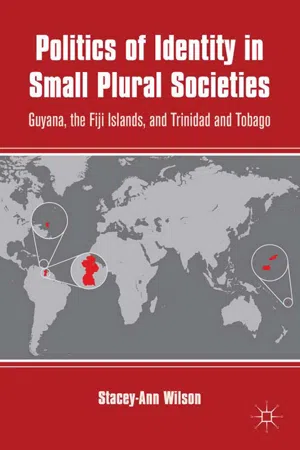 eBook - PDF
Politics of Identity in Small Plural Societies
Guyana, the Fiji Islands, and Trinidad and Tobago
- S. Wilson(Author)
- 2012(Publication Date)
- Palgrave Macmillan(Publisher)
Raymond Williams argues that race and ethnicity as concepts cannot be understood outside the social context in which they are applied. 2 There is no shortage of debate on the validity and usefulness of race and ethnicity in conceptualizing identity. There is very little agreement on what is and is not meant by race, ethnicity, and culture. Even among analysts using the 16 O Politics of Identity in Small Plural Societies idiom of race, the meanings have changed over time primarily from strictly bio- logical arguments to sociological ones. The same is true of ethnicity, although writers who use the idiom of ethnicity have tended to focus less on biology and more on instrumentalist and constructivist arguments. Because “ethnicity is a new term in the social sciences” 3 it is bound to appear ambiguous to those comfortable with and perhaps committed to the idiom of race. Kwame Appiah warns that biological concepts “of race are both dangerous in practice and mis- leading in theory.” 4 Those committed to the idiom of race are concerned that the retreat from race (in favor of ethnicity) may serve to mask racism and inequalities. eBook - PDF
Visualizing Human Geography
At Home in a Diverse World
- Alyson L. Greiner(Author)
- 2017(Publication Date)
- Wiley(Publisher)
The Census Bureau clearly plays an influential role in shaping a discourse of identity in the United States. S. Meltzer/PhotoLink/Photodisc/Getty Images, Inc. Where Geographers CLICK American FactFinder THE PLANNER ✓ ✓ This is an online resource provided by the U.S. Census Bureau. You can use this website to view and create maps of different kinds of census data. From the main page, click on Guided Search and follow the steps. 158 CHAPTER 6 Geographies of Identity: Race, Ethnicity, Sexuality, and Gender 4. Explain the reasons for ethnic conflict and violence in Sudan. 5. Define environmental justice. 1. Identify three models of ethnic interaction. 2. Distinguish between ethnic islands, ethnic neighborhoods, and ethnoburbs. 3. Explain symbolic ethnicity. Ethnicity in the Landscape Learning Objectives ethnoscape A cultural landscape that reveals or expresses aspects of the identity of an ethnic group. E thnic geography is a subfield of human geog- raphy that studies the migration and spatial distribution of ethnic groups, ethnic interac- tion and networks, and the various expres- sions or imprints of ethnicity in the landscape. The study of such ethnic imprints, or ethnoscapes, has traditionally focused on identifying and documenting dis- tinctive examples of material cul- ture including religious buildings, community centers, murals, and ethnic restaurants. Lately, the study of ethnic imprints has broadened to include radio and television stations that cater to particular ethnic groups, as well as Internet sites that support ethnic communities. Ethnic Interaction and Globalization In the United States, the study of ethnic geography, and specifically ethnic interaction, tends to overlap with studies of immigration. Scholars have developed different models to depict and help explain ethnic interaction. Three of these models—assimilation, pluralism, and heterolocalism—have been the most influential. eBook - PDF
Educations in Ethnic Violence
Identity, Educational Bubbles, and Resource Mobilization
- Matthew Lange(Author)
- 2011(Publication Date)
- Cambridge University Press(Publisher)
Yet, ethnic violence and nationalist violence are not synonymous for two reasons. First, only nationalist violence necessarily involves ideas of polit- ical community. Violence between Korean and African Americans in Los Angeles after the Rodney King trial, for example, was ethnic but lacked a nationalist component. Second, states frequently participate directly in nationalist violence, and nationalist violence commonly involves state-on- civilian violence. By definition, however, ethnic violence involves civilian- on-civilian violence. In this book, I focus on ethnic violence in general and only consider nationalist violence when it is simultaneously ethnic violence. Despite being a word understood and employed by nearly everyone, education is almost impossible to define because it is an institution, a resource, a process, and an activity. In this book, I recognize that edu- cation is multifaceted but focus on three of its many characteristics: education as learning process, education as institution, and education as resource. Together, these three make education an influential social carrier that can shape diverse types of social relations, including ethnic violence. In its broadest sense, education is a series of experiences that have a formative effect on the mind or physical abilities of an individual; that is, it is a learning process. As a learning process, education is very influential and shapes the cognitive abilities and frameworks of individuals. Through education, people learn techniques and “facts” and become acquainted with diverse materials. Moreover, and of greater relevance to this book, education socializes people to hold particular norms, outlooks, expecta- tions, and identities. As a learning process, education occurs constantly throughout one’s life and in diverse settings. eBook - PDF
Ethnicity and Old Age
Expanding our Imagination
- Torres, Sandra(Authors)
- 2019(Publication Date)
- Policy Press(Publisher)
Wallman (1979) wrote, for example, ‘ethnicity refers generally to the perception of group difference ... and the sense of difference which can occur when members of a particular cultural ... group interact with non-members. (Wallman, 1979 : ix) It is because of all of this that ethnicity and race scholars deem categorisation and boundary making to be central to the ways in which these constructs are regarded, the manner in which people use them to differentiate between people, and the ways in which people perceive them to be central to who they are, what they are like, how they behave, and what they prefer. To this end Gelfand (2003) – who is one of the most well-known American ethno-gerontologists and one of the few to have written a book about ethnicity and old age – has written that definitions of ethnicity often have three components: self-identification, other’s identification, and the specific behaviours with which an ethnic group is associated (and/or with which they associates themselves). Ethnicity scholars Cornell and Hartmann (1998) refer to the claims we make about kinship, common history, and the fact that certain symbols, practices and/or norms capture the essence of the ethnic identities people identify with (and/or are assigned to by others) when explaining how ethnicity and race can be made sense of. It is worth noting in this respect is that when we categorise people as either members of a group that we ourselves belong to (or to one which we deem to be different from our group), we are drawing a boundary between the ‘us with whom we identify, and the ‘them’ whom we regard as different (Tajfel et al., 1971). Anthias (1998), a sociologist known for her work on stratification and the consequential disparities that this creates, has argued that categorisation, and the drawing of boundaries that we engage in when we categorise, are the mechanisms we use when constructing ‘otherness and sameness’. eBook - PDF
Basic Aspects of Language in Human Relations
Toward a General Theoretical Framework
- Harald Haarmann(Author)
- 2019(Publication Date)
- De Gruyter Mouton(Publisher)
Chapter 2 Man's sociocultural capacities and the essence of ethnic identity - Language as a variable in processes of identification Among the basic capacities of man is his ability to organize himself socially into groups and to identify himself with cultural patterns which emerge from communi-ty life. The dependence of people's lives on social and cultural networks is equal to the reliance on the functioning of systems of symbolic relations. Man is a cul-tural being, which in essence means that he is a symbol-using animal (Lessa -Vogt 1965: 203). Ethnic identification is a consequence of such a dependence, and it counts as one of the basic experiences of a human being as a member in a speech community. As a vehicle of the individual's sociability, ethnic identification is rel-evant in any community, be it on the level of a tribal group or on the scale of na-tional boundaries in a modern industrialized society. Basic elements in the shaping of an individual's ethnic identity are descent (ancestry or paternity), the acquisition of language and the adoption of specific cultural patterns (patrimony), and the acti-vation of a value system (phenomenology). Descent is an element which remains unchanged throughout a person's lifetime and which does not depend on the indi-vidual's will or wishes. Everybody is the sum of the genetic bioprogram of his/her ancestors, and this is a stable ethnic marker. The stability of ancestry as an ethnic marker does not correlate with a stable set of cultural patterns or values. A black American, for example, may identify himself/herself positively with his/her racial features (along the lines: 'I like being black.'), or the evaluation of such features may be negative (along the lines: 'I hate being black.'). The other elements of ethnic identity, patrimony and phenomenology, are vari-ables which depend on the cultural environment and on education.
Index pages curate the most relevant extracts from our library of academic textbooks. They’ve been created using an in-house natural language model (NLM), each adding context and meaning to key research topics.

