Social Sciences

Social Class and Education
Social class and education refers to the relationship between an individual's socioeconomic status and their access to educational opportunities. It encompasses the impact of social and economic inequalities on educational attainment and outcomes. This area of study explores how social class influences educational experiences, resources, and achievement, and how it contributes to perpetuating or challenging social inequalities.
Written by Perlego with AI-assistance
Related key terms
1 of 5
10 Key excerpts on "Social Class and Education"
 eBook - ePub
The Sociology of Education
An Introduction
- Ivor Morrish(Author)
- 2019(Publication Date)
- Routledge(Publisher)
As we come to consider some of the relationships between social stratification and education we must bear in mind that, in all the variety of theories concerning class and group structure, certain vital facts emerge regarding such concepts as power, status, prestige, life chances, life-styles, patterns of consumption, leisure activities, and occupations. These are concrete facts amongst a considerable amount of abstract theorizing, and they are closely related to problems of culture, education and socialization. In all the ramifications of the literature on class and social groupings it is not easy for anyone, whether pundit or dilettante, to obtain any final and clear-cut view on social stratification. Human personality and development, whether considered in group or in individual terms, defies the strictly statistical analysis that so many seek in the sociology of the future.At least Dahrendorfs analysis recognizes the problem of the increasing number of 'classless' individuals who, as 'floating intellectuals', wander through the many areas of society, doing everything from working in sewers, singing pop-songs, producing or otherwise participating in TV shows, to lecturing in colleges and universities. But, no doubt, B. S. R. Green and E. A. Johns are right in their conclusion on the question of class:'While it may be agreed that socio-economic changes in our own society have largely invalidated the class conflict model, it must not be assumed that the concept of social class has been made irrelevant. The fact remains that people can be classified according to occupational prestige, income, education or other closely associated indicators of social status and that such classifications are not merely statistical categories but reflect differences in values, goals, attitudes and behaviours. For example, high social status is associated with greater political involvement, with more favourable attitudes towards further education and with a more rational mode of decision-making in such situations as occupational choice' (30) .D. Social Class and Education
In this section we are mainly concerned with the effects of social class or stratification upon education. In Chapter 8 eBook - PDF
- Gordon Tait(Author)
- 2015(Publication Date)
- Cambridge University Press(Publisher)
It seems apparent from the arguments set out here, that not only does social class have a significant role to play in structuring opportunity, access and reward within Australian life, it affects our education system in very similar ways. With regards to understanding the connection between Social Class and Education, this chapter has discussed how earlier attempts to explain this relationship largely resulted in reductionist, teleological models promising a ‘solution’ to the problem of class. These models have located class as one of the three fundamental pillars of human social existence, along with sex/gender and race/ ethnicity, as the next two chapters will attest. This chapter has gone on to suggest that perhaps a more sophisticated approach to social class now focuses on its existence as sets of cultural practices, and sets of lived relations, elements which in turn have significant implications for all aspects of education. Ultimately then, rather than these practices and relations reflecting some underlying truth about a unified and objective notion of social class, perhaps these diverse and often unconnected components are all there is to the matter – all there is to the thorny issue of social class. Furthermore, if one of the central intentions of a socially just approach to education is to try and give students from the lowest of social class background a decent shot at doing well, perhaps the best way forward is to focus, not upon the large-scale, seemingly immutable, economic inequalities that characterise Australian society, but rather upon the smaller scale, more manageable, issue of fostering cultures of learning. 2 If we are to believe what hear from some of our political leaders, and sections of the media, gender is now a settled issue – a battle won.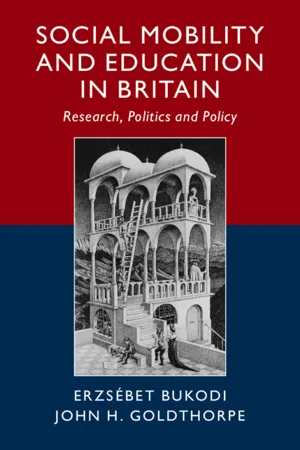 eBook - PDF
Social Mobility and Education in Britain
Research, Politics and Policy
- Erzsébet Bukodi, John H. Goldthorpe(Authors)
- 2018(Publication Date)
- Cambridge University Press(Publisher)
1 | Social Class as the Context of Social Mobility Social mobility is the movement of individuals over time between different social positions. Insofar as positions are taken to be in some way more or less advantaged, mobility can be characterised as being upward or downward in direction: that is, as being from a less to a more advantaged position or vice versa. To this extent, the understand- ing of social mobility in the social sciences is on much the same lines as it is in everyday life. However, where questions arise concerning actual rates, patterns and trends of mobility, and the systematic collection and analysis of relevant data have to be undertaken, it is necessary for social scientists to think about mobility in ways that are conceptually more explicit and precise than those that serve for less demanding purposes. First and foremost, it is essential that the context of mobility – that is, the positions between which mobility is seen as occurring – should be clearly specified. Within the social sciences there are in fact signifi- cant differences in this regard. Sociologists, who, as indicated in the Introduction, have thus far carried out the greater part of research into social mobility, tend to focus on mobility between social strata, as characterised, for example, in terms of social class. In contrast, econo- mists, among whom a sustained interest in social mobility is, at least in Britain, a relatively recent development, focus on mobility in terms of income – that is, on the mobility of individuals between different levels within the overall income distribution. In this book we will, as sociologists, be concerned primarily with social class mobility: that is, with mobility between different class positions. eBook - ePub
Foundations of Education
Problems and Possibilities in American Education
- Samuel M. Craver, Maike Ingrid Philipsen(Authors)
- 2011(Publication Date)
- Continuum(Publisher)
Social class fundamentally conditions a person’s options, or lack thereof. Furthermore, class impacts access to health care, child care, and numerous other services that affect the quality of life. Privilege tends to breed more privilege, which greatly improves opportunities and assistance should a privileged person encounter obstacles in life. Contrarily, poverty and material deprivation usually have a negative impact on people, limiting their access to adequate care, goods, services, and education. 52 Out-of-school factors (OFSs) are often directly related to school success, and class is indicative of many of those OFSs (for example, low birth weight, inad equate medical care, food insecurity, environmental pollutants, family stress, and neighborhood characteristics), any and all of which can significantly affect the learning opportunities of children. Indeed, poverty exacts a strong toll on communities, neighborhoods, families, and, therefore, schools and children. 53 In short, socioeconomic conditions shape life chances, a factual condition that has received inadequate attention in several leading school reform movements in the closing decades of the twentieth century and the beginning of the twenty-first century, a time characterized by policy shifts from concerns about equality of educational opportunity to concerns about school achievement as measured by test scores. It is difficult to capture a simple meaning of social class because it consists of many attributes. Class membership may be defined by income and financial assets, such as inherited wealth, property, and investments (or the lack thereof); it may also be defined by educational attainment and professional or occupational status. Class may be characterized by attributes difficult to measure, such as power, prestige, and tastes in style and language eBook - PDF
Sociology
Made Simple
- Jane L. Thompson(Author)
- 2013(Publication Date)
- Made Simple(Publisher)
None of these is a natural or neutral operation, though. All of them are 'man-made' and reflect the accumulated attitudes and interests of those individuals and groups who, over a period of time, have been most closely responsible for formulating their philosophies, shaping their policies and directing and enacting their decisions. The indivi-duals and groups in question have tended historically to be those whom I referred to in Chapter 2 as the ruling class. But more of this later. The point to note here is that however important or effective the influence of these 'informal' educational agencies might be—for good or ill—these are not usually the experiences which are seriously considered and recognised when 'education' is being defined or discussed. 79 80 Sociology For most people education is what happens in schools and colleges and all the other easily identifiable institutions which are part and parcel of the education system. So far as sociologists are concerned, most of their attention has been focused on schoohng and related issues, as the only part of the education process which is both universal and compulsory. For this reason, most of what follows in this chapter will be concerned with the main aspects of the sociology of education as they relate to the organisation and experience of schoohng. The Historical Context Strange as it may seem, despite appeals to 'tradition' the experience of education for most people in Britain is a fairly recent development. The first real intervention by the state in the business of providing universal, free and compulsory schooling only really began to take effect towards the end of the last century. The history of the last hundred years has been one of conflicting views about the merits of different ways of organising schools, one of struggle to expand educa-tional provision and equalise educational opportunities and one of tension between the roles of education as an agency of social control and social change. eBook - PDF
Moving Up And Out
Poverty, Education & Single Parent Family
- Lori Holyfield(Author)
- 2010(Publication Date)
- Temple University Press(Publisher)
4 Education and Mobility I often teach a course called Social Class in America. Over the period of a semester we grapple with many as-pects of social inequality, but perhaps the most difficult challenge is getting students past the notion that we live in a classless society. The egalitarian ethos is strong in our cul-ture, and students often accept it without any measure of skepticism. As we move through the semester, together we attempt to get beyond the ideology of equality and equip ourselves to contemplate the old saying, “It’s easy to climb the ladder of social mobility when your parents own the ladder!” But what other factors influence the process of so-cial mobility? Poverty and the distribution of wealth are class issues, admittedly complicated by race and gender. We are born into a particular social class, and most of us will die in the same one into which we were born. While some will rise above our class origins, many more—equally conscientious, willing, and able—will remain in poverty. I typically spend a third or more of the semester talking about sociological theories that explain stratification (that is, systematic patterns of inequality) in society. But a clear approach to the paradox of inequality and social class re-veals itself in the following scenario that I share with stu-dents: “Garbage collectors and lawyers will go on strike to-morrow. In two weeks, whom will you miss the most and 49 why?” 1 Usually, the question stirs discussion of the ways in which culture legitimates some groups and tasks while it stigmatizes others. In this chapter, I draw upon a few socio-logical perspectives that are helpful in getting at a deeper understanding of inequality and poverty. When people ask me how I managed to move out of poverty, I always get a lump in my throat. It is not because I am embarrassed to tell of my journey or because I want to forget that part of my past. eBook - PDF
- Roland Meighan, Clive Harber(Authors)
- 2007(Publication Date)
- Continuum(Publisher)
In general terms, they saw education func-tioning both as a transmission and as a control mechanism in the reproduction of the social relations which underpin the capitalist mode of production. First, education plays an important part in forming the skills and attitudes that workers need in order to be fully productive in work; second, education helps defuse and depoliticize the potentially explosive class relations of the productive process and thus serves to perpetuate the social, political and economic conditions through which a part of the product of labour is expropriated in the form of profits. 329 A Sociology of Educating The bureaucratic and hierarchically structured order which characterizes school was seen by Bowles and Gintis as the main dimension by which pupils' personal development and learned behavioural characteristics were nurtured in a specific way, i.e. their socialization was in a climate which celebrated and was based upon relationships of dominance and subordination, and was thus compatible with the social order of the workplace. That such an order is perpetuated in British schools is supported by studies of schooling in this country. With regard to teacher-pupil relations, for example, Sharp and Green (1975), in their study of a progressive primary school, found that even in a setting based upon a child-centred ideology, the power of the teacher to shape pupils' identities and create a stratification system within the classroom is enormous: The teacher is crucial to this process not simply because she is the reality definer but because ... she can be regarded as a scarce resource in that she possesses and can transmit the means whereby the careers of pupils can be facilitated or held back. eBook - PDF
Youth and Social Class
Enduring Inequality in the United Kingdom, Australia and New Zealand
- Alan France, Steven Roberts(Authors)
- 2017(Publication Date)
- Palgrave Macmillan(Publisher)
Ball, S. J. (2003). Class strategies and the education market place. London: RoutledgeFalmer. Ball, S. J., Davies, J., David, M., & Reay, D. (2002). ‘Classification’ and ‘Judgement’: Social class and the ‘cognitive structures’ of choice of higher education. British Journal of Sociology of Education, 23(1), 51–72. Bates, I., & Riseborough, G. (1993). Youth and inequality. Milton Keynes: Open University Press. Bathmaker, A. M., Ingram, N., & Waller, R. (2013). Higher education, social class and the mobilisation of capitals: Recognising and playing the game. British Journal of Sociology of Education, 34(5–6), 723–743. Berrington, A., Roberts, S., & Tammes, P. (2016). Educational aspirations among UK young teenagers: Exploring the role of gender, class and ethnicity. British Educational Research Journal, 42(5), 729–755. BIS. (2015). Widening Participation in Higher Education, London: Department for Business Innovation and Skills, https://www.gov.uk/government/ uploads/system/uploads/attachment_data/file/443986/Widen-Partic- HE-2015s.pdf. EDUCATION, SOCIAL MOBILITY AND THE ENDURING NATURE OF CLASS 61 Bok, J. (2010). The capacity to aspire to higher education: ‘It’s like making them do a play without a script’. Critical Studies in Education, 51(2), 163–178. Boliver, V. (2013). How fair is access to more prestigious UK universities?. The British Journal of Sociology, 64(2), 344–364. Bourdieu, P. (1973). The three forms of theoretical knowledge. Social Science Information, 12(1), 53–80. Bradley, D., Noonan, P., Nugent, H., & Scales, B. (2008). Review of Australian higher education: Final report. (Bradley review), Canberra: Department of Education, Employment and Workplace Relations. Bradley, H., & Ingram, N. (2013). Banking on the future: Choices, aspirations and economic hardship in working-class student experience. In Atkinson, W., Roberts, S., Savage, M. (eds.), Class inequality in austerity Britain (pp. 51–69). eBook - PDF
Multicultural Education
Issues and Perspectives
- James A. Banks, Cherry A. McGee Banks, James A. Banks, Cherry A. McGee Banks(Authors)
- 2019(Publication Date)
- Wiley(Publisher)
(2) At least at the postsecondary level, the selection of the institution to attend in and of itself matters with regard to persistence and graduation rates, linkages to valued graduate and professional programs, and labor-market outcomes. 54 Social Class and Education S U M M A R Y To wrap up, then, class counts, but must be worked at, and the structure of institutional arrangements also counts, as privileged institutions facilitate and enable moves to the next level to a greater extent than do less-privileged ones. The bulk of the evidence, then, clearly suggests that despite widespread expansion of K-16+ edu- cational opportunities, this expansion has, by and large, worked best for those already advantaged (Gamoran, 2008; Shavit et al., 2007). As we suggest here, this is accomplished both by what the poor and working classes do not get by virtue of schooling, as well as what the children of the privileged do get, and their families are able to demand, by virtue of their privilege. Q U E S T I O N S A N D A C T I V I T I E S 3.1 What was the significance of the Coleman Report? In what ways did the work of Jencks challenge and/or extend this work? To what extent do the debates opened by this work continue to influence discussions on school equity and fund- ing today? 3.2 In what ways does social class shape schooling? In what ways does schooling shape social class? How do the upper and upper-middle classes (the educated middle class, the affluent, and the wealthy) maintain the social structure and their own social and economic advantage? To what benefit? To what detriment? 3.3 Is all school knowledge equally valued by society? Is track- ing compatible with equal opportunity and meritocracy? Explain. If students receive fundamentally different types of education based on their academic track/ability group, what are the long-term implications beyond school? Can schools be de-tracked? Should they be de-tracked? Explain. eBook - PDF
Sociology, Gender and Educational Aspirations
Girls and Their Ambitions
- Carol Fuller(Author)
- 2009(Publication Date)
- Continuum(Publisher)
Thus, social capital provides an explanatory means by which to explain differences in individ-ual educational aspirations as well as broader class differences. However, Class and Education 21 critics are concerned that the arbitrary nature of social capital creates problems in applying and testing the concept empirically. In addition, Morrow (1999) suggests that Coleman’s development of social capital is not adequately contextualized in terms of socio-economic history and that, along with Putnam, is a concept that is ‘gender blind and ethnocentric . . . imported from the USA without . . . attention to cross and inter-cultural differences’ (1999: 749). This is a very relevant critique. If strong commu-nity relationships have positive consequences educationally, as Coleman suggests, then how can social capital adequately explain the disparity in terms of educational attainment in the UK amongst students from differ-ent ethnic backgrounds, particularly Pakistani and Bangladeshi students? Students from Pakistani and Bangladeshi backgrounds consistently under-achieve at G CSE yet are a group who could be considered as high in social capital because of typically strong family and community ties. Morrow also notes that Coleman appears to implicitly advocate a theoretical model that is founded on assumptions associated with the nature of family structure, that is the ‘norm’ of the nuclear family. Such a theoretical stance essentially demonizes single mothers and other family types, that is, as not being con-ducive to social capital and, therefore, implicitly lays the blame for declin-ing social capital and ensuing poor educational achievement, indeed all social ills, at their door. In terms of social capital and class, research by Croll (2004) suggests that whilst social and economic influences do con-strain the resources families have available to use on behalf of their chil-dren, they are not solely determined by them.
Index pages curate the most relevant extracts from our library of academic textbooks. They’ve been created using an in-house natural language model (NLM), each adding context and meaning to key research topics.

