Politics & International Relations

Environmental Racism
Environmental racism refers to the disproportionate impact of environmental hazards on marginalized communities, particularly those of color. It encompasses the siting of polluting industries, waste facilities, and other environmental burdens in these communities, leading to health disparities and economic injustices. This concept highlights the intersection of environmental issues and social inequality, calling for equitable environmental policies and protections.
Written by Perlego with AI-assistance
Related key terms
1 of 5
12 Key excerpts on "Environmental Racism"
 eBook - ePub
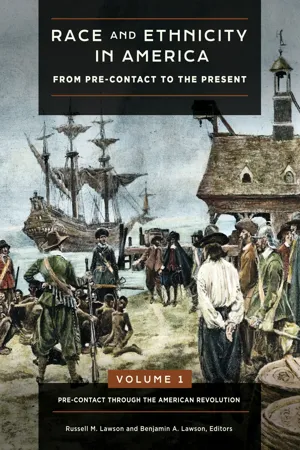
Race and Ethnicity in America
From Pre-contact to the Present [4 volumes]
- Russell M. Lawson, Benjamin A. Lawson, Russell M. Lawson, Benjamin A. Lawson(Authors)
- 2019(Publication Date)
- Greenwood(Publisher)
Environment 47 (6): 10–23.Bullard, Robert D., ed. 2007. Growing Smarter: Achieving Livable Communities, Environmental Justice, and Regional Equity. Cambridge, MA: MIT Press.Camacho, David E., ed. 1998. Environmental Injustices, Political Struggles: Race, Class, and the Environment. Durham, NC: Duke University Press.Holifield, Ryan. 2001. “Defining Environmental Justice and Environmental Racism.” Urban Geography 22 (1): 78–90.Kirk, Gwyn. 1997. “Ecofeminism and Environmental Justice: Bridges across Gender, Race, and Class.” Frontiers: A Journal of Women Studies 18 (2): 2–20.McGurty, Eileen Maura. 1997. “From NIMBY to Civil Rights: The Origins of the Environmental Justice Movement.” Environmental History 2 (3): 301–323.Newkirk, Vann. 2018. “Puerto Rico’s Environmental Catastrophe.” The Atlantic, October 18. Accessed April 28, 2019. https://www.theatlantic.com/politics/archive/2017/10/an-unsustainable-island/543207/Sandler, Ronald, and Phaedra Pezzullo, eds. 2007. Environmental Justice and Environmentalism: The Social Justice Challenge to the Environmental Movement. Cambridge, MA: MIT Press.Schlosberg, David. 2013. “Theorising Environmental Justice: The Expanding Sphere of a Discourse.” Environmental Politics 22 (1): 37–55.Environmental RacismEnvironmental Racism generally refers to unjust environmental practices that differentially and negatively affect racial minority communities. These practices may include unjustly exposing communities to more environmental and health risks because of disproportionate contact with pollutants, denying access to procedures and processes aimed at preventing exposure to environmental contaminants, or preventing communities of color from obtaining access to environmentally unpolluted spaces and resources. Dismantling practices and policies associated with Environmental Racism is often seen as a specific goal of the environmental justice movement. eBook - ePub
- Nicholas Low(Author)
- 2002(Publication Date)
- Routledge(Publisher)
barrios. Native American reservations to rural ‘poverty pockets’ in the United States, unequal protection is creating endangered communities, people and environments. In the southern United States, for example, ‘Jim Crow’ (i.e. apartheid American style) racial discrimination, institutionalized in housing, employment and education, buttressed this process.A new form of activism emerged out of the struggles against disparate and unequal enforcement of environmental protection laws in black and white communities. This new environmental activism was an extension of the modern anti-racist civil rights movement. Environmental Racism may be difficult to prove in a court of law. Nevertheless, it is as real as the racism found in housing, employment, education and voting (Bullard, 1993a). Environmental Racism refers to any policy, practice or directive that differentially affects or disadvantages individuals, groups or communities on the basis of race or colour, whether the differential effect is intended or unintended. Environmental Racism is just one form of environmental injustice and is reinforced by government, legal, economic, political and military institutions. Environmental Racism combines with public policies and industry practices to provide benefits for whites while shifting costs to people of colour (Godsil, 1990; Colquette and Robertson, 1991; Collin, 1992; Chase, 1993; Bullard, 1993a; Coleman, 1993; Colopy, 1994; Westra and Wenz, 1995).The environmental justice movement—as is true of most other social movements in the United States and elsewhere—emerged in response to practices, policies and conditions that were judged to be unjust, unfair and illegal. Some of these practices, policies and conditions include (a) unequal enforcement of environmental, civil rights, and public health laws; (b) differential exposure of some populations to harmful chemicals, pesticides and other toxins in the home, school, neighbourhood and workplace; (c) faulty assumptions in calculating, assessing and managing risks; (d) discriminatory zoning and land-use practices; (e) disparate siting of polluting facilities; and (f) exclusionary practices that limit some individuals and groups from participation in decision-making (Lee, 1992; Bullard, 1993b, 1994).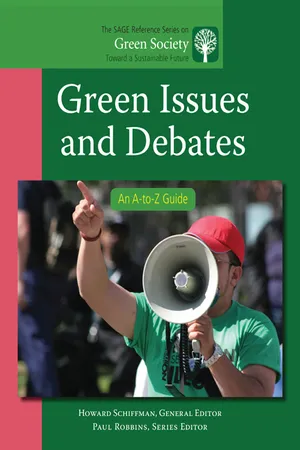 eBook - PDF
Green Issues and Debates
An A-to-Z Guide
- Howard S. Schiffman(Author)
- 2011(Publication Date)
- SAGE Publications, Inc(Publisher)
The term incorporates Environmental Racism and environmental classism. When the environmentally disadvantaged groups are correlated with ethnic minorities, environ-mental injustice is parallel to Environmental Racism; when it is solely an issue of economics, it is termed environmental classisim . Another related concept is that of environmental equity, which requires equal treatment and protection of environmental laws. The idea of equal distribution of risks raised in the early days of the movement received criticism because it may imply equalized pollution rather than risk reduction and avoidance. This misleading terminology that allowed inter-pretation of equity only in distribution terms eventually gave way to the more common use of the broader term environmental justice , which includes procedural justice as well. Environmental justice emphasizes the right to a safe and healthy environment for all peo-ple and is less provocative than Environmental Racism, which suggests discrimination in policy making, the enforcement of laws, and targeting communities of color for disposal sites and polluting industries. It is more difficult to argue against claims of justice com-pared to equity or racism. History and Development The environmental justice movement is commonly dated to the first court case challenging the siting of a waste facility on violation of civil rights grounds in Houston, Texas, in 1979 ( Bean v. Southwestern Waste Management Corp .). Another key event was a protest against a proposal to site a polychlorinated biphenyl (PCB) landfill in a predominantly African American community in Warren County, North Carolina, in 1982. During the dispute, Reverend Benjamin F. Chavis Jr., director of the United Church of Christ’s Commission for Racial Justice, coined the term Environmental Racism and linked the two popular social movements of the late 20th century: environmentalism and civil rights.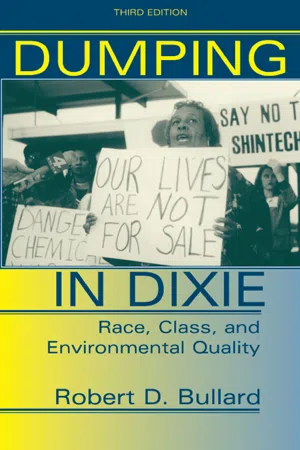 eBook - ePub
Dumping In Dixie
Race, Class, And Environmental Quality, Third Edition
- Robert D. Bullard(Author)
- 2018(Publication Date)
- Routledge(Publisher)
6Environmental Racism is real; it is not merely an invention of wild-eyed sociologists or radical environmental justice activists. It is just as real as the racism found in the housing industry, educational institutions, the employment arena, and the judicial system. What is Environmental Racism, and how does one recognize it? Environmental Racism refers to any policy, practice, or directive that differentially affects or disadvantages (whether intended or unintended) individuals, groups, or communities based on race or color. Environmental Racism combines with public policies and industry practices to provide benefits for whites while shifting industry costs to people of color.7 It is reinforced by governmental, legal, economic, political, and military institutions. In a sense, “Every state institution is a racial institution.”8Environmental decision making and policies often mirror the power arrangements of the dominant society and its institutions. A form of illegal “exaction” forces people of color to pay the costs of environmental benefits for the public at large. The question of who pays for and who benefits from the current environmental and industrial policies is central to this analysis of Environmental Racism and other systems of domination and exploitation.Racism influences the likelihood of exposure to environmental and health risks as well as of less access to health care.9 Many U.S. environmental policies distribute the costs in a regressive pattern and provide disproportionate benefits for whites and individuals at the upper end of the education and income scales.10 Numerous studies, dating back to the 1970s, reveal that people-of-color communities have borne greater health and environmental risk burdens than the society at large.11
- Warren J. Blumenfeld(Author)
- 2019(Publication Date)
132 the what, the so what, and the now what people of color over white people for similar crimes. Though the U.S. represents 4.4% of the world’s population, it houses 22% of the world prison inmates. While most police officers enter law enforcement with good intentions to serve and assist the public and to support their own families, they bring with them their past socialization sometimes aided and abetted by members of their departments. Though usually subtle, the process by which systemic racism reproduces itself into law enforcement and other social institutions can also at times express itself quite blatantly. (See Immigration as Official U.S. “Racial” Policy: A Brief History, Liberatory Praxis Appendix F.) Environmental Racism What: Reverend Benjamin Chavis Jr., the former leader of the NAACP, intro- duced the term “Environmental Racism” in 1982 during a series of protests held at the proposed Warren County, North Carolina PCB landfill site. He explained it as … racial discrimination in environmental policy-making and enforcement of regula- tions and laws; the deliberate targeting of communities of color for toxic-waste facili- ties; the official sanctioning of the presence of life-threatening poisons and pollutants in communities of color; and the history of excluding people of color from leadership in the environmental movement. So What: The case of an oil pipeline going through tribal lands in the United States demonstrates an example of “Environmental Racism” in North Dakota at the Oceti Sakowin encampment by thousands of protest- ers, including people from Standing Rock Sioux nation and from numer- ous other tribal communities in opposition to the Dakota Access Pipeline. Environmental Racism is the disproportionate exposure to and impact on communities of color to environmental pollutants, toxins, and other con- taminants depriving them of the ecological benefits of clean ground, water, and air.
- M. Betsill, K. Hochstetler, D. Stevis, M. Betsill, K. Hochstetler, D. Stevis(Authors)
- 2005(Publication Date)
- Palgrave Macmillan(Publisher)
66 palgrave advances in international environmental politics gendered, but also with male power helping to produce such change in the first place (Dankelman and Davidson, 1988; Sontheimer, 1991). It has also produced much work on the gender politics of environmental movements (for example, Bretherton, 1998, 2003). Environmental justice movements, starting in the US but spreading elsewhere, have tended to focus on the way that racial inequalities have been used as well as intensified by environmental degradation (see also Parks and Roberts in this volume). The most prominent trigger for such movements has been over the location of toxic waste dumps, which have disproportionately been placed in ethnic minority communities (Bullard, 1990; Szasz, 1994). At the same time, mainstream environmental NGOs have widely been regarded to have failed to develop campaigns to deal with this sort of environmental injustice. These inequalities have thus structured both how environmental degradation is organized and legitimized, and how movements to campaign against such degradation have emerged. These racial inequalities often also intersect with class inequalities. Both in a loose use of the term ‘class’, regarding the extreme income inequalities which are prevalent in many countries, as well as regarding a more precise usage concerning the relation to the means of production, environmental politics are conditioned for many by class relations. Early developments of such arguments (Enzensberger, 1974; more recently, Harvey, 1993) have tended to regard environmentalism with some suspicion, suggesting that it is a middle-class movement one of whose effects (even if unintentionally) is to ‘pull up the ladder’ behind them and prevent working-class people from enjoying the benefits of wealth that they themselves enjoy. This is similar in structure to arguments about ‘ecocolonialism’ in relation to North–South inequalities (Agarwal and Narain, 1990). eBook - PDF
Environmental Justice in the New Millennium
Global Perspectives on Race, Ethnicity, and Human Rights
- F. Steady(Author)
- 2009(Publication Date)
- Palgrave Macmillan(Publisher)
We need only remember former Harvard University president and chief economist of the World Bank, Lawrence Summers’ now infa- mous 1991 suggestion to reroute toxic waste to the poorest nations, Strategies of Confinement 109 to understand how the dynamics of toxic dumping and environmental neglect relate unequivocally to the transnational politics of race and class. 59 Although those who have examined the global dimensions of environmental justice have tended to concentrate on the racist, classist, and colonialist overtones of the uneven relationship between Western and non-Western nation-states, examining the ways Environmental Racism reproduces itself at multiple sites within nation-states outside of the United States also speaks to this phenomenon. Understanding what these politics of inequality have to do with transnational episte- mologies of race allows us to situate the environmental justice debate within the discourse of global racial politics. The global racial episte- mology that allows people of color around the world, particularly in the Global South, to become toxic waste sites, is built on the tenets of white supremacy. This logic suggests that places like the Niger Delta and the coast of Bahia are acceptable trashcans for hazardous waste, because the people who inhabit these spaces are of no import within the global social hierarchy and pose a criminal threat to the tenets of “modern Western civilization.” The construction of communities of color as toxic dumping grounds extends from colonial and imperi- alist projects that marry racial repression with the struggle for land control. These projects signal what scholars like Francis Adeola have called practices of environmental colonialism. eBook - ePub
Green Voices
Defending Nature and the Environment in American Civic Discourse
- Richard D. Besel, Bernard K. Duffy, Richard D. Besel, Bernard K. Duffy(Authors)
- 2016(Publication Date)
- SUNY Press(Publisher)
The “disproportionate presence of toxic facilities and pollutants” in “people of color communities” constitutes an “insidious form of institutionalized racism.” 12 The racism and injustice manifest here are not the products of ill-intentioned individuals, susceptible to change through reeducation or the politics of the personal. Environmental Racism represents the very structure of society itself and therefore requires societal change. Systemic racism must be confronted by systemic activism. “We have to channel our anger,” Chavis instructs his audience, “into a constructive modus operandi, where our political will is felt by those that make policy in this country, by those that make those decisions.” 13 The goal of the Summit is to produce that systematic modus operandi, the “mechanisms” that will “make the good news real in our communities, in the nation, and in the world.” 14 Such mechanisms are not simply the product of revelatory naming, however. The activists’ systemic challenge to Environmental Racism must also produce such clarity of vision, for themselves and others: “The problem has been there are some who would exploit. There are some that would do anything to anybody to advance their own personal or collective avarice and greed. We are saying that we have to pull the sheets off all such persons.” 15 The white sheets and racism of the Ku Klux Klan had been obvious for all to see; it was the summit’s task to reveal the white sheets of contemporary, subtler racism. The institutional nature of Environmental Racism is also evident in the mainstream environmental movement, and Chavis takes advantage of several opportunities to chastise that movement eBook - ePub
Environmental Justice
Key Issues
- Brendan Coolsaet(Author)
- 2020(Publication Date)
- Routledge(Publisher)
Justice and social policy, 128. Upper Saddle River, NJ: Prentice-Hall, Inc.Blais, Lynn E. 1996. Environmental Racism reconsidered. North Carolina Law Review 75: 75–148.Bravo, Mercedes A., Rebecca Anthopolos, Michelle L. Bell, and Marie Lynn Miranda. 2016. Racial isolation and exposure to airborne particulate matter and ozone in understudied US populations: Environmental justice applications of downscaled numerical model output. Environment International 92–93: 247–255.Cagle, Susie. 2019. Richmond v Chevron: The California city taking on its most powerful polluter. The Guardian, Oct. 9. www.theguardian.com/environment/2019/oct/09/richmond-chevron-california-city-polluter-fossil-fuelCivil Rights Act, Title VI, 42. 1964. U.S.C. §§ 2001e-1 to -17.Cole, Luke W. and Sheila R. Foster. 2001. From the ground up: Environmental Racism and the rise of the environmental justice movement. New York: New York University Press.Davenport, Coral. 2016. Senate approves funding for flint water crisis. The New York Times, Sept. 15.DeFur, P.L., G.W. Evans, E.A. Hubal, A.D. Kyle, R. Morello-Frosch, and D.A. Williams. 2007. Vulnerability as a function of individual and group resources in cumulative risk assessment. Environmental Health Perspectives 115: 817–824.Del Real, Jose A. 2019. The grow the nation’s food, but they can’t drink the water. The New York Times, May 21.Environmental Protection Agency. 1996. Nondiscrimination in programs receiving federal Assistance from the environmental protection agency. Code of Federal Regulations 40: §7.35(b)-(c).Environmental Protection Agency. 2016. EJ 2020 action agenda: The U.S. EPA’s environmental justice strategic plan for 2016–2020. www.epa.gov/sites/production/files/2016-05/documents/052216_ej_2020_strategic_plan_final_0.pdfEnvironmental Protection Agency. n.d. EJ screen: Environmental justice screening and mapping tool. www.epa.gov/ejscreen .Fahsbender, John J. 1996. An analytical approach to defining the affected neighborhood in the environmental justice context. NYU Environmental Law Journal eBook - ePub
Rio
Unravelling the Consequences
- Caroline Thomas(Author)
- 2014(Publication Date)
- Routledge(Publisher)
an issue in political and academic circles, but I wonder whether that means anything more than that it is impossible not to pay lip-service to it.I will look at these barriers under two broad headings, political and academic. I have to admit that I am very unhappy about making this simple division, for the blindingly obvious reason that they are so clearly fundamentally interrelated. Yet I feel that this is the best way to get to grips with two somewhat distinct logics of the problem. That is to say that there are reasons why environmental issues may well be peripheralised in the world of international relations and a separate set of reasons why this will occur in the academic discipline. They illustrate two rather different aspects of how power operates.I must hasten to add that the arguments that follow are certainly not omitted from much of the recent scholarship on the subject of environmental politics and international relations. Hurrell and Kingsbury [1992 ], for example, introduce their edited book with an excellent chapter looking at the difficulties facing international attempts to deal with environmental issues. Similarly, Albert Weale’s recent account of the politics of pollution [1992 ] has a sophisticated discussion of the international dimension of pollution control. Oran Young’s pioneering work on environmental regimes and co-operation (see Young [1989 ; 1990 ] as examples) has been focused on the processes by which the international states system can develop environmental regimes.Each of these writers takes as his starting point the states-system and analyses how inter-state agreement and co-operation can be achieved despite it. These attempts place all these writers within the pluralist camp in international relations theory. This is only one of the alternatives within international relations theory, as each author well knows; yet each writes from within eBook - PDF
Where We Live, Work and Play
The Environmental Justice Movement and the Struggle for a New Environmentalism
- Patrick Novotny(Author)
- 2000(Publication Date)
- Praeger(Publisher)
2 Race, Ethnicity and the Politics of the Environmental Justice Movement The environmental justice movement is widely seen as being responsible for the emerging awareness of the affect of environmental problems on the poor, particularly in African-American, Native American, Latino, and Asian Pacific communities. It is argued in this chapter and in the subse- quent chapter on the SouthWest Organizing Project that by connecting the environment with more recognizable struggles for civil rights and social justice, the leaders of these groups have increased the involvement of their communities with the environment. FRAMING RACE AND ETHNICITY IN THE ENVIRONMENTAL JUSTICE MOVEMENT The environmental justice movement and its activism in African- American, Native American, Asian Pacific, and Latino communities is prompting a resurgence of scholarly interest in the incidence of environ- mental problems in these communities, largely inspired by the research conducted by the United Church of Christ Commission for Racial Justice in its 1987 study, Toxic Wastes and Race in the United States: A National Report on the Racial and Socioeconomic Characteristics of Communities with Hazardous Waste Sites. The widening awareness in the past decade of environmental problems as they affect the rural and inner-city poor, particularly African-American, Latino, and Asian Pacific communities, is an important objective of the en- vironmental justice movement. Study after study has shown that the poor bear the burdens not only of hazardous wastes but of water and soil con- tamination, carbon dioxide emissions, asthma, and lead poisoning, all of which put them at even greater risk for health problems (Krieger, Rowley, 12 Where We Live, Work and Play Herman, Avery and Phillips 1993, 88-122; Florini, Krumbhaar and Silbergeld 1990). The connection of the environment with impoverishment is evident to many of those Americans who live in the shadows of industry. eBook - ePub
Traditions and Trends in Global Environmental Politics
International Relations and the Earth
- Olaf Corry, Hayley Stevenson, Olaf Corry, Hayley Stevenson(Authors)
- 2017(Publication Date)
- Routledge(Publisher)
However, in recent times, the political assumptions and ethical foundations upon which such institutions are built have been heavily criticised. Not least for insufficiently challenging global power inequalities (procedural justice) and for producing governance arrangements that do not protect – let alone improve the position of – already vulnerable people and natural environments (Gardiner 2011; Okereke 2007). For example, in the case of international biodiversity conservation and the protected land disputes it gives rise to, local livelihoods and non-economic valuations of nature have frequently been shown to come second to global capitalist priorities and logics (Holmes 2011; Okereke 2007; Sullivan 2013; Swyngedouw 2013). By adopting such discourses and endorsing biased institutional arrangements, these approaches to environmental justice risk depoliticising and disempowering their subjects. Where power imbalances are explicitly invoked, it is primarily through the lens of mainstream state-centric IR theory. As a general rule, scholarship on global environmental governance and global environmental politics more widely, fails to take account of inequalities in social power relations, within and between various levels of analysis (for example, Breitmeier et al. 2006; Mitchell et al. 2006). Within IR, power is operationalised as the ability to set rules (explicitly through formal channels but also implicitly through social interactions and defining the terms of debate), thereby making other actors do what they may not have done otherwise (Lukes 1974)
Index pages curate the most relevant extracts from our library of academic textbooks. They’ve been created using an in-house natural language model (NLM), each adding context and meaning to key research topics.

