Politics & International Relations

Environmental Justice
Environmental justice refers to the fair treatment and meaningful involvement of all people, regardless of race, color, national origin, or income, in the development, implementation, and enforcement of environmental laws, regulations, and policies. It aims to address the disproportionate burden of environmental hazards and pollution on marginalized communities and promote equitable access to a healthy environment.
Written by Perlego with AI-assistance
Related key terms
1 of 5


12 Key excerpts on "Environmental Justice"
 eBook - ePub
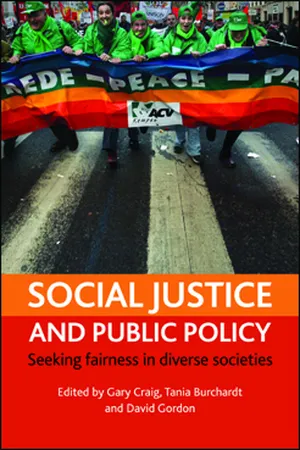
Social justice and public policy
Seeking fairness in diverse societies
- Craig, Gary, Burchardt, Tania, Gary Craig, Tania Burchardt, David Gordon(Authors)
- 2008(Publication Date)
- Policy Press(Publisher)
These considerations are reflected in the sustainable development debate – sustainable development being development that gives equal consideration to social, economic and environmental concerns. Brundtland argues that sustainable development is based on the premise that environmental degradation is based on human activity, but more specifically the activities of the most affluent. Dealing with this inequitable impact is seen as crucial to increasing environmental standards, improving equitable shares of environmental resources, poverty alleviation and strengthening the democratic process.There are a number of perspectives on how environmental and sustainable development issues are defined within a social justice paradigm. However, the common theme of Environmental Justice is constructed around the political and legal concepts of substantive civil and political rights. The main components of Environmental Justice are based most of all on the right of all to a fair environment, a substantive right embedded in natural law, and the right of all human beings to equal resources. The civil and political process then defines the paradigm of empowering participation, access to information and resources (social and political), allowing all human beings to make informed decisions on the environment at micro and macro levels, both between and within generations.Generally, dialogue around Environmental Justice has been concerned with evidencing environmental injustice, that is, breaches of the proposed human right to the environment and barriers to environmental decision making. It is generally acknowledged that environmental injustice creates environmental ‘bads’ impacting disproportionately on marginalised, socially and economically excluded communities and groups. The task of the Environmental Justice movement, as seen for example in the US, has been to empower the disenfranchised and provide a good example of environmental equality. A detailed analysis of this movement, the actors and resources that created the mobilisation and participation of people, could be used as a model for the mobilisation and resourcing of peoples historically excluded from the UK environment debate. eBook - PDF
Ecological Social Work
Towards Sustainability
- Jennifer McKinnon, Margaret Alston(Authors)
- 2017(Publication Date)
- Red Globe Press(Publisher)
Environmental injustice , on the other hand, indicates the disproportionate way in which minority groups have to deal with the negative impact of environmental burdens, at various levels. They experience the largest consequences that impact their health and their quality of life. The concept was developed by the Environmental Justice Movement, which originated in the US in 1982 as a result of civil disobedience by poor A SAFE AND JUST SPACE FOR HUMANITY 185 Afro-Americans, protesting against toxic pollution in Warren County, North Carolina. This grassroots protest for Environmental Justice was the start of a new perspective on environmental problems by minority groups. The Environmental Justice Movement is involved in a debate about rights with a focus on distribu-tive Environmental Justice and in its political power analysis: ‘It brings to the surface the ethical and political questions of “who gets what, when, why, and how much”.’ (Bullard & Johnson, 2000: 559). Equal access to information and political participation is necessary to have a genuine impact on the political decision-making processes. Environmental Justice has been developed from a human rights perspective. For that reason it is distinguished from ‘ecological justice’, which deals with the (lack of) balance in the relationship between humans and the rest of nature (Miller et al., 2012). Although in practice, this difference in terminology is not strictly maintained, concepts such as individual (civil) rights, equal opportuni-ties, social justice, human dignity and self-determination are essential in the discourse of the Environmental Justice Movement. As a result, Environmental Justice is often considered as the first paradigm which connects environment with race, class, gender and social justice in one framework (Agyeman et al., 2003). eBook - PDF
Environmental Political Thought
Interests, Values and Inclusion
- Robert Garner(Author)
- 2018(Publication Date)
- Bloomsbury Academic(Publisher)
The determined lead-ership of Lois Gibbs resulted in national media coverage and the inter-vention of President Carter, who ordered that the people be relocated (Dryzek, 2013 : 213–14). Today, numerous Environmental Justice cam-paigns exist focusing, in particular, on the location of hazardous waste, and national organisations, such as the National Black Environmental Justice Network in the United States and the Black Environmental Net-work in the UK, have been formed. The concept of Environmental Justice is now applied to a wider range of issues and the national focus of Environmental Justice movements has been dwarfed by the question of justice on a global scale (Carmin and Agyeman, 2011 ). In this so-called second generation of Environmental Justice, attention was altered from a demand for ‘not in my backyard’ to ‘not in anyone’s backyard’ (Vanderheiden, 2016 : 323). The growing interconnectedness in the world of peoples and sovereign states has pro-vided a fillip for extending justice beyond national boundaries. Limiting a discussion of justice to the internal affairs of wealthy Western states seems trivial, given the staggering inequalities between different parts of the world. As a reflection of this wider concern of the Environmental Justice movement, climate change is seen, above all, as an issue that has a disproportionate impact on disadvantaged groups. ENVIRONMENTAL POLITICAL THOUGHT 124 Recognising the global character of justice, political theorists have sought to develop theories of justice that are global in scope. There is lit-tle agreement, however, on what our moral obligations should be to those outsiders who do not belong to our community. For some philosophers, the moral obligation on the richest to help the poorest is clear cut. For some, the sacrifices required will make many of us feel uncomfortable. At one end of the spectrum is the position represented by Peter Singer ( 1985 ) (see Box 8.3 ). eBook - ePub
- Gary C Bryner(Author)
- 2015(Publication Date)
- Routledge(Publisher)
Devising solutions to environmental injustices is similarly fraught with challenges. The inequitable distribution of the burdens and benefits of environmental protection reaches well beyond the site selection and pollution focus of the traditional Environmental Justice movement to include the management of natural resource extraction. Actions taken to improve environmental quality may not result in improved social equity and may even exacerbate inequities. Policies that promote justice and strengthen the political power and decision-making influence of the poor and other marginalized groups may not produce improvements in overall environmental conditions. Allowing indigenous groups to continue to hunt and fish on traditional lands, for example, may be a justice imperative, but it may also threaten the survival of endangered species or clash with plans for protecting wilderness. Pursuing the goal of Environmental Justice requires innovative remedies that balance and reinforce the goals of strengthening the power of politically disadvantaged communities as well as improving environmental quality.A lively debate exists about the nature of the problem of Environmental Justice, the extent and seriousness of the risks, and the causes and underlying factors. But just as important and difficult is the question of what kinds of responses we should pursue. What are our options and how should we choose from among them? Natural resource laws and policies traditionally focus on encouraging development of resources, protecting natural systems, and ensuring the sustainability of resource development. These laws and policies are usually assessed in terms of how well they achieve these resource development and environmental protection goals and how they interact with economic goals of efficiency and growth. Environmental Justice advocates argue equal importance should be accorded to the consequences of natural resource policy decisions for the societal goals of protecting individual rights, promoting justice and fairness, ensuring fair participation, and fostering social equity.This chapter develops a framework for exploring alternative ways of defining injustices related to natural resources and the environment that are found in the relevant literature and public policies and also to suggest how Environmental Justice can be approached from different perspectives. The literature on EJ from U.S. scholars typically focuses on rights-based assertions of injustices in the distribution of environmental harms. More broadly, the EJ literature from the developing world centers on the lack of support for sustainable development for all humankind, particularly those in the poorest regions of the world. The chapter begins with a discussion of the alternative frameworks for defining EJ, which primarily come from the United States. It then takes up the question of EJ between nations. To broaden the analysis cross-nationally, it then turns to a brief case study on how the concept of Environmental Justice can help clarify some of the key issues surrounding climate change and the case of how the rights of indigenous peoples implicate environmental protection policy making. eBook - ePub
Traditions and Trends in Global Environmental Politics
International Relations and the Earth
- Olaf Corry, Hayley Stevenson, Olaf Corry, Hayley Stevenson(Authors)
- 2017(Publication Date)
- Routledge(Publisher)
Some have argued that the issue of climate change has been a key driver of emerging discourses of justice in GEP (e.g., Parks and Timmons Roberts 2006: 329). This is true to an extent, but there has been a deepening engagement with questions of justice in global environmental politics from various perspectives and with regard to various environmental concerns. Some of this scholarship poses troubling questions to IR and its assumptions. Many climate-related writings draw on John Rawls and other moral philosophers, seeking to update and apply their ethical principles for a just society (Ehresman and Stevis 2010: 89; Gardiner 2011). For instance, the notion of ‘cosmopolitan justice’ has featured prominently in academic GEP discourses. Here, the difficulties associated with nation-state regimes – sovereignty, national interest, global competitiveness – are side-stepped by adjusting the Rawlsian premise of equal rights and responsibilities for all ‘peoples’ (those affiliated to a given state) to all ‘persons’ (regardless of their citizenry) on the planet (Brock 2009; Harris 2013; Hayden 2005). This position challenges many of the theoretical foundations of IR, making its applied institutions no longer the preferred medium for governing global environmental issues. Ultimately, cosmopolitan justice argues that the needs, capabilities and values of individuals are universal (although culturally nuanced), and are thus better met through collaboration within and across – as opposed to between – traditional state boundaries or political jurisdictions.Broadly speaking, Environmental Justice refers to the application of principles of social justice to understanding and managing human–environment interactions. Environmental Justice analyses and actions have focused on different dimensions (distributive and procedural) and subjects (individuals, collectives and non-humans). For example, contestation over changes in land use can be understood by asking: who benefits, how is this determined, and does this differ for individuals, communities or the environment? This conceptual diversity developed in conjunction with a range of different real-world social movements and political discourses (Schlosberg 2007, 2013); for example, indigenous communities speaking of cultural representation in regard to land disputes in North America. This dialogue between theory and practice has been fruitful for Environmental Justice and global environmental politics alike, bringing together environmental policymakers and activists of all stripes (Agyeman and Evans 2004; Schlosberg and Collins 2014). eBook - PDF
- Richard Hugman, Jan Carter(Authors)
- 2017(Publication Date)
- Red Globe Press(Publisher)
Individual and social well-being, participation and fairness – enduring social work concerns – are understood with greater clarity as social and Environmental Justice are jointly considered. Environmental Justice Environmental Justice shares a similar developmental trajectory as social justice. Indeed, in key ways they are quite closely related. The modern Environmental Justice movement began in the early 1970s in response to growing incidents of industrial contamination impacting communities like Love Canal and the intentional targeting of industrial and municipal waste sites near working poor, minority and politically disempowered communities – commonly referred to as environmental racism (Melosi 2004 ; A CRITICAL ANALYSIS OF SOCIAL AND Environmental Justice 153 Gottlieb 2005 ). Environmental Justice brought to the forefront of public consciousness the idea that social concerns could not be separated from environmental concerns. In order to ensure just social and economic conditions, the environment must be protected since it is the biophysical wellspring of a just society. Thus, over time, Environmental Justice became increasing linked with and often an extension of social justice. In some ways the modern Environmental Justice movement is not new. It is an extension of the safeguarding impulse of early twentieth-century conservationism and preservationism. These early environmental move-ments recognized that rampant industrialization and commercialization posed a potential threat to natural systems. The expansionist pioneering ethos, sustained by the myth of unending reserves of natural resources ready for the harvest, was no longer tenable. Unless individuals, business interests and governments took steps to preserve and conserve natural resources these, in time, would become exhausted and thus imperil ongo-ing economic development and social stability. eBook - ePub
Natural Resources and Environmental Justice
Australian Perspectives
- Anna Lukasiewicz, Stephen Dovers, Libby Robin, Jennifer McKay, Steven Schilizzi, Sonia Graham, Anna Lukasiewicz, Stephen Dovers, Libby Robin, Jennifer McKay, Steven Schilizzi, Sonia Graham(Authors)
- 2017(Publication Date)
- CSIRO PUBLISHING(Publisher)
Reed and George 2011 ).Our ‘intersection point’ between justice and environment thus definitely includes the distributional and procedural aspects of Environmental Justice, but it also includes research in social justice, which looks at the allocation of goods and benefits within a society, focusing on distributive, procedural and relational fairness, often from the viewpoint of marginalised or disadvantaged stakeholders (Syme and Nancarrow 2001 ; Whiteman 2009 ). Social justice sometimes considers human–environmental interactions (Foster et al. 2010), but the majority of its research remains firmly anthropocentric. Both environmental and social justice often view the environment as a passive background against which justice is played out. Recently, a trend has emerged to pick an environmental theme and to concentrate justice research around it: for example, water justice (Perreault 2014 ; Zwarteveen and Boelens 2014 ); climate justice (Posner and Weisbach 2010 ); or food justice (Gottlieb and Joshi 2013 ; Wittman 2009 ). In contrast, ecological justice identifies the environment as a subject of justice – a stakeholder to whom justice is owed (Driscoll and Starik 2004 ; Opotow and Clayton 1994 ; Starik 1995 ; White 2008 ). Other fields that contribute to our ‘intersection point’ include: environmental law (Le Bouthillier et al. 2012); ecological economics (Costanza 1989 ); environmental philosophy (Mathews 2014 ); and aspects of political theory and research into human rights (Gearty 2010 ; Hancock 2003 eBook - PDF
- Robert Brinkmann(Author)
- 2016(Publication Date)
- Wiley-Blackwell(Publisher)
Thus, when considering Environmental Justice issues in some areas of the world, it is important to recognize the unique relationships that some groups have with the land. It is also important to note that many tribal lands are in some of the more environmentally difficult areas of the United States. Many are located in very dry or cold regions. Issues like global climate change, water withdrawal, and neighboring environmental disturbances can have disproportionate impacts than more temperate areas. Exporting environmental problems One of the major themes of Environmental Justice that has emerged in recent years is the notion that devel- oped countries are exporting environmental problems around the world, leading to issues of Environmental Justice in the receiving country. This is done in the fol- lowing ways: 1 Exporting dirty industries 2 Selling products banned in a developed country to a developing country 3 Taking advantage of overseas cheap labor that work in poor conditions to avoid paying workers a living wage in the home country 4 Exploiting resources of a country with poor environ- mental rules 5 Exporting waste, particularly hazardous waste, to other countries with lax regulation. Many of us are powerless to address these issues in our daily lives. However, new organizations that evaluate Environmental Justice issues have emerged. For example, the Fair Trade label has emerged in recent years to note that the labor practices for the product are just. Plus, many companies have infused Environmental Justice within their international corporate environ- ment and recognize that failure to act fairly in the world impacts not only the company’s bottom line profit, but also the overall ethical reputation of the corporation (Figure 11.6).
- Sumudu A. Atapattu, Carmen G. Gonzalez, Sara L. Seck(Authors)
- 2021(Publication Date)
- Cambridge University Press(Publisher)
G. Gonzalez, “Environmental Justice and International Law,” in S. Alam, J. H. Bhuiyan, T. M. R. Chowdury, and E. J. Techera (eds.), Routledge Handbook of International Environmental Law (Abingdon, UK: Routledge, 2013), p. 77 (applying this definition to environmental conflicts between affluent and poor countries). 73 See D. French, “Sustainable Development and the Instinctive Imperative of Justice in the Global Order,” in D. French (ed.), Global Justice and Sustainable Development (Leiden: Martinus Nijhoff, 2010), p. 8. 74 See Kuehn, note 72, p. 10688. 75 Ibid., pp. 10693–10698; M. Burkett, “Climate Reparations”(2009) 10 Melbourne Journal of International Law 513 at 522–523. 76 See C. G. Gonzalez, “An Environmental Justice Critique of Comparative Advantage: Indigenous Peoples, Trade Policy, and the Mexican Neoliberal Economic Reforms” (2011) 32 University of Pennsylvania Journal of International Law 728; R. Guha, Environmentalism: A Global History (New York: Longman, 2000), p. 105. 77 See for example Chapters 4, 14, and 23 in this volume. 78 M. Fricker, Epistemic Injustice: Power and the Ethics of Knowing (Oxford: Oxford University Press, 2007). 79 R. Tsosie, “Indigenous Peoples and Epistemic Injustice: Science, Ethics and Human Rights” (2012) 87 Washington Law Review 1133 at 1201; B. de Sousa Santos, Epistemologies of the South: Justice against Epistemicide (Boulder, CO: Paradigm, 2014). 10 Sumudu A. Atapattu, Carmen G. Gonzalez, Sara L. Seck injustice by explaining the differences between Indigenous and Western knowledge, the ways in which Indigenous communities have been harmed by the subordination of their world views, and the importance of Indigenous epistemologies and cosmologies not only to Indigenous self- determination, but also to the achievement by all communities of Environmental Justice and sustainable development. eBook - PDF
Environmental Justice in the New Millennium
Global Perspectives on Race, Ethnicity, and Human Rights
- F. Steady(Author)
- 2009(Publication Date)
- Palgrave Macmillan(Publisher)
Gender roles and gender inequalities contribute to the “feminization of poverty,” which means that, as a group, poor women in the Caribbean are likely to be less well-equipped economically to prepare for and to recover from disas- ters. The intensity of their gender-related responsibilities also increases with the effects of climate change. For example, rising temperatures, more intense hurricanes, and floods mean that in the wake of a disas- ter, there is increased risk of malaria and diarrhea from contaminated drinking water, which would increase the workload for women. As an example, for the first time in over fifty years, Jamaica experienced an outbreak of malaria in 2005 and 186 cases were reported. As a result of quick and effective interventions by the health authorities, the out- break was contained. Environmental Justice and Sustainable Development The term Environmental Justice embodies the principles of fairness and equality in managing the environment and promoting environmen- tal sustainability as well as sustainable development. 4 It implies using natural resources rationally, to ensure that successive generations can enjoy their environmental heritage. The Environmental Justice Move- ment in the United States has focused on building awareness of forms of exploitation and discrimination against people of color and minori- ties in relation to the environment. These groups tend to be exploited because they have unequal access to power and decision making in managing the environment, as well as matters that affect their envi- ronmental health. Environmental Justice is therefore aimed at analysis and activism to promote fairness, protection, and the sustainable use of natural, physical, and human resources. This chapter argues that as the majority of people in the Caribbean are of African descent, it means justice for people who are most vulnerable, disadvantaged, and powerless.
- M. Betsill, K. Hochstetler, D. Stevis, M. Betsill, K. Hochstetler, D. Stevis(Authors)
- 2005(Publication Date)
- Palgrave Macmillan(Publisher)
18 We therefore remain sceptical of Environmental Justice becoming too inclusive. Clearly, in trying to make the concept acceptable to everyone, those fighting for global Environmental Justice may succeed to the point of diluting their concept to the point of impotence and analytical worthlessness. It is important, therefore, that the concept of Environmental Justice be carefully specified and applied. In terms of strategies for Environmental Justice movements, there are some implications that can be drawn from our analysis. First, we believe that we need to strengthen the international institutions which are addressing environmental issues. We need to make international law ‘harder’ – giving ‘teeth’ to the environmental chamber of the International Court of Justice, for example. We need to fund and respect the rulings of the chamber and the United Nations Human Rights Commission in Geneva, and other UN agencies such as the United Nations Environment Programme. Most urgently, the dozens of existing environmental treaties need functional enforcement mechanisms (Dunoff, 1995; Kalas, 2001; Palmer, 1992). Together, these efforts support the broader need for us to pursue our multiple community loyalties, rather than just our national identities (Sen, 1999; Wapner, 1996). environmental and ecological justice 349 Somewhat ironically, we believe that these stronger international institutions may be crucial to national Environmental Justice movements making any further progress, including in the nation where it was born, the United States. There the Environmental Justice movement has suffered serious setbacks in the last five years and appears to be foundering, precisely at the time the global movement is taking off (Agyeman et al., 2003; Cole and Foster, 2001; Roberts and Toffolon-Weiss, 2001). To conclude, there are a number of possible directions in which this area of research might head. eBook - ePub
Environmental Justice
Key Issues
- Brendan Coolsaet(Author)
- 2020(Publication Date)
- Routledge(Publisher)
Speaking for Ourselves: Environmental Justice in Canada. Vancouver, BC: University of British Columbia Press.Pulido, Laura. 1996. Environmentalism and Economic Justice: Two Chicano Struggles in the Southwest. Tucson: University of Arizona Press.Schlosberg, David. 2007. Defining Environmental Justice: Theories, Movements, and Nature. Oxford: Oxford University Press.Taylor, Charles. 1989. Sources of the Self: The Making of the Modern Identity. Cambridge, MA: Harvard University Press.Taylor, Charles. 1994. The politics of recognition, in A. Gutmann (ed.) Multiculturalism: Examining the Politics of Recognition. Princeton: Princeton University Press.United Nations. 2007. United Nations Declaration on the Rights of Indigenous Peoples. Resolution adopted by the General Assembly on 13 September 2007.Whyte, Kyle. 2017. The recognition paradigm of environmental injustice, in Ryan Holifield, Jayajit Chakraborty and Gordon Walker (eds.) The Routledge Handbook of Environmental Justice. Abingdon: Routledge, pp. 113–123. Passage contains an image
6 Capabilities, well-being, and Environmental Justice 1
Breena HollandLearning outcomes
- Distinguish human capabilities as a conception of human well-being.
- Understand the direct and indirect ways that the natural environment supports capabilities.
- Identify threats to capabilities as different kinds of environmental injustice.
Introduction
Environmental Justice—whether conceived in terms of distributional equity, fair procedures, or recognition—2
Index pages curate the most relevant extracts from our library of academic textbooks. They’ve been created using an in-house natural language model (NLM), each adding context and meaning to key research topics.

