Politics & International Relations

Ecosocialism
Ecosocialism is a political ideology that combines elements of socialism and environmentalism. It seeks to address social and ecological issues by advocating for the reorganization of society to prioritize sustainability, equity, and the well-being of both people and the planet. Ecosocialists often emphasize the need for systemic change to combat climate change and promote ecological harmony.
Written by Perlego with AI-assistance
Related key terms
1 of 5
11 Key excerpts on "Ecosocialism"
 eBook - PDF
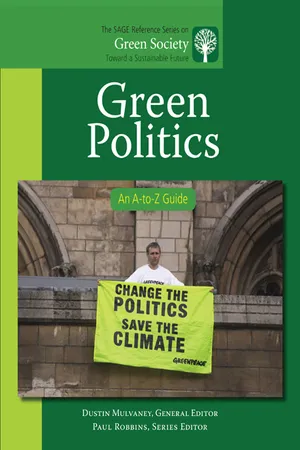
Green Politics
An A-to-Z Guide
- Dustin Mulvaney, Dustin R. Mulvaney(Authors)
- 2010(Publication Date)
- SAGE Publications, Inc(Publisher)
Ecosocialists also believe that to attain sustainability, economies that are industrialized need to contract and stabilize into a steady equilibrium. This contraction also requires individuals to accept more basic standards of material living, and ecosocialists point out that this does not mean having less happiness. This more basic standard of living can be acceptable to people if it is done gradually and it is understood that people are becoming more equal. A social environment that stresses equality is vital for people to be content with economic contraction. A guarantee of certain minimal goods will also foster content-edness and restrain social conflicts. To achieve stability in the shrinking economy, planning will be important. A comprehensive plan with price controls will prevent fear and chaos. 141 Ecotax Ecosocialists believe that in developing nations, the most important issue is stopping population growth, and they believe the state must take action to facilitate this occurrence. Ecosocialists also believe a socialist framework for the new economy will enable the moral growth and the new moral economy that will be essential for attaining a sustainable sys-tem. Ecosocialists are clear that socialism is a moral project. Ecosocialism is dependent on the belief that individuals have the capacity to overcome greed and self-interest and that moral growth is possible. See Also: Ecocapitalism; Governmentality; Institutions; Limits to Growth; Participatory Democracy; Political Ideology. Further Readings Benton, T. The Greening of Marxism. New York: Guildford, 1996. Burkett, Paul. Marx and Nature. New York: Monthly Review, 1999. McBrewster, John, Frederic P. Miller and Agnes F. Vandome. Eco-Socialism: Socialism, Social Ecology, Green Politics, Green Anarchism, Eco-Communalism, Inclusive Democracy, Environmentalism, Environmental Justice, Anti-Capitalism, Green Party. Beau Bassin, Mauritius: Alphascript Publishing, 2009. eBook - PDF
- Liam Leonard, Paula Kenny, Liam Leonard(Authors)
- 2010(Publication Date)
- Emerald Group Publishing Limited(Publisher)
Social Ecology is a coherent radical critique of current social, political and anti-ecological trends. It is a reconstructive, ecological, communitarian and ethical approach to society. Social ecology advocates a reconstructive and transformative outlook on social and environmental issues, and promotes a directly democratic, con-federal politics. As a body of ideas, social ecology envisions a moral economy that moves beyond scarcity and SUSTAINABLE JUSTICE AND THE COMMUNITY 120 hierarchy, towards a world that re-harmonises human communities with the natural world, while celebrating diversity, creativity and freedom. The core beliefs of social ecologists hold that the human potential to play a more creative role in natural and social evolution can be realised, unlocking the creative and communal potential to develop communities free from the curse of crass managerialism, unjust hierarchies, social inequity and ecological degradation. This approach to direct democracy could deliver a sustainable form of justice built on a fair and ethical system of politics and socio-economic planning. 4.5. GREEN THEORY AND SUSTAINABLE JUSTICE ‘Deep green theory’ is a critique of the ethics of ‘deep ecology’ put forward by writers such as Richard Sylvan and David Bennett. Distinctions are made between ‘non-ethical living’, which includes anthropocentric exploitation of the environment, and three ethical positions: ‘shallow’, ‘intermediate’ and ‘deep’ green ethics. Deep green theory develops Arne Naess’s concept of ‘deep ecology’ or ‘ecosophy’ which rejects the anthropocentricism for ecocentric models of living, with human life and ecology co-existing equally. However, deep green theory develops the concepts of deep ecology, incorporating alternative ideological understandings of the possibilities of deep green politics. No longer available |Learn more
Political Ecology
System Change Not Climate Change
- Dimitri Roussopoulos(Author)
- 2019(Publication Date)
- Black Rose Books(Publisher)
We, therefore, hope that the green dynamic does not get suffocated by party politics. Organising as a party is only acceptable as a temporary compromise, in order to keep one’s independence and to be able to take part in political institutions. Women must have equal representation. Dissenting views must be expressed and accepted. Responsibilities must be shared, rotated and kept in check. No line, group or person must be able to impose their will over all others; however, individuality must not drown in mediocrity and stereotypes. 36 In many of their declarations and proposals these libertarian eco-socialists display an affinity with the current of thought known as social ecology, which we discuss below. They stop short, however, of embracing the municipalist approach to ecological and social change integral to the school of social ecology. Although the libertarian eco-socialists in Europe reject the nation-state in favor of a continent of regions, they fail to identify a specific configuration of political and economic institutions as the potential foundation for the radical social and political changes they set as their goal. 111 Political Ecology and Social Ecology Social Ecology Social ecology is rooted in a rich philosophical framework that is reflected in its politics. Comprehensive and systematic, it represents the greatest advance in twentieth century eco-philosophy. The progenitor of the theory of social ecology is the American radical ecologist Murray Bookchin. Since the 1950s, he laboured brilliantly to lay the foundation of this philosophy in which history, technology and urbanism are interwoven. Bookchin was no academic philosopher ensconced in some university. Rather, he was a radical scholar who, in addition to being a prolific writer, was a political activist over many decades, and he constantly sought new ways of generating civic politics while remaining resolutely anti-capitalist and anti-statist. eBook - PDF
- Peter Newell(Author)
- 2019(Publication Date)
- Cambridge University Press(Publisher)
And the latter more cognisant and accepting of the need not just to change ownership structures and internal relations between classes but address the excesses and unsustainability of industrialism as usual, whether socialist or capit-alist. Those exploring this potential include Weston ( 1986 ), Ryle ( 1988 ), Pepper ( 1993 ), Wall ( 2017 ) and Baer ( 2018 ). Ryle, for example, argues ( 1988 : 6): ‘ The mere invocation of the word “ ecology ” , crucial as it is, does not in itself determine in a positive sense the future development of social and economic reality . . . Ecological limits may limit political choices but they do not determine them. ’ Not organised along socialist lines or according to principles of social justice, all sorts of authoritarian, anarchic or apocalyptic and dystopian undemocratic post-capitalist futures remain possible. Hence, ‘ We should not assume that “ ecology ” can satisfactorily de fi ne the new politics we are trying to develop ’ ( 1988 : 8). This conversation raises important questions for Greens about which forms of social relations might be ecologically viable and, consequently, takes us back to the questions social ecology seeks to address around justice, hierarchy and autonomy to which we now turn. Social Ecology Social ecology shares with eco-socialism the premise that the ecological crisis has its origins in society. Whereas for eco-socialists capitalist society is the focus of critique, for social ecologists, there is a range of social hierarchies (such as race, class and gender) that conspire to produce the current crisis. Social ecology is most closely associated with the work of Murray Bookchin who suggests that ‘ Ecology, Social Ecology 35 in my view, has always meant social ecology ’ (Bookchin 1980 : 76). It seeks to relate the ecological crisis explicitly to the organisation of the social order with its attendant hierarchies and patterns of exploitation. No longer available |Learn more
- Andrew Dobson(Author)
- 2012(Publication Date)
- Routledge(Publisher)
ConclusionWe have established the differences between ecologism and other major political ideologies, and the incompatibility between what I have called environmentalism and ecologism is now clear. Ecologism seeks radically to call into question a whole series of political, economic and social practices in a way that environmentalism does not. Ecologism envisages a post-industrial future that is quite distinct from that with which we are most generally acquainted. While most post-industrial futures revolve around high-growth, high-technology, expanding services, greater leisure, and satisfaction conceived in material terms, ecologism’s post-industrial society questions growth and technology, and suggests that the Good Life will involve more work and fewer material objects. Fundamentally, ecologism takes seriously the universal condition of the finitude of the planet and asks what kinds of political, economic and social practices are (a) possible and (b) desirable within that framework. Environmentalism, typically, does no such thing.In terms of human relationships with the non-human natural world, ecologism asks that the onus of justification be shifted from those who counsel as little inference as possible with the non-human natural world to those who believe that interference is essentially non-problematic. Environmentalists will usually be concerned about intervention only as far as it might affect human beings; ecologists will argue that the strong anthropocentrism that this betrays is far more a part of our current problems than a solution to them.Practical considerations of limits to growth and ethical concerns about the non-human natural world combine to produce, in ecologism, a political ideology in its own right. We can call it an ideology (in the functional sense) because it has, first, a description of the political and social world – a pair of green spectacles – which helps us to find our way around it. It also has a programme for political change and, crucially, it has a picture of the kind of society that ecologists think we ought to inhabit – loosely described as the ‘sustainable society’. Because the descriptive and prescriptive elements in the political-ecological programme cannot be accommodated within other political ideologies (such as socialism) without substantially changing them, we are surely entitled to set ecologism alongside such ideologies, competing with them in the late twentieth-century political market-place. In contrast, I maintain that the various sorts of environmentalism (conservation, pollution control, waste recycling, etc.) can be slotted with relative ease into more well-known ideological paradigms, and that the way these issues have been readily taken up right across the political spectrum shows this co-option at work. eBook - PDF
- Hein-Anton van der Heijden(Author)
- 2010(Publication Date)
- Palgrave Macmillan(Publisher)
Ecologism also offers an alternative political prescription for a sustainable society, and it identifies various strategies for reaching that kind of society (Carter 2007: 11–12). 77 78 Social Movements, Public Spheres and the Environment Reformist approaches, by contrast, according to Dobson, do not add up to an ideology. They do not offer a distinctive view of the human condition or the structure of society, and they are embedded in, and easily accommodated by, other ideologies like conservatism, liberalism and socialism (Carter 2007: 12, Dobson 1995: 7). In this book’s theoretical framework on the ways to study the cog- nitive praxis of social movements (Chapter 2), I have used the con- cepts of ‘discourse’ and ‘discourse coalitions’ rather than ideology. It is quite common to conceive of ecological modernization as a dis- course (Hajer 1995), and, contrary to Dobson, I see no reason not to proceed in the same way with respect to ecologism, and to also con- ceive it as a discourse. One additional advantage is that the concepts of discourse and discourse coalitions help to clarify ‘the troublesome relationships between three major elements of ecology – the contem- porary eco-philosophy, the political ideology of ecology and ecological political practice’ (Vincent 1993: 249). Consequently, in the next two sections ecologism and ecological modernization will be systematically addressed as contemporary political discourses. As this chapter is on the ‘good society’ at a European level, the third and fourth sections will address the specific European dimension of such a society. Up to now, neither ecologism nor ecological modernization has systematically paid attention to the European political dimension of their projects. As Bomberg and Carter observe, there has always been an uneasy ambivalence underpinning the relationship between Green ideology and European integration. 1 On the one hand, European inte- gration is attractive to Greens. eBook - PDF
Community Development in an Uncertain World
Vision, Analysis and Practice
- Jim Ife(Author)
- 2016(Publication Date)
- Cambridge University Press(Publisher)
An ecological position may imply some degree of social equity, but this is not necessarily so. Indeed, a society based on authoritarian control and social or economic inequality could well be regarded as ecologically acceptable and as meeting the criteria of a Green political agenda. An eco- fascist system is in theory quite possible and may be easier to implement than more democratic alternatives. The resort to authoritarian and divisive solutions to ecologi- cal problems is an easy policy option in societies with traditions of power, hierarchy and control, and an ecological perspective could well be used to justify such measures. For these reasons, a social justice perspective is also required, which deals with such issues as social equity, oppression and human rights. ◼ ◼ A social justice perspective: some key concepts The discussion of social justice in this section is located in the context of societies that can be categorised as Western (or Northern), industrial (or postindustrial) and advanced capitalist, such as the countries of North America, Europe and Australasia. This is not to deny that there are other societies with social justice issues, or that the interrelationship of societies at the global level is critical to a broad understanding of social justice. These global social justice issues, and their implications for social jus- tice programs in the ‘developed world’, are considered further in chapter 8. A social justice perspective is at heart value-laden. It derives from a sense that the social order (and hence the economic and political orders) is unfair, and that it needs to be at least reformed, if not dismantled, in order to bring about a world that is more equitable. It does not necessarily have the same imperative as an eco- logical perspective, demanding change so that human civilisation can survive, but rather rests on an assumption that people are suffering unnecessarily because of the kind of society that we have created. eBook - PDF
Environments, Natures and Social Theory
Towards a Critical Hybridity
- Damian White, Alan Rudy, Brian Gareau(Authors)
- 2017(Publication Date)
- Red Globe Press(Publisher)
Institutionally, it is argued this sustainable ecological society would require a commitment to implementing new directly democratic institutions, new libera-tory ecotechnologies, a renewed commitment to the city, urban ecologies and a broader recognition that we must actively garden the biosphere much more creatively. What is required then to move toward a “rational society” marked by a democratic and egalitarian stewardship of our socio-ecological relations is a reclaiming of the view of human beings not as isolated individuals, not primarily as consumers, not simply “mouths to feed,” but in Aristotelean Social Environmentalism and Political Ecology 75 fashion, as zoon politikon , citizens capable of collectively and democratically governing their social, ecological and technological affairs in a new polis. Barry Commoner: Socialist Ecology The writings of the environmental scientist, political activist and democratic socialist Barry Commoner (1971, 1990) make for another interesting early dis-ruptive voice in the environmental debate. Commoner directly and publicly criti-cized Paul Ehrlich and neo-Malthusian environmentalism from the early 1970s onwards. Why? He argued, in both The Closing Circle (1971) and Making Peace with the Planet (1990), that neither “population,” “affluence” nor even a generic “humanity” offers much for causally explaining the forces driving environmental deterioration. Commoner suggests that population growth in itself does not nec-essarily correlate with rising consumption of more environmentally damaging goods. He also suggests (contra Bookchin) that even “growth” in general terms cannot be seen as a simple causal driver of environmental impacts. Growth can lead to growth of pollution, but this does not mean “any increase in economic activity automatically means more pollution.” Rather, “what happens to the environment depends on how this growth is achieved ” (Commoner 1971:141). No longer available |Learn more
Common Futures
Social Transformation and Political Ecology
- Alexandros Schismenos, Yavor Tarinski(Authors)
- 2020(Publication Date)
- Black Rose Books(Publisher)
I. Political Ecology and Social Change Yavor Tarinski Introduction [I]t is one thing to establish international treatises, national laws, and environmental ministries and agencies; it is quite another to effect the concrete changes in attitudes, practices and institutions necessary to resolve the ecological crisis. Dimitrios Roussopoulos 1 NOWADAYS, the need to act against the ongoing environmental degrada-tion seems more than evident, as well as its relatedness to other social, polit-ical, and economic problems that we are facing today. From marginal activist groups to governments of the strongest countries on the planet, all appear to be concerned with how the future of our shared world will look like. However, what does not seem so obvious is how we are going to deal with the deepening ecological crisis. The mainstream environmentalist strategy, strongly propagated by governments and big business, strives at situating the current ecological challenges on the level of nation-states and global markets. According to it, it is the national governments and the multinational corporate players, the very ones responsible for the current mess in the first place, that should agree on how to protect nature. For many years, a significant part of the environ-mental movement had its imaginary entangled with the bureaucratic dynamics of political parties or green consumerism. But renowned author Dimitrios Roussopoulos masterfully points at the inability of nation-states and intergovernmental technocratic institutions to successfully tackle the crisis, despite thousands of international agreements and protocols: “In 1886, the first international environmental agreement was signed; today there are over 250 agreements, most of them concluded since the 1960s. eBook - PDF
Rethinking Green Politics
Nature, Virtue and Progress
- John Barry(Author)
- 1998(Publication Date)
- SAGE Publications Ltd(Publisher)
However, symbiotic-sustainable relations will be characterized by sub-climatic ecological states within which long-run sustainability (in terms of human material welfare) will be less than that given by a pure sustainability conception of ecological rationality. In other words, whereas sustainability implies human society constraining and m2.naging the natural progression of ecosystems for its own interests in maximizing long-run human material welfare, symbiosis implies society imposing extra, normatively based, limits on itself in the sustainable use of ecosystems. For collective ecological management, functional rational ity is not sufficient by itself (though it is necessary) for resolving ecological problems. From the point of view of green politics, resolving the ecological problems facing society requires deliberative processes within which the normative content and ends of social-environment relations may be discussed, debated and hopefully reconstituted. However, this is not to say that the expanded conception of ecological rationality outlined here will guarantee sustainable and symbiotic social-environmental relations. Nothing can guarantee the latter and seeking to frame green politics in those terms is counter-productive. All one can reasonably hope to achieve is to create the context within which it is more likely that the social-environmental metabolism will be ecologically rational. Hence the importance of extra-institutional, cultural change for green politics. A final way in which to understand ecological rationality is to see it as an indication of the learning and adaptive capacities of social insti-tutions to cope with the material and moral dimensions of the social-environmental metabolism. eBook - PDF
Theorising Welfare
Enlightenment and Modern Society
- Sue Penna, Martin O′Brien(Authors)
- 1998(Publication Date)
- SAGE Publications Ltd(Publisher)
6 Political Ecolo gy The relationship between social activ ities -of production, consumption, migration, technological development and pollution -and environmental change -global warming, resource depletion, divers ity loss and increased eco-toxicity -is a topic high on the agenda of many public and private, local and transnational organisat ions. Almost every aspect of economic and social policy is inflected by environmental considerat ions, including polic ies on taxation, social planning, performance monitoring, waste management, loca l economic development and internat ional trade relations. The incorporat ion of 'environmental ' issues into policy and practice has given rise to a wide range of multi-faceted social and politi-cal conflicts. Disputes over fish quotas in depleted seas, the health hazards of urban pollution, the consequences and control of infectious (human and animal) diseases, or liabi lity (and responsibil ity) for ecological disasters (oil spills, acid rain, nuclear discharges, etc.), for example, turn on the distr ibut ion of rights, duties, costs and benefits involved in inhab iting an increas ingly poisoned and degraded globa l environment. Some of these disputes are openly economic, centring on gains and losses of income and wealth resulting from environmental change; others place ethics and morals at the forefront of policy and practice, emphasising both human dependence on and obligation towards a sustainable environment. The meanings and the consequences of, and responsibil ities for, environmental change are the subject of intense and widesprea d negotiat ion and conflict (Burningham and O'Brien, 1994). Furthermore, they apply both to the direct and unmediated consequences of environmental exploitation and to the ind irect, knock-on effects of particula r ways of organis ing systems of production, distr ibution and consumption.

