History

Mikhail Gorbachev
Mikhail Gorbachev was the last leader of the Soviet Union, serving as General Secretary of the Communist Party from 1985 to 1991. He implemented policies of glasnost (openness) and perestroika (restructuring), which aimed to reform the Soviet political and economic systems. Gorbachev's leadership ultimately led to the dissolution of the Soviet Union and the end of the Cold War.
Written by Perlego with AI-assistance
Related key terms
1 of 5
11 Key excerpts on "Mikhail Gorbachev"
 eBook - PDF
- Robert V. Daniels(Author)
- 2008(Publication Date)
- Yale University Press(Publisher)
Gorbachev and the Reversal of History B y the end of the s, it had become obvious to all but the most ob-durate skeptics that the reforms initiated in the Soviet Union under the leadership of Mikhail Gorbachev represented no mere tinkering with the Soviet system but an attempt at fundamentally redirect-ing what had manifestly become an obsolete political and economic structure. Whether the effort would succeed against the resistance of conservatives and amid conditions of economic crisis and nationality ferment was another mat-ter, as was the question how and why Gorbachev managed to undertake such a radical reform to begin with. Gorbachev clearly did not conceive his reform program all at once. Cer-tainly its enunciation unfolded only step-by-step, and then in response to events and problems as they emerged. Initially, perestroika was indeed no more than tinkering, though it was based, as Gorbachev himself reported, on con-siderable discussion beforehand with intellectual critics of the old Brezhnev system. 1 For a time it was little more than a restatement of Andropov’s program of discipline, incentives, and the acceleration of economic development within the framework of the old system. Roughly a year after becoming general secretary, Gorbachev seems to have decided on a major new departure, centering on the concept of glasnost. There is plenty of evidence, some from Gorbachev himself, that he was encountering serious resistance in the party apparatus and in the central economic bureau-cracy, opposing even the modest Andropovite reforms he was pursuing up to that time. Ironically, the relaxation of Stalin-type despotism made it harder for a reformist leader to command change from above; the behavior of the bureaucracy in the face of the Chernobyl nuclear disaster only confirmed this fact. eBook - PDF
In Confidence
Moscow's Ambassador to Six Cold War Presidents
- Anatoly Dobrynin(Author)
- 2016(Publication Date)
- University of Washington Press(Publisher)
The party, with its local branches throughout the country, was the governing backbone from the high leadership in Moscow to the villages and factories. As general secretary of the party, Gorbachev was the country’s undisputed ruler, and he therefore con-tinued until 1989 to emphasize the leading role of the party in all things, in-cluding his own reforms. But then his attitude toward the party began to change because, once he had opened the Pandora’s box of glasnost and democracy, criticism natu-rally arose from within the party’s own ranks. His own Politburo was not unanimous in support of his reforms, and Gorbachev could not forget that Khrushchev had been summarily dismissed in a party coup. Fearful of losing control in the party and thus of losing supreme power in the country, at the end of 1988 he switched to parliamentary rule via the presidency, a post from which the party could not dismiss him. But these were essentially back-room political maneuvers, and they served only to weaken Gorbachev’s posi-tion in the country. And in August 1991, when the parliament banned the 6 3 8 ■ I N C O N F I D E N C E Communist Party and threw its support to Yeltsin, Gorbachev was left with no followers.* In the end Mikhail Gorbachev did not have a clear vision or the con-crete national priorities to go with it at home or abroad. I suspect that he will not be entirely comfortable with the suggestion that his endeavor to intro-duce new thinking unleashed forces that he was unable to control. The polit-ical and economic chaos created by Gorbachevs own confusion over how to go about the difficult task of necessary reform, combined with the upheavals of the latter part of 1991, led to his personal political downfall and the col-lapse of the Soviet Union.
- John B. Dunlop(Author)
- 1995(Publication Date)
- Princeton University Press(Publisher)
1_________________________________________________
Gorbachev and Russia
What is Russia? It is the Union. What is theUnion? It is mostly Russia. (Mikhail Gorbachev) 1What effect did it have on you seeing the red flag come down from the Kremlin? [Gorbachev:] “The same as it did on all thecitizens of this country. The red flag is our life.”2Presumably the last thing that Mikhail Gorbachev wanted to accomplish when he took power in 1985 was to prepare the emergence of an independent Russian state. A committed “Soviet patriot,” Gorbachev believed fervently that the 1917 Revolution had elevated Russia from dreary backwardness to a leading role in world affairs. As he enthused in his programmatic essay, Perestroika , published in 1987: “Russia, where a great Revolution took place seventy years ago, is an ancient country with a unique history filled with searchings, accomplishments, and tragic events. . . .”Gorbachev then continued:However, the Soviet Union is a young state without analogues in history or in the modern world. Over the past seven decades . . . our country has traveled a path equal to centuries. One of the mightiest powers in the world rose up to replace the backward semifeudal Russian Empire. . . . [M]y country’s progress became possible only thanks to the Revolution. . . . It is the fruit of socialism.3Although by 1985 it had become an article of faith among many Western sovietologists that the stormy Nikita Khrushchev, ousted from power in 1964, had been the last Marxist-Leninist “true believer” who was going to rule the Soviet Union, it turned out that they were badly mistaken. Gorbachev, the son of peasants from Stavropol’ krai , it emerged, shared much the same quasi-religious ideological passions and allegiances as did Khrushchev. As the shrewd Montenegrin observer of Soviet politics, Milovan Djilas, noted in 1988: “Gorbachev, unlike Brezhnev, strikes me as a true believer, and I cannot see him [consciously] presiding over the liquidation of communism.”4 No longer available |Learn more
- Michael MccGwire(Author)
- 2000(Publication Date)
- Brookings Institution Press(Publisher)
1 1. Mikhail Gorbachev, Perestroika: New Thinking for Our Country and the World (Harper 174 Nevertheless, in his report to the important ideological conference in December 1984, Gorbachev pointed out that profound transformations must be carried out in the economy and in the entire system of social relations. He spoke of the need to develop socialist self-government by the people and to enlist the interests and energies of the masses and said it was necessary to get rid of obsolete approaches and methods of socialist competition. He specifically advocated glasnost as a way of combating bureaucratic distortions. He castigated formalism and the bureaucratic approach as the fierce enemy of lively thought and lively action. He noted that socialism's main influence on world development was exercised through successes in the socioeconomic sphere. And he stressed that in respect to world events and to the struggle between the two opposing systems, the party must be ready to make substantive and timely changes in theory and practice to bring them into line with reality. 2 Twenty months earlier he had used Lenin's writings to stress the importance of cost accounting and the intelligent use of commodity money relations and of material and moral incentives. 3 Similarly, when Gorbachev addressed the British Parliament later that December he noted that the nuclear era dictated new political thinking about international relations and referred to Europe as our common home. 4 In other words, at least three months before he was elected general secretary in March 1985, Gorbachev was speaking publicly in terms that would come to be associated with the perestroika process. And while he may not have had a clearly defined plan, he was certainly a radical (in the literal sense) and, if required to choose, was predisposed to the kind of decisions that were taken during the first two years of his tenure.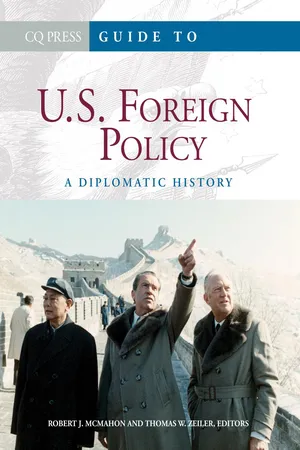 eBook - PDF
Guide to U.S. Foreign Policy
A Diplomatic History
- Robert J. McMahon, Thomas W. Zeiler, Robert J. McMahon, Thomas W. Zeiler(Authors)
- 2012(Publication Date)
- CQ Press(Publisher)
Shortly after the abortive coup, Gorbachev resigned as general secretary of the Communist Party. Bush recognized the independence of the three Baltic States on September 2, and by the end of October, all the republics officially declared their independence. ★ I N T H E I R O W N W O R D S : M I K H A I L G O R B A C H E V ’ S F A R E W E L L A D D R E S S , D E C E M B E R 2 6 , 1 9 9 1 the shackles of the bureaucratic command system. Doomed to cater to ideology, and suffer and carry the onerous burden of the arms race, it found itself at the breaking point. . . . Perestroika and glasnost, he contended, had been necessary to save the Soviet experiment from itself. Furthermore, he argued that: All the half-hearted reforms—and there have been a lot of them—fell through, one after another. This country was going nowhere and we couldn’t possibly live the way we did. We had to change everything radically. Gorbachev could not admit, however, that the system that had been so broken could not be fixed by his own “half-hearted reforms,” and once he chose to try to reform the system, it collapsed under its own inherent contradictions. SOURCE: Available at http://www.nytimes.com/1991/12/26/ world/end-of-the-soviet-union-text-of-gorbachev-s-farewell-address.html. December 1991 proved to be perhaps the most difficult month of Mikhail Gor-bachev’s brief but pivotal term as secretary general of the Soviet Union. Despite his best efforts to fix the Communist system in which he so deeply believed, per-estroika and glasnost had succeeded only in hastening the system’s demise. After resigning his post as president, Gorbachev appeared on Soviet television on December 26, 1991, “and faced reality.” Thanks to the formation of the Commonwealth of Independent States, he reflected on the previous six years: . . . I find it necessary to inform you of what I think of the road that has been trodden by us since 1985.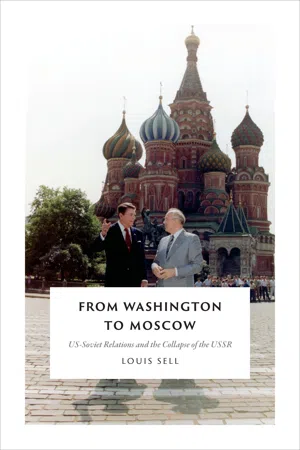 eBook - PDF
From Washington to Moscow
US-Soviet Relations and the Collapse of the USSR
- Louis Sell(Author)
- 2016(Publication Date)
- Duke University Press Books(Publisher)
Gorbachev cited with justifiable pride the achievements of the past. “Free press, freedom of worship, representative legislatures and a multi-party system . . . An end has been put to the cold war and to the arms race.” Not until the final words of his half-hour address did Gorbachev acknowledge “there were mistakes made” but he took no responsibility for these failings and his account of the past seemed impersonal and disconnected from the harsh realities that his fellow citizens were facing and which many blamed on him. 2 As Gorbachev was speaking, the famous Soviet hammer and sickle banner came down from the Kremlin, replaced by the red, white, and blue Russian flag. In Red Square, only a few chance passersby observed the final lowering of the flag that for much of the twentieth century had symbolized both hope and fear for millions. Watching the event, a drunk suddenly shouted, “Why are you laughing at Lenin?”—whose embalmed body still rested nearby in the shut-tered mausoleum. The drunk was silenced by others, who warned that foreign-ers were watching and that he should not embarrass the new Russia. Another passerby laughed, “Foreigners? Who cares? They’re the ones who are feeding us these days.” 3 Mikhail Gorbachev • 167 Comrade Gorbachev Goes to Moscow Mikhail Sergeyevich Gorbachev was born in 1931 in the remote village of Priv-olnoye, in the southern Russian steppe country near Stavropol. The last leader of the USSR was also the first to be born and live his entire life under Soviet power, a fact that is not irrelevant in understanding why Gorbachev’s reforms ultimately failed. Gorbachev vigorously attacked many of the problems of the Soviet system. Yet when it became clear that the real issue was not reform of the system but its replacement, Gorbachev could not bring himself to aban-don the Socialist order under which he had been born, grown, and prospered. eBook - PDF
The Soviet Attitude to Political and Social Change in Central America, 1979–90
Case-Studies on Nicaragua, El Salvador and Guatemala
- D. Paszyn(Author)
- 2000(Publication Date)
- Palgrave Macmillan(Publisher)
In particular, Moscow's direct involvement in regional conflicts proved to be not only of high economic, but also political and diplomatic, cost. For example, the Soviet military intervention in Afghanistan contributed to the end of deÂtente. Moreover, Moscow had lost the support of the Islamic world and most members of the non-aligned movement. Finally, Gorbachev inherited the unresolved Polish cri- sis, where the political and economic demands of the Solidarity independent trade union movement threatened political stability throughout the East-European empire and the Soviet Union itself. Although there had been other workers' revolts in Eastern Europe since the Second World War (1953, 1956, 1970), none had been as fundamental as Solidarity's challenge in Poland (1980), which had caused great concern in Moscow. In other words, the economies of Eastern Europe were as much in need of reform as the Soviet economy. These problems, in a nutshell, formed the Brezhnev (and Andropov and Chernenko) legacy to Mikhail S. Gorbachev, who, when he became General Secretary of the Communist Party, had committed himself, under a policy of perestroika (restructuring), to a major reform of the entire Soviet socio-economic and political system to resolve these problems. In the context of this radical restructuring, glasnost (openness) was conceived as a necessary prerequisite for the transfer of technology and innovation, and demokratizatsiia (democratization) to making officials more responsive to the needs of economic rationality. As Abel Aganbegyan put it: Perestroika and Soviet±Nicaraguan Relations 59 We plan to step up the pace of growth in the economy, but this cannot be separated from the process of democratization and of what we call glasnost, a greater openness in all aspects of govern- ment and social organization. eBook - PDF
New World Disorder
The Leninist Extinction
- Ken Jowitt(Author)
- 2023(Publication Date)
- University of California Press(Publisher)
Gorbachev's ability to pursue increas- ingly radical reform reflects the catastrophes (from corruption to Chernobyl) connected with Brezhnevian neotraditionalism, the short-lived quality of Andropov's efforts, and the unavail- ability to date of an acceptable alternative to his semimodern revision of the Party polity. Opposition to Gorbachev exists, but characterizing it re- quires nuance. When Egor Ligachev denies that he opposes Gorbachev and says that all members of the Politburo agree with the charter for change announced in April 1985, I accept his claim, and remind myself that Li Peng and Zhao Ziyang agreed on the need for the Four Modernizations in China. Political conflict develops within a coalition as differing inter- pretations of generally agreed-on reforms manifest themselves. As the political implications of Gorbachev's interpretation of perestroika, and particularly "democratization," become appar- ent, one may predict that divergent, opposed, and even mutu- ally exclusive political interpretations and positions will appear in the Politburo. Evidence of politically divergent elite interpretations of perestroika already exists. One major expression occurred in November 1987 at the time of the October Revolution's seven- tieth anniversary. In his speech on that occasion, Gorbachev presented the most positive public appraisal of Stalin heard in years. Most (liberal) Sovietologists homed in on his blunt accu- sations against Stalin. "The guilt of Stalin and his immediate entourage before the Party and the people for the wholesale repressive measures and acts of lawlessness is enormous and unforgivable," he declared. But there was more, including the recognition that "a factor in the achievement of victory was the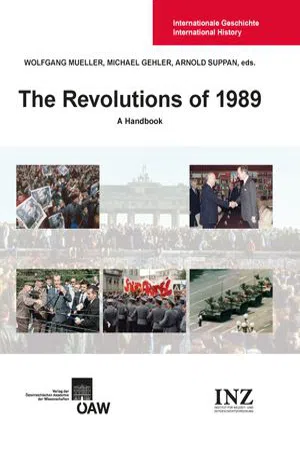
- Wolfgang Mueller, Michael Gehler, Arnold Suppan(Authors)
- 2014(Publication Date)
REVOLUTIONS A N d R e I G R A c h e v GORBACHEV AND THE “NEW POLITICAL THINKING” The radical shift of Soviet foreign policy at the end of the 1980s and the sub-sequent chain of events that eventually led to the end of the Cold War are justly associated with the name Mikhail Gorbachev. Those who praise him (mostly abroad), like those who curse him (mostly in his own country), may disagree on many subjects, but nearly all recognize the significance of the changes he man-aged to bring about in the international political arena. To explain the extraordinary results of his undertakings, one might cite his strategic vision, his tactical skill, his intellectual courage and his strong political will. And yet the principal lever which allowed him to “move the world” (to use as a metaphor the famous remark of Archimedes) was what he called the philos-ophy of “new political thinking,” which became the foundation of his foreign policy achievements. To avoid simplification we should not interpret the concept of “new political thinking” as a ready-made set of rules and principles carved into tablets that Gorbachev brought with him when he entered the office of the general secretary in March 1985.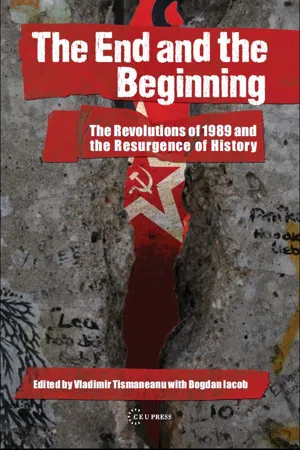 eBook - PDF
The End and the Beginning
The Revolutions of 1989 and the Resurgence of History
- Vladimir Tismaneanu, Bogdan C. Iacob, Vladimir Tismaneanu, Bogdan C. Iacob(Authors)
- 2012(Publication Date)
- Central European University Press(Publisher)
15 Gorbachev’s neo-Leninism played 13 See, for instance, Svetlana Savranskaia, “The Logic of 1989: The Soviet Peaceful Withdrawal from Eastern Europe,” in Masterpieces , 1–18. 14 Medvedev, “Raspad,” 14–150; Savranskaia, Op. cit., 9; Georgy Shakhnazarov proposed a partial withdrawal of Soviet troops from Czechoslovakia in his memorandum to the leadership in March 1987, in Masterpieces , 244–46. 15 The liberal-reformist perspective on Gorbachev is best represented by Archie Brown, The Gorbachev Factor (New York: Oxford University Press, 1996), and also his Seven Years That Changed the World. Perestroika in 264 THE END AND THE BEGINNING a crucial role in his choices for one reformist tack after another: after “acceleration” came glasnost, and then experimentation with “con-trolled democracy.” It is important that Gorbachev—initially sup-ported by the KGB, the military, and the military-industrial complex, as well as the party’s nomenklatura—quickly began to lean towards a small minority of his advisers, the so-called “enlightened” apparat-chiks, who were prone – as part of the Soviet intelligentsia – to grand ideas and sweeping generalizations. It was this milieu that became the main generator of the “new thinking,” an extremely vague notion that primarily meant the rejection of the old ideological approaches. The small group of “new thinkers” around Gorbachev included Alexander Yakovlev, Eduard Shevardnadze, Anatoly Chernyaev, Vadim Zagladin, Georgy Shakhnazarov, and much later Vadim Medvedev. The primary common features of this group were high educational standards, an attentiveness to ideology and ideas in general, and an “internationalist” outlook (with perhaps the exception of Shevardnadze). eBook - ePub
Past As Prelude
History In The Making Of A New World Order
- Meredith Woo-cumings, Michael Loriaux, Meredith Woo-Cummings(Authors)
- 2019(Publication Date)
- Routledge(Publisher)
For both, political reforms were valued because they would make the decisionmaking process more rational, enhance the powers of the reformer, and aid in the struggle for reforms in foreign policy and in the economy. Gorbachev, who went much farther down the path of liberalizing Russian politics than did Alexander II, injected the Soviet system with competition, rationalized the political structure of the Soviet Union, created some of the foundations for representative government, and liberalized the role of the media. He did all this for a variety of reasons. In particular, he thought that these reforms were crucial to (1) making decisionmaking more informed, more efficient, and therefore more rational; (2) creating a new body of public officials with some stake in the reform process; (3) enhancing the possibility (rare in recent Soviet history) that policies made would actually be implemented; (4) obscuring all those moves that were in fact not just augmenting his political powers but also creating an institutionalized base for the exercise of those powers; (5) keeping his enemies divided; (6) giving the public and the intelligentsia a stake in the reform process; (7) kicking the state out of the economy by kicking the public into politics; (8) providing a cushion for the costs of economic reform by giving at least some segments of the public more political influence; and (9) mobilizing support in the West for the Soviet reform process in general and for Gorbachev in particular. Thus the political reforms of Gorbachev served a number of strategic functions. 34 Finally, both Gorbachev and Alexander II introduced reforms in foreign policy that were strategic in nature, including such actions as courting Western elite opinion and making alliances in the international system that would, in effect, guard their security during the rigors of domestic reform
Index pages curate the most relevant extracts from our library of academic textbooks. They’ve been created using an in-house natural language model (NLM), each adding context and meaning to key research topics.

