History

Ronald Reagan
Ronald Reagan was the 40th President of the United States, serving from 1981 to 1989. He is known for his conservative economic policies, including tax cuts and deregulation, as well as his tough stance against the Soviet Union during the Cold War. Reagan's presidency is often associated with a resurgence of American patriotism and a shift towards conservative values in U.S. politics.
Written by Perlego with AI-assistance
Related key terms
1 of 5
9 Key excerpts on "Ronald Reagan"
 eBook - ePub
An Empire of Ideals
The Chimeric Imagination of Ronald Reagan
- Justin D. Garrison(Author)
- 2013(Publication Date)
- Routledge(Publisher)
Still others believe Reagan came to the relevant ideas rather early and on his own and that he genuinely and deeply believed in them. This explanation is the most plausible because it is so strongly supported by the existing scholarship and the evidence to be presented in this study. Reagan spent most of his adult life developing and refining the vision he shared with Americans in his numerous presidential speeches. During his presidency, it was when Reagan shared his very own outlook in his speeches that so many people felt as if he embodied the American spirit. This does not have to mean that each of his formulations perfectly expressed his innermost beliefs. Does any human being fully know his own mind? And who can fully articulate what he does believe? Nevertheless, a great deal can be learned about where Reagan really stood from the pervasive and salient themes and frequently repeated ideas and images in his spoken and written statements. Whatever its ultimate origins and motivations, his vision has an enduring appeal, and it urgently needs to be better understood. It is time to listen to Reagan's words with a more attentive and also more critical ear.Scholars, politicians, and journalists have observed that Reagan was a highly imaginative president and that his vision was a fundamental source of his popularity and political success. A number of general books have been written about Reagan, his presidency, and his rhetoric.18 Other works have focused on specific speeches, such as the one Reagan delivered to the British Parliament in 1982, or on specific parts of Reagan's prepresidential life, such as his tenure at General Electric, or on specific events during his presidency, such as his response to the air traffic controllers' strike in 1981.19 A number of scholars have explored Reagan's foreign and domestic policy ambitions and achievements as well as some aspects of his vision within the broader historical and cultural contexts of the United States in the 1980s.20Scholars and journalists have also examined parts of Reagan's imagination to determine his status as a conservative. Some have argued that Reagan is an exemplary conservative. To support this claim, such writers typically draw attention to Reagan's anticommunism, claiming in a number of cases that he won the Cold War or at least contributed mightily to the downfall of the Soviet Union. They also cite as evidence of Reagan's conservatism his love of and advocacy for liberty, free markets, and democracy around the world; his abhorrence of big government and bureaucracies; and his admiration for the Declaration of Independence, the Constitution, Thomas Jefferson, and other documents and figures commonly associated with the American Founding. Other writers have examined Reagan's understanding of liberty, democracy, human nature, limited government, and the American Founding and concluded that Reagan is actually much more of a progressive—expressing ideas similar to those of Thomas Paine, Ralph Waldo Emerson, and Woodrow Wilson—than a conservative committed to the ideas of George Washington, John Adams, Edmund Burke, and The Federalist . Parts of Reagan's vision have also been investigated to discover the influence of religion and religious ideas upon his general worldview and his presidency. Some argue that Reagan was a deeply pious man whose religious beliefs had a positive influence on his broader vision of politics and his policy goals. Others claim that his religious ideas contributed to a rather problematic understanding of politics in the United States.21 The meaning and legacy of Reagan and his vision is a topic of growing interest. Although writers from the political left and right disagree about the nature and accuracy of Reagan's legacy, many of them agree that Reagan has shaped American political thinking and practice to such an extent that he and his legacy must be acknowledged and taken very seriously.22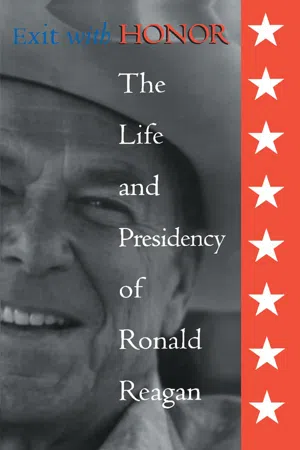 eBook - ePub
Exit with Honor
The Life and Presidency of Ronald Reagan
- William E Pemberton(Author)
- 2015(Publication Date)
- Routledge(Publisher)
They appreciated his symbolic gestures, such as hanging portraits of William Howard Taft and Calvin Coolidge in the cabinet room, but supply-side economics, and its promise to cut taxes while retaining high spending levels, sounded too good to be true to many conservatives, who were horrified by mounting deficits. Still, most conservatives, even those disappointed at lack of action on the social agenda, remained loyal to Reagan. They saw him as an old warrior who had led them in many important battles, as a dynamic leader who attracted young people into the movement, and as a visionary who left conservatives with an optimistic, forward-looking populist message that placed them squarely in the mainstream where the voters were. Most agreed with Jerry Falwell’s claim that conservatives in the 1980s owed everything to one man, Ronald Reagan. 13 Most journalists and political contemporaries, even if they disliked his policies, believed that Reagan was a major president in terms of his impact on history. Historians, however, did not seem to agree. A major survey of historians found that an overwhelming majority of them blamed Reagan for the economic problems of the 1980s and gave him little credit for gains; 66 percent believed that he was very or somewhat racist and 19 percent said that he was mildly racist; over 70 percent believed he was very or somewhat sexist; 92 percent thought that the general public overestimated him. A sizable majority, 62 percent, ranked Reagan in the “below average” category, between Zachary Taylor and John Tyler. 14 Despite this preliminary evaluation by historians, Reagan was a president of consequence. He moved the nation’s political center to the right and changed the nature of Washington’s “policy talk” by ushering in an age of diminished expectations in people’s attitude toward government. He transformed both political parties. In 1988 and afterward Republicans of all persuasions scrambled for the Reagan mantle eBook - ePub
- Andrew L. Johns(Author)
- 2015(Publication Date)
- Wiley-Blackwell(Publisher)
During the centennial of Ronald Reagan's birth in February 2011, the praise for the 40th president was frequent and effusive. As expected, leading Republicans honored Reagan as the greatest president of their time, although each one found in Reagan's style, achievements, or legacies something that served his or her own political purposes. Mitt Romney, then campaigning for the Republican presidential nomination that he eventually secured, lauded Reagan as a “transformative president” (Romney, 2011). Reagan came to the White House “in a moment of national crisis, not altogether dissimilar from the one we face today,” Romney asserted, and his tax and budget cuts paved “a path trod today by the Tea Party.” Embracing Reagan was a way for Romney to enhance his own appeal to Republican conservatives, some of whom suspected that the former governor was, at heart, a “Massachusetts moderate.” Senator John McCain of Arizona, the Republican nominee for president in 2008 who campaigned on the slogan of “Country First,” celebrated Reagan for his “unshakable faith in America's greatness” (McCain, 2011). Sarah Palin, McCain's vice presidential running mate and a frequent advocate of “commonsense” solutions to the nation's political problems, admired Reagan for rescuing America from “the depths of economic, cultural, and spiritual malaise” in the early 1980s through “optimism and common sense” (Palin, 2011). John Boehner of Ohio, the new speaker of the House who was trying to establish his credibility with Tea Party members in whose view the federal government had become far too large and expensive, remembered Reagan's presidency as “a call to arms” (Boehner, 2011). He recalled that Reagan's “promise of a smaller, less costly and more accountable government” resonated with “small-town, small-business people like me who were fed up with intrusive government and indecisive leadership.”America's leading Democrat, President Barack Obama, added his voice to this celebratory chorus, and his favorable comments were more than perfunctory praise on a ceremonial occasion. Three years earlier, when he was first campaigning for the presidency, Obama commended Reagan for changing “the trajectory of America” at a time when people were weary of “all the excesses of the 1960s and 1970s and government had grown and grown but there wasn't much sense of accountability in terms of how it was operating” (“Obama's Reagan Comparison Sparks Debate,” 2008). During the Reagan centennial, which occurred only a few months after the Democrats suffered what the president called a “shellacking” in mid-term elections that gave Republicans control of the House of Representatives, Obama remembered Reagan as a Republican who put national interest ahead of partisan advantage. “He understood that while we may see the world differently and hold different opinions about what's best for our country, the fact remains that we are all patriots who put the welfare of our fellow citizens above all else.” Obama emphasized that Reagan was able “to compromise on issues as contentious as Social Security and tax cuts…and work with leaders of all political persuasions to advance the cause of freedom, democracy and security around the world.” Obama was reminding his Republican congressional adversaries that Reagan, the hero of contemporary conservatives, was a pragmatist rather than an ideologue (Obama, 2011).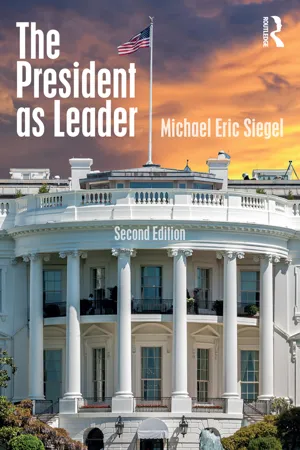 eBook - ePub
- Michael Eric Siegel(Author)
- 2017(Publication Date)
- Routledge(Publisher)
CHAPTER 4The Presidency of Ronald Wilson Reagan
Courtesy: Ronald Reagan LibraryR onald Reagan was inaugurated as the fortieth president of the United States on January 20, 1981, amid political conditions that could not have been more cleverly scripted for the former actor. Radical Iranian students held fifty-two American hostages for the 444th day in succession, and, somewhat meaningfully, released them only hours after Reagan’s inauguration.1 A theocratic regime in Tehran, whose devotees had kidnapped the American hostages and whose influence appeared to be spreading throughout the Persian Gulf, threatened to disrupt the stability of the region. The Soviet army occupied Afghanistan and Ethiopia, and was poised to enter Poland to put down anti-communist strikes and demonstrations, and Cuban troops had intruded on three African countries.2Domestically, almost all major economic indicators were pointing in the wrong direction: inflation was at 12.5 percent, interest rates hovered around 16 percent, and the unemployment rate had climbed to 7.1 percent.3 In his first inaugural address at the West Front of the U.S. Capitol, President Reagan put the economic problem at the center of his concerns when he said:These United States are confronted with an economic affliction of great proportions. We suffer from the longest and one of the worst sustained inflations in our national history. It distorts our economic decisions, penalizes thrift, and crushes the struggling young and the fixed-income elderly alike. It threatens to shatter the lives of millions of our people.4According to the final report of the Initial Actions Project, a political guide to action prepared for Reagan by pollster-strategist Richard Wirthlin, “No American president since Franklin D. Roosevelt had inherited a more difficult economic situation.”5 The miserable condition of the American economy prompted James Baker, a Reagan aide and future White House chief of staff, to declare, “We ought to have three goals, and all of them are economic recovery.”6 eBook - ePub
The Climax of Capitalism
The U.S. Economy in the Twentieth Century
- Tom Kemp(Author)
- 2014(Publication Date)
- Routledge(Publisher)
The Reagan Era: the 1980sThe Reagan administration which took over in 1980 consciously intended to reverse the economic policies of its predecessors and bring to an end the historical consensus which had existed since the Second World War. Against the drift toward a broader role for government in maintaining employment and providing greater security for its citizens, it posed the return to free market forces. It sought, therefore, to diminish the role and the cost of government, making possible tax reductions with a balanced budget. It wanted the state out of the economic arena as far as possible; but it also wanted a strong state to defend property and the social order, and to fight crime. Law and order were prominent among the aims of the conservative right, which provided philosophical support for the new administration. At the same time there had to be an increase in the military preparedness of the United States, which had allegedly slipped back, in the face of the 'evil empire' presumably bent on world domination. Increased military expenditure was thereforejustified, but other forms of government spending had to be cut, including the social programmes dating from the 'Great Society'. If market forces were given free rein, the economy would expand: there would be more jobs and less poverty as a result of the famous 'trickle down effect'. Although it was not clear to many of those who voted Republican, the Reagan policies, if carried out, would benefit the rich and the burden of reduced government expenditure would be mainly felt by the poor. In fact, the years of the Reagan administrations showed a definite increase in income inequality. Further, it sought, with some success, to reduce the power of the labour unions; the defeat of the air-traffic controllers in 1982 was intended as an object lesson for the labour movement as a whole. eBook - ePub
How Did We Get Here?
From Theodore Roosevelt to Donald Trump
- Robert Dallek(Author)
- 2020(Publication Date)
- Harper(Publisher)
In 1984 Reagan won one of the greatest landslides in American presidential history. Aided by the flourishing economy; Mondale’s announcement that he would raise taxes to reduce the national debt; the continuing widespread affection for “the Gipper,” as Reagan was dubbed for his role in the popular film biography of Notre Dame football coach Knute Rockne; the view that Reagan had unified the country; and two very skillful television ads, “The Bear in the Woods,” touting Reagan’s resistance to Soviet communism, and “Morning in America,” an upbeat reminder of the good economy, Reagan captured forty-nine of the fifty states with 525 electoral votes and 58.8 percent of the popular vote. Only Minnesota, Mondale’s home state, and D.C., a Democratic enclave, voted against him, giving Mondale a scant 13 electoral votes, despite having made New York congresswoman Geraldine Ferraro his running mate, the first woman in U.S. history to be a vice presidential nominee.Reagan’s second term from 1985–89, as with so many other second presidential terms, was less effective, though he continued to hold the affection of much of the public through the missteps of the next four years. But for all the support Reagan enjoyed, many Americans worried that his anti-communist rhetoric could provoke a war with the Soviet Union. He called on the West to conduct a “crusade for freedom,” which was aimed against Moscow’s control of Eastern Europe, and predicted that Marxism-Leninism would end on the “ash heap of history.” His rhetoric came under attack as too strident and undermining peaceful resolutions of tensions with the Soviet Union. In March 1983, when he spoke to the National Association of Evangelicals and called Moscow “the focus of evil in the modern world,” it frightened some Americans as challenging Russia to a showdown. At the same time, Reagan promoted a Strategic Defense Initiative (SDI) known better as “Star Wars,” a delusional program promising military technology that would shield against ICBMs and mutually assured destruction (MAD). The Soviets denounced Reagan’s rhetoric as “irresponsible” and “insane.” Reagan ran into additional overseas difficulties in the Middle East. When it came to foreign affairs in his first term, Cannon asserts, “too often, Reagan was a performer and presidential leadership was an empty shell.” During foreign policy meetings with national security advisers, he kept his counsel—largely because he was ignorant about the subjects under discussion.Reagan often tried to settle an argument among his advisers by taking a middle ground between them. In the contest between diplomacy and more aggressive action, Reagan usually favored a compromise. In the case of the Middle East in general and Lebanon in particular, where a civil war had been raging since 1975, Reagan’s aggressive action “courted catastrophe.” According to contemporary analysis, it was “a case study of foreign policy calamity.” eBook - ePub
The Presidential Character
Predicting Performance in the White House, With a Revised and Updated Foreword by George C. Edwards III
- James David Barber, James Barber(Authors)
- 2019(Publication Date)
- Routledge(Publisher)
We may see other Reagans in the years ahead. We are bound to see other rhetoricians attuned to the modern media. We may well see future conjunctions of the man and the mood of the nation which will mightily reinforce one another. As the transition from Carter to Reagan once again demonstrated, understanding the "institution" of the Presidency tells you far less than you want to know, and provides only the shape of the stage and the arrangement of the furniture on and around which the action will take place. Theory which fails to reach the person of the President will fall short of useful prediction and that gap will prevent the speculations politicians will need as they struggle to bring power to bear on urgent problems. Therefore we ought to focus on those facets of the Reagan case that also shed light on his type and the types of conditions in which he operates.Beyond the strong confirmation which actual experience gave to the predictions about Reagan, three questions are intriguing, regarding his character, world view and style.- Character is not everything. Given his passive-positive character, what explains the fact that within the first two months of its takeover, the Reagan Presidency got through Congress a startiingly novel package of economic legislation, overcoming what looked at the time like high odds against it?
- World view is never certain. Reagan came on as a "conservative," but, as predicted, he soon had the "conservatives" furious at him and at least some of the "liberals" appreciating his "flexibility." What was it that Reagan believed in?
- Style is significant, because it influences those it is aimed at. Reagan's rhetoric, it appears, came across. Whatever his intention, what was his actual practice and how is that likely to have affected the American people?
Winning Congress
Ronald Reagan won the election with 50.75 percent of the popular vote in a contest in which nearly half those eligible to vote did not bother.51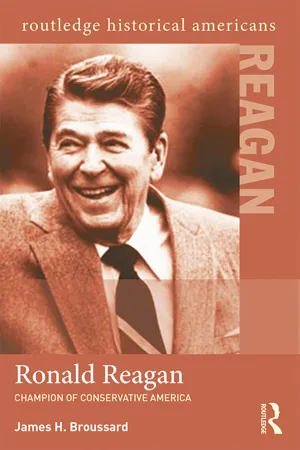 eBook - ePub
Ronald Reagan
Champion of Conservative America
- James H. Broussard(Author)
- 2014(Publication Date)
- Routledge(Publisher)
7 President Reagan, 1982–1984: Recession to Reelection
DOI: 10.4324/9780203081563-7A visitor to the White House once remarked on the “merry twinkle” in the president’s eyes and the “‘tone of familiarity’ that instantly set people at ease.”1 He was speaking of Abraham Lincoln in the 1860s, but the description fit Ronald Reagan just as snugly. Like Lincoln, Reagan told endless jokes, stories, and parables.In Hollywood, he began a lifetime’s work collecting funny stories until, as biographer Lou Cannon observed, in the White House years “anecdotes were Reagan’s fundamental form of communication.”2 Like any good performer, he used jokes to break the ice in political gatherings, in cabinet meetings, and even high-level international conferences.With individuals, his banter served to diminish the interpersonal distance between The President and his companion, whether a fellow politician, a White House visitor, or an ordinary citizen. It was his method of “descending from the throne” and was among the ways in which he was the most egalitarian president since Lincoln himself. Unlike such predecessors as Nixon or Johnson, he was secure enough with the “inner Reagan” to make his age, his habits, and even his lack of knowledge the butt of many of his own jokes.Entering his second year, Reagan would need all his optimism and self-confidence. If the midsummer political victories of 1981 had faded into disappointment by December, 1982 promised to be even worse. The economy shrank, unemployment rose, and deficits grew. Overseas, allies and adversaries worried that Reagan was a combative cowboy. Ending the Cold War seemed less attainable than ever, as the Soviets reacted angrily to Reagan’s military buildup and harsh rhetoric.Reagan’s approach to foreign policy was, like that of many in his generation, shaped by memories of the late 1930s when the failure of Britain and France to face down Hitler’s aggression led to the catastrophe of world war. The conclusion seemed clear: weakness in democratic nations encouraged aggression by tyrants; military strength could prevent war. For Reagan, on these two lessons hung “all the law and the prophets.” eBook - PDF
The Reagan Administration
A Reconstruction of American Strength?
- Helga Haftendorn, Jakob Schissler, Helga Haftendorn, Jakob Schissler(Authors)
- 2019(Publication Date)
- De Gruyter(Publisher)
His image of the U.S. is that of a chosen nation whose moral actions are in harmony with divine Providence, a nation that cannot compromise with its ideological foe, the U.S.S.R., or other communist states, without infringing its mission to spread its own social system. Accordingly, unilateral action is more likely than concord and compromise with other nations. In these traditions great emphasis is placed on the morality of capitalism. There is no room for government intervention in the economy or international trade, for instance, in the form of protectionism. 6. Political Culture in the Rhetoric of Ronald Reagan on Specific Issues in Foreign Policy While identifying elements of U.S. political culture is of some interest, only the way they are joined with various political issues will tell us something about the character of Reagan's policies. Communism: This topic comprises all statements dealing with communism as an ideology but not with specific communist states. Communism shows the highest frequency, 55%, of paragraphs containing elements of the political culture. This comes as no surprise. The charge of being soft on communism is one of the most dangerous provocatives in foreign policy; triggering it 84 Werner Schmidt could lead to a rapid loss of popular support for the President's policy and undermine its legitimacy. At the same time Reagan can take no more than symbolic actions against the evoked communist menace. Most Americans are not prepared for a policy of confrontation with the U.S.S.R., as this would raise the danger of a military conflict. They are not about to make the sacrifice this would entail. Thus, Reagan's use of political culture regarding communism serves primarily a symbolic purpose as a substitute for substantive action which is not possible. It is not surprising that on the subject of communism the percentage of liberal elements is far and away the highest (47%). The religious tradition also appears well above average (7% ).
Index pages curate the most relevant extracts from our library of academic textbooks. They’ve been created using an in-house natural language model (NLM), each adding context and meaning to key research topics.

