History

Calvin Coolidge
Calvin Coolidge was the 30th President of the United States, serving from 1923 to 1929. He was known for his conservative economic policies and his belief in limited government intervention in business. Coolidge's presidency was marked by economic prosperity and a focus on reducing government spending and taxes. He was also known for his quiet and reserved demeanor, earning him the nickname "Silent Cal."
Written by Perlego with AI-assistance
Related key terms
1 of 5
8 Key excerpts on "Calvin Coolidge"
 eBook - ePub
- Harold Bierman, Jr, Donald Schnedeker(Authors)
- 2011(Publication Date)
- WSPC(Publisher)
HAPTER 33Calvin Coolidge
Calvin Coolidge (1872–1929) was the 30th President of the United States. He was Vice President and became President when Warren G. Harding died suddenly in 1923. Coolidge was elected President in 1924 and declined the invitation to run for President in 1928. He was a Republican lawyer from the state of Vermont, but became the governor of Massachusetts.The more I read about Coolidge the more I like him.“The Press Under a Free Government” extract contains the famous line: “After all, the chief business of the American people is business.” Taken out of context, it indicates a shallow man. Read it in context, it is part of a very insightful speech.After the scandals of Harding’s administration, it was necessary to restore public confidence in the President’s office. Coolidge as a small Republican government achieved that goal. From 1923–1928, the USA prospered. He handed over the Presidency to Hoover in 1928 and the country was in excellent shape. Of course, there are those that are critical of his laissez-faire philosophy for the central government. He was an early supporter of women’s suffrage.In 1919, the police of Boston went on strike. Coolidge, the Governor of the state of Massachusetts, sent a telegram to Samuel Gompers, the union organizer, that stated: “There is no right to strike against the public safety by anyone, anywhere, any time.” (September 14, 1919.) This telegram made Coolidge famous throughout the country.In the 1928 election, Coolidge refused to run for a second full term. The result was Herbert Hoover ran and was elected. The 1929 stock market crash and 1931–1939 depression resulted. Would history have been different with Coolidge as President? Maybe.Coolidge could write a striking thought. In the supports of civilization, we have: “There is no force so democratic as the force of an idea.” And “This glory we owe in no small part to the all-embracing influence of our colleges and universities.” eBook - ePub
Star-Spangled Men
America's Ten Worst Presidents
- Nathan Miller(Author)
- 2008(Publication Date)
- Scribner(Publisher)
At the core of Coolidge’s policies were minimal government interference with business, supply-side tax cuts, balanced budgets, low interest rates, economic nationalism, and hostility to immigration. There was more than a whiff of his views in the 1996 Republican platform. No knight in shining armor riding forth to tilt at assorted wrongs—indeed, the only horse at the White House in his time was a mechanical steed for exercise—Coolidge was the high priest of the status quo. Under his hand, whatever remained of the progressivism of Theodore Roosevelt and Woodrow Wilson was quietly chloroformed. “The business of America is business,” Coolidge intoned. He believed “the man who builds a factory builds a temple,” and the “man who works there worships there.”Coolidge was an odd figure to preside over the White House during the hyperactive Roaring Twenties, and Kansas editor William Allen White dubbed him a “Puritan in Babylon.” With his sharp nose, thin, pursed lips, and Vermont twang—it was said he pronounced the word cow with three syllables—Coolidge seemed embarrassingly out of place in the world of flappers, get-rich-quick schemes, bootleg booze, and easy sex. He appeared so austere that Alice Longworth, passing on a joke she had heard, said he “looked like he had been weaned on a pickle.”7 But to a nation rocked by the scandals of the Harding years, Coolidge stood for rectitude. In the midst of political cynicism and spiritual doubts, he signified old-fashioned piety. Many Americans found him an ideal leader at a time when they were pushing the outer limits of self-indulgence, yet feared that traditional values were being lost.Coolidge’s political career was a shining example of the power of inertia over talent. Harold J. Laski, the British political writer, saw him as “a churchwarden in some rural parish who has by accident strayed into great affairs.”8 eBook - ePub
Conservative Heroes
Fourteen Leaders Who Shaped America, from Jefferson to Reagan
- Garland S Tucker(Author)
- 2015(Publication Date)
- Intercollegiate Studies Institute(Publisher)
Like Grover Cleveland before him, Coolidge actually achieved a record of substantial success in implementing conservative principles. His success was the result of unswerving perseverance and focus. In addition to having, in Secretary Mellon, an equally dedicated believer in economy, low taxes, and limited government—“commonsense government,” as they called it—Coolidge was unrelenting in his drive to reduce government expenditures and taxes. Amity Shlaes has written, “As documented in White House appointment books, whereas other presidents met sporadically with budget advisers, Coolidge met faithfully and weekly with his Budget Bureau director, General Herbert Mayhew Lord.” 37 Coolidge said near the end of his presidency: “I favor the American system of individual enterprise, and I am opposed to any general extension of government ownership and control. I believe not only in advocating economy in public expenditure, but in its practical application and actual accomplishment.” 38 His conservative presidential successors have enjoyed considerably less success in implementing their principles. The results of his perseverance were impressive. Government expenditures fell steadily: from 1921 through 1928, the federal budget was reduced by an astounding 35 percent. The federal debt was reduced, unemployment dropped as low as 3 percent, and the economy boomed. More Americans entered the middle class than ever before. In general, Coolidge was determined to pull government back and give Americans the opportunity to excel. Beyond the impressiveness of his official record, there was an underlying integrity that bound together the private and the public Coolidge. The Washington Post was correct in observing that Coolidge spoke of his economic policies in moral terms. He devoutly believed in the sanctity of work, thrift, honesty, forthrightness, and lack of pretense, and he carried a lifelong fear of the effects of debt and sloth eBook - PDF
United States Foreign Policy in the Interwar Period, 1918-1941
The Golden Age of American Diplomatic and Military Complacency
- Benjamin Rhodes(Author)
- 2001(Publication Date)
- Praeger(Publisher)
CHAPTER 4 Foreign Policy Under Coolidge and Kellogg: A Relative Bed of Roses Calvin Coolidge was one of the unlikeliest American presidents and easily the most eccentric. The son of a Vermont politician, Coolidge was educated at Amherst College, then read law at Northampton, Massachusetts, and began a relentless climb up the Massachusetts political ladder. His election in November 1918 as governor of Massachusetts appeared to be a fitting pinnacle to a career founded exclusively on local and state issues. But a series of chance events brought Coolidge to national attention. First, he became a hero when he took a hard line during the Boston police strike of 1919. Styling the strikers "deserters," Coolidge supported the dismissal of those who had not reported for service. Then at the 1920 Republican con- vention at Chicago, to Coolidge's surprise, the delegates revolted against their party leaders and nominated him for vice president. When asked by his wife whether he would accept the post, the taciturn Coolidge replied, "I suppose I shall have to." 1 Had it not been for the accident of Harding's death, Coolidge would likely have faded into the same political oblivion that had befallen such recent vice presidents as Charles Fairbanks, James S. Sherman, and Tho- mas R. Marshall. To the presidency he brought common sense, a concilia- tory style of problem solving, and a reputation for remaining composed under fire. The latter quality he demonstrated in the early morning hours of August 3, 1923, when he learned of Harding's death while he and his wife were visiting the family farm at Plymouth Notch, Vermont. On the advice of Hughes, Coolidge secured a copy of the presidential oath, which his father administered by the light of an oil lamp amid a small audience of neighbors and reporters. Later when asked what had been his first thought on learning he had become president, Coolidge typically responded, "I thought I could swing it." 2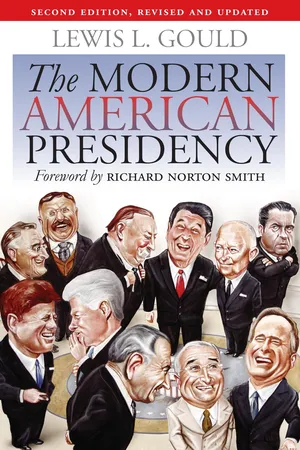 eBook - ePub
The Modern American Presidency
Second Edition, Revised and Updated
- Lewis L. Gould(Author)
- 2009(Publication Date)
- University Press of Kansas(Publisher)
Because of his well-cultivated reputation as a dour, taciturn New Englander, Calvin Coolidge’s adept use of the mass media in the White House has not been regarded as part of the evolution of the modern presidency. Like Harding and Hoover, Coolidge has been viewed as a foil for the more charismatic Franklin D. Roosevelt. Anecdotes abound regarding Coolidge’s passivity in the White House and his reluctance to advance legislative initiatives during the Roaring Twenties. Yet a review of his presidency indicates that what a later generation would call spin was a well-developed technique during the 1920s. Constant attention to the management of the press developed as one of the hallmarks of the Coolidge years, and most of the strategies that the president employed would be seen as innovations when they reappeared between 1933 and the end of the twentieth century.John Calvin Coolidge had just turned fifty-one on 4 July 1923, a month before the death of Warren G. Harding thrust him into the presidency. On his way up through Massachusetts politics between 1906 and 1919, Coolidge showed a mastery of the system and a skill at creating a pleasing public image. He burst on the national scene as governor of Massachusetts during the Boston Police Strike in 1919, when he told Samuel Gompers of the American Federation of Labor in a public letter that “there is no right to strike against the public safety by anybody, anywhere, anytime.” Yet even this personal touch was probably the result of artful crafting from one of the governor’s informal speechwriters. According to a well-informed Massachusetts reporter, Robert Lincoln O’Brien, Coolidge was already relying on Attorney General Henry A. Wyman. The words Wyman wrote “sounded good” to Coolidge, and “he finally issued them under his name.” Two or three other ghostwriters worked for Coolidge during his vice presidency.17When he took over from Harding, Coolidge did not do much to change the organizational structure of the White House as he found it. He replaced Harding’s secretary with a former Virginia congressman, C. Bascom Slemp, and he retained Judson Welliver as a speechwriter for two years. In his commitment to Republican ideology, Coolidge was more of a conservative than Harding had been, and he lacked any of his predecessor’s interest in reshaping the federal government along more efficient lines. The new president wanted an honest administration that helped business and lowered taxes, and he saw no need to innovate in organizing the presidency. He recognized that a supportive and kindly press would be of significant assistance in accomplishing his goals. In the process, the press would further his plans to be elected in his own right in November 1924.18 eBook - PDF
- Paul A. Carter(Author)
- 2019(Publication Date)
- Columbia University Press(Publisher)
When government comes unduly under the influence of business, the tendency is to develop an administration which . . . becomes narrow and selfish in its outlook, and results in an oligarchy, Coolidge lectured his Chamber of Commerce audience. When government enters the field of business with its great resources . . . , having the power to crush all competitors, [it] likewise closes the door of opportunity and results in monopoly. So much for New Nationalisms and New Freedoms, for Fair Deals and Great Societies. But by the same token Calvin Coolidge also opposed any fusion of political and in-dustrial power into one great social monolith, of the kind some lib-erals in our own time have also come to fear. The national govern-ment had begun operations in 1789 within walking distance of Wall Street, but President Coolidge was pleased that it had not re-mained there: The great cities of the ancient world were the seats of both govern-ment and industrial power. . . . In the modern world government is inclined to be merely a tenant of the city. Political life and indus-trial life flow on side by side, but practically separated from each other. When we contemplate the enormous power, autocratic and uncontrolled, which would have been created by joining the author-ity of government with the influence of business, we can better ap-preciate the wisdom of the fathers in their wise dispensation which made Washington the political center of the country and left New York to develop into its business center. They wrought mightily for freedom. Political life and industrial life ideally flowed on side by side in their separate channels, but apparently one channel was a narrow rivulet and the other a broad and mighty stream. After all, Coo-lidge told the American Society of Newspaper Editors on January 176 A REPUBLICAN GOVERNMENT 17, 1925, the chief business of the American people is business.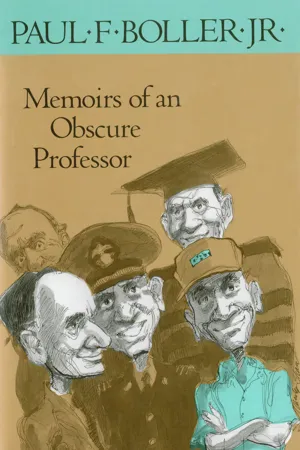 eBook - ePub
- Paul F. Boller(Author)
- 2013(Publication Date)
- TCU Press(Publisher)
Presidential Anecdotes (1981). But if I had to do it over again, I would still write LaFollette rather than Coolidge in large letters on the blackboard.* * * *“Coolidge!” H. L. Mencken once snorted. “A remarkable man, a really remarkable man. Nero fiddled while Rome burned, but Coolidge only snores.” Mencken thought Coolidge’s record as president was “almost a blank. No one remembers anything that he did or anything that he said.”Mencken erred. Many of the things Coolidge did and said are remembered. Not his public policies, to be sure, for he was a commonplace president. (“The greatest man,” someone joked, “ever to come from Plymouth Notch, Vermont.”) Not his public addresses, either, for, though mostly well-written, they were filled with obviosities. But Coolidge’s personal style—the stony silences, the droll remarks, the Yankee twang, the deadpan humor, the mischievous moments—tickled the fancy of his contemporaries and continued in legend to amuse and delight the American people long after both he and Mencken had departed from the scene. It is surprising, when you come to think of it, that the Sage of Baltimore, with his keen eye for American absurdities, missed the funny side of Calvin Coolidge. For it is as a humorist—albeit a prickly one—that Coolidge is chiefly remembered today. He was not a folksy storyteller like Abraham Lincoln; nor was he given to showbiz one-liners like Ronald Reagan. He was more of a one-worder, or even no-worder, than anything else. But in his own eccentric way he was something of a funnyman. Most of our presidents have been excessively solemn, especially about themselves, and some of them even mistook solemnity for seriousness. Coolidge was solemn, too, a great deal of the time, but frequently tongue lurked whimsically in cheek when he held forth in public.The Coolidge persona fascinated the public from almost the beginning. Long before Coolidge became president upon Warren G. Harding’s death in 1923, amusing stories about the Vermonter’s terse putdowns, cagey leg-pulls, and enigmatic silences were beginning to accumulate, and while he was in the White House they increased rapidly in number and popularity. Some of the tales were contrived, but many of them were hilariously authentic. Coolidge knew about the stories and was quietly amused. “Intuition told him,” according to one observer, “that humor . . . when employed in the right place was unequalled as an agent of success.” Speaking at a Gridiron Club dinner in December 1923, Coolidge good-naturedly blamed the newsmen for all the stories about him. “They have undertaken to endow me with some characteristics and traits that I didn’t altogether know I had,” he declared. “But I have done the best I could to be perfectly fair with them and in public, to live up to those traits.”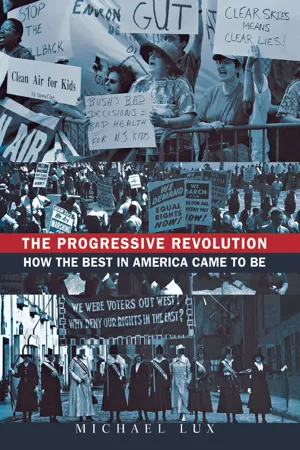 eBook - ePub
The Progressive Revolution
How the Best in America Came to Be
- Michael Lux(Author)
- 2009(Publication Date)
- Trade Paper Press(Publisher)
6
Trickle-Down vs. Bottom-Up
From the earliest days of the republic, an ongoing debate has raged between democrats and aristocrats, populists and the wealthy, debtors and bankers, the working class and big business, the advocates of a “free” money supply and those of a “tight” money supply, the “levelers” versus the elitists, and people who wanted government to invest in and be a guarantor of equal opportunity for all and those who worshipped the free market above all else. Whatever the era, whatever form the battle took, and whatever the specific rhetoric or issues, this divide has been intrinsic to American history.Modern conservatives actually understand this very well; they just don’t like to openly admit it. Behind the scenes, though, they are very clear about whose heirs they are in the historic debate. There are two examples that illustrate my point:1. When Ronald Reagan became president, he very quietly took down Jefferson’s portrait from his office and put up that of Calvin Coolidge. It seemed like an odd choice. Jefferson was a revered Founding Father with his own glorious monument on the National Mall in Washington, while Coolidge was one of the most obscure and little-known presidents. He was mainly known to historians as “Silent Cal” and had no signature accomplishments. His conservative, antiregulation policies had led to the stock market crash of 1929 and the Great Depression, which happened just a few months after he left office. The choice of Coolidge struck people as highly quirky. But Coolidge was a conservative’s conservative, a strikebreaking antilabor ideologue who cut taxes and opposed any regulation on business or banking. He was the last president before the Great Depression swept FDR and a progressive Democratic majority into a forty-year dominance of American politics. Reagan’s fondest hope was to go back to that time, when government was small, regulations on business were nonexistent, taxes were low, and unions were weak.2. Karl Rove wanted to go back even further in history. He didn’t like either the New Deal or the Progressive Era, when Teddy Roosevelt and Woodrow Wilson busted corporate trusts, eliminated child labor, created a national parks system, instituted a progressive income tax, and gave women the right to vote. Rove’s political hero was William McKinley. Again, a pretty obscure president who didn’t really have any astable accomplishments to his presidency besides a trumped-up war with Spain that allowed us to have colonies in the Philippines. But McKinley was the ultimate pro-big business corporate president, and he had defeated the most economically progressive and populist major party presidential candidate of all time, William Jennings Bryan—twice. McKinley put Teddy Roosevelt on the ticket as vice president to end Roosevelt’s reign as governor of New York, where he had really started to annoy big business. He would have been appalled at his successor’s reforms. But while McKinley lived, big business reigned supreme. For Rove, this otherwise lackluster president’s pro-big business credentials and his willingness to make up reasons to go to war made him and his administration a perfect prototype for the second Bush presidency.
Index pages curate the most relevant extracts from our library of academic textbooks. They’ve been created using an in-house natural language model (NLM), each adding context and meaning to key research topics.

